Interactive Lessons

Think it through: stories, claims, shares, time and data

Lecture notes

Definition

Think it through: build the reasoning from word blocks

A story can be solved with a sum, but to think it through you also say what you do and why. In the applications you build that reasoning from word blocks: a sentence with two gaps, for example The sum and The reason, and under every gap 3 blocks. One is right and two are classic mistakes. A right block turns green and fills the gap; a wrong block turns red and a card tells what went wrong. The application checks every block, so a reason that you choose counts as saying why.
Example
On Saturday 365 people visit a museum and on Sunday 258. “To answer the story I work out , because I know both parts and I look for the whole.” .
On Saturday 365 people visit amuseum and on Sunday 258 people.How many visitors are there in thetwo days?Saturday365Sunday258365 + 258 = ?
Rule

Say it out loud or in writing

The blocks check your thinking; they do not replace talking. In class say why out loud or write it in your own words: “I did …, because …”. Free explanation stays with the teacher: the application never reads what you say or write, and nothing is stored.
Example
“I added, because Saturday and Sunday are two parts of one total.” The teacher listens for the step (adding) and for the reason (two parts make a whole) → .
Rule

Add or subtract: parts and a whole

Say what you know and what you look for. Two parts make a whole: when you look for the whole, add; when you look for a part, or for how much more, take away. The check goes the other way: the answer and the part you know give the whole again.
Example
A jar holds 520 sweets and 187 are eaten. How many are left? The whole is 520 and a part is 187, so . Check → . How much more is 842 than 519? .
Rule

Multiply or divide: equal groups

With equal groups you know two of three things: the number of groups, the size of a group and the total. When you look for the total, multiply. When you look for the size of a group or for the number of groups, divide.
Example
24 boxes of 12 pens → pens. 288 stickers shared over 12 children → each. 288 stickers in bags of 24 → bags.
Tip

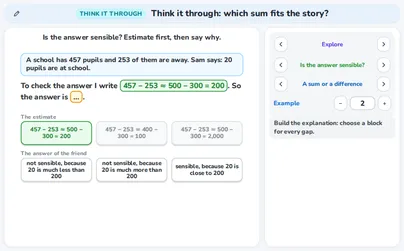
Estimate first: is the answer sensible?

Round every number to its first digit and work out the easy sum. An answer far from the estimate is not sensible: look for a slip, such as the wrong operation or an extra digit.
Example
. Sam answers 1 297. That is , far from 500, so it is not sensible. The real answer is . For a product → , so 8 360 is far too big and 836 is sensible.
Rule

Leftovers: round up or leave out

After dividing, look at the leftover and ask what the story needs. If the leftover still needs a place, round up: one more bus. If only full ones count, leave it out: the leftover does not make another full one.
Example
83 children, a minibus holds 12 → , and the 11 children still need a minibus, so 7 minibuses. 83 rolls in bags of 12: 6 full bags (72 rolls); the 11 left over do not fill a bag.
Rule

What is left over, and sharing money

If the question asks what is left over, the answer is the leftover itself (the remainder). Money is different: it can be split into cents, so you may go on dividing.
Example
47 cookies shared equally over 5 children → , so 9 each and 2 left over. 47 euro shared by 5 friends → , so 9.40 euro each. Check → .
Rule

Multiply by a number below 1: less

Multiplying by a number below 1 takes a part of the number, so the answer is less. Multiplying by a number above 1 gives more. So “multiplying always makes a number bigger” is a myth. You can say it before you calculate: compare the number with 1.
Example
Cheese costs 6 euro for every kilogram. For 0.5 kg you pay less than 6 euro → . For 1.5 kg you pay more → .
Rule

Divide by a number below 1: more

Dividing by a number below 1 gives more pieces than wholes, because every piece is smaller than 1. Dividing by a number above 1 gives fewer. “Dividing always makes a number smaller” is a myth.
Example
A ribbon of 6 metres is cut into pieces of 0.5 metre → pieces, more than 6. Pieces of 1.5 metres → pieces, fewer than 6. Check → .
Tip

A quick way: 25, 99 and 5

Look at the numbers before you start: a clever change can make the sum easy, and a good reason says why the change is allowed. There are 3 patterns: is a quarter of n times 100 (four times 25 is 100); is take away n; is half of n times 10.
Example
, because . . , because .
Special case

A quick way needs the right numbers

A trick works only when its numbers fit. A quarter of n is a whole number only when n is a multiple of 4. The written methods for harder products, the column method and long division, are practised in their own applications.
Example
For a quarter of 37 is 9.25, not a whole number → . Using would give 900, which is not 925. With the quarter is 9 and the trick is easy.
Definition

A count is not a share

A count says how many. A share says how much of the whole, so you need both numbers. A bigger group does not say how it is split: more children in a class does not mean more boys than girls. Look at the numbers of boys and girls, not at the size of the group.
Example
Class A has 24 children and class B has 30. The table says class B has 13 boys and 17 girls → . Class B is bigger, but it has fewer boys than girls → .
Class A has 24 children and classB has 30 children. Mia says: classB has more boys than girls.Class A24Class B30Can you tell?
Rule

When only the sizes are known, you cannot tell

If the story gives only the size of a group, many splits are possible. The right verdict is “nobody can tell”, and the reason names what is missing: the numbers of boys and girls.
Example
30 children could be 20 boys and 10 girls, or 10 boys and 20 girls → and . The same size gives opposite answers.
Definition

The ratio card: a : b means a out of b

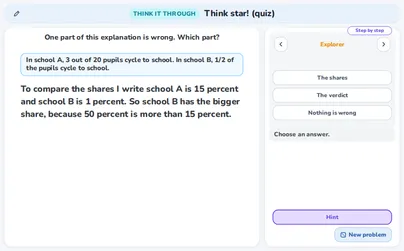
In these applications a ratio a : b means a out of b in all, a part and the whole. The card on the screen says that 2:5 here means 2 parts out of 5 parts in all. This is a plain remark about how the applications read a ratio. Many books read a : b as part to part, which would be 2:3 for the same situation. Read the card first.
Example
In school A the ratio of the pupils who cycle to all pupils is 2:5. That is 2 out of 5 pupils → , which is 40%. And , so 3 out of 5 pupils do not cycle.
Rule

Compare shares in the same form

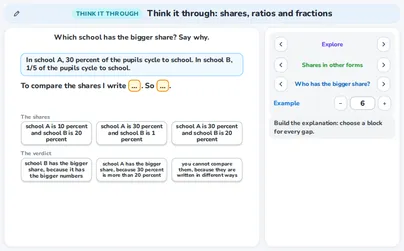
Shares come in many forms: a fraction, “x out of y”, a percent, a decimal or a ratio a : b. To compare two shares write them in the same form, for example as percents. Bigger numbers do not make a bigger share.
Example
School A: 3/10 of the pupils cycle. School B: 8 out of 40. and , so school A has the bigger share, although 8 is more than 3. Another pair → and , so 9 out of 20 is the bigger share.
30%>20%
Rule

A share is not a number of people

A share needs a size to become a number. The bigger share of a small group can be fewer people than the smaller share of a big group. “Do more pupils swim?” cannot be answered from the shares alone.
Example
School A has 200 pupils and 40% swim → . School B has 400 pupils and 30% swim → . School A has the bigger share but fewer swimmers → .
Rule

Percent of what?

Always ask: percent of what? A percent belongs to one whole. 60% of the goals tells you nothing about the number of matches, but 60% of the matches does.
Example
Bas plays 5 matches and wins 60% of them → matches. If he only scores 60% of the goals, you cannot say in how many matches.
Rule

A claim about use: check it with a division

To check “one litre for every 20 km”, divide the distance by the litres (or work out the litres for 100 km) and compare the answer with the claim.
Example
Jos drives 75 km on 5 litres of petrol. , so one litre lasts 15 km, not 20 km: the claim is not right. Check → , but .
Rule

What changes when you double?

Doubling does not always double the answer. More people need more rice, in the same ratio. More painters finish the same work in less time. A fixed start price is paid only once, so twice the distance costs less than twice the price.
Example
Rice: 150 g for 4 people, so for 8 people. Painters: 4 painters need 6 days, , so 8 painters need 3 days, . Taxi: 3 euro start and 2 euro per km. 5 km cost euro, 10 km cost euro, not 26.
Rule

A fraction in between

Between two fractions there is always another one. Write both with the same, bigger denominator and take the number halfway.
Example
Between 1/4 and 1/3 → and , so 7/24 is in between → .
1/4 = 6/24<7/24<1/3 = 8/24
Rule

No smallest and no biggest fraction

You can always cut a piece in two, so there is no smallest fraction above zero. The missing piece of a fraction below 1 can be cut in two as well, so there is no biggest fraction below 1.
Example
Half of 1/10 is 1/20 and half of 1/20 is 1/40 → , and it goes on. Below 1 → , with 1/10, 1/20 and 1/40 missing.
Rule

More pieces, smaller pieces

With the same numerator, a bigger denominator gives a smaller fraction, because the whole is cut into more, smaller parts. Writing both with the same denominator shows it.
Example
Ben takes 3/5 of a pizza and Ada takes 3/8 of a pizza of the same size. and , so Ben gets more → .
3/5>3/8
Rule

The rest of 100 percent

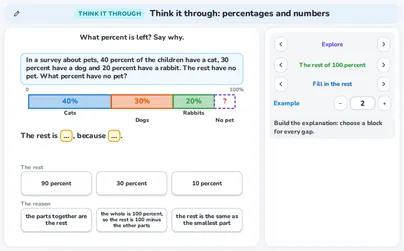
All the parts of a whole make 100 percent. The rest is 100 minus the parts you know: add the known percents first.
Example
In a pet survey 30% of the children have a cat, 25% a dog and 15% a rabbit. , so → the other 30% have no pet.
30%Cats25%Dogs15%RabbitsNo pet?= 30%0100%
Rule

Can these percentages all be right?

When every pupil chooses one thing, the percents of all the parts must add up to 100. More than 100 or less than 100 means that the percentages cannot all be right.
Example
Swimming 35%, football 40%, tennis 20% and dancing 15% → , which is more than 100, so they cannot all be right. With football at 30% the sum would be , and they could be right.
35%Swimming40%Football20%Tennis15%Dancing0100%110%
Rule

Percent or number: the size of the group is needed

A percent is a share of the whole group. Without the size of the group you cannot turn it into a number of children. “30% have no pet” does not say how many children that is.
Example
If the class has 20 children, children have no pet. If the class has 40 children, children. The percent is the same, the numbers are different.
Rule

How many is that? Percent means out of 100

Percent means out of 100: p percent of n is p/100 of n. It is not p itself, and it is not out of 10.
Example
25% of 120 children cycle → children. Not 25, and not , which divides by 10 instead of 100.
Watch out!

The same percent, the same number?

The same percent of a bigger group is more people. Compare the sizes of the groups too before you say that two numbers are equal.
Example
In class A 40% of 80 children have a bike, in class B 40% of 200 children → and . The percent is the same, the numbers are not.
Definition

Ages and birthdays: how a difference changes

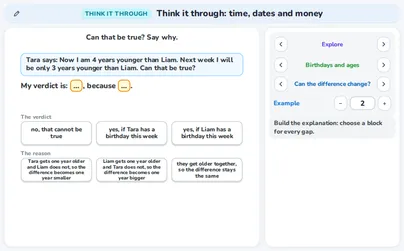
Two people get older at the same speed, so after whole years the difference between their ages stays the same. In a few weeks one of them may have a birthday and the other not: then the difference changes by one year, never by more. Only a birthday of the younger one makes it smaller.
Example
Liam is 11 and Tara is 9 → . In exactly 3 years they are 14 and 12 → . In one week Tara may be 10 and Liam still 11 if Tara has her birthday that week → . So “2 years younger now, 1 year younger next week” can be true.
Watch out!

An hour has 60 minutes

Minutes go up to 60, not to 100. A part of an hour is changed to minutes by multiplying by 60: half an hour is 30 minutes, a quarter is 15 and three quarters is 45.
Example
2.75 hours is not 2 hours 75 minutes. , so 2.75 hours is 2 hours 45 minutes, which is minutes. And 2.5 hours is not 2 hours 50 minutes → .
Rule

How long is the trip? Count to the next hour

Count to the next whole hour first, then the whole hours, then the rest. Across midnight count to midnight and then on.
Example
A train leaves at 15:50 and arrives at 17:20: 10 minutes to 16:00, 60 minutes to 17:00 and 20 minutes more, so minutes, which is 1 h 30 min. A night train from 22:40 to 01:15 → minutes, which is 2 h 35 min.
Rule

Do you catch it? Add the walking time

Add the walking time to the arrival time, with 60 minutes to an hour, and compare the result with the departure time.
Example
The train arrives at 14:50 and you walk 15 minutes → , so you reach the stop at 15:05. A bus at 15:00 is gone; a bus at 15:10 is caught.
Rule

Week or month? Count a whole year

Compare the cost of a whole year: a year has 52 weeks and 12 months. A month is not exactly four weeks.
Example
A pool costs 7 euro per week or 30 euro per month. A year → euro by the week and euro by the month, so the month is cheaper. With “4 weeks in a month”, would wrongly say that the week is cheaper.
Rule

Pay for hours and minutes

Change the minutes to a part of an hour first, then multiply by the pay for one hour.
Example
Ella earns 8 euro for every hour and works 2 hours 30 minutes. 30 minutes is 0.5 hour, so euro. Not , and not .
Rule

Two charts, one story: compare day by day

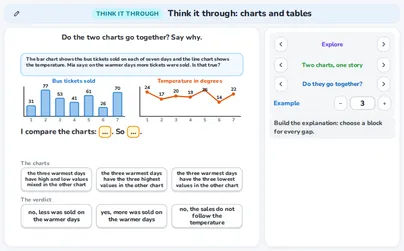
Look at the warmest days and see what the other chart shows on those days. If the three warmest days have the three highest values, the two charts go together. If they have the three lowest values, they go the other way round. Otherwise the values do not follow the temperature.
Example
Ice creams sold (bars) and the temperature (line) on 7 days. The three warmest days are days 4, 6 and 3 (26, 24 and 23 degrees); on those days 47, 41 and 38 ice creams were sold, the three highest values. So more ice creams were sold on the warmer days.
Ice creams sold121202383474215416307Temperature (°C)151172233264195246217
Watch out!

Going up together is not proof

Two charts that go up and down together show that the two things go together. They do not show that one causes the other: something else can make both go up.
Example
On warm days more ice creams and more pool tickets are sold. Ice cream does not make people swim; the warm, sunny weather makes both go up. “Selling ice creams makes the weather warm” is not proven.
Rule

A week with three wishes

First keep only the weeks that meet the limits, then choose the best of those for the last wish. The week that is best for one wish alone may break another one.
Example
Sam wants at most 8 mm of rain, not warmer than 25 degrees and as much sun as possible. Weeks 2 and 5 have 12 and 9 mm: too wet. Week 4 has 27 degrees: too warm, although it has the most sun (60 hours). Weeks 1 and 3 stay within the limits with 38 and 47 hours of sun, so week 3.
Week°CRain (mm)Sun (h)1184382241251✘321647✔427260✘522944✘At most 8 mm, up to 25 °C, most sun
Rule

Claims about two columns

To test “weeks with a higher temperature also have more sun”, take the two weeks with the highest value in the first column and look at the second column for those weeks.
Example
In the table the two warmest weeks are 4 and 2 (27 and 24 degrees). They have 60 and 51 hours of sun, the two highest values: a higher temperature goes with more sun. The same weeks have 2 mm and 12 mm of rain, one low and one high, so rain does not follow the temperature.
Tip

The quiz and the class round

The quiz mixes the 5 applications and never ends: choose Starter, Explorer or Champion and answer with a block or a number. In the class round the whole class answers 5 questions at once, each pupil on their own screen: a word, a rule, a true or myth statement and two calculations. Every wrong option is a classic mistake with a name.
Example
A round question: “A film lasts 2.75 hours. How many minutes is that?” Right: 165, because . A wrong option is 275, the mistake “uses 100 minutes for an hour” → .
Rule

Keys, and nothing is sent

Blocks, buttons and fields work without a mouse: Tab goes to a block or button and Enter chooses it, also the arrow buttons of the choosers and the − and + of Example. In a number field type the number and press Enter to check it. Esc closes this information page. Everything you choose or type is checked in your browser and sent nowhere, and nothing is stored. The situations are our own and the numbers are made new every time.
Example
Try it in Practice: press Tab until a block is marked, press Enter to choose it, type a number in the field and press Enter to check it.

Exercises

150 children go on a trip and a minibus holds 18 children. How many minibuses are needed? Say why. Easy
Show solution
gives 8 and 6 left over → .
The 6 children still need a place, so round up.
So 9 minibuses are needed.
Answer → 9 minibuses
Check → is enough for 150, but is not.
In a class vote 40% choose pizza, 25% choose pasta and 10% choose rice. The rest choose soup. What percent chooses soup? Easy
40%Pizza25%Pasta10%RiceSoup?0100%
Show solution
All the parts make 100%, so add the known parts first → .
The rest is .
40%Pizza25%Pasta10%RiceSoup?= 25%0100%
Answer → 25%
Check → .
Tara is 3 years younger than Liam. In exactly 2 years, how much younger is she? Say why. Easy
Show solution
In whole years both of them get 2 years older, so the difference stays the same.
For example Liam 12 and Tara 9 become 14 and 11 → and .
Answer → 3 years younger
Check → and .
A film lasts 3.25 hours. How many minutes is that? Say why. Easy
Show solution
An hour has 60 minutes, not 100, so 0.25 hour is minutes.
The whole hours are minutes, so .
Answer → 195 minutes
Check → would be the mistake of using 100 minutes for an hour.
Is more or less than 8? Say why, before you calculate. Easy
Show solution
0.25 is below 1, so you take only a part of 8: the answer is less than 8.
, and .
Answer → less, it is 2
Check → dividing by 0.25 goes the other way → , which is more than 8.
Estimate with the first digits. Is the answer 927 sensible? Say why. Medium
Show solution
Round each number to its first digit: 648 becomes 600 and 279 becomes 300.
.
927 is close to 900, so the answer is sensible.
Answer → yes, it is close to 900
Check → .
School A has 160 pupils and 25% of them swim. School B has 300 pupils and 20% of them swim. Which school has the bigger share and which has more swimmers? Say why. Medium
Show solution
The shares are in the same form: 25% is more than 20%, so school A has the bigger share.
A share is not a number → and .
School B has more swimmers, , even though its share is smaller.
Answer → school A has the bigger share, school B has more swimmers
Check → → in school A 40 pupils swim and 120 do not.
A car drives 90 km on 6 litres of petrol. The maker says: one litre for every 12 km. Is that right? Say why. Medium
Show solution
Divide the distance by the litres → .
One litre lasts 15 km, not 12 km, so the claim is not right.
Answer → no, one litre lasts 15 km
Check → , but .
A night train leaves at 23:25 and arrives at 01:05. How long is the trip? Say why. Medium
Show solution
Across midnight count to midnight first: 23:25 to 00:00 is 35 minutes.
From 00:00 to 01:00 is 60 minutes, and 5 minutes more to 01:05.
minutes, which is 1 h 40 min.
Answer → 1 h 40 min
Check → 100 minutes is minutes.
A club costs 9 euro per week or 38 euro per month. Which is cheaper over a whole year? Say why. Medium
Show solution
A year has 52 weeks and 12 months.
By the week → euro. By the month → euro.
, so the month is cheaper, by euro.
Answer → by the month, 12 euro cheaper
Check → with “4 weeks in a month”, would wrongly say the week is cheaper.
Use a quick way for and for and say why each one works. Hard
Show solution
Four times 25 is 100, so take a quarter of 48 → and .
99 is one less than 100, so .
Answer → 1 200 and 1 188
Check → , and .
Find a fraction between 2/5 and 1/2 and say why there is always one. Hard
Show solution
Write both with the denominator 20 → and .
9/20 is halfway, so .
You can always do this again with an even bigger denominator, so there is no “next” fraction.
Answer → 9/20
Check → , and .
The charts show the scarves sold and the temperature on 7 days. Mia says: on the warmer days more scarves were sold. Is that true? Say why. Hard
Scarves sold501442223314185406287Temperature (°C)161192253224285206247
Show solution
The three warmest days are days 5, 3 and 7 (28, 25 and 24 degrees).
On those days 18, 22 and 28 scarves were sold: the three lowest values.
So fewer scarves were sold on the warmer days: Mia is wrong.
Answer → not true: fewer scarves were sold on the warmer days
Check → the charts show that the two go the other way round; they do not show why.
Sam wants a week with at most 6 mm of rain and at least 22 degrees, and with as much sun as possible. Which week should Sam choose? Say why. Hard
Week°CRain (mm)Sun (h)12035222610633235494191270525458At most 6 mm, from 22 °C, most sun
Show solution
Keep the weeks with at most 6 mm of rain: weeks 1, 3 and 5.
Of those keep the weeks with at least 22 degrees: weeks 3 and 5, because week 1 has only 20 degrees.
Weeks 3 and 5 have 49 and 58 hours of sun, so week 5 has the most.
Answer → week 5
Check → week 4 has the most sun overall (70 hours), but also 12 mm of rain and only 19 degrees.
Today Tara is 3 years younger than Liam. In 10 weeks she is 2 years younger. Whose birthday must be in these 10 weeks, and why? Hard
Show solution
The difference gets smaller, from 3 to 2.
Only a birthday of the younger one makes the difference smaller: she gets one year older and the other does not.
So Tara has a birthday in these 10 weeks and Liam does not.
Answer → Tara
Check → Liam 12 and Tara 9 give ; when Tara turns 10, .
In school A the ratio of the pupils who cycle to all pupils is 3:8. School A has 120 pupils. How many pupils cycle? Say why. Hard
Show solution
The ratio card says that 3:8 means 3 out of 8 pupils in all, so the share is 3/8.
One eighth of the pupils is .
So pupils cycle.
Answer → 45 pupils
Check → , and pupils do not cycle → .
Are you a teacher?

Start live lessons with these applications for your whole class. Free to try for one month.

Try it free

Fits these school years

IB (MYP, Diploma): PYP, MYP 1, MYP 2, MYP 3

Cambridge International: Primary, stage 4, Primary, stage 5, Primary, stage 6

Netherlands: Groep 5, Groep 6, Groep 7, Groep 8

Türkiye (MEB): Year 4 (MEB), Year 5 (MEB), Year 6 (MEB)

England (GCSE, A Level): Year 4, Year 5, Year 6

USA (Common Core): Grade 3, Grade 4, Grade 5

What the applications of this topic teach 5 applications

Think it through: which sum fits the story?

  • Telling which sum fits a story: what is known, what is asked
  • Checking if an answer is sensible by estimating first
  • Deciding what to do with a leftover: round up, leave out, share
  • Predicting the effect of × or ÷ by a number below 1

Think it through: shares, ratios and fractions

  • Telling when a bigger group does not mean a bigger share
  • Comparing shares given in different forms
  • Seeing that there is always a fraction in between
  • Seeing that 7/4 and 1 3/4 are the same number

Think it through: percentages and numbers

  • Finding the rest of 100%
  • Judging whether a set of percentages is possible
  • Percent of a group: p percent of n and why the group size matters

Think it through: time, dates and money

  • Judging if a claim about ages and birthdays is possible
  • Working with hours as decimals and the length of a trip
  • Comparing a week price with a month price over a year
  • Working out pay for hours and minutes

Think it through: charts and tables

  • Seeing why two charts that go together do not prove a cause
  • Choosing a week from a table by three wishes
  • Testing a claim about two columns of a table