Interactive Lessons

Surds and standard form

Lecture notes

Definition

Standard form

Standard form writes a number as a number between 1 and 10, times a power of ten. The power is a whole number.
Example
45000 in standard form.

Rule

Big numbers

Move the point to just after the first digit and count the places it moved. That number is , and it is positive for a number of 10 or more.
Example
The point moves 6 places to the left.
Rule

Small numbers

Move the point to just after the first digit that is not zero. A number between 0 and 1 has a negative : the places the point moved, with a minus.
Example
The point moves 4 places to the right.
Rule

Back to an ordinary number

With a positive move the point places to the right, with a negative to the left. Fill the gaps with zeros.
Example
Watch out!

The number in front

The number must be at least 1 and less than 10. A number like 35 or 0.5 in front is not standard form yet: fix it and change the power.
Example
✘ and ✔ and
Rule

Comparing

Compare the powers of ten first: the bigger power is the bigger number, also for negative powers. With equal powers compare the numbers .
Example
because 5 > 4 because −3 > −5
Rule

Multiplying

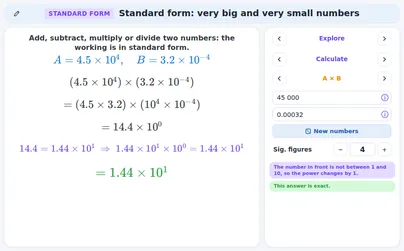
Multiply the numbers and add the powers of ten. If the new is 10 or more, fix it and change the power.
Example
Rule

Dividing

Divide the numbers and subtract the powers of ten. If the new is less than 1, fix it and change the power.
Example
Rule

Adding and subtracting

Give both numbers the same power of ten first. Then add or subtract the numbers and keep the power.
Example
Tip

Why the rules work

Powers of ten follow the laws of indices, so the rules are true for all numbers, not only for the examples you tried.
Example
Tip

Test a rule

Try a guessed rule on a few pairs of numbers. One wrong row is enough to show that a rule is false, but rows that work never prove it: for that you need a law.
Example
The rule “add the powers” says 3 + 2 = 5, so .The true sum is 2000 + 300.
Rule

Significant figures

The significant figures are the digits of that count. Round an answer to the same number of significant figures as the data.
Example
3 significant figures: 2 significant figures:
Tip

Real sizes

Standard form fits sizes from an atom to the stars. One step in the power is a factor 10, so the powers show how far apart two sizes are.
Example
The Earth to the Sun is about m, a hydrogen atom about m wide. powers of ten apart
Special case

Power 0 and negative numbers

A number from 1 up to 10 has the power 0, because . A negative number keeps its minus sign in front.
Example
Definition

Simplest form of a root

A root is in simplest form when no square number greater than 1 is left under it. Take the largest square factor out of the root.
Example
36 is the largest square that divides 72.
Rule

Factor tree

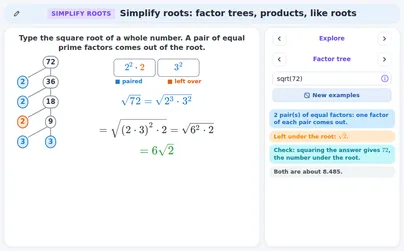
Split the number into primes with a factor tree. Every pair of equal primes comes out of the root as one prime, and the primes left over stay under the root.
Example
One pair of 2 and one pair of 3 come out, one 2 stays.
7289243322
Rule

Roots of products and quotients

For numbers that are not negative, a root of a product is the product of the roots, and the same for a quotient (the bottom is not 0). Use it in both directions.
Example
Rule

Into the root and compare

A number in front goes under the root as its square. To compare two roots, bring both numbers under the root and compare what is under it.
Example
and , so
Rule

Like roots

Roots are like roots when they have the same number under the root after simplifying. Add or subtract the numbers in front and keep the root, just as .
Example
stays as it is
Rule

Multiplying roots and brackets

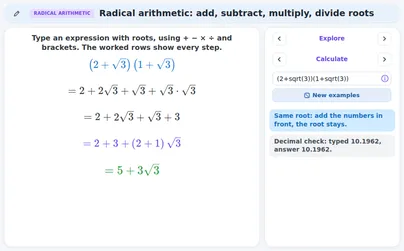
Multiply the numbers in front with each other and the numbers under the roots with each other. With brackets multiply every term by every term, then collect the like roots.
Example
Watch out!

Not the sum under the root

The root of a sum is not the sum of the roots, and the same for a difference. Roots go through products and quotients, never through plus and minus.
Example
Rule

Conjugates and the area model

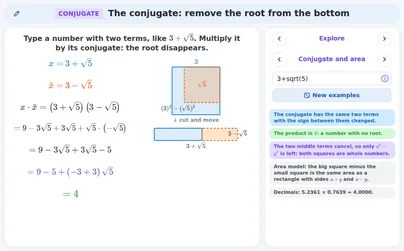
The conjugate of is : only the sign between the terms changes. Their product is a difference of two squares, so no root is left when is a root. In the picture the big square minus the small square has the same area as the rectangle.
Example
33√29−23+√273−√2
Rule

Making the bottom free of roots

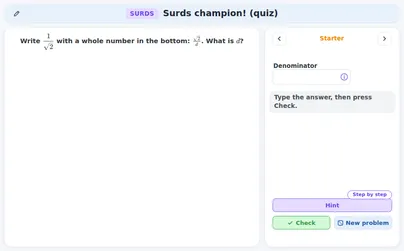
To remove the root from the bottom of a fraction, multiply top and bottom by the conjugate of the bottom (by the root itself if the bottom is one root). The bottom becomes a whole number and the value does not change.
Example
Tip

Check by squaring

Square a result to check it: if equals , its square must be 72. A calculator test is quick, but only algebra is certain for every number.
Example
✔
Special case

Negative numbers under a root

A negative number has no real square root. Also only when is not negative; in general .
Example
, and not is not a real number
Definition

Fractional exponent 1/n

A power with the exponent is the -th root: the bottom of the fraction is the index of the root. For it is the square root. The base is not negative.
Example
The cube root of 27 and the square root of 100.
Rule

Exponent m/n

With the exponent take the root and the power in either order. The root first keeps the numbers small. A negative exponent turns the answer upside down.
Example
Rule

Testing a conjecture

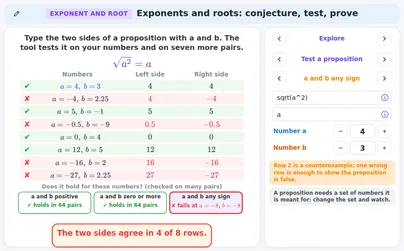
A conjecture is a guess about numbers of a stated kind. Test it on several pairs, also with zero, fractions and negative numbers. One counterexample, a case where the two sides differ, shows that it is false.
Example
Conjecture with and . and , so
Watch out!

Examples do not prove

Many examples that agree do not prove a conjecture: the next one may be the counterexample. To be sure for all numbers you need algebra.
Example
is a prime number for to , but not for .
Special case

Rules and the numbers they are for

Every rule holds for a set of numbers. A square root or a power with an even root needs a base that is not negative; an odd root, like the cube root, also exists for a negative number. And .
Example
The rule fails for , and . and
Tip

Roots and fractional powers in life

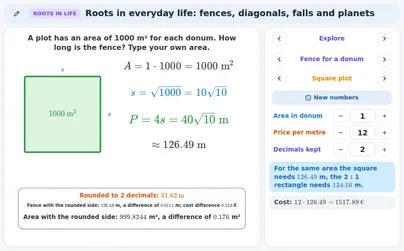
Many real formulas hold a root or a fractional power: the diagonal of a rectangle, the fall time of a stone (with ) and the year of a planet at AU from the Sun. Keep the exact root as long as you can and round only at the end., ,
Example
A stone falls from 20 m; a planet is 4 AU from the Sun. s years
Rule

Error of a rounded root

A rounded root is a little off. Work the situation out with the exact root and with the rounded one and subtract: that is the error there. The error grows when it is used again, for example when a side is counted four times in a fence.
Example
A square plot of 1 donum has an area of 1000 m², so its side is m. Take . m, not m: about 9 cm short
ss10002xx1000

Exercises

Write 45000 in standard form. Easy
Show solution
Move the point to just after the first digit: 4.5
It moved 4 places to the left, so .
Answer →
Check:
Write 0.00072 in standard form. Easy
Show solution
Move the point to just after the first digit that is not zero: 7.2
It moved 4 places to the right, so .
Answer →
Check:
Which is bigger: or ? Easy
Show solution
Compare the powers of ten first: 6 and 5.
6 > 5, so the first number is bigger.
Answer →
Check:
Calculate in standard form. Medium
Show solution
Multiply the numbers in front:
Add the powers: , so
18 is more than 10:
Answer →
The number in front must stay between 1 and 10.
Calculate in standard form. Medium
Show solution
Divide the numbers in front:
Subtract the powers: , so
0.4 is less than 1:
Answer →
Check:
Calculate in standard form. Medium
Show solution
The powers are equal: add the numbers in front.
Answer →
Check:
Calculate in standard form. Hard
Show solution
The powers are different. Write with the power 5:
Add the numbers in front:
Answer →
Check:
A light year is about km. A star is 4 light years away. How many km is that, in standard form? Hard
Show solution
Multiply:
, so
38 is more than 10:
Answer → km
Check: 4 is a bit less than half of 10, and is the distance of 10 light years.
Is the rule “to add, add the powers” true? Test it on . Hard
Show solution
The rule gives and , so .
The true sum is .
The two answers differ, so one counterexample is enough.
Answer → false: the rule gives , the truth is
The right rule: same power, add the numbers in front and keep the power.
Simplify . Easy
Show solution
The largest square that divides 48 is 16: .
Answer →
Check:
Write as one root. Easy
Show solution
The 3 goes under the root as its square: .
Answer →
Check:
Calculate and give the answer in simplest form. Medium
Show solution
Simplify each root: and .
They are like roots: add the numbers in front.
Answer →
Not : roots are not added under the root.
Expand . Medium
Show solution
Multiply every term by every term:
Collect the numbers: . Collect the like roots:
Answer →
Check:
Which is bigger: or ? Medium
Show solution
Bring both numbers under the root: and .
, so the first root is bigger.
Answer →
Check: is about 6.9 and is about 6.7.
Make the bottom free of roots: . Hard
Show solution
The conjugate of the bottom is . Multiply top and bottom by it.
The bottom:
So
Answer →
Check: , so it is the same number as .
Is true? Test it. Hard
Show solution
Left side:
Right side:
: one counterexample is enough.
Answer → false: 5 and 7 differ
A root goes through products and quotients, not through plus and minus.
A square has an area of 72 cm². How long is its diagonal? Hard
Show solution
The side is cm.
The diagonal is the hypotenuse:
Answer → 12 cm
Also .
Calculate . Easy
Show solution
The exponent means the fourth root: .
Which number to the fourth power is 81?
Answer → 3
Check:
Write as a power with a fractional exponent. Easy
Show solution
The index 3 goes to the bottom of the fraction, the power 2 to the top.
Answer →
Check:
Calculate . Medium
Show solution
Root first: , because .
Then the power:
Answer → 8
Power first would give : the root first keeps the numbers small.
A pupil tests for and it is always right. Is it true for every ? Medium
Show solution
Also test a negative number: .
, and .
One counterexample is enough.
Answer → false: only for
In general .
A square plot has an area of 2000 m². Its side is rounded to 45 m. What area does the plot get with that side? Medium
Show solution
The square with side 45 m has the area m².
The error: m².
Answer → 2025 m², 25 m² too much
Check: , so 45 is a little too long.
Calculate . Hard
Show solution
A negative exponent turns the fraction over: .
Root first: .
Then the power:
Answer →
Check:
Is true for all and ? Test , and , . Hard
Show solution
, : and . They agree.
, : is not a real number, but .
This is a counterexample: the sides do not agree.
Answer → false: only for
Two rows that agree prove nothing.
A gate is 3 m wide and 5 m high. The diagonal brace is m long, but it is cut at 5.8 m. How far is it off? Hard
Show solution
The exact length is .
and , so .
m
Answer → about 3 cm too short
Check: is less than 34.
Are you a teacher?

Start live lessons with these applications for your whole class. Free to try for one month.

Try it free

Fits these school years

IB (MYP, Diploma): MYP 4, MYP 5, Diploma, year 1

Cambridge International: Lower Secondary, stage 9, IGCSE

Netherlands: Year 1, Year 2, Vmbo kb (years 3-4), Vmbo gt (years 3-4), Havo · Mathematics A, Vwo · Mathematics A, Vwo · Mathematics C, Year 3 (havo, vwo), Havo · Mathematics B, Vwo · Mathematics B

Türkiye (MEB): Year 9 (MEB)

England (GCSE, A Level): Year 9, Year 10 (GCSE), Year 11 (GCSE)

USA (Common Core): Grade 8, Algebra 1

What the applications of this topic teach 6 applications

Standard form: very big and very small numbers
  • Writing very big and very small numbers in standard form
  • Comparing numbers in standard form by their powers of 10
  • Adding, subtracting, multiplying and dividing in standard form
  • Testing a rule about powers of 10 and proving it with the laws of indices

Simplify roots: factor trees, products and like roots
  • Simplifying a root to a√b with a factor tree
  • Splitting the root of a product or quotient into roots
  • Bringing a number into a root and comparing roots by size
  • Recognising like roots

Radical arithmetic: add, subtract, multiply and divide roots
  • Adding and subtracting roots by simplifying and collecting like roots
  • Multiplying and dividing roots, and expanding brackets with roots
  • Seeing why √(a + b) is not √a + √b

The conjugate: remove the root from the bottom
  • Writing the conjugate of an expression with a square root
  • Seeing that conjugates multiply to a number without a root
  • Rationalising the denominator of a fraction

Exponents and roots: conjecture, test, prove
  • Testing a statement about powers and roots and finding a counterexample
  • Calculating with fractional and negative exponents
  • Seeing why examples do not prove a rule for all numbers
  • Following the algebra that proves a rule, line by line

Roots in everyday life: fences, diagonals, falls and planets
  • Using roots in fences, diagonals, falling stones and planet years
  • Giving an exact answer as a root and as a decimal
  • Judging how many decimals a rounded root needs