Interactive Lessons

Estimating and number structures

Lecture notes

Definition

Estimate a crowd with a box

To estimate is to find a number that is close, without counting every one. Look at a small box with a known number of dots. Then see how many such boxes would fit in the whole picture.
10
Example
A box holds 10 dots. About 5 boxes fit in the picture., so about 50 dots.Counting later shows 47: the estimate is close.
Rule

How close is close? The reasonable range

An estimate is never wrong, it is only closer or further away. An estimate is in the reasonable range when it is within 10% of the real number: take off 10% and add 10%.
340300310306374
Example
340 dots: 10% of 340 is 34.The range is to .300 is 11.8% below 340: outside the range.310 is 8.8% below 340: inside the range.
Watch out!

A spread-out crowd looks bigger

The same dots look like more when they are spread out. Do not look at the empty space. Look at the groups, or compare with the box.
4040
Example
Both pictures have 40 dots.The spread-out one looks like more, but .
Rule

Count in groups of 100 and 10

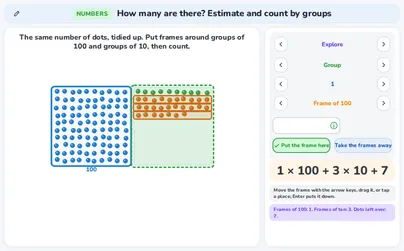
Do not count one by one. Put the dots in groups of 100, then in groups of 10. Count the groups, then the dots that are left over.
637
Example
6 groups of 100, 3 groups of 10 and 7 left over.
Definition

Hundreds, tens and ones

Ten ones make one ten. Ten tens make one hundred. So a number is built from hundreds, tens and ones, and every digit says how many.
100
Example
348 = 3 hundreds, 4 tens and 8 ones.
100101348
Tip

Estimate first, then count exactly

First estimate, so you know about how many to expect. Then count exactly with groups. If the exact count is far from your estimate, look again.
Example
Estimate: about 600.Groups → .600 is 5.8% below 637: close.
Definition

Inside: how a number is built

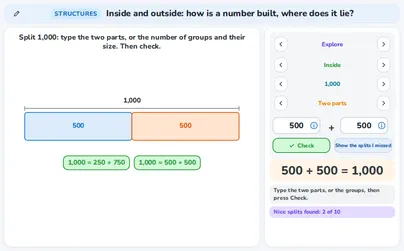
The inside structure of a number is how it is made from parts. A number can be split in many ways. Every way is a sentence that you can check by adding.
1 000500500
Example
Rule

Equal groups

A number can also be made of equal groups. The more groups, the smaller every group. 2 groups of 500 and 4 groups of 250 are the same number.
5005002×2502502502504×2002002002002005×
Example
Tip

Find all the nice splits

Choose a step you like, for example 50. The splits of 1 000 into two parts that grow in steps of 50 are 10 in all. Go through them in order, so that you miss none.
100900250750400600500500
Example
, , , , ,, , , , .
Tip

Use a structure to calculate

Knowing how a number is built makes calculating easier. If you know that 360 is 12 groups of 30, you also know and .
36012×30
Example
Definition

Outside: where does a number lie?

The outside structure says where a number lies between round numbers. Ask: which round number is near, and how far away is it? 998 lies close to 1 000.
99099510002998
Example
998 lies 2 below 1 000: very close.
Rule

Closer to which round number?

Put the number between two round numbers and find the halfway mark. A number past the halfway mark is closer to the bigger round number. Or compare the two distances.
4004505001189489
Example
489 lies between 400 and 500. The halfway mark is 450. and .11 is less than 89: 489 is closer to 500.
Special case

Exactly halfway: round up

When a number is exactly halfway, both round numbers are equally far away. The rule is: round up. So 450 goes to 500.
400450500500
Example
and The same distance, so round up: 450 → 500
Tip

Tens, hundreds or thousands

The round numbers depend on what you choose: tens, hundreds or thousands. The same number can be close to one round number and far from another. Choose the step first, then look at the neighbours.
480490500148940050011489
Example
489: the tens are 480 and 490. 490 is 1 away.489: the hundreds are 400 and 500. 500 is 11 away.
Rule

Decimals inside

Decimals have an inside structure too. 1 is 0.75 and 0.25. 2 is 10 groups of 0.2. 5 is 10 groups of 0.5. Check by adding or multiplying.
10.750.252
Example
Rule

Decimals outside

Decimals lie between round numbers too: wholes, tenths or hundredths. 0.98 lies close to 1. 1.2 is exactly halfway between 1.1 and 1.3.
0.90.9510.020.98
Example
→ very close to 1. and → halfway.
1.11.21.3
Definition

One number, many meanings

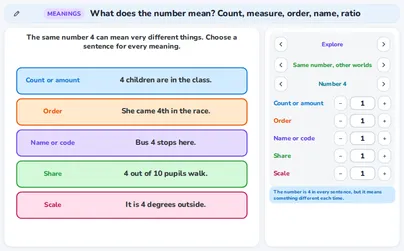
The same number can mean different things. The number 4 can be a count, a measure, a place in a race, a name, a share or a place on a scale. The meaning tells you what you can do with the number.
Example
4 children: a count4 kg: a measure4th place: an orderphone number …4: a name4 out of 10: a share−4 degrees: a place on a scale
Rule

Counts and measures: calculate with them

A count tells how many, a measure tells how much. You can add, subtract, multiply and divide them. Adding two counts, or two measures of the same kind, makes sense.
Example
4 children + 3 children = 7 children
Watch out!

Names and codes are not for calculating

Some numbers only name something: a telephone number, a shirt number, a bus number. Adding or multiplying them gives a number that means nothing.
Example
Shirt 4 and shirt 3 do not make shirt 7.You cannot add telephone numbers.
Rule

Order and place on a scale

An order number (4th place) tells the place in a row. You can compare it, but not add it. A place on a scale (−4 degrees) is a position. You can find the difference between two places.
−4059
Example
From −4 degrees up to 0 is 4 degrees, then 5 more → degrees warmer.
Rule

Ratio or share

A ratio or share compares a part with the whole. 4 out of 10 can be written as a fraction, as a decimal and as a percentage.
410=0.4
Example
4 out of 10 = 4/10 = 0.4, so 40%
Definition

Math language: from a story to a number sentence

Math language puts a story into numbers and signs. Find the numbers, choose the operation, write the number sentence and calculate. Then say what the answer means in the story.
Example
3 packs cost €7.50. What does 1 pack cost?Check →
Definition

A friendly number

To estimate a calculation, round every number to a friendly number: a number that is easy to calculate with. A price like €49.95 is almost a round number.
49.849.9500.0549.95
Example
€49.95 is almost €50: a bit less. and
Rule

Estimate, calculate, correct

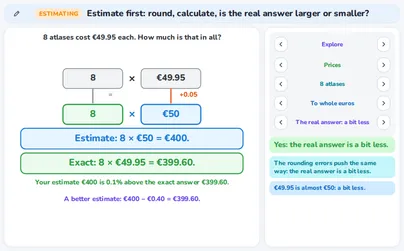
Round, then calculate with the friendly numbers: that is your estimate. To get closer, find how much each price was rounded and take that off (or add it).
4005050505050505050
Example
8 atlases of €49.95 are about .Exactly → , so 400 is 0.1% above it.Corrected →
Rule

A total of prices

Do the same for more prices: round every price, then add or multiply. Notice how many prices were rounded up and how many down.
Example
6 chairs of €139.95 are about .Exactly → .€28.95 + €51.99 + €9.95 is about .Exactly → .
Rule

Is the real answer more or less?

Say if the real answer is more or less than your estimate. In a sum or a product: when every number you rounded went up, the real answer is less. When every rounded number went down, the real answer is more.
4.84.950.114.89
Example
is about .4.89 was rounded up, so the real answer is less.Exactly → . The estimate is 2.2% above it.
Rule

Taking away and dividing: the other way round

The number you take away, or divide by, works the other way round. Round it up and the estimate gets smaller, so the real answer is more. Round it down and the real answer is less.
Example
is about .Both roundings made the estimate smaller, so the real answer is more → . is about .0.49 was rounded up, so the real answer is more → . The estimate is 2% below it.
Special case

One up, one down: cannot tell

If you round one number up and another down, the mistakes can cancel. Then you cannot tell if the real answer is more or less, unless you look at how much each number was rounded.
Example
is about . Exactly → . is about . Exactly → .The same estimate: the real answer is more in the first sum and less in the second.
Watch out!

Check the calculator with your estimate

A calculator shows what you typed. If a decimal point lands in the wrong place, the result is far from your estimate. So estimate first, then compare.
39963996
Example
is about .The calculator shows 39.96: far from 400.The decimal point slipped: 399.6.
Rule

Whole numbers and fractions of a number

For a product of whole numbers, round the bigger number to a ten. For a fraction of a number, round the whole to a number that divides easily by the denominator.
Example
is about . Exactly → , so 200 is 6.4% above it.3/4 of 82 is about . Exactly: 61.5.
Tip

Round finer or rougher

You choose how much to round. Whole euros give an estimate that is closer. Tens of euros are easier to add but lie further away. Both are fine: say which one you used.
Example
, to whole euros → , which is 0.1% above 90.89.To tens of euros → , which is 1% below.
Definition

Split by place

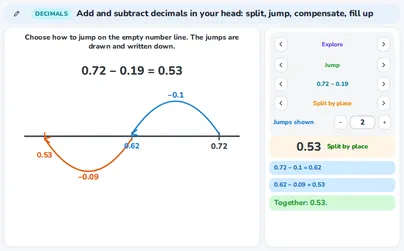
Split the second number into its places: tenths, hundredths. Then take away (or add) one part at a time. The jumps on an empty number line show it.
−0.1−0.090.720.620.53
Example
→ split 0.19 into 0.1 and 0.09. and → , then
Rule

Jump to a round number first

First jump to a round number, then jump the rest. From 0.72 jump back to 0.7, then take away what is left of 0.19.
−0.02−0.170.720.53
Example
Rule

Round, then correct

When a number is just below a round number, use the round number and then correct. 7.99 is almost 8: take away 8, then give back the extra that you took away.
−814.66.6+0.016.61
Example
Rule

Fill up to find the difference

To find how far apart two numbers are, count up from the smaller one: first to a round number, then to the bigger one. Add the jumps.
+0.5+54.55
Example
From 4.5 to 10 → and , so
Rule

Like whole numbers

Calculate with whole numbers first, then put the decimal point back. 0.72 is 72 hundredths and 0.19 is 19 hundredths, so you can calculate .
Example
72 hundredths − 19 hundredths = 53 hundredths
Rule

The same number of decimals

Before you add or subtract, write the same number of decimals. A zero at the end changes nothing → . Then calculate like whole numbers and put the decimal point in.
10.10.01340025365
Example
hundredths
Tip

Choose a way and say why

There is more than one way and every way gives the same answer. Look at the numbers and choose the way with the fewest or the easiest jumps. Then say why, out loud or in writing.
Example
in all three ways.Split by place: 3 jumps.Jump to a round number: 2 jumps.Round, then correct: 2 jumps, and one is only 0.01.
Definition

Thousandths

After hundredths comes one more place: thousandths. Every place to the right is 10 times smaller. 6.175 is 6 and 1 tenth and 7 hundredths and 5 thousandths.
10.10.010.0016175
Example
Rule

Ten thousandths make a hundredth

10 thousandths make 1 hundredth, and 10 hundredths make 1 tenth. To change hundredths into thousandths, write a zero behind: 7 hundredths = 70 thousandths. A zero at the end changes nothing.
0.01
Example
7 hundredths = 70 thousandths
Rule

Round to a hundredth

To round to a hundredth, look at the thousandths digit. If it is 5 or more, round up. If it is less than 5, round down.
2.472.482.476
Example
→ the thousandths digit is 6, so round up. → the thousandths digit is 3, so round down.
Rule

Compare crowds by their groups

Look at the groups, not at every dot. Compare the hundreds first, then the tens, then the ones. In Compare the totals stay hidden until you press Show the totals.
236263
Example
A has 2 squares of 100, 3 bars of 10 and 6 dots. . B has 2 squares, 6 bars and 3 dots. . The hundreds are the same and 6 tens are more than 3 tens, so B has more.
Rule

How many more? And in order

To find how many more, take the smaller number away from the bigger number. With three crowds, take the fewest from the most. To put crowds in order, compare them two by two. In the box Order type the letters, from the smallest crowd to the biggest.
03672108144180216252236A263B199C
Example
Crowds A, B and C: 236, 263 and 199. C has the fewest and B the most, so . In order that is , so C, A, B.

Exercises

A picture has 340 dots. Is an estimate of 310 in the reasonable range? And an estimate of 300? Easy
Show solution
10% of 340 is 34.
and .
310 lies between 306 and 374. 300 is below 306.
340300310306374
310 is in the range; 300 is just outside it (11.8% below 340)
Check → and , which is less than 0.1.
There are 637 dots. How many groups of 100, groups of 10 and single dots are there? Easy
637
Show solution
The hundreds: 6 groups of 100 make 600.
.
In 37 there are 3 groups of 10 and 7 left over.
6 groups of 100, 3 groups of 10 and 7 dots
Check → .
Write 1 000 as 4 equal groups. Easy
Show solution
Divide 1 000 into 4 equal groups.
.
Check → .
Which hundred is 489 closest to? How far away is it? Easy
Show solution
The hundreds around 489 are 400 and 500. The halfway mark is 450.
and .
4004505001189489
11 is less than 89.
500, which is 11 away
Check → 489 is past the halfway mark 450, so it is closer to 500.
Which of these can you add? (a) 4 children and 3 children (b) 4 kg and 3 kg (c) telephone numbers ending in 4 and in 3 Easy
Show solution
Ask what each number means.
(a) is a count and (b) is a measure: you can add them.
(c) only names a phone: adding gives a number that means nothing.
(a) and (b)
Check → children and make sense.
Round €49.95 to a friendly number and estimate the cost of 8 atlases. Easy
Show solution
49.95 is almost 50.
.
about €400
Check → exactly , close to 400.
6 chairs cost €139.95 each. Estimate the total, then correct your estimate. Medium
Show solution
139.95 is almost 140 → .
Every price was rounded up by 0.05 → .
Take that off → .
about €840; corrected €839.70
Check → .
Estimate €28.95 + €51.99 + €9.95. Is the real answer more or less? Medium
Show solution
Round to whole euros → .
All three prices were rounded up, so the real answer is less.
Exactly → .
about €91; the real answer is less (90.89)
Check → .
Calculate in two different ways. Medium
Show solution
Split 0.19 → and .
−0.1−0.090.720.620.53
Round, then correct → and .
0.53
Check → .
Calculate by rounding 7.99 first. Medium
Show solution
7.99 is almost 8 → .
8 is 0.01 more than 7.99, so you took away 0.01 too much.
Give it back → .
6.61
Check → .
How far is it from 4.5 to 10? Fill up in two jumps. Medium
Show solution
First jump to the next whole number → .
Then jump to 10 → .
+0.5+54.55
Add the jumps → .
5.5
Check → .
Write with the same number of decimals and calculate. Medium
Show solution
Write a zero behind 3.4 → .
Both numbers now have 2 decimals → hundredths.
10.10.01340025365
Put the decimal point back: 3.65.
3.65
Check → .
3 packs of pens cost €7.50 together. Write the number sentence and say what 1 pack costs. Medium
Show solution
Share the money equally over the 3 packs: divide.
The number sentence is .
.
→ 1 pack costs €2.50
Check → .
Estimate . Is the real answer more or less? How many per cent is the estimate off? Hard
Show solution
4.89 is almost 5 → .
4.89 was rounded up, so the real answer is less.
Exactly → . The difference is .
, which is 2.2%.
about 375; the real answer is less (366.75); the estimate is 2.2% above it
Check → .
Estimate . Is the real answer more or less? Hard
Show solution
0.49 is almost 0.5 → .
A bigger divisor gives a smaller answer. 0.49 was rounded up, so the estimate is smaller than the real answer.
The real answer is more → .
about 6 000; the real answer is more (about 6 122.45)
Check → , which is less than 3 000, so the real answer is more than 6 000.
The calculator shows 39.96 for . Does that fit your estimate? What happened? Hard
Show solution
Estimate → .
39.96 is far from 400: it does not fit.
The digits 3, 9, 9 and 6 are right, but the decimal point is one place too far to the left.
39963996
Move it one place to the right: 399.6.
It does not fit: the decimal point slipped; the result is 399.6
Check → .
Write 2 as 10 equal groups and 5 as 10 equal groups. Then write 1 as two parts when one part is 0.25. Hard
Show solution
, so .
2
, so .
, so .
, and
Check → , and .
Write 6.175 as a sum of its places and as thousandths. Then round it to a hundredth. Hard
Show solution
.
10.10.010.0016175
6 ones are 6 000 thousandths, so .
The thousandths digit is 5: round up. .
, rounded 6.18
Check → .
“4 out of 10 pupils walk to school.” Write that as a decimal and a percentage. In a school of 250 pupils, how many walk? Hard
Show solution
4 out of 10 = 4/10 = 0.4, and , so 40%.
The share is 0.4 of the whole.
For 250 pupils → .
; 100 pupils walk
Check → .
Crowd A has 4 squares of 100, 1 bar of 10 and 8 dots. Crowd B has 4 squares, 8 bars and 1 dot. Which crowd has more, and by how many? Medium
Show solution
Write both numbers. and .
The hundreds are the same. 8 tens are more than 1 ten, so B has more.
Take the smaller from the bigger. .
B has 63 more.
Check → .
Are you a teacher?

Start live lessons with these applications for your whole class. Free to try for one month.

Try it free

Fits these school years

IB (MYP, Diploma): PYP, MYP 1, MYP 2, MYP 3

Cambridge International: Primary, stage 4, Primary, stage 5, Primary, stage 6

Netherlands: Groep 5, Groep 6, Groep 7, Year 1, Groep 8

Türkiye (MEB): Year 3 (MEB), Year 4 (MEB), Year 5 (MEB), Year 6 (MEB)

England (GCSE, A Level): Year 4, Year 5, Year 6

USA (Common Core): Grade 3, Grade 4, Grade 5

What the applications of this topic teach 5 applications

How many are there? Estimate and count by groups

  • Estimating how many dots there are by comparing with a box
  • Counting exactly with groups of 100 and 10: 6 × 100 + 3 × 10 + 7
  • Comparing two crowds of dots: which has more and by how many

Inside and outside: how is a number built, where does it lie?

  • Splitting a number into parts or equal groups: 1 000 = 500 + 500 = 4 × 250
  • Telling where a number lies between round numbers
  • Doing the same with decimals: 1 = 0.75 + 0.25

What does the number mean? Count, measure, order, name, ratio

  • Telling whether a number is a count, a measure, an order or a name
  • Knowing which calculations make sense: counts yes, phone numbers no
  • Turning a story into a number sentence: 7.50 ÷ 3 for one pack
  • Knowing that 4 out of 10 is 0.4 and 40%

Estimate first: round, calculate, is the real answer larger or smaller?

  • Rounding to friendly numbers to estimate: 8 × 49.95 is about 400
  • Telling if the real answer is above or below the estimate
  • Using an estimate to check a calculator answer
  • Correcting an estimate: within 10% is reasonable

Add and subtract decimals in your head: split, jump, compensate, fill up

  • Mental addition and subtraction of decimals: split, jump, compensate
  • Rounding then correcting: 14.6 − 7.99 = 14.6 − 8 + 0.01
  • Working like whole numbers: 72 − 19 = 53, so 0.72 − 0.19 = 0.53