Interactive Lessons
Lecture notes Exercises

Powers and roots: squares, cubes and index laws

Lecture notes

Definition

Square numbers

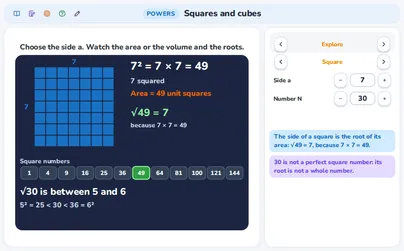
A square number is a whole number times itself: . It is the area of a square with side a, drawn with unit squares.
aaa²
Example
→ 5 rows of 5 unit squares1, 4, 9, 16, 25, 36 …

5525
Definition

Cube numbers

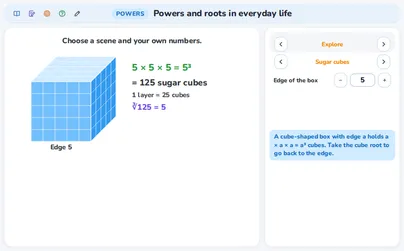
A cube number is a whole number three times as a factor: . It is the volume of a cube with edge a.
aaa
Example
→ 3 layers of 3 × 31, 8, 27, 64, 125 …
Definition

Powers

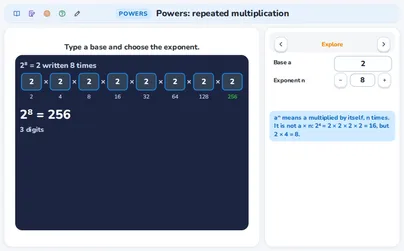
means a multiplied by itself n times. It is not a × n.
aaaan
Example
is something else
12481601234×2×2×2×2
Definition

Base and exponent

The base is the number that is multiplied. The exponent is the small raised number: it says how many times the base is written.
aaaan
Example
→ base 3, exponent 5
333335
Watch out!

Signs of powers

An even number of negative factors gives a positive answer, an odd number gives a negative one. Without brackets only the number next to the exponent is raised: .
−10010(−3)²−3²
Example
and
−10010(−3)²−3²(−2)³
Definition

Square roots

The square root undoes squaring: because . A number like 49 that has a whole square root is a perfect square.
aaAa=√A
Example
, side of a square of area 49 → 7
7749
Definition

Cube roots

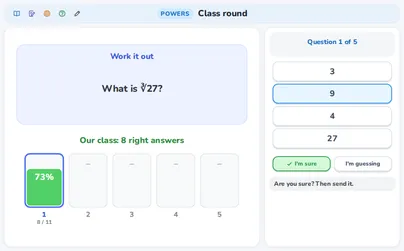
The cube root undoes cubing: because . The edge of a cube is the cube root of its volume.
Vaaa
Example
, edge of a cube of volume 64 → 4
V=64444
Rule

Estimate a root

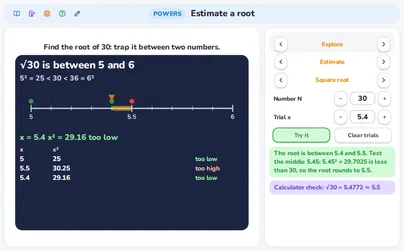
If a number is not a perfect square, its root lies between two whole numbers. Find the perfect squares on both sides, then try tenths.
5²n6²
Example
→ →
55.56√30
Rule

Roots of products

A root can be taken of each factor: and the same for a quotient. It does not work for a sum.
√a√b√ab
Example
, but
6212
Rule

Powers of 10

is a 1 followed by n zeros. Each step to the right on the place-value chart is one power of 10 lower.
1101001 00010⁰10¹10²10³×10×10×10
Example
10⁶10⁵10⁴10³10²10¹10⁰1000000
Rule

Multiply powers

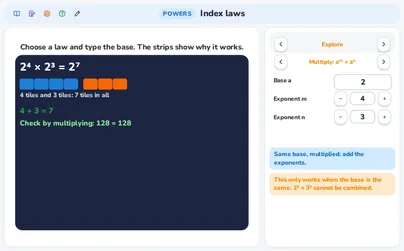
Same base, multiplied: add the exponents. . The strip shows m tiles and then n tiles.
m+nmn
Example
cannot be combined
2⁸2⁵2³
Rule

Divide powers

Same base, divided: subtract the exponents. . Pairs of equal factors cancel.
aaaaaa
Example
5⁶5⁴5²
Rule

Power of a power

A power of a power: multiply the exponents. . It is n rows of m tiles.
mnmn
Example
326
Rule

Power of a product

Every factor gets the power: . A sum does not: is not .
ababa²b²
Example
, but
2×32×33649662+3
Special case

Zero power

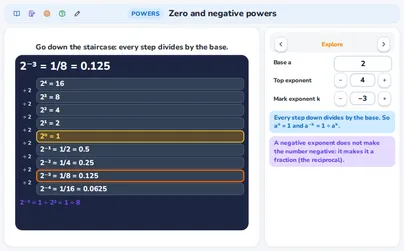
Going down one step divides by the base, so for every a that is not 0. A power of 0 means no factors at all.
84212³2²2¹2⁰÷2÷2÷2
Example
→ and
25515²5¹5⁰÷5÷5
Rule

Negative powers

A negative exponent gives the reciprocal: . It does not make the number negative. A fraction turns upside down.
4211/21/42²2¹2⁰2⁻¹2⁻²÷2÷2÷2÷2
Example
,
11/21/41/82⁰2⁻¹2⁻²2⁻³÷2÷2÷2
Rule

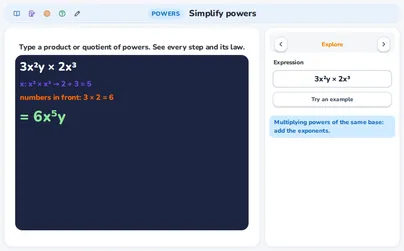
Simplify with letters

Multiply or divide the numbers in front as usual, and use the index laws on each letter. A sum of terms cannot be simplified this way.
Example
12x⁵y4x²y
Definition

Fractional index

The index means the n-th root: and .
√a√aa
Example
3398222
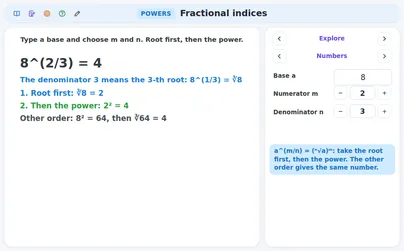
Rule

a^(m/n)

Take the root first (the denominator), then the power (the numerator): . A negative index takes the reciprocal.
27³√3²9
Example
8³√2²4
Rule

Letters and fractions

With letters the laws are the same: add the fractions in the exponents. is .
21/23/2
Example
21/23/2
Rule

Equivalent or not? Compare two expressions with powers

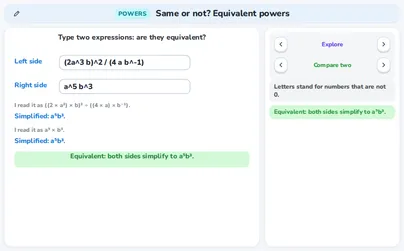
To decide whether two expressions with powers are equivalent, bring both to one form with the laws of exponents: multiplying adds the exponents, dividing subtracts them and a power of a power multiplies them. The same form means equivalent. If the forms differ, find numbers for the letters that give a different value on each side: one counterexample is enough to say “not equivalent”. Equal values for one choice of numbers prove nothing. In Compare two you type both sides.
Example
Is equivalent to ? The left side is and the right side is : not equivalent. A counterexample: for a = 2 the sides are 16 and 8. Is equivalent to ? : not equivalent; for a = 1 the sides are 4 and 2.
Rule

An unknown exponent: which power gives the number?

To find the exponent in , write the powers of (, , , …) until you reach : the exponent of that power is . If lies between two powers, lies between two whole numbers. A negative exponent turns the power upside down, so . No power of a positive number is zero or negative.
Example
For the powers are , , , and , so . and , so . For the power is less and is more than 50, so is between 3 and 4.
Rule

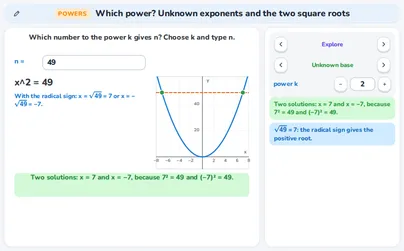
Two square roots: x² = n has two solutions

The equation with has two solutions, or (a positive and a negative number), because a number and its opposite have the same square. The radical sign means only the positive root. If there is no solution, because a square is never negative; has one solution. An odd power has one solution, for example gives .
Example
has and , so or ; but . has no solution. and , so .

Exercises

Work out 2⁵, (−3)² and −3². Easy
Show solution
, but
−10010(−3)²−3²
Answer → 32, 9 and −9
Brackets decide which number gets the power.
Between which two whole numbers is √70? Give it to 1 decimal place. Easy
Show solution
→ between 8 and 9
8²709²
Try tenths →
The middle is less than 70 → rounds to 8.4
8.38.358.4√70
Answer → between 8 and 9, about 8.4
Check with the square: 8.4 × 8.4 is a little more than 70.
Work out 2⁻³, 10⁻² and (2/3)⁻². Medium
Show solution
11/21/41/82⁰2⁻¹2⁻²2⁻³÷2÷2÷2
A fraction turns upside down →
Answer → 1/8, 0.01 and 9/4
A negative exponent never makes the answer negative.
Simplify 3⁵ × 3² ÷ 3⁴ and 12x⁵y ÷ 4x²y. Medium
Show solution
Add, then subtract the exponents →
3⁷3⁴3³
Numbers in front →
Letters → and
12x⁵y4x²y
Answer → 27 and
Check 27 by multiplying: 243 × 9 ÷ 81.
Simplify (2x³)² × 3x⁻² ÷ 6x². Hard
Show solution
The power belongs to the 2 too →
2x³()²4x⁶
Multiply →
Divide →
12x⁴÷6x²2x²
Answer →
Forgetting to square the 2 gives 1 instead of 2 in front.
Work out 27^(2/3) and 16^(−3/4). Hard
Show solution
Root first, then the power →
27³√3²9
The negative index takes the reciprocal →
16⁴√2³81/x1/8
Answer → 9 and 1/8
Take the root first: the numbers stay small.
Are you a teacher?

Start live lessons with these applications for your whole class. Free to try for one month.

Try it free

Fits these school years

IB (MYP, Diploma): MYP 1, MYP 2, MYP 3, MYP 4, MYP 5, PYP

Cambridge International: Lower Secondary, stage 7, Lower Secondary, stage 8, Lower Secondary, stage 9, IGCSE, Primary, stage 5, Primary, stage 6

Netherlands: Groep 8, Year 1, Year 2, Year 3 (havo, vwo), Vmbo bb (years 3-4), Vmbo kb (years 3-4), Vmbo gt (years 3-4), Havo · Mathematics A, Vwo · Mathematics A, Vwo · Mathematics C, Havo · Mathematics B, Vwo · Mathematics B, Groep 7

Türkiye (MEB): Year 5 (MEB), Year 7 (MEB), Year 8 (MEB), Year 9 (MEB), Year 10 (MEB), Year 6 (MEB)

England (GCSE, A Level): Year 5, Year 6, Year 7, Year 8, Year 9, Year 10 (GCSE), Year 11 (GCSE)

USA (Common Core): Grade 6, Grade 8, Grade 7, Algebra 1

What the applications of this topic teach 10 applications

Squares and cubes: area and volume

  • Knowing square numbers as areas of squares: a² = a × a
  • Knowing cube numbers as volumes: 1, 8, 27, 64, 125
  • Going back with the square root √ and the cube root ∛
  • Placing a root between two whole numbers

Estimate a root

  • Finding the two whole numbers a root lies between
  • Finding a root to 1 decimal by trial: too low, too high
  • Using √(a × b) = √a × √b

Powers: repeated multiplication

  • Knowing that a power is repeated multiplication, not a × n
  • Working out powers of negative numbers, decimals and fractions
  • Knowing that 10ⁿ is a 1 followed by n zeros
  • Telling (−3)² from −3² and comparing 2⁵ with 5²

Index laws: multiply, divide, power of a power
  • Using the index laws aᵐ × aⁿ = aᵐ⁺ⁿ and (aᵐ)ⁿ = aᵐⁿ
  • Using (a × b)ⁿ = aⁿ × bⁿ
  • Knowing that (a + b)ⁿ is not aⁿ + bⁿ
  • Choosing the right law and finding exponents for a target

Zero and negative powers

  • Knowing why a⁰ = 1: each step down divides by the base
  • Knowing that a⁻ⁿ = 1 ÷ aⁿ
  • Writing 10⁻ⁿ as a decimal: 10⁻³ = 0.001

Simplify powers (numbers and letters)

  • Simplifying products and quotients of powers with the index laws
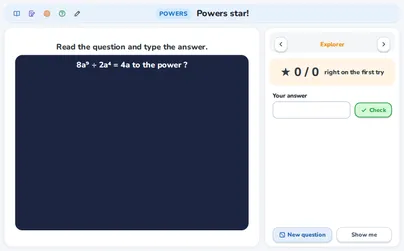
  • Simplifying expressions with letters: 12x⁵y ÷ 4x²y and (2a³)²
  • Naming the law used in each step

Fractional indices

  • Knowing that a^(1/n) is the n-th root of a
  • Working out a^(m/n): root first, then the power
  • Simplifying with fractional indices: x^(1/2) × x^(3/2) = x²
  • Writing √x as x^(1/2)

Powers and roots in everyday life

  • Seeing squares in a tiled floor and the pixels of a picture
  • Seeing cube numbers in a box of sugar cubes
  • Using powers for a message that keeps multiplying
  • Going back with roots to find how many doublings there were

Same or not? Equivalent powers

  • Deciding if two power expressions are equivalent and naming the law
  • Showing with a counterexample that expressions are not equivalent
  • Seeing that equal values for one choice do not prove equivalence

Which power? Unknown exponents and the two square roots
  • Finding an unknown exponent in an equation such as 2^x = 32
  • Knowing that x² = n has two solutions when n is positive
  • Telling when a power equation has one solution, two or none