Interactive Lessons

Solving problems: heuristics, checking and reasoning

Lecture notes

Definition

A problem is not a routine sum

A problem is a question where nobody tells you the way: you choose how to start. The 24 problems of the application are original, we wrote them for it, and the application chooses the numbers, so a classmate may get other numbers. Each problem can be solved in two or three ways.
Example
A garden fence has 12 posts, 3 m apart. How long is the fence? Nobody says “multiply” or “subtract”: you choose the way.
Definition

Seven tools

The toolbox holds 7 tools: Sketch, Table, Pattern, Work backwards, Smaller numbers, List and Guess and improve. A tool is a way of looking at a problem, not a rule. You may open more than one, and no tool is the best for every problem.
SketchTablePatternWork backwardsSmaller numbersListGuess and improve
Example
For the fence of 12 posts: a drawing shows the gaps, a table lists small cases and a pattern gives the rule. Three tools lead to the same answer: 33 m.
Rule

Sketch: draw what you know

Draw the situation with dots and lines before you calculate: a drawing shows what is where. With Sketch you drag six dots onto a grid; the numbers on the lines are lengths in squares. The application does not judge your drawing.
Example
12 posts in a row, 3 m apart: the dots show 11 gaps, not 12. So the fence is long.
03311·3
Rule

Table: write the small cases

With Table you write the small cases in a table, one row at a time. Look at how the numbers change from row to row. The application has a button for the next row and shows the difference between two rows.
Example
Posts 2, 3, 4 and 5 give 3, 6, 9 and 12 m. Every extra post adds 3 m. For 12 posts → .
Rule

Pattern: find the rule and test it

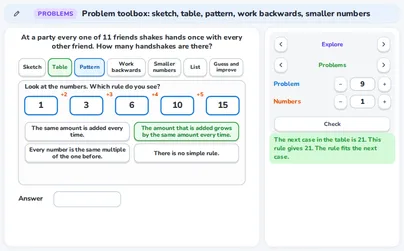
With Pattern you look at five numbers of the table and choose the rule you see: the same step each time, a step that grows, or the same factor. The application shows the next number your rule gives beside the real one, so you can see whether the rule fits.
Example
The numbers 4, 7, 10, 13: each is 3 more than the one before. The 20th number is .
4710131234n+3+3+3
Rule

Work backwards: undo the steps

When you know the end result and want the start, undo the steps from the last one to the first: add instead of take away, divide instead of multiply. Work backwards shows the boxes one by one, from the end result back to the start.
Example
Think of a number, double it, take away 7: the result is 25. Back → , then . Check → .
25+732÷216
Rule

Smaller numbers: shrink the problem

Try the same problem with smaller numbers first. With Smaller numbers you open at least three small cases, choose the rule you see and then go back to the big problem. That is the tab Make it simpler.
Example
Handshakes: 2 friends make 1, 3 friends make 3, 4 friends make 6, 5 friends make 10. The differences are 2, 3, 4, so 6 friends make 15. For 10 friends → .
1361015n2345Δ
Rule

List: change one thing at a time

When the answer is a number of cases, list them in an order: change one thing at a time. List marks a case that is in your list twice and a case that is not allowed, and it tells you when a case is missing.
Example
Two-digit numbers made of two different digits from 1, 2 and 3: 12, 13, 21, 23, 31, 32. The numbers 11, 22 and 33 are not allowed. That is 6 numbers. Check → .
123111121322122233313233
Rule

Guess and improve

Guess a number, check it against what is wanted, then improve it: higher or lower? Every guess tells you on which side the answer lies. Guess and improve shows the result of each guess and the two guesses between which the answer lies.
Example
10 pens cost 22 euros in total. A pen costs 1 or 3 euros. Guess 4 pens of 3 euros → , too low. Guess 8 → , too high. Guess 6 → . Right!
0246810486
Rule

Choose by what the problem is like

No tool is wrong in general: only a reason can be wrong. Ask what the problem is like: a situation in space (Sketch), numbers that grow step by step (Table or Pattern), a known end result (Work backwards), cases to count (List) or a number you can try (Guess and improve). In the tab Choose the application judges your reason against the problem.
Example
For “Sem thinks of a number, doubles it and takes away 7” the reason “the end result is known and the start is wanted” is good for Work backwards. The reason “the numbers grow step by step” is true for another problem: it would point to Table.
SketchTablePatternWork backwardsSmaller numbersListGuess and improve
Definition

Four stages

Solving a problem has four stages: Given and wanted (what do I know, what is asked), Relation (how are they connected), Work (do the calculation) and Check (does the answer fit the story?). In the tab Four stages you put the pieces of one problem in their stage.
1Given and wanted✔12 posts, 3 m apartthe lengthof the fence2Relation✔gaps = posts − 1length = gaps · 33Work✔(12 − 1) · 3 = 334Check✔about 33 m: sensible
Example
The fence: 12 posts, 3 m apart, the length wanted (given and wanted). Gaps = posts − 1 (relation). (work). About 33 m: sensible (check).
Tip

Make a hard problem simple

A big problem is easier when you shrink it. Take the small cases, find what happens each time and then use that for the big numbers. If you are stuck, ask three questions: what is given? what is wanted? is there a small case?
Example
12 posts is big. Look at 2, 3 and 4 posts: 3, 6 and 9 m. The rule: 3 m for every post after the first. Back to 12 posts → .
Watch out!

A pattern needs a check

Two or three cases can fit more than one rule. The numbers 1, 2, 4 could double (next 8) or grow by 1, 2, 3 (next 7). Test your rule on the next case.
Example
Pizza cuts: 0 cuts give 1 piece, 1 cut 2, 2 cuts 4, 3 cuts 7. Doubling would give 8, but the differences are 1, 2, 3, so 4 cuts give 11.
1247111622n123456Δ
Special case

More than one route, and what is recorded

After you type the answer, the application lists the routes that lead to it and the tools you opened. Only the tools you open are recorded, and only inside the page: nothing is sent to a teacher, a server or anywhere else. Reload the page and the record is gone.
Example
Fence of 12 posts: you opened Table and typed 33. Right! Routes: table, pattern, smaller numbers. You used: table.
Definition

Does it fit?

A result must fit the situation. A benchmark is a range of values that you know are sensible, for example a pupil of 12 is about 1.3 to 1.9 m tall. Compare a result with the benchmark before you trust the calculation. In the tab Does it fit? you decide whether a result can be right.
Example
The calculator says 16.2 m for a pupil of 12. That is far above 1.9 m, so it cannot be right. The decimal point slipped: 1.62 m.
00.511.522.51.62
Rule

Estimate first, then compare

Make a quick estimate or use a benchmark you know. If the result is far outside the range, look for the slip: a misplaced decimal point, a wrong unit or the wrong operation. Then work out the number that the calculation should have given.
Example
A bus in town at 520 km/h? A town bus drives about 20 to 60 km/h. 520 is ten times too big: it should be 52 km/h.
Watch out!

A right calculation can give an impossible result

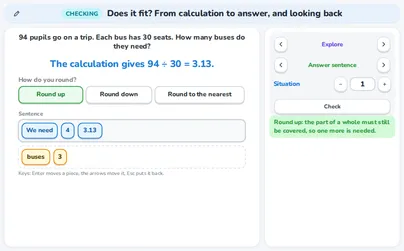
A calculation can be right and the result still impossible for the situation: 3.13 buses, 14.5 bags, 8.83 tables. Ask what the situation allows: a part of a bus cannot drive.
Example
94 pupils go on a trip and a bus has 30 seats. . There is no 0.13 of a bus, so the answer must be a whole number.
Rule

The answer sentence

A calculation is not yet an answer. Write the answer as a sentence with the number and the unit. In the tab Answer sentence you build it from tiles: the words, the number and the unit in the right order.
Example
, so the answer sentence is: We need 4 buses.
Rule

Round up, down or to the nearest

The situation decides how you round. Round up when a part is not enough (buses, tables). Round down when only full ones count (full bags, whole pieces). Round to the nearest when the number is an estimate.
Example
→ round up, 4 buses (3 buses seat only 90). → round down, 14 full bags.
33.544.55+0.873.134
Tip

Put the answer back in the story

Check your answer in the story: does it do what the problem says? Test the answer and the number next to it, so you know the rounding is right.
Example
4 buses seat , which is at least 94. 3 buses seat , which is less than 94. So 4 buses it is.
Rule

Another way

Solve the same problem in a second way and compare. Two methods that give the same answer make you more sure. In the tab Another way you see two worked solutions of one problem.
Example
300 g of rice for 4 people. How much for 10 people? Ratio table → for 2 people, . Price of one → each, . Both give 750 g.
4210300150750÷2÷2×5×5
Rule

Compare the methods

Ask three questions: which method has fewer steps? which one uses a picture or a table? which one is still handy when the numbers are 100 times bigger? Right and handy are two different things: a method can be right and still slow for big numbers.
Example
→ adding in order takes 9 additions. Pairs → , , … five pairs, . That is two steps, and it still works for .
Rule

Look back with four questions

After a problem, look back with four questions: what was the hard part? which tool helped? what will I try first next time? what if the numbers were ten times bigger? In the tab Look back you choose a sentence for each question and the application sums up your choices in two sentences.
Example
You choose “finding a way to start” and “the table”. The summary says: The hard part was finding a way to start. What helped me was the table.
Definition

Conjecture: what you think is always true

A conjecture is a sentence that you think is always true, because of what you saw. In the tab Notice you look at a table of results and build your conjecture from sentence tiles: a word (is always, is sometimes, is never) and a property.
Example
Odd + odd → , , . Conjecture: the sum of two odd numbers is always even.
Rule

Test it, then search for a counterexample

Test your conjecture with cases of your own (Test this case), then press Search for a counterexample. If a counterexample exists, the application shows it. If none is found, that is still not a proof: a reason that works for every case is needed.
Example
Own tests , and are all even. The conjecture survives, but the three tests only make it likely.
Rule

A counterexample breaks “always”

One case that does not fit is enough to show that “always” is false. Look for special cases: 0, 1, 2 and numbers of a special kind.
Example
Claim: every prime number is odd. The prime number 2 is even, so the claim is false.
Rule

An example is not a proof

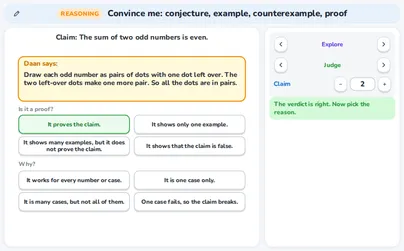
An example shows that a claim is true for one case. Many examples are still examples. A proof is a reason that works for every case.
Example
is one example. Ten more sums are still examples. A picture of pairs of dots that works for any two odd numbers is a proof.
Rule

A proof with a picture of dots

Draw a general case. An odd number is some pairs of dots and one dot left over. Two odd numbers have two dots left over, and together they make one more pair. So all the dots are in pairs: the sum is even.
Example
→ 7 is three pairs and one dot, 9 is four pairs and one dot. The two extra dots make one more pair → pairs, so 16.
Rule

A proof with letters

Write an odd number as and another odd number as . Their sum is , a multiple of 2, so even. The letters stand for any numbers: that is why the argument works for every case.
Example
Take and → and . The letters give the same number.
Rule

Judge the arguments of four classmates

In the tab Judge four classmates (Mila, Daan, Yusuf and Elif) argue for or against a claim. You decide what each argument is: it proves the claim, it shows only one example, it shows many examples but does not prove the claim, or it shows that the claim is false. Then you pick the reason.
Example
Claim: the sum of two odd numbers is even. Daan’s is one example. Mila’s three sums are many examples. Elif’s picture works for every case, so it proves the claim.
The sum of two odd numbers iseven.DaanI tried 3 + 5 = 8. It iseven.1only one exampleMilaI tried 3 + 5, 7 + 9 and11 + 13. All sums areeven.…many examples, no proofElifOdd = pairs plus one dot.The two extra dots make apair.✔proves the claim
Watch out!

“It worked every time I tried” is not a proof

A claim can pass ten, a hundred or a thousand cases and still fail at the next one. Only a reason that works for every case is a proof; one failing case is a counterexample.
Example
The expression gives the prime numbers 11, 13, 17, 23, 31, 41, 53, 67, 83 and 101 for to 10. For it gives , which is not a prime number.
Rule

Build an argument from pieces

In the tab Build you build the argument for a claim from pieces. Pieces that only give examples are not part of the argument: leave them out. The order matters: the argument must read like a story, from the first idea to the conclusion.
Example
Claim: the sum of three numbers in a row is a multiple of 3. The pieces in order: call the smallest number n; the sum is ; then ; so it is a multiple of 3. The piece is only an example.
Rule

Always, sometimes, never

Sort statements by what happens in all cases: always true (no case fails), sometimes true (some cases fit and some do not) or never true (every case fails). One counterexample moves a statement from “always” to “sometimes”. In the tab Always, sometimes, never you sort 12 statements in two sets of six.
Example
“A prime number is odd”: 3 is odd but 2 is not, so sometimes. “The sum of two odd numbers is odd” → and every such sum is even, so never.
Special case

A claim about a range of numbers

A claim may be only about some numbers, for example “every multiple of 6 between 5 and 50 is divisible by 4”. Look only at that range: list the multiples, test them one by one, and one failing number is the counterexample. In the practice sets you type any number that breaks the claim.
Example
The multiples of 6 between 5 and 50: 6, 12, 18, 24, 30, 36, 42, 48. The number 6 is not divisible by 4, so 6 is a counterexample. So are 18, 30 and 42.
Tip

Try to break it first

To test a claim, first try to break it: look at the smallest and the strangest numbers, like 0, 1 and 2. If you cannot break it, ask yourself why it is true. The reason you find is the start of your proof.
Example
Claim: doubling a whole number gives a bigger number. Try 0 → , and 0 is not bigger than 0. The claim fails for 0.
Doubling a whole number alwaysgives a bigger number.YusufNot for 0: 2 · 0 = 0, and0 is not bigger than 0.✘the claim is false
Tip

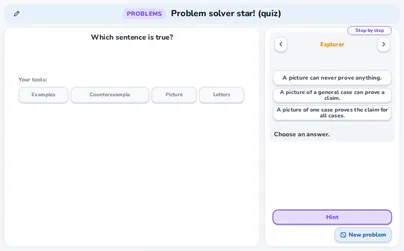
The quiz mixes the three applications

The quiz gives endless practice with a score: a problem to solve, a number after working backwards, a result to correct, a counterexample to type, a statement to judge. There are three levels, and every question comes with hints and a worked solution.
Example
A question: Sem thinks of a number, doubles it and takes away 7. The result is 25. Which number? Answer → .
Tip

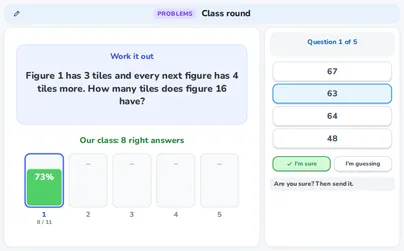
The class round

In the class round the whole class answers 5 questions at once: what the words mean (counterexample, working backwards), the rules of checking and answering, and true-or-myth statements about proof. Three kinds of questions are made new each round: a problem, a rounding and a counterexample.
Example
A myth: “Three examples prove a claim.” A true statement: “One counterexample disproves a claim.”
Tip

Keys, and nothing is sent

Chips, tiles and cards work without a mouse: Tab to one, Enter (or a click) chooses it or moves it to the line, the arrow keys move a tile along the line or to another line or stage, Home and End jump to the first or last place and Esc puts it back. Everything you type is checked in your browser and sent nowhere.
Example
In the tab Four stages: Tab to a piece, Enter picks it, the arrow keys move it to another stage and Esc puts it back in the box.

Exercises

A fence has 10 posts, 4 m apart. How long is the fence? Easy
Show solution
Draw the posts in a row. Between 10 posts there are 9 gaps, not 10.
Every gap is 4 m → .
0369·4
The fence is 36 m long.
Answer → 36 m
Check → would be too long: the last post has no gap after it.
The pattern 5, 9, 13, 17, … goes on. What is the 12th number? Easy
Show solution
Every number is 4 more than the one before → and .
5913171234n+4+4+4
From the 1st to the 12th number there are 11 steps of 4 → .
Start and add → .
Answer → 49
Check → test the rule on the next number: the 5th number is , and .
Sem thinks of a number, triples it and takes away 5. The result is 22. Which number did he think of? Easy
?·3?−522
Show solution
The end result is known, so work backwards from 22.
The last step took away 5, so add 5 → .
The step before tripled the number, so divide by 3 → .
22+527÷39
Answer → 9
Check → .
53 children sit at tables of 6. How many tables do they need? Write the answer as a sentence. Easy
Show solution
…
A part of a table is not enough, so round up. 8 tables seat children: too few.
88.258.58.759+0.178.839
Write the sentence with the number and the unit: We need 9 tables.
We need 9 tables.
Check → seats, which is at least 53.
The calculator says that a classroom door is 20 m high. A door is about 1.9 to 2.3 m high. Can it be right? What should the number be? Easy
Show solution
20 m is far above 2.3 m, so it cannot be right.
20 is ten times too big: the decimal point is in the wrong place.
The number should be 2.0 m. It lies in the range 1.9 to 2.3 m.
1.51.7522.252.52
No: it should be 2.0 m.
Check → .
At a party 8 friends each shake hands once with every other friend. How many handshakes are there? Medium
Show solution
Make the problem smaller: 2 friends make 1 handshake, 3 friends make 3, 4 friends make 6 and 5 friends make 10.
The differences are 2, 3 and 4: every new friend shakes hands with all the friends who are already there.
Go on: 6 friends make 15, 7 friends make 21 and 8 friends make 28.
13610152128n234567Δ
Answer → 28 handshakes
Check → → every friend shakes 7 hands and every handshake is counted twice.
Two numbers add up to 47. One of them is 9 more than the other. What is the smaller number? Medium
Show solution
Guess the smaller number: 15. The other is 24 and , which is too low.
Guess 20: the other is 29 and , which is too high.
Guess 19: the other is 28 and . Right!
Answer → 19
Check → .
Bus A leaves the station every 6 minutes and bus B every 8 minutes. They leave together at 8:00. After how many minutes do they next leave together? Medium
AB06121824
Show solution
List the minutes of bus A: 6, 12, 18, 24, 30, …
List the minutes of bus B: 8, 16, 24, 32, …
The first number in both lists is 24.
Answer → 24 minutes
Check → and .
A baker packs 87 rolls in bags of 6. How many full bags can she make? Write the answer as a sentence. Medium
Show solution
Only full bags count, so round down. rolls are packed and 3 rolls are left over.
Write the sentence with the number and the unit: She can make 14 full bags.
She can make 14 full bags.
Check → , which is more than 87: a 15th full bag is not possible.
Daan argues for the claim that the sum of two even numbers is even (see his card). What kind of argument is this: a proof, one example, many examples or a counterexample? Medium
The sum of two even numbers iseven.Daan2 + 4 = 6, 8 + 10 = 18,12 + 2 = 14 and 6 + 20 =26. All even.
Show solution
Daan tried four cases and every one fits the claim.
Four cases are many examples, but the next case could still fail.
He gives no reason that works for every case, so it is not a proof.
Many examples: not a proof.
Check → a proof would say why: even numbers are pairs of dots with none left over, and pairs plus pairs are pairs.
Claim: every multiple of 6 is divisible by 4. Find a counterexample. Medium
Show solution
List the multiples of 6: 6, 12, 18, 24, …
Test them → works, but is not a whole number.
So 6 breaks the claim: it is a counterexample.
Answer → 6 (18 and 30 also work)
Check → 6 is a multiple of 6 and .
A round pizza is cut with 6 straight cuts. No three cuts meet in one point. What is the largest number of pieces? Hard
Show solution
Make it smaller: 0 cuts give 1 piece, 1 cut 2 pieces, 2 cuts 4 pieces and 3 cuts 7 pieces.
Doubling would give 8 for 3 cuts, so it is not doubling: the differences are 1, 2 and 3.
1247111622n123456Δ
The 4th cut adds 4 pieces, the 5th adds 5 and the 6th adds 6 → .
Answer → 22 pieces
Check → .
Elif buys 12 pens for 26 euros in total. Some pens cost 1 euro and the others cost 3 euros. How many pens cost 3 euros? Hard
Show solution
Suppose all 12 pens cost 1 euro: that is 12 euros. The real total is 26 euros, which is euros more.
Every pen of 3 euros costs 2 euros more than a pen of 1 euro → .
So 7 pens cost 3 euros and 5 pens cost 1 euro.
Answer → 7 pens
Check → .
The board shows the pieces of an age problem: Zeynep is 9 years older than her brother and in 4 years she is twice as old as he is then. One piece is in the wrong stage. Which one? Hard
1Given and wantedZeynep is 9 olderbrother now = ?2Relation(b + 9) + 4 =2 · (b + 4)3Work9 − 4 = 518 = 2 · 94Check5 + 9 = 14
Show solution
calculates the age of the brother: it belongs in Work.
tests the answer (in 4 years Zeynep is 18 and her brother is 9): it belongs in Check.
The piece belongs in Check, not in Work.
Check → the brother is 5 now and Zeynep is 14. In 4 years: 9 and 18, and .
Prove that the sum of three numbers in a row is a multiple of 3. Call the smallest number n. Hard
Show solution
The three numbers are , and .
Their sum is .
Now , which is a multiple of 3 for every .
Answer →
Check → → and .
How many of these statements are always true? (a) The sum of two even numbers is even. (b) A prime number is odd. (c) The sum of two odd numbers is odd. (d) A multiple of 4 is even. Hard
Show solution
(a) Even numbers are pairs of dots with none left over, so the sum is pairs again: always true.
(b) The number 2 is a prime number and it is even: sometimes true.
(c) , and every sum of two odd numbers is even: never true.
(d) Every multiple of 4 is 2 · 2 · k, so it has a factor 2: always true.
Answer → 2 (a and d)
Check → (a) and (d) are always true, (b) is sometimes true and (c) is never true.
Are you a teacher?

Start live lessons with these applications for your whole class. Free to try for one month.

Try it free

Fits these school years

IB (MYP, Diploma): MYP 1, MYP 2, MYP 3

Cambridge International: Lower Secondary, stage 7, Lower Secondary, stage 8, Lower Secondary, stage 9

Netherlands: Groep 7, Groep 8, Year 1, Year 2, Year 3 (havo, vwo), Vmbo bb (years 3-4), Vmbo kb (years 3-4), Vmbo gt (years 3-4)

Türkiye (MEB): Year 5 (MEB), Year 6 (MEB), Year 7 (MEB), Year 8 (MEB)

England (GCSE, A Level): Year 7, Year 8, Year 9

USA (Common Core): Grade 6, Grade 7, Grade 8

What the applications of this topic teach 3 applications

Problem toolbox: sketch, table, pattern, work backwards, smaller numbers

  • Solving one problem in more than one way, with the right tool
  • Working in four stages: given and wanted, relation, work, check
  • Making a problem smaller, finding the rule, going back to big numbers

Does it fit? From calculation to answer, and looking back

  • Checking a result against a benchmark
  • Rounding up, down or to the nearest to fit the situation
  • Writing an answer sentence with number and unit
  • Solving a problem a second way and comparing the methods

Convince me: conjecture, example, counterexample, proof

  • Stating a conjecture from a table and testing it
  • Finding a counterexample: one is enough to disprove a claim
  • Judging arguments: one example, many examples, a proof
  • Sorting statements into always, sometimes or never true