Interactive Lessons

Sets: notation, Venn diagrams and counting

Lecture notes

Definition

What is a set

A set is a collection of different things, its elements. We write it between curly braces. The order does not matter.
Aabcd
Example
123312
Definition

Elements and ∈

says that x is an element of A, and says it is not. A number written twice is still one element.
Axy
Example
→ and has 2 elements
A2465
Special case

Empty and universal set

The empty set has no elements. The universal set holds all the things we talk about; every other set lives inside it.
Aξ∅
Example
→ the numbers 1 to 10
ξ24681013579
Definition

Subsets

says that every element of B is also in A. The empty set is a subset of every set.
AB1324
Example
, → is not a subset of A
AB1324
Special case

Finite or infinite

A finite set ends, so you can count its elements. An infinite set goes on for ever; the three dots show that.
010012
Example
→ finite, 4 elements → infinite
010012
Rule

Describe a set

A set can be given in words, as a list or by a rule. The three ways describe the same set.
Example
the positive even numbers less than 10
A246813579
Rule

Rule {x : …}

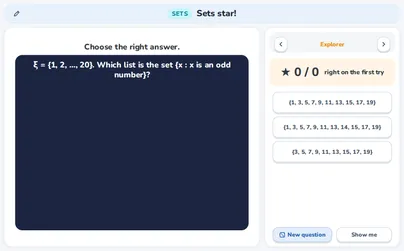
In read the colon as “such that”. After it comes the rule that every element must follow.
Example
= → points on a line
015xy
Definition

Number of elements

is the number of elements of A. Count every element once.
Aabcden(A)=5
Example
2468n=435n=2
Definition

Venn diagram

A Venn diagram draws a set as a circle in a rectangle . Each element goes in the region where it belongs.
Aξxyz
Example
, 2, 4, 6, 8 inside the circle1, 3, 5, 7 outside it
Aξ24681357
Rule

Union and intersection

holds what is in A or in B (or both). holds what is in A and in B.
ABA∪BABA∩B
Example
,
AB1234A∪BAB1234A∩B
Rule

Complement

holds everything in that is not in A. The complement depends on the universal set.
AξA′
Example
, →
Aξ246135
Rule

Four regions

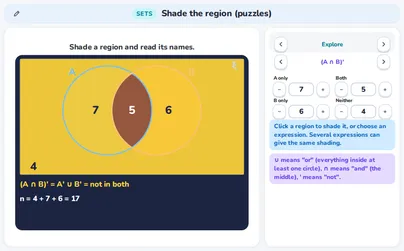
Two circles make four regions: A only, both, B only and neither. Each region has a name in symbols.
A∩B′A∩BA′∩B(A∪B)′
Example
A only → both → B only → neither →
A∩B′A∩BA′∩B(A∪B)′
Special case

Disjoint sets

Disjoint sets have no element in common. Their circles do not overlap.
ABξ
Example
, →
ABξ1324
Rule

Counting formula

If you just add n(A) and n(B), the elements in both circles are counted twice. Take the middle away once.
ABamb
Example
AB135718+12−5
Tip

Fill from totals

Start with the middle. A only is n(A) minus the middle, B only is n(B) minus the middle, and neither is minus the union.
ABξ1223
Example
, , , both 5A only , B only neither
ABξ51375n=30
Tip

Sets of numbers

A rule makes a set of numbers. With two rules in a Venn diagram, the numbers that follow both rules go in the middle.
ABξx
Example
multiples of 2 and of 3, numbers 1 to 12in the middle → 6 and 12
ABξ248106123915711
Definition

Number systems

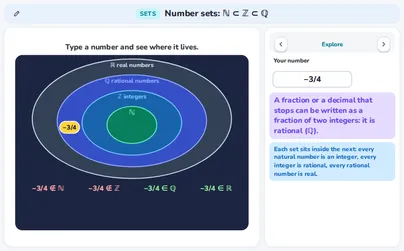
The number sets sit inside each other: natural numbers ℕ (0, 1, 2 …), integers ℤ, rational numbers ℚ (fractions) and real numbers ℝ.
ℝℚℤℕ
Example
, ,
ℝℚℤℕ−32/3√2
Tip

Sorting

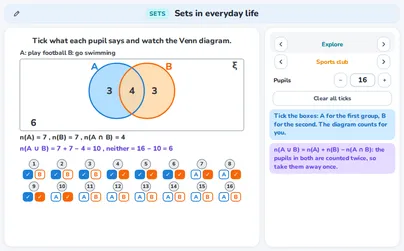
Sorting by two properties is a Venn diagram: each property is a circle, and what has both goes in the middle.
ABξ✔
Example
pupils who play football (A) or swim (B)plays and swims → in the middleneither → outside the circles
ABξ✔✘
Rule

Three sets

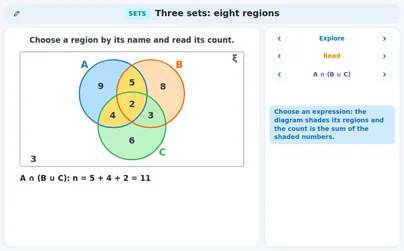
Three circles make eight regions, seven inside the circles and one outside. The middle is .
ABCξ
Example
→ all three only → in A and B, not in C → none
Tip

Middle outwards

Fill a three-set diagram from the middle outwards: first all three, then each pair without the middle, then each set alone, last neither.
ABCξ12223334
Example
only only

Exercises

Write A = {x : x is a positive even number less than 10} as a list. How many elements does A have? Easy
Show solution
Even numbers: 2, 4, 6, 8, and then 10 is not less than 10
Count them →
A246813579n=4
Answer → , 4 elements
Check each number with the rule: none missing, none extra.
A = {1, 2, 3, 4, 5} and B = {4, 5, 6, 7}. Find A ∩ B and A ∪ B. Easy
AB1234567
Show solution
In both A and B → 4 and 5 →
AB1234567
In A or B, each number once →
AB1234567
Answer → and
Do not write 4 and 5 twice in A ∪ B.
30 pupils were asked. 18 like football, 12 like swimming and 5 like both. How many like neither? Medium
Show solution
The pupils in both are counted twice → like football or swimming
ABξ135718+12−5
Neither →
ABξ13575n=30
Answer → 5 pupils
Check: .
ξ = {1, …, 10}, A = {2, 3, 5, 7} and B = {1, 3, 5, 7, 9}. List A′ ∩ B. How many elements does (A ∪ B)′ have? Medium
Show solution
, in B too →
ABξ23571946810
, so → 4 elements
ABξ23571946810
Answer → and 4 elements
A′ is taken inside ξ, not in all the numbers there are.
40 students: n(A) = 20, n(B) = 15, n(C) = 12, n(A ∩ B) = 8, n(A ∩ C) = 5, n(B ∩ C) = 4 and n(A ∩ B ∩ C) = 2. How many are in none of the sets, and how many in A only? Hard
Show solution
Add the three sets, take away the pairs, add the middle back → , ,
None →
A only →
ABCξ26329558n=40
Answer → 8 in none, 9 in A only
Without adding the middle back, the answer is 2 too big.
ξ = {1, …, 30}, A = the multiples of 4 and B = the multiples of 6. Find n(A), n(B), n(A ∩ B), n(A ∪ B) and n((A ∪ B)′). Hard
Show solution
→ and →
Both are the multiples of 12 → → 2
ABξ52320n=30
and
ABξ52320n=30
Answer → 7, 5, 2, 10 and 20
The common multiples of 4 and 6 are the multiples of 12, not of 24.
Are you a teacher?

Start live lessons with these applications for your whole class. Free to try for one month.

Try it free

Fits these school years

IB (MYP, Diploma): MYP 4, MYP 5

Cambridge International: Lower Secondary, stage 9, IGCSE, Lower Secondary, stage 7, Lower Secondary, stage 8

Netherlands: Year 2, Year 3 (havo, vwo), Year 1, Vwo · Mathematics C, Havo (all mathematics courses)

Türkiye (MEB): Year 9 (MEB), Year 5 (MEB), Year 6 (MEB), Year 10 (MEB), Year 7 (MEB)

England (GCSE, A Level): Year 9, Year 10 (GCSE), Year 7, Year 8, Year 11 (GCSE)

USA (Common Core): Algebra 1, Grade 6, Grade 7, Grade 8

What the applications of this topic teach 8 applications

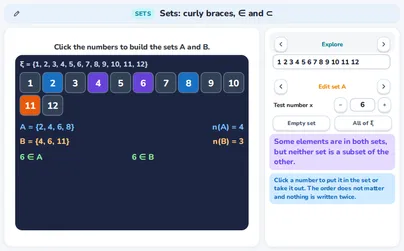
Sets: curly braces, ∈ and ⊂

  • Writing a set in curly braces: no repeats, order does not matter
  • Using ∈ and ∉ for elements of a set
  • Knowing the empty set ∅, the universal set ξ and A′
  • Telling subset, equal, disjoint, finite and infinite sets

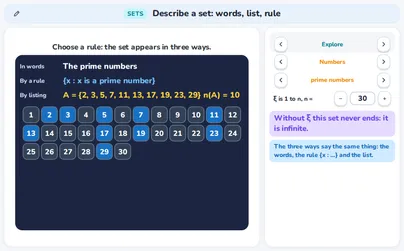
Describe a set: words, list, rule

  • Describing a set in words, by a rule {x : …} and as a list
  • Making sets of multiples, factors, primes and squares
  • Telling when a set is infinite
  • Writing the set of points {(x, y) : y = mx + c} of a line

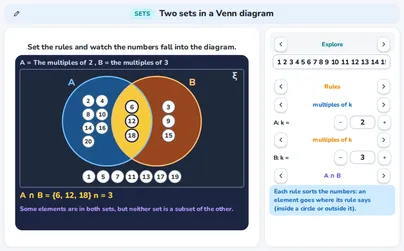
Two sets in a Venn diagram

  • Placing numbers in the four regions of a two-set Venn diagram
  • Reading and listing A ∪ B, A ∩ B, A′ and B′
  • Naming a region in more than one way: (A ∪ B)′
  • Sorting numbers by two properties in a Venn diagram

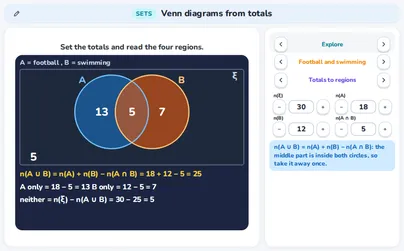
Venn diagrams from totals

  • Counting a union: n(A ∪ B) = n(A) + n(B) − n(A ∩ B)
  • Filling a Venn diagram from totals, and finding totals from the regions
  • Telling when totals are impossible and why
  • Solving a survey story with two groups

Number sets: ℕ ⊂ ℤ ⊂ ℚ

  • Knowing the number sets ℕ ⊂ ℤ ⊂ ℚ ⊂ ℝ
  • Telling which sets a number belongs to
  • Finding the smallest set that contains a number

Shade the region (puzzles)

  • Shading A ∪ B, A ∩ B, A′ and B′ in a Venn diagram
  • Seeing that (A ∪ B)′ = A′ ∩ B′ names the same region
  • Counting the elements of a shaded region from its parts

Three sets: eight regions

  • Naming the eight regions of a three-set Venn diagram
  • Filling a three-set diagram from totals, from the middle outwards
  • Reading A ∪ B ∪ C, (A ∪ B)′ and A ∩ (B ∪ C) as counts
  • Telling when totals are impossible

Sets in everyday life

  • Sorting pupils by two things in a Venn diagram
  • Counting pupils in both groups, one group only or neither
  • Using n(A ∪ B) = n(A) + n(B) − n(A ∩ B) in a survey