Interactive Lessons

Maths language: words, symbols and working

Lecture notes

Definition

Maths has its own words

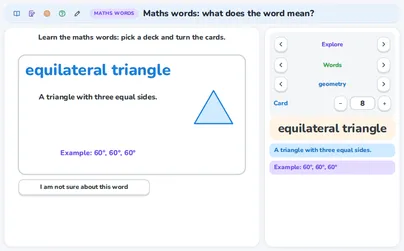
Every maths idea has a word, and knowing the word makes the idea easy to talk about. The application teaches 113 words in 8 decks: numbers, fractions and percentages, algebra, geometry, measuring, statistics, probability and reasoning. The word is on the card, with a short explanation and a picture or an example.
numbersfractions andpercentagesalgebrageometrymeasuringstatisticsprobabilityreasoning
Example
The word sum is the answer of an addition. In the sum is 12.
7addend+5addend=12sum
Rule

Four operations, four answers: sum, difference, product, quotient

Every operation has a name for its answer. The answer of an addition is the sum, of a subtraction the difference, of a multiplication the product and of a division the quotient. You say it like this: “the product of 12 and 4”.
sum12 + 4 = 16difference12 − 4 = 8product12 · 4 = 48quotient12 ÷ 4 = 3
Example
The quotient of 12 and 4 is . The product of 12 and 4 is .
Rule

The numbers of a calculation: addend, factor, divisor

The numbers of a calculation have names too. The numbers of an addition are addends, the numbers of a multiplication are factors. In a division the number you divide by is the divisor.
7addend+5addend=12sum6factor·4factor=24product20÷4divisor=5quotient
Example
In the divisor is 4 and the quotient is 5. In the factors are 6 and 4 and the product is 24.
Rule

Fraction words: fraction, numerator, denominator

A fraction is a part of a whole. The number above the fraction line is the numerator, the number below it is the denominator. Fractions with the same denominator have a common denominator.
34numeratordenominatorfraction line
Example
In 2/5 the numerator is 2 and the denominator is 5. The fractions 2/5 and 3/5 have a common denominator: both denominators are 5.
25numeratordenominatorfraction line
Rule

Angle words: acute, right, obtuse, straight angle

An angle gets its name from its size. An acute angle is smaller than 90°, a right angle is exactly 90°, an obtuse angle is between 90° and 180° and a straight angle is exactly 180°.
acute angle45°right angle90°obtuse angle120°straightangle180°
Example
An angle of 120° is bigger than 90° and smaller than 180°, so it is an obtuse angle.
obtuse angle120°
Rule

A square is also a rectangle and a rhombus

A square is also a rectangle and a rhombus, because it has all their properties. A rectangle has four right angles, a rhombus has four equal sides, a parallelogram has two pairs of parallel sides. Here a trapezium is a quadrilateral with at least one pair of parallel sides, so a parallelogram is a trapezium too.
Example
A square has four equal sides, so it is a rhombus. It has four right angles, so it is a rectangle.
Watch out!

Perimeter or area?

The words perimeter and area are often mixed up. The perimeter is the length around a shape and is measured in cm. The area is how much flat space the shape covers and is measured in cm².
perimeter2 · 8 + 2 · 5 = 26area8 · 5 = 40
Example
A rectangle of 8 cm by 5 cm: perimeter , area .
8 cm5 cm
Tip

Mark the words you are not sure about: they stay in your browser

Press I am not sure about this word on a card. The word comes back first in My list. Your marks stay in this browser only: they are not sent to anyone, not to your teacher and not to a server, and they are gone when you close the page. Start fresh clears the list at once.
Example
You mark denominator as not sure. In the list it shows first, with its explanation hidden until you press Show the explanation.
Definition

A symbol is a short way to write a phrase

Maths writes short. Every symbol has a way to say it: ∠ is “angle”, ∥ is “is parallel to”, ⊥ is “is perpendicular to”, ≈ is “is approximately equal to” and ≠ is “is not equal to”. The application teaches 24 symbols this way.
∠angle∥parallel to⊥perpendicularto≈approximatelyequal to≠notequal to
Example
AB ∥ CD is read “AB is parallel to CD”: the lines AB and CD never meet.
AB ∥ CDAB is parallelto CD
Rule

Write an angle with three letters: ∠ABC

An angle is written ∠ and three letters. The middle letter is the corner. ∠ABC and ∠CBA are the same angle, because the corner is B in both.
AC60°B
Example
In ∠ABC = 60° the corner is B. The arms are the lines BA and BC.
Rule

|AB| is a length, AB is a line segment

Two bars around the letters mean the length: |AB| is a number. Without bars, AB is the line segment itself, the drawn line. So you write |AB| = 5 cm and never AB = 5 cm.
|AB|length (anumber)ABlinesegment
Example
|AB| = 5 cm says: the length of AB is 5 cm.
|AB| = 5 cmthe length ofAB is 5 cm
Rule

∥ means never meeting, ⊥ means a right angle

AB ∥ CD says that the lines AB and CD are parallel: they keep the same distance and never meet. AB ⊥ BC says that the lines make a right angle of 90°. In a drawing the arrows show parallel sides and the small square shows a right angle.
ABCD
Example
In the rectangle ABCD: AB ∥ DC (the arrows) and AB ⊥ BC (the little square at B).
Rule

The letter x has three jobs

Look at what stands around the x. In 3 x 4 it is a times sign. In 3x = 12 it is the unknown: a number you look for. In y = 3x it is a variable: it can take many values. A number next to a letter means times: 3x means 3 · x and 3.5x means 3.5 · x.
3 x 4times sign3x = 12unknowny = 3xvariable
Example
For → and . In the unknown is , because .
Watch out!

Careful: −3² is not (−3)²

A power belongs only to the number right next to it. Without brackets, means . With brackets, means . The same holds for and .
−3²−9(−3)²9
Example
and .
2 · 3²18(2 · 3)²36
Rule

The point and the comma: two ways of writing a number

English writes : the comma groups the thousands and the point starts the decimals. Turkish and many other languages write the same number , so the two signs swap jobs. Both mean one thousand two hundred thirty-four and fifty-six hundredths.
1​.234,56Turkish1,234​.56English
Example
Both strings are the number , read as one thousand two hundred thirty-four and 56 hundredths.
Watch out!

The same writing can be two different numbers

The same signs can mean a different number. In an English text is a little more than one. In a Turkish text is one thousand two hundred thirty-four. Calculators and spreadsheets follow the language of the device, so always check which way a number is written.
1​.234Turkish:12341​.234English:1​.234
Example
In an English text is . In a Turkish text is , so the two differ by .
Rule

Say a big number in groups of three

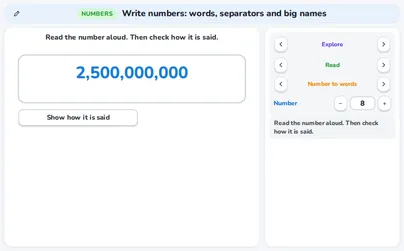
Split a big number into groups of three digits, from the right. Every group gets its name and the groups are said from the left. So is three million five thousand. A group of only zeros is not said.
3three million005five thousand000
Example
In the groups are 2, 500, 000 and 000. You say two billion five hundred million.
Rule

The big names: million, billion, trillion, quadrillion

Every step of a thousand times a thousand has a new name: a million is 10⁶, a billion is 10⁹, a trillion is 10¹² and a quadrillion is 10¹⁵. Each name is a thousand times the one before.
10⁶million10⁹billion10¹²trillion10¹⁵quadrillion
Example
A billion has 9 zeros → . A trillion is a million times a million → .
Rule

Write amounts of money correctly

An amount in euros gets a decimal point before the cents, like € 3.50. A price at the pump has three decimals and is rounded to whole cents for the bill. Add the prices line by line and write the total as an amount.
Givenbread € 3.50cheese € 1.99milk € 2.25Working3.50 + 1.99 = 5.495.49 + 2.25 = 7.74AnswerTotal: € 7.74
Example
A price of 1.899 per litre: 20 litres cost euros. A receipt of three items → .
Rule

From words to symbols: build the expression part by part

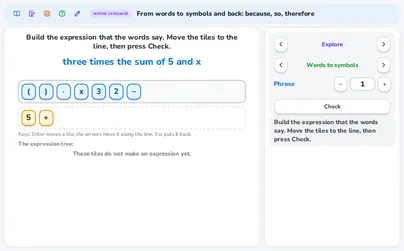
Say the phrase in parts and write every part in symbols. “three times the sum of 5 and x” is : first the sum , which needs brackets, then three times it. In the expression tree the lowest sign is worked out first.
35x+·
Example
For the sum is and three times it is .
352+·=7=21
Watch out!

“6 less than x” turns round: x − 6

Some phrases come in the other order than the symbols. “6 less than x” starts with the 6 but it is : you start with x and take 6 away. “” is something else.
x − 66 lessthan x✔6 − xthat issomething else✘
Example
For → but .
Rule

The words of the operations are building blocks

Learn the words as building blocks: sum is +, difference is −, product is ·, quotient is ÷, square is ², cube is ³ and square root is √. “double” is 2 times, “triple” is 3 times and “half” is ÷ 2.
+sum−difference·product÷quotient²square√square root
Example
“the square of 5” is and “the square root of 25” is .
Rule

From symbols to words: read each sign

To say a sentence of symbols, read every sign with its words. is “x is less than or equal to 5”, is “x is greater than 3” and is “x is not equal to 3”. Check that the words say the same as the symbols, not something near.
x ≤ 5less thanor equal tox > 3greaterthanx ≠ 3notequal to
Example
is “two times x plus 3 equals 11”. It is true for → .
Rule

Because and since give the reason, so and therefore give the result

A reasoning has a claim (what you say is true) and a reason (why). Because and since bring the reason: “the angles are equal, because they are Z angles”. So and therefore bring the result after the reason: “they are Z angles between parallel lines, so the angles are equal”.
becauseA because BsinceA since BsoB so AthereforeB therefore A
Example
“The angles are equal, because they are Z angles between parallel lines.” and “They are Z angles between parallel lines, so the angles are equal.” say the same.
Watch out!

The reason must be true for the figure

A reasoning is only good when its reason is true. “The square is a rhombus, because all the angles are acute” is wrong: a square has right angles. Unless is not a reason: it names an exception, like “the lines meet, unless they are parallel”.
Example
The reason “all sides are equally long” is true for a square, so “the square is a rhombus, because all sides are equally long” is a good reasoning.
Rule

Describe a figure with properties that are always true

A property belongs to a class only when it is true for every member. All squares and rhombuses have four equal sides; rectangles do not. All rectangles have four right angles and diagonals of equal length; rhombuses do not. A kite has diagonals that are perpendicular and two pairs of equal neighbouring sides.
square✔rectangle✘rhombus✔parallelogram✘trapezium✘kite✘four equal sides
Example
Which of the six have four equal sides? square and rhombus. Which have four right angles? square and rectangle.
square✔rectangle✔rhombus✘parallelogram✘trapezium✘kite✘four right angles
Definition

An equals sign says: both sides have the same value

The equals sign is not a command “work this out”. It is a statement about two values, and the statement can be true or false. is true because has the value 7.
3 + 4= 7=7= 7
Example
has the value 7 and 7 has the value 7. So the sign is true. But .
Watch out!

A chain of equal signs must stay equal: 3 + 4 = 7 + 2 = 9 is false

In a chain every sign compares the part before it with the part after it. In the first sign compares (the value 7) with (the value 9). That sign is false, even if the last number is the right answer.
3 + 4= 7=7 + 2= 9=9= 9
Example
The first sign compares 7 and 9: they differ, so it is false. The second sign compares 9 and 9: it is true. So 1 of the 2 signs is false.
Rule

Mend a chain: one step per line

Put every step on its own line. The result of one line is the start of the next line. Then every line is true. becomes on one line and on the next.
3 + 4= 7=7= 7=9= 9✔3 + 4 = 7✔7 + 2 = 9
Example
has 2 false signs ( and ). On three lines it is right → , then , then .
12 · 5= 60=60 ÷ 2= 30=30 + 7= 37=37= 37✔12 · 5 = 60✔60 ÷ 2 = 30✔30 + 7 = 37
Rule

Choose the sign by value: =, ≠ or ≈

Work out both sides and compare the values. = means exactly the same value, ≠ means different values and ≈ means that one side is a rounded value of the other. , because π has endless decimals. but .
=equal≠not equal≈nearlyequal
Example
and , so . 2 · 3 and 3 · 2 are both 6, so they are equal.
2 · 3= 6=3 · 2= 6
Rule

The lines of an equation keep the solution, not the value

When you solve an equation line by line, the lines do not have equal values. They have the same solution: the same number for x makes every line true. , and are all true for , and for no other number.
2x+3=112x=8x=4
Example
Try → , and , all true. Try → , not 11, and , not 8: false.
Definition

A working has four parts: Given, Asked, Working, Answer

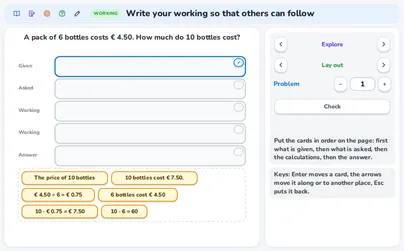
A good working can be followed from top to bottom. Many school pages use four labels: Given (what is given), Asked (what is asked), Working (the calculation lines) and Answer (the answer as a sentence). Ask your teacher which words your school uses.
Given6 bottles: € 4.50Askedprice of 10 bottlesWorking€ 4.50 ÷ 6 = € 0.7510 · € 0.75 = € 7.50Answer10 bottles cost€ 7.50.
Example
6 bottles cost € 4.50. Given: 6 bottles, € 4.50. Asked: the price of 10 bottles. Working: € 4.50 ÷ 6 = € 0.75 and 10 · € 0.75 = € 7.50.
Rule

One calculation per line, with its unit

Write one calculation on every line and keep the unit on every line: €, cm, km/h. The result of one line is a number of the next line. A line with a unit says what the number is about.
Working€ 4.50 ÷ 6 = € 0.7510 · € 0.75 = € 7.50Answer10 bottles cost€ 7.50.
Example
€ 4.50 ÷ 6 = € 0.75 is the price of one bottle. Then 10 · € 0.75 = € 7.50 is the price of ten bottles.
Working4.50 ÷ 6 = 0.75✘10 · 0.75 = 7.50✘Answer7.50✘
Rule

End with an answer sentence

The answer is a sentence with the number and the unit. “10 bottles cost € 7.50.” tells the reader what the number is. A bare 7.50 does not.
Working10 · € 0.75 = € 7.50Answer7.50✘
Example
Wrong: 7.50. Right: 10 bottles cost € 7.50. The sentence has the number 10 as well as the amount.
Working10 · € 0.75 = € 7.50Answer10 bottles cost€ 7.50.
Watch out!

A jump hides a step

If a line is missing, the reader cannot see where a number comes from. A jacket of € 80 with 25% off: the line € 80 − € 20 = € 60 uses a € 20 that has not been calculated yet. Write every step.
Working…€ 80 − € 20 = € 60AnswerNow € 60.
Example
Missing line: 25 ÷ 100 · € 80 = € 20. Then € 80 − € 20 = € 60 follows.
Working25 ÷ 100 · € 80 = € 20€ 80 − € 20 = € 60AnswerNow € 60.
Rule

Read someone else’s working: four things to look for

When you read a working, look for four defects: a unit that is missing, a false equal sign (steps glued into a chain), an answer that is only a number, and a jump that hides a step. Name the defect first, then say how to mend it.
Working€ 80 ÷ 4 = € 20€ 80 − € 20 = € 60Answer€ 60✘
Example
In € 80 ÷ 4 = € 20 and € 80 − € 20 = € 60 every line is true and has its unit. The only defect is the answer: € 60 is an amount, not a sentence.
Tip

A missing step: the line before gives a number to the line after

In a working with a gap, look at the line after the gap: it starts with a number that must come from the gap. Work out what the missing line must be so that the next line is true.
Givenpen € 1.207 penspaid € 10Working…€ 10 − € 8.40 = € 1.60
Example
A pen costs € 1.20; 7 pens are paid with € 10. The line € 10 − € 8.40 = € 1.60 needs the line 7 · € 1.20 = € 8.40 before it.
Givenpen € 1.207 penspaid € 10Working7 · € 1.20 = € 8.40€ 10 − € 8.40 = € 1.60
Tip

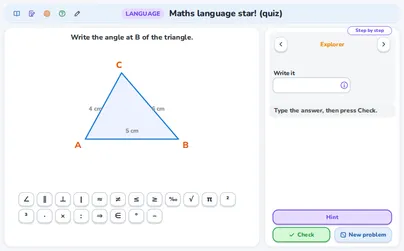
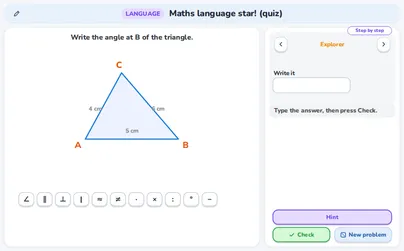
The quiz mixes the six applications

The quiz asks one question at a time from the six applications: a word for a picture, a symbol for a description, a number in words, a chain of equal signs, a connector or a missing line. There are three levels and the same help: Hint, Next step, Show answer.
Example
A question may say: “The product of 12 and 4 is …”. The answer is the number 48, because .
Tip

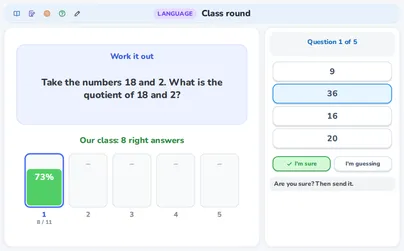
The class round: four kinds of questions, every wrong answer has a trap

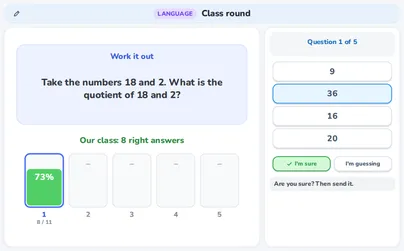
In the class round the whole class answers 5 questions at the same time: words, rules, true or myth, and calculations such as the words of the operations, a power with a minus sign, the zeros of a big name and the false signs of a chain. Every wrong option has a trap name, so the teacher sees which mistake is common.
Example
How many zeros has a trillion? Right: 12. The trap 9 is what you get if you count the zeros of a billion.
Tip

Tiles can be moved by keyboard

Tiles and cards move with the mouse, a finger or the keyboard. Press Tab to reach a tile, Enter (or a click) to move it to the line, the arrow keys to move it along the line or to the next line, Home and End to jump to the first or last place, and Esc or Backspace to put it back.
Example
To build → press Enter on the tiles 3, ·, (, 5, +, x and ) one after the other. Then press Check.
Definition

Nothing you type is sent anywhere

The application checks your answers itself, in your own browser. The words, numbers and lines you type are not saved and not sent to us, to your teacher or to anyone else. The only thing it keeps is your “not sure” list, in this browser only, until you close the page.
Example
You type “three million five thousand” for 3 005 000. The page compares your words with the number in your browser, and nothing leaves your computer.

Exercises

What is the word for the answer of ? Easy
9·6=54
Show solution
The sign · is a multiplication.
The answer of a multiplication has its own name: the product.
So 54 is the product of 9 and 6.
9factor·6factor=54product
product
Check → , and the nine and the six are the factors.
Write “AB is parallel to CD” with symbols. Easy
Show solution
“Parallel to” says that the lines never meet. Its symbol is ∥.
Put the symbol between the two names: AB ∥ CD.
AB ∥ CDAB is parallelto CD
AB ∥ CD
Check → ⊥ would say that the lines make a right angle: that is another sentence.
Write in words. Easy
Show solution
Split into groups of three from the right: 3, 005 and 000.
3 is three million, 005 is five thousand and the group 000 is not said.
3three million005five thousand000
Say the groups from the left: three million five thousand.
three million five thousand
Check → and .
Write “twice as much as x” as an expression and work it out for . Easy
Show solution
“Twice” means times 2, so the expression is .
Put 7 in place of x → .
; for the value is 14
Check → 14 is twice as much as 7 → .
How many equal signs are false in ? Easy
Show solution
Work out the parts → has the value 7, has the value 9 and the last part is 9.
The first sign compares 7 and 9: they differ, so it is false.
The second sign compares 9 and 9: it is true.
3 + 4= 7=7 + 2= 9=9= 9
1 sign
Check → on two lines it is right → and then .
6 bottles cost € 4.50. Write the line that gives the price of one bottle, with its unit. Easy
Show solution
For one bottle divide the price by the number of bottles: ÷ 6.
Write the result with its unit on the same line: € 4.50 ÷ 6 = € 0.75.
Given6 bottles: € 4.50Working€ 4.50 ÷ 6 = € 0.75
€ 4.50 ÷ 6 = € 0.75
Check → 6 · € 0.75 = € 4.50.
In the fraction 7/12, which number is the numerator and which is the denominator? What is the sum of the numerator and the denominator? Medium
Show solution
The number above the fraction line is the numerator: 7. The number below it is the denominator: 12.
712numeratordenominatorfraction line
The sum is the answer of an addition → .
numerator 7, denominator 12, sum 19
Check → .
What are the values of and of ? Medium
Show solution
Without brackets the power belongs only to the 5 → .
With brackets the power belongs to −5 → .
−5²−25(−5)²25
−25 and 25
Check → the two values are opposites: −25 and 25.
How many zeros has a trillion? And what is 2.5 billion written in digits? Medium
Show solution
A trillion is 10¹²: a 1 with 12 zeros.
10⁶million10⁹billion10¹²trillion10¹⁵quadrillion
2.5 billion is 2 billion and a half billion → .
.
12 zeros; 2 500 000 000
Check → the words are two billion five hundred million.
Write “2 less than double a” as an expression and work it out for a = 7. Medium
Show solution
“Double a” is 2 · a.
“2 less than” turns round: take 2 away from it. The expression is 2 · a − 2.
For a = 7 → .
27·2−=14=12
2 · a − 2; for a = 7 the value is 12
Check → the other order gives , which is another number.
How many equal signs are false in ? Mend it into lines. Medium
Show solution
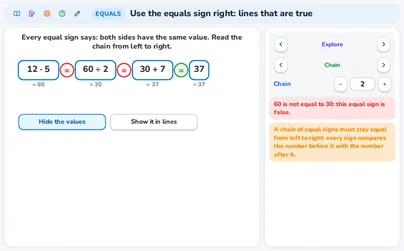
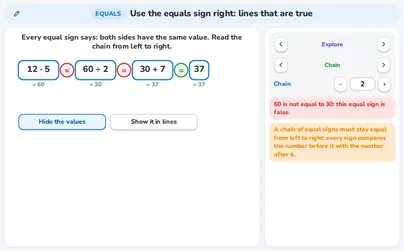
Work out the parts → , and . The chain has the values 60, 30, 37 and 37.
Sign 1 compares 60 and 30: they differ, false. Sign 2 compares 30 and 37: they differ, false. Sign 3 compares 37 and 37: true.
So 2 signs are false. Put every step on its own line → , then , then .
12 · 5= 60=60 ÷ 2= 30=30 + 7= 37=37= 37✔12 · 5 = 60✔60 ÷ 2 = 30✔30 + 7 = 37
2 false signs
Check → on three lines every line is true and the answer is 37.
A pen costs € 1.20. Mia buys 7 pens and pays with € 10. Write the two calculation lines and the answer sentence. Medium
Show solution
First the cost of the pens: 7 · € 1.20 = € 8.40.
Then the change: € 10 − € 8.40 = € 1.60.
The answer is a sentence with the unit: “Mia gets € 1.60 change.”
Givenpen € 1.207 penspaid € 10Working7 · € 1.20 = € 8.40€ 10 − € 8.40 = € 1.60
7 · € 1.20 = € 8.40; € 10 − € 8.40 = € 1.60; Mia gets € 1.60 change.
Check → € 8.40 + € 1.60 = € 10.
Find the difference of the sum of 15 and 9 and the quotient of 48 and 6. Hard
Show solution
The sum of 15 and 9 is the answer of an addition → .
15+9=24sum
The quotient of 48 and 6 is the answer of a division → .
48÷6=8quotient
The difference of 24 and 8 is the answer of a subtraction → .
24−8=16difference
16
Check → .
For find the values of and of . What is their difference? Hard
Show solution
The power belongs to the x only → .
With brackets the power belongs to 3x → .
3x²48(3x)²144
The difference is the answer of a subtraction → .
48 and 144; the difference is 96
Check → and → the second is 3 times the first.
A text says . Write the same number the English way. Then add (written the same way) and write the sum the same way. Hard
Show solution
Swap the jobs of the signs: the point becomes a comma and the comma becomes a point. English → .
1​.234,56Turkish1,234​.56English
Read both as numbers: 1 234.56 and 765.44.
Add → .
Write the sum like the first number → (or just ).
and
Check → .
Say with “because” and with “so” that 12 is a multiple of 4, with the reason . Hard
Show solution
The claim is “12 is a multiple of 4”. The reason is “”: it is true, because .
With because the reason comes after the claim: “12 is a multiple of 4, because .”
becauseA because BsinceA since BsoB so AthereforeB therefore A
With so the reason comes first: “, so 12 is a multiple of 4.”
“12 is a multiple of 4, because .” and “, so 12 is a multiple of 4.”
Check → the reason must be true → .
Which sign fits between and , between and , and between and ? Write =, ≠ or ≈. Hard
Show solution
Work out both sides of every pair: 0.333 and 1/3, which is 0.3333 and so on; ; .
0.333 is a rounded value of 1/3: ≈. 25 · 4 and 100 are the same value: =.
=equal≠not equal≈nearlyequal
3.5 is not near 3: ≠.
≈, = and ≠
Check → , and .
A jacket costs € 80 with 25% off. Write the calculation lines and the answer sentence. How many lines does the whole working have, with Given, Asked and Answer? Hard
Show solution
First the discount: 25 ÷ 100 · € 80 = € 20.
Then the new price: € 80 − € 20 = € 60. The answer sentence: “The new price is € 60.”
Count the lines: Given 1, Asked 1, two calculation lines and Answer 1 → .
Givenjacket € 80, 25% offAskedthe new priceWorking25 ÷ 100 · € 80 = € 20€ 80 − € 20 = € 60AnswerNow € 60.
25 ÷ 100 · € 80 = € 20; € 80 − € 20 = € 60; the new price is € 60; 5 lines
Check → € 20 + € 60 = € 80.
Are you a teacher?

Start live lessons with these applications for your whole class. Free to try for one month.

Try it free

Fits these school years

IB (MYP, Diploma): MYP 1, MYP 2, MYP 3

Cambridge International: Lower Secondary, stage 7, Lower Secondary, stage 8, Lower Secondary, stage 9, Primary, stage 6

Netherlands: Year 1, Year 2, Year 3 (havo, vwo), Vmbo bb (years 3-4), Vmbo kb (years 3-4), Vmbo gt (years 3-4), Groep 7, Groep 8

Türkiye (MEB): Year 5 (MEB), Year 6 (MEB), Year 7 (MEB), Year 8 (MEB)

England (GCSE, A Level): Year 7, Year 8, Year 9, Year 6

USA (Common Core): Grade 6, Grade 7, Grade 8, Grade 5

What the applications of this topic teach 12 applications

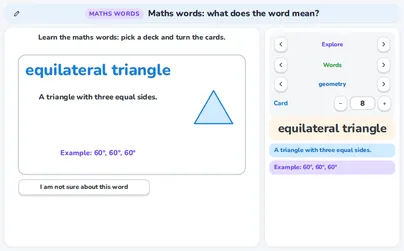
Maths words: what does the word mean?

  • Knowing the words for operations: sum, difference, product, quotient
  • Naming the parts of a calculation and of a fraction
  • Matching maths words with a picture or an example
  • Sorting words into quadrilaterals, triangles and circles

Maths words, primary school edition: what does the word mean?

  • Knowing the words for operations: sum, difference, product, quotient
  • Naming the parts of a calculation and of a fraction
  • Matching maths words with a picture or an example
  • Sorting words into quadrilaterals, triangles and circles

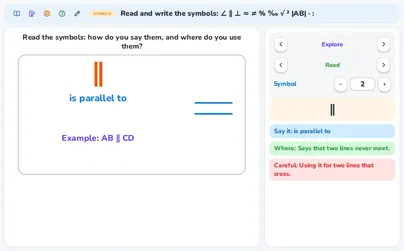
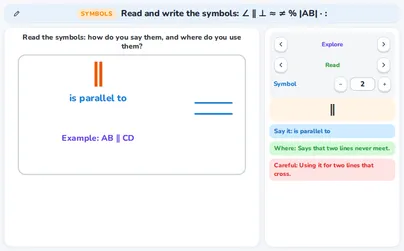
Read and write the symbols: ∠ ∥ ⊥ ≈ ≠ % ‰ √ ² |AB| · :

  • Saying what the symbols ∠ ∥ ⊥ ≈ ≠ % ‰ √ π mean
  • Writing ∠ABC, |AB|, AB ∥ CD and AB ⊥ BC
  • Telling −3² from (−3)²
  • Knowing that 3x means 3 · x

Read and write the symbols, primary school edition: ∠ ∥ ⊥ ≈ ≠ % |AB| · :

  • Saying what the symbols ∠ ∥ ⊥ ≈ ≠ < > % · ÷ mean
  • Writing ∠ABC, |AB|, AB ∥ CD and AB ⊥ BC
  • Telling 2 + 3 · 4 from (2 + 3) · 4: 14 and 20

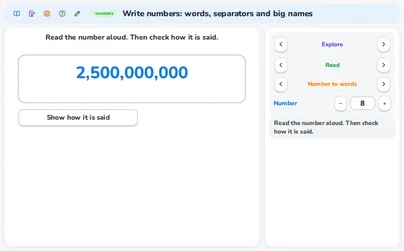
Write numbers: words, separators and big names

  • Reading and writing big numbers in words, from million to quadrillion
  • Telling the decimal sign from the thousands sign, which differ by language
  • Knowing that a billion is 10⁹ and a trillion is 10¹²
  • Writing and adding amounts of money, rounding a price per litre

Write numbers, primary school edition: words, separators and big names

  • Reading and writing big numbers in words, from million to quadrillion
  • Telling the decimal sign from the thousands sign, which differ by language
  • Knowing that a billion is a thousand million: 1 000 000 000
  • Writing and adding amounts of money, rounding a price per litre

From words to symbols and back: because, so, therefore

  • Turning words into expressions: three times the sum of 5 and x
  • Saying symbol sentences in words: x ≤ 5 and 2x + 3 = 11
  • Joining a claim and a reason with because, since, so, therefore
  • Describing a quadrilateral by properties that are always true

Use the equals sign right: lines that are true

  • Seeing that an equals sign is a statement, true or false
  • Mending a false chain such as 3 + 4 = 7 + 2 = 9
  • Choosing =, ≠ or ≈ for a pair of values

Use the equals sign right, primary school edition: lines that are true

  • Seeing that an equals sign is a statement, true or false
  • Mending a false chain such as 3 + 4 = 7 + 2 = 9
  • Choosing =, ≠ or ≈ for a pair of values

Write your working so that others can follow

  • Laying out a working: Given, Asked, Working, Answer
  • Writing one calculation per line with units and an answer sentence
  • Finding mistakes in someone else's working

Maths language star! (quiz), primary school edition

  • Answer questions on the 5 applications of this edition: maths words, symbols, numbers in words, chains of equal signs and the lines of a working.

Class round, primary school edition: the whole class at once

  • I know what the words numerator, parallel, mean and prime number mean.
  • I know that so and therefore join a reason to its result, that a chain of equal signs must stay equal and that a good answer is a sentence with the number and the unit.
  • Tell what is true and what is a myth: the sum of 12 and 4, the chain 3 + 4 = 7 + 2 = 9, a billion and the word “because”.