Interactive Lessons

Mathematics in the world: jobs, subjects and the road ahead

Lecture notes

Definition

Mathematics is in every job

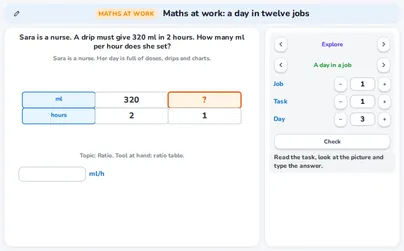
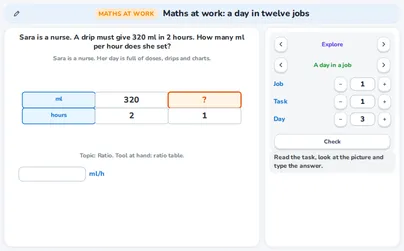
The application follows 12 invented people, each with a short day of 3 tasks: 36 tasks in all. The people and the numbers are made up (nobody is a real person) and the application picks new numbers for each of the 9 days. Open A day in a job and type the answer of a task.
Saranurse1A drip gives 50 ml in 2 hours.How many ml per hour?Ratio2A bottle holds 300 ml. 20% goesto one patient. How many ml?Percent3The chart: 36 °C at 8:00, 38 °Cat 12:00. How many at 10:00?GraphRatio✔AreaPercent✔AngleGraph✔Formula
Example
Sara is a nurse. A drip must give 50 ml in 2 hours, so she sets 50 ÷ 2 = 25 ml per hour.
Definition

Six topics and the tool at hand

The tasks of all the jobs use six topics: Ratio, Area, Percent, Angle, Graph and Formula. Every topic has its own tool at hand, drawn next to the task: a ratio table, a rectangle drawing, a percent bar, an angle drawing, a line graph or a formula card. After a right answer the application names the topic and the tool.
Example
Mei is a pilot. A plane flies 1 200 km at 300 km/h. The topic is Formula and the tool at hand is a formula card: time = distance ÷ speed = hours.
Rule

Ratio: find one, then multiply

In a ratio table you write the pair you know, find the value for 1 and multiply by the new number. Cooks scale recipes, nurses set drips and farmers share milk in the same way. The answer is a number that you type next to its unit.
Example
Aisha is a cook. A recipe for 4 people needs 400 g of flour. For 1 person → . For 8 people → .
418400100800÷4÷4×8×8
Rule

Area: length times width

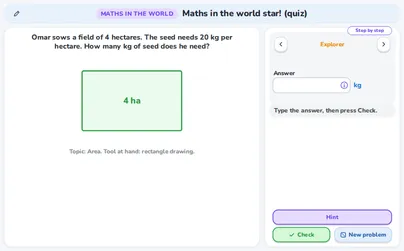
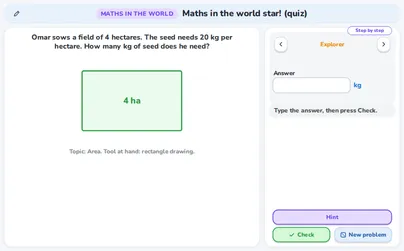
The tool at hand for Area is a rectangle drawing. The area of a rectangle is its length times its width, in square units such as m², cm² or hectares. When something is needed for every square metre, multiply the area by that amount.
Example
Jack builds a wall that is 8 m long and 3 m high → . He needs 50 bricks for every m² → bricks.
8 m3 m24 m²
Rule

Percent: a part of a whole

The tool at hand for Percent is a percent bar: the whole is 100%. To find a part, take the percent of the whole; to find what is left, take the part away from the whole. A shopkeeper takes a part off a price in a sale, and a pharmacy assistant counts the boxes that are sold.
Example
Fatima has a coat of € 80. In the sale it is 25% cheaper: 25% of 80 is euros. The sale price is euros.
25%8025%80
Rule

Angle: a right angle and 180°

The tool at hand for Angle is an angle drawing. A corner is a right angle when two sides and the diagonal measure 3, 4 and 5 (or a multiple of them, such as 6, 8 and 10). The three angles of a triangle always add up to 180°.
Example
Tom checks a corner: 30 cm along one wall and 40 cm along the other. That is 3-4-5 times 10, so the diagonal must be 50 cm → . Kofi has a roof triangle with angles of 50° and 60°: the top angle is .
30 cm40 cm
Rule

Graph: read a straight line

The tool at hand for Graph is a line graph. When the line is straight it changes by the same amount in every step, so a value halfway between two points lies halfway between their heights. Nurses read temperature charts, electricians read meters and game designers watch a score grow.
Example
A chart shows 36 °C at 8:00 and 38 °C at 12:00. At 10:00, halfway, it is . A score of 20 points at the start and 80 points after 6 seconds rises points every second, so after 4 seconds it is .
353638398:0010:0012:0037
Rule

Formula: put the numbers in

The tool at hand for Formula is a formula card. A formula says how quantities belong together, for example time = distance ÷ speed. Write the formula, put in the numbers with their units, then calculate. Check that the unit of the answer makes sense.
Example
Mei flies 1 200 km at 300 km/h: time = hours. Dev measures 230 V and 3 A: power = voltage · current = W.
Definition

A closer look at one job

Open A closer look for one job. Mark the topics that the job uses and press Check: the three tasks of the day appear, and What you need to know with a line about the road in plain words, such as a practical route and then a course. These are examples, not rules: ask your mentor about the real choices.
Tomcarpenter1A floor is 7 m by 4 m. How manym² of boards?Area2Two walls: 30 cm and 40 cm. Howlong is the diagonal?Angle3A beam costs € 4 per metre. 3beams of 5 m: the cost?FormulaRatioArea✔PercentAngle✔GraphFormula✔
Example
Tom, the carpenter, uses Area (a floor), Angle (a corner) and Formula (the cost of beams). His road in the application: “a practical route, then a course for carpenters”.
Tip

Two jobs, one tool

In Two jobs, one tool two jobs use the same tool at hand. You solve one task of each and see that the thinking is the same. There are 6 such pairs, for example a nurse and a cook, who both use a ratio table.
Example
Sara sets a drip: 50 ml in 2 hours is 25 ml in 1 hour. Aisha scales a recipe: 400 g for 4 people is 100 g for 1 person. In both the first step finds the value for 1.
2155025125÷2÷2×5×5418400100800÷4÷4×8×8
Watch out!

Not only engineers

A common idea is that only engineers use mathematics. That is not true: nurses, cooks, farmers, builders and shopkeepers calculate every day. Another idea is that a pilot needs only addition. A pilot divides a distance by a speed, works with angles and works out fuel with ratios. A result must also make sense in the job.
Example
Mei plans 600 km at 300 km/h → hours. The answer 3 hours cannot be right → is more than the flight.
Definition

The same maths in other subjects

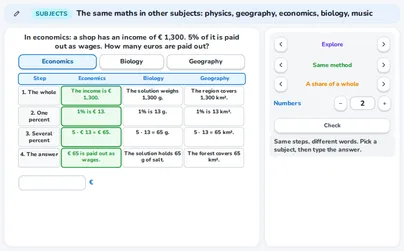
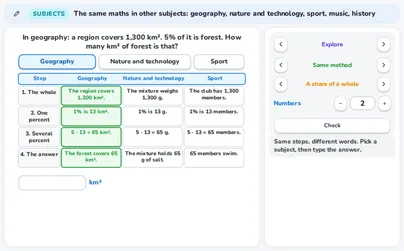
School subjects use the same mathematics in their own words. Economics, biology and geography share percent problems, ratio tables and means. Physics adds formulas such as speed and density, and music and sport use fractions of a bar and rates such as beats per minute. In Same method one problem is shown in three subjects: the numbers are the same and the words differ.
Example
A share of a whole. Economics: an income of € 600, 25% paid as wages: 25 · 6 = € 150. Biology: 600 g of solution, 25% salt → . Geography: a region of 600 km², 25% forest → . The steps are the same → , then .
Rule

The same steps: a ratio table

A ratio table has four steps in every subject: the pair you know, the value for 1, times the new number, the answer. Choose a subject with the chips Economics, Biology and Geography and compare the table of four Step rows: only the words change.
Example
Economics: 4 notebooks cost € 8, so 10 notebooks cost 10 · 2 = € 20. Biology: a leaf loses 8 g in 4 hours, so 20 g in 10 hours. Geography: 4 cm on a map stand for 8 km, so 10 cm stand for 20 km. All three start with .
Rule

The same steps: the mean

The mean is found in three steps in every subject: write the numbers, add them and divide by how many there are. In The mean the numbers are temperatures in geography, heights of plants in biology and items sold in economics.
Example
Four days of 18, 20, 19 and 19 °C: the sum is and . Four plants of 18, 20, 19 and 19 cm have the mean height 19 cm: the numbers are the same, the unit differs.
Rule

Speed: distance divided by time

In Formulas of other subjects the formula Speed is speed = distance ÷ time. Physics writes v for the speed, s for the distance and t for the time, and a maths book often writes d for the distance. The unit shows the formula: km/h means kilometres in one hour.
Example
A cyclist rides 36 km in 3 hours: v = s ÷ t = . Turn it round: distance = speed · time = .
Rule

Density and its unit

Density = mass ÷ volume. Physics writes ρ (the Greek letter rho) for the density, m for the mass and V for the volume. The unit g/cm³ means grams in every cubic centimetre. Write the unit in your answer: 8 g/cm³ says much more than 8.
Example
A block has a mass of 120 g and a volume of 15 cm³: ρ = m ÷ V = /cm³. Check → .
Rule

Map scale, a week and a class

On a map 1 cm stands for a fixed real distance, the scale: the real distance is the map distance times the scale. The mean temperature of a week is the sum of the seven temperatures divided by 7. The share of a class is the part divided by the whole, times 100.
Example
On a map 1 cm stands for 5 km. Two towns are 7 cm apart → . A week of 12, 14, 15, 13, 16, 15 and 13 °C adds up to 98 °C, and . In a class of 25 pupils, 8 come by bike → .
Definition

Graphs from the lab and the atlas

Read a line graph in the words of the subject: find the number on the bottom line, go up to the line and read the number at the side. Graphs from the lab and the atlas has cooling water from the lab and the climate of a year from the atlas; Music and sport adds the heart rate of a run. A question asks for a value, the highest value, a difference or the first time a value is reached.
Example
Water cools down: 90, 77, 68, 61, 56 and 53 °C after 0, 2, 4, 6, 8 and 10 minutes. After 4 minutes: 68 °C. Highest: 90 °C. It cools by . It is first 61 °C or colder after 6 minutes.
50608090024681068
Definition

Music and sport

In music a bar can be counted in eighths: a whole note is 8 eighths, a half note 4, a quarter note 2 and an eighth note 1. Music and sport shows a bar and asks how many notes fill the rest of it. A run is the other picture: the heart rate rises in a line graph and is counted in beats per minute.
Example
A bar holds 8 eighths. A half note and a quarter note take eighths, so eighths are left: that is quarter note.
Definition

Word list: a subject word and a maths word

A subject word often hides a maths word. In Word list you see a subject word and choose the maths word that goes with it. There are 12 subject words and 7 maths words: percent, mean, ratio, rate, fraction of a whole, line graph and scale factor.
subject wordmaths wordconcentration(biology)percentmap scale(geography)ratiotempo (music)ratea quarter note(music)fraction of awhole
Example
A concentration of 5% salt is a percent. A map scale is a ratio. A tempo of 120 beats per minute is a rate. A quarter note is a fraction of a whole.
Watch out!

The same quantity, other letters

Subjects use different letters for the same quantity: distance is s in physics and often d in a maths book, and one letter can mean different things in different subjects. Always read what the letter stands for. Always write the unit: 12 km/h tells you more than 12.
Example
A cyclist rides 36 km in 3 hours → . The answer 12 without a unit does not say whether it is a speed, a time or a distance. With the unit, 12 km/h means 12 km in 1 hour.
Definition

Five routes after year 1

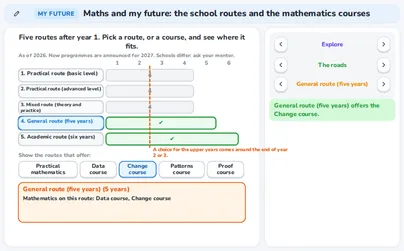
After year 1 pupils follow one of five routes to the upper years: two practical routes, a mixed route, a general route and an academic route. They take 4, 4, 4, 5 and 6 years. A choice for the upper years comes around the end of year 2 or 3. As of 2026; new programmes are announced for 2027 and schools differ, so ask your mentor. Open The roads.
123456Practical route(basic level)1Practical route(advanced level)1Mixed route(theory andpractice)1General route(five years)23Academic route(six years)2345a choice around year 2 or 31Practical mathematics2Data course3Change course4Patterns course5Proof course
Example
Route 5 takes 6 years and route 1 takes 4 years → years longer.
Definition

Five types of mathematics

In the upper years mathematics comes in five types: Practical mathematics, the Data course, the Change course, the Patterns course and the Proof course. The data course is about data, chance and applications, the change course about change, graphs and formulas, the patterns course about patterns and models, and the proof course adds depth and proof on top of the change course.
Example
Five types, five kinds of problem: a wage plan (practical), a poll (data), a straight line (change), a number pattern (patterns) and a proof that something is true for every number (proof).
Rule

Which route offers which course

Each of the three practical routes (1, 2 and 3) offers one course, practical mathematics. The general route (4) offers the data course and the change course. The academic route (5) offers four: data, change, patterns and proof. With the chips under Show the routes that offer: you pick a course, and the routes that offer it turn green with a tick.
123456Practical route(basic level)1Practical route(advanced level)1Mixed route(theory andpractice)1General route(five years)23Academic route(six years)2345a choice around year 2 or 31Practical mathematics2Data course3Change course4Patterns course5Proof course
Example
Which routes offer the proof course? Only route 5. Route 5 offers more courses than route 4 and more than route 1.
Rule

A taste of a course

In A taste choose a course and try a small taste problem of that type: a wage plan, a poll, a straight line, a number pattern or a proof idea. Nothing is graded and nothing is stored. A taste is only a taste: it does not tell you which course to take.
Example
A poll: 24 of 40 pupils like football, . A proof idea: 6, 7 and 8 are three numbers in a row → and , the middle number. It works for any three numbers in a row, because n − 1, n and add up to 3n.
Tip

Jobs and the road

Jobs and the road shows a job and the five routes. Mark the routes that often lead to the job and press Check: then every route says often, also possible or not usual. A route that is not usual is not forbidden: the labels are examples, not rules.
Example
Take job 1, the nurse. Routes 3 and 4 (the mixed route and the general route) often lead to it, routes 2 and 5 are also possible and route 1 is not usual. A job usually has more than one road.
Tip

What I like

In What I like mark the statements that fit you. The page counts how many marks point to each type of mathematics and suggests the type with the most. It is a suggestion, not a verdict. There are 10 statements, two for each type. Your marks stay in this browser tab only (in its session memory) and Start fresh clears them.
Example
Mark “I like working with data and polls.” and “I like to know the chance that something happens.”: both point to the data course, so the tally is 2 for data and 0 for the others, and the suggestion is the data course. Marks on different types give a tie, and then the page suggests every type in the tie.
Watch out!

A suggestion is not a verdict

Choosing a route is not a test, and a first choice does not close every door. Some ideas are wrong: that the data course is only for pupils who dislike numbers (it is full of percents and means), that every route has the same mathematics (the routes offer one, two or four courses) and that the choice can be made later without effort. Ask your mentor and look at what your school offers.
Example
The data course has real numbers: 24 of 40 pupils like football, . A poll is not an escape from numbers.
Definition

A Fermi estimate

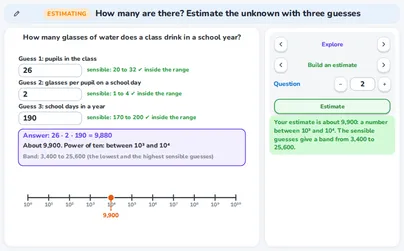
Some questions cannot be looked up, such as how many bicycles are parked at a big station. A Fermi estimate builds the answer from three sensible guesses that you multiply. In Build an estimate type three guesses and press Estimate. The numbers of the questions are rounded example values: the word “about” is on the answer.
Example
How many bicycles are parked at a big station? Guess 5 bicycle parks, 30 rows in a park and 40 bicycles in a row → bicycles.
Rule

The power of 10 and “about”

The answer is judged by its power of 10: a number with p + 1 digits lies between and . The application writes “About” and the power of 10. Nobody needs the exact number: the first question is how big it is, thousands or millions.
110¹10²10³10⁴10⁵10⁶10⁷10⁸10⁹10¹⁰a class25a school1 000a big city1 000 000the world8 000 000 0006 000
Example
6 000 has 4 digits, so p = 3: the answer lies between and . About 6 000 bicycles. On the line of powers of 10 the mark of 6 000 sits between 1 000 and 10 000.
Rule

The band of the answer

Every guess has a lowest and a highest sensible value. Multiply the three lowest values and the three highest values: the answer lies in this band. A narrow band means a more certain answer, a wide band a less certain one. The application shows the band after the answer.
band: 900 to 28 80010²10³10⁴10⁵6 000
Example
For the bicycles: lowest and highest . The band is 900 to 28 800, times wide. The answer 6 000 is inside it.
Rule

Sensible ranges and wild guesses

After you press Estimate the application shows for every guess its sensible range, for example “sensible: 20 to 60”, with a tick when your guess is inside it and an exclamation mark when it is outside the range. A wild guess is flagged, but the answer is still worked out, so you can see what it does. An empty box or a number that is not bigger than 0 is not accepted.
Example
If you type 400 bicycles in a row, the range is 20 to 60: 400 is outside it and is flagged. With the answer is times too big.
Rule

Judge a number: possible, doubtful, impossible

In Judge a number the number of a headline is placed on a line of powers of 10. Compare it with the sensible range and choose possible, doubtful or impossible. Inside the range is possible. Up to 10 times outside the range is doubtful: possible, but very unlikely. More than 10 times outside is impossible.
sensible: 1 to 3110¹10²6? doubtful
Example
8 000 steps on a school day is inside 3 000 to 15 000: possible. 6 litres of water in a day: the range is 1 to 3 litres, and times too big: doubtful. A bicycle of 1 000 kg: the range is 8 to 25 kg, and times too big: impossible.
Rule

Improve a guess: split it

One wide guess is hard to make. Split it into two smaller guesses that build the same quantity: the band gets narrower. In Improve a guess choose the split that builds the quantity. A split that builds another quantity, such as sections and entrances, does not help.
Example
How many people fit in a football stadium? The wide guess is 5 000 to 80 000 → times wide. Split it: 20 to 40 seating sections and 500 to 1 000 people per section give to , which is times wide → times narrower.
Tip

Compare with sizes you know

Place a number on the line by its number of digits and compare it with sizes you know: a class (25), a school (1 000), a big city (1 000 000) and the world (8 000 000 000 people). The line lets you see at once whether a number is too big or too small by a factor of ten, a hundred or a thousand.
Example
A class of 25 has 2 digits: between and . A school of 1 000 is , a big city of 1 000 000 is , and the world has 10 digits: between and .
Watch out!

An estimate is not exact

Four ideas to drop: that the first guess must be exact (no guess has to be, it has to be sensible), that more guesses always give a better estimate (more wild guesses make the band wider), that a Fermi estimate is always exactly right (it is right to about a factor of ten when the guesses are sensible) and that a headline number is always right (ask: is this number possible?). The numbers of the application are rounded example values: look up real numbers in a real source.
Example
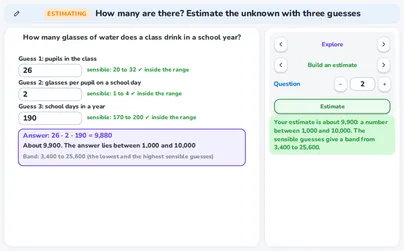
A class estimates the glasses of water it drinks in a school year: 26 pupils, 2 glasses a day and 190 days give , about 10 000 (p = 3). The band runs from to and holds the answer.
Tip

The quiz

The quiz Maths in the world star! is practice only. Choose Starter, Explorer or Champion and answer questions that come from all 4 applications: a task of a job, a formula of a subject, a road question or a Fermi question. Some answers are typed numbers, others are a true statement to choose. Stuck? Press Hint; Next step shows the solution one step at a time and Show answer gives the answer. Step by step switches the help.
Example
A question may be: a plane flies 1 200 km at 300 km/h, how many hours? . The next one may be: your three guesses are 5, 30 and 40, what is p? has 4 digits, so p = 3.
Tip

The class round

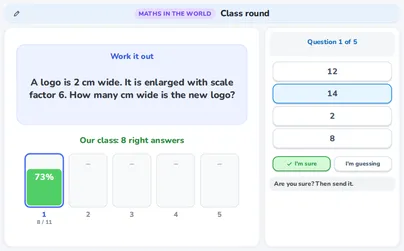
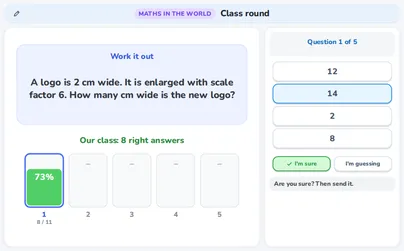
In the class round the whole class answers 5 questions at once, each pupil on their own screen. The bank holds 4 definitions, 4 rules and 6 true-or-myth statements, and there are 3 kinds of generated questions: a job task, a formula of a subject and a Fermi product. Every wrong option stands for a known mistake, so you see which mistake was chosen most.
Example
The statement “Only engineers use mathematics at work” is a myth. The question “Speed is …” has one right option, distance divided by time, and wrong options such as time divided by distance, which divides the wrong way round.
Tip

Keys and privacy

Everything can be done with the keyboard: Tab moves to a chip, a card or a button, and Enter (or a click) chooses it. The arrow keys move a slider such as Job. In an answer box you type the number and press Enter to check. Esc closes the number pad or this window. Nothing you type is sent anywhere: every answer is checked in your browser. The only thing kept is the marks of What I like, in the session memory of this browser tab. The people, the jobs and the numbers are invented.
Example
Tab to Check, press Enter, and the answer is checked on your own screen: nothing leaves the page. Press Start fresh in What I like and the marks are gone from the session memory.

Exercises

A nurse must give 300 ml in 4 hours. How many ml per hour does she set? Easy
Show solution
Make a ratio table: 300 ml for 4 hours, ? ml for 1 hour.
4130075÷4÷4
Divide by 4 → .
She sets 75 ml per hour.
Answer → 75 ml per hour
Check → 75 · 4 = 300 ml.
A floor is 7 m long and 4 m wide. How many m² of boards does a carpenter need? Easy
Show solution
The topic is area, the tool at hand is a rectangle drawing.
Length times width → .
The carpenter needs 28 m² of boards.
Answer → 28 m²
Check → , the length of the floor.
A coat costs € 60. In the sale it is 20% cheaper. What is the sale price in euros? Easy
Show solution
The topic is percent. Take 20% of 60 → .
Take it off the price → .
The sale price is € 48.
Answer → € 48
Check → 20% is a fifth → .
A cyclist rides 60 km in 4 hours. What is the speed in km/h? Easy
Show solution
Use the formula speed = distance ÷ time (v = s ÷ t).
Put in the numbers → .
The speed is 15 km/h.
Answer → 15 km/h
Check → .
Three guesses are 4, 25 and 30. The answer of the estimate is their product. What is the answer and what is its power of 10 p? Easy
Show solution
Multiply the guesses → and .
3 000 has 4 digits, so p = 3.
The answer lies between and → about 3 000.
Answer → 3 000, p = 3
Check → p + digits: 3 000 has 4 digits.
A recipe for 3 people needs 270 g of flour. Aisha cooks for 10 people. How many g of flour does she need? Medium
Show solution
Ratio table: 3 people need 270 g.
For 1 person → .
For 10 people → .
311027090900÷3÷3×10×10
Answer → 900 g
Check → 10 people is more than 3 people, so the answer must be more than 270 g: 900 g fits.
A block has a mass of 96 g and a volume of 12 cm³. What is its density in g/cm³, and which formula do you use? Medium
Show solution
The formula is density = mass ÷ volume (ρ = m ÷ V).
Put in the numbers → .
The density is 8 g/cm³.
Answer → 8 g/cm³
Check → .
A bar of music holds 8 eighths. It has a half note and two eighth notes. How many quarter notes fill the rest of the bar? Medium
Show solution
A half note is 4 eighths and an eighth note is 1 → eighths are used.
eighths are left.
A quarter note is 2 eighths → quarter note.
Answer → 1 quarter note
Check → eighths: the bar is full.
Route 4 offers the data course and the change course. Route 5 offers four courses. How many more courses does route 5 offer than route 4, and how many years longer does it take? Medium
Show solution
Route 5 offers 4 courses and route 4 offers 2 → more.
Route 4 takes 5 years and route 5 takes 6 years → year longer.
So route 5 has 2 more courses and takes 1 year longer.
Answer → 2 more courses, 1 year longer
Check → only route 5 offers the proof course and the patterns course, which is why it has the most.
A headline says: “A class of 25 pupils eats 400 sandwiches in a day.” The sensible range is 10 to 60. Is the number possible, doubtful or impossible? Medium
sensible: 10 to 6010¹10²10³400? doubtful
Show solution
400 is above the range 10 to 60, so it is not possible.
The limit for doubtful is 10 times the top → , and 400 is below 600.
Outside the range but within 10 times: doubtful.
Answer → doubtful
Check → sandwiches for every pupil: very unlikely, but not out of the question.
Ines has 400 boxes on a shelf and sells 35% of them in a week. How many boxes are left? Name the topic and the tool at hand. Hard
Show solution
The topic is percent and the tool at hand is a percent bar. 35% of 400 is .
Boxes left → .
Another way → is left, and .
Answer → 260 boxes (percent, percent bar)
Check → .
A class estimates the glasses of water it drinks in a school year: 26 pupils, 2 glasses a day, 190 days. The sensible ranges are 20 to 32 pupils, 1 to 4 glasses and 170 to 200 days. Give the estimate, its power of 10 p and the band. Is the estimate inside the band? Hard
Show solution
The estimate is , about 10 000. It has 4 digits, so p = 3.
Lowest values → . Highest values → .
The band is 3 400 to 25 600, and 9 880 lies between them: the estimate is inside.
Answer → about 10 000, p = 3, band 3 400 to 25 600
Check → every typical guess is inside its own range, so the product is inside the band.
How many pupils go to school in a town? The wide guess is 2 000 to 60 000. Split it into 15 to 30 schools and 500 to 1 000 pupils in one school. How many times narrower is the band? Hard
Show solution
The wide guess → times wide.
The split → to , and times wide.
The band is times narrower.
Answer → 7.5 times narrower
Check → .
A nurse’s drip gives 90 ml in 3 hours. How many ml does it give in 5 hours? An electrician’s cable costs € 12 for 4 m. What do 9 m cost? Which tool at hand do both jobs share? Hard
Show solution
The drip: 90 ÷ 3 = 30 ml in 1 hour, and 30 · 5 = 150 ml.
The cable → euros for 1 m, and euros.
Both find the value for 1 first and then multiply: the tool at hand is the ratio table.
Answer → 150 ml; € 27; the ratio table
Check → and → the value for 1 comes back.
A pupil wants the proof course. Which route offers it, how many years does that route take, and how many more years is that than the shortest route? Hard
Show solution
Only route 5 offers the proof course.
Route 5 takes 6 years.
The shortest routes take 4 years → more years.
Answer → route 5, 6 years, 2 more years
Check → the routes take 4, 4, 4, 5 and 6 years, so 6 is the longest. As of 2026; schools differ: ask your mentor.
Are you a teacher?

Start live lessons with these applications for your whole class. Free to try for one month.

Try it free

Fits these school years

IB (MYP, Diploma): MYP 1, MYP 2, MYP 3

Cambridge International: Lower Secondary, stage 7, Lower Secondary, stage 8, Lower Secondary, stage 9

Netherlands: Year 1, Year 2, Year 3 (havo, vwo), Groep 8

Türkiye (MEB): Year 5 (MEB), Year 6 (MEB), Year 7 (MEB), Year 8 (MEB)

England (GCSE, A Level): Year 7, Year 8, Year 9

USA (Common Core): Grade 6, Grade 7, Grade 8

What the applications of this topic teach 9 applications

Maths at work: a day in twelve jobs

  • Seeing how jobs use ratios, area, percent, angles and graphs
  • Solving a task of a job with the tool at hand
  • Seeing two different jobs use the same tool

Maths at work, primary school edition: a day in twelve jobs

  • Seeing how jobs use ratios, area, percent, angles and graphs
  • Solving a task of a job with the tool at hand
  • Seeing two different jobs use the same tool

The same maths in other subjects: physics, geography, economics, biology, music

  • Seeing the same maths in other subjects: share, ratio table, mean
  • Using formulas of other subjects: speed, density, map scale
  • Reading a line graph from a lab, an atlas or a run

The same maths in other subjects, primary school edition: geography, nature and technology, sport, music, history

  • Seeing the same maths in other subjects: share, ratio table, mean
  • Using formulas of other subjects: speed, a time line, map scale
  • Reading a line graph from an experiment, the atlas or a run

Maths and my future: the school routes and the mathematics courses

  • Naming the school routes after year 1 and their maths courses
  • Trying a small taste problem of each type of mathematics
  • Using own likes as a hint for a type of mathematics

How many are there? Estimate the unknown with three guesses

  • Building an estimate from three sensible guesses
  • Telling the size of an answer by its power of 10
  • Judging if a number in a headline is possible, doubtful or impossible
  • Splitting a wide guess into two smaller guesses

How many are there? Primary school edition: estimate the unknown with three guesses

  • Building an estimate from three sensible guesses
  • Saying between which two numbers an answer lies
  • Splitting a wide guess into two smaller guesses

Maths in the world star! (quiz), primary school edition

  • Answer questions on the 3 applications of this edition: jobs and their tasks, the formulas of other subjects and estimates.

Class round, primary school edition: the whole class at once

  • I know that jobs use mathematics in many ways, for example a nurse who uses ratios to set a drip rate.
  • I know the formulas of speed, map scale and the mean: distance divided by time, the map distance times the scale and the sum divided by the number of days.
  • I know that a Fermi estimate is built from a few sensible guesses and is right within a factor of ten when the guesses are sensible.