Interactive Lessons

Counting: lists, the product rule and arrangements

Lecture notes

Definition

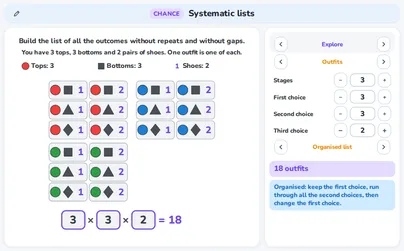
Organised list

To count outcomes, list them in order: keep the first choice, run through all the second choices, then change the first choice. Nothing is missing and nothing is repeated.
11,121,2112,122,2213,123,23
Example
3 tops, 2 trouserstop 1: with trousers 1, 2top 2: with trousers 1, 2 …
1211,11,222,12,233,13,23×2=6
Watch out!

Repeats and gaps

A mixed-up list can have a repeat (the same outcome twice) or a gap (an outcome missing). Cross out the repeats, then compare the count with the total to see how many are missing.
123411,11,21,31,422,12,2?2,43?3,23,3?
Example
12 outcomes in allthe list has 9 different ones are missing
1293
Rule

Product rule

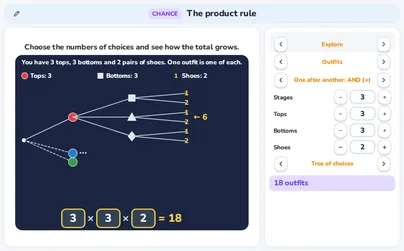
If one choice can be made in ways and after it another in ways, there are ways in all. With three stages multiply the three numbers.
m×nm×n
Example
3 tops, 4 trousers: + 2 pairs of shoes:
12341123425678391011123×4=123×4×23×4×2=24
Definition

Tree of choices

A tree draws the choices as branches. Every first choice has the same branches after it, so draw the first one in full and count its leaves, then multiply.
123……
Example
3 starters, 4 mainsfirst branch has 4 leaves
1234……
Rule

Repeated addition

Multiplying is adding the same number again and again. 3 groups of 4 is , which is . A product rule count is a short way to add equal groups.
4+4+4
Example
3 groups of 4 dots
3×4=12
Rule

Add for “or”

If you choose ONE thing from one group OR one from another group, add the numbers: . One after another (AND) multiplies; one or the other (OR) adds.
m+nmn
Example
3 buses or 4 trains ways to travel
734
Rule

Codes with repeats

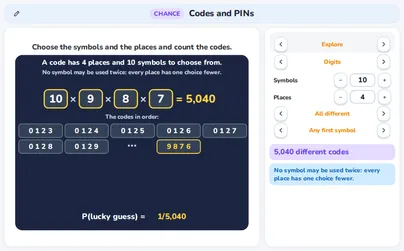
If a symbol may be used again, every place has the same choices. A code of places has ( factors) possibilities.
n×n×nn×n×n=n³
Example
Bike lock, 3 wheels, digits 0 to 9
10×10×1010³=1000
Rule

All different

If no symbol may be used twice, every place has one choice fewer than the place before:
n×n−1×n−2n(n−1)(n−2)
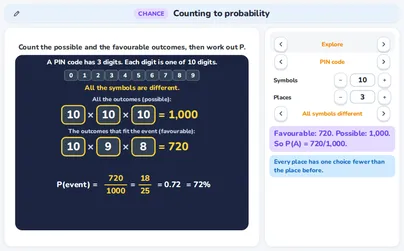
Example
3 different digits from 0 to 9
10×9×8720
Rule

First digit not 0

A number does not start with 0, so its first place has only 9 choices. Count the restricted place first, then the others as usual.
9×10×109×10×10
Example
3-digit numbers, repeats allowed
9×10×10900
Rule

Fixed place

A place that is fixed has only 1 choice. The other places are counted as before, so fixing one bead of leaves orders.
1×n−1×n−2(n−1)!
Example
5 beads, the first one fixed
1×4×3×2×14!=24
Special case

How fast it grows

One more place gives times as many codes: . Orders grow even faster: one more bead gives times as many.
nn²n³123×n×n
Example
10 digits: 3 places 1000,4 places 10 times as many but
101001000100001234×10×10×10
Definition

n factorial

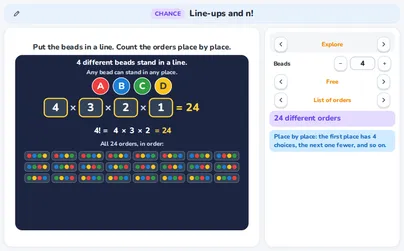
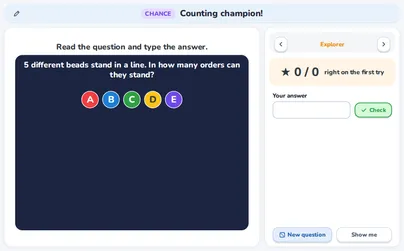
The number of orders of different objects is , read “n factorial”. By agreement .
n×n−1×…×2×1n!
Example
5 friends in a row
5×4×3×2×15!=120
Rule

Permutations

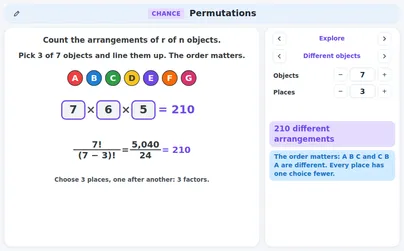
Choose of different objects and put them in order. The order matters:
n×n−1×n−r+1×(n−r)!n!÷(n−r)!
Example
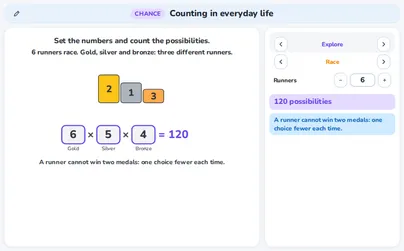
Gold, silver, bronze from 9 runners
9×8×7×6!9!÷6!=504
Rule

Letters of a word

Equal letters can swap places without making a new word. Divide by the orders of each repeated letter:
MOON4!÷2!
Example
6 letters, two of one, two of another
AABBCD6!÷(2!×2!)
Rule

Count to probability

When all outcomes are equally likely, count the possible and the favourable outcomes with the rules above:
pfp−f
Example
3-digit PIN, all digits different
1000720280
Rule

At least once

“Used at least once” is hard to count, but “never used” is easy. All outcomes minus the never ones:
11−xx
Example
3-digit PIN uses a 7never:
1000729271
Tip

Everyday counting

Ask: do I choose one thing after another (multiply), one or the other (add), is a symbol used again, and does the order matter? Ice creams, bike locks, podiums and benches all follow these rules.
6×5×46×5×410×10×1010³
Example
Podium: order matters, Bike lock: repeats,
6×5×412010×10×101000

Exercises

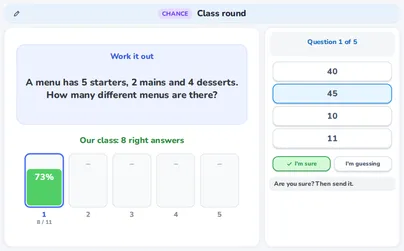
A lunch has 3 starters and 4 mains. How many different menus are there? Easy
Show solution
Each of the 3 starters goes with all 4 mains
1234……
3×412
Answer → 12 menus
Draw the first starter in full: 4 leaves. The other starters have the same 4.
You choose one fruit from 5 fruits or one biscuit from 3 biscuits. How many choices are there? Easy
Show solution
You pick only ONE thing, so the choices are added
853
Answer → 8 choices
Multiplying 5 × 3 = 15 would be a fruit AND a biscuit.
4 friends sit in a row. In how many orders can they sit? Easy
Show solution
The first seat has 4 choices, the next 3, then 2, then 1
4×3×2×14!=24
Answer → 24 orders
Every friend sits once, so each seat has one choice fewer.
A code has 4 places and 6 symbols, and a symbol can be used again. How many codes are there? Medium
Show solution
Every place has 6 choices
6×6×6×66⁴=1296
Answer → 1296 codes
With 5 places there would be 6 times as many.
5 runners race. In how many ways can gold, silver and bronze be given out? Medium
Show solution
Gold: 5 runners. Silver: 4 left. Bronze: 3 left
51×42×3360
Answer → 60 ways
A runner cannot win two medals, so each medal has one choice fewer.
How many 3-digit numbers have three different digits? (The first digit is not 0.) Medium
Show solution
First digit: 9 choices (not 0). Second: 9 left (0 is allowed now). Third: 8 left
9×9×8648
Answer → 648 numbers
Count the restricted place first.
How many different arrangements of the letters of the word MOON are there? Hard
MOON
Show solution
4 letters, the O occurs twice: orders if all were different
4×3×2×14!=24
The two O's can swap without a new word: divide by
MOON4!÷2!
Answer → 12 arrangements
Forgetting to divide gives 24, which counts every word twice.
A PIN has 3 digits (0 to 9, repeats allowed). What is the probability that all the digits are different? Hard
Show solution
Possible:
10×10×101000
Favourable:
10×9×8720
1000720280
Answer → 18/25
Count the possible with repeats and the favourable without repeats.
A PIN has 3 digits (0 to 9, repeats allowed). What is the probability that the digit 7 is used at least once? Hard
Show solution
Never a 7: every place has 9 choices,
9×9×9729
All outcomes:
1000729271
Answer → 271/1000
Counting the codes with a 7 directly is hard; count the ones without it (7).
Are you a teacher?

Start live lessons with these applications for your whole class. Free to try for one month.

Try it free

Fits these school years

IB (MYP, Diploma): MYP 1, MYP 2, MYP 3, MYP 4, MYP 5

Cambridge International: Primary, stage 5, Primary, stage 6, Lower Secondary, stage 7, Lower Secondary, stage 8, Lower Secondary, stage 9, IGCSE

Netherlands: Groep 6, Groep 7, Groep 8, Year 1, Year 2, Year 3 (havo, vwo), Havo · Mathematics A, Vwo · Mathematics A, Vwo · Mathematics C, Vwo · Mathematics D

Türkiye (MEB): Year 6 (MEB), Year 7 (MEB), Year 8 (MEB), Year 9 (MEB), Year 10 (MEB)

England (GCSE, A Level): Year 5, Year 6, Year 7, Year 8, Year 9, Year 10 (GCSE), Year 11 (GCSE)

USA (Common Core): Grade 6, Grade 7, Grade 8

What the applications of this topic teach 7 applications

Systematic lists

  • Writing an organised list of outfits, menus or routes
  • Finding repeats and missing outcomes in a mixed-up list
  • Multiplying the choices at each stage to count the outcomes

The product rule

  • Using the product rule: m ways then n ways gives m × n
  • Drawing a tree of choices and counting its leaves
  • Telling AND (multiply) from OR (add)

Codes and PINs

  • Counting codes with repeats allowed: n^p
  • Counting codes with all different symbols
  • Counting numbers whose first digit is not 0

Line-ups and n!

  • Counting the orders of n different beads: n!
  • Using factorial notation and knowing that 0! = 1
  • Counting the orders when the first or last bead is fixed

Permutations

  • Counting permutations of r objects chosen from n
  • Counting arrangements of the letters of a word with repeats
  • Using factorial notation, also for r = n

Counting to probability

  • Counting possible and favourable outcomes with the counting rules
  • Working out a probability from the counts
  • Finding “at least once” as all outcomes minus those that never occur

Counting in everyday life

  • Counting choices: an ice cream shop, a bike lock, a race podium
  • Telling when a symbol may be used again and when not
  • Seeing what one more choice does to the total