Interactive Lessons

Composite and inverse functions

Lecture notes

Definition

The composite function

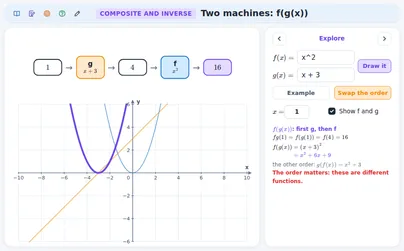
Two machines in a row: x goes into g first, and what comes out goes into f. We write fg(x) = f(g(x)). The inner function g works first, the outer function f works last.
xgg(x)ff(g(x))
Example
, . Find : , then :
2+35x²25
Rule

The formula of fg(x)

Put the whole formula of g in place of x in f, and simplify. To write h(x) as f(g(x)), find the inside part g and the outside part f.
xg: x²x²f: 2x+12x²+1
Example
and : . At :
3x²92x+119
Watch out!

The order matters

fg(x) and gf(x) are usually different: fg means first g, then f; gf means first f, then g. Sometimes they are equal, but never take it for granted. Work out both with a number.
xg: +3x+3f: ×22(x+3)fgxf: ×22xg: +32x+3gf
Example
and , : but :
1g: +34f: ×28fg1f: ×22g: +35gf
Definition

The inverse function

The inverse function f⁻¹ undoes f: f⁻¹(b) is the input that gives the output b. So f⁻¹(f(x)) = x and f(f⁻¹(x)) = x. Careful: f⁻¹(x) is not 1/f(x).
afbbf⁻¹a
Example
: , so :
42x+31111f⁻¹4
Rule

Finding the inverse formula

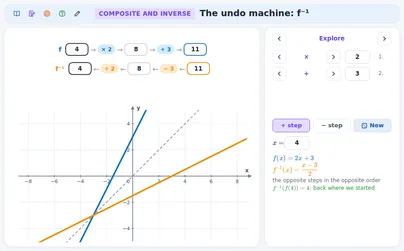
Swap x and y, then solve for y. Or undo the steps of f in the opposite order: the last step of f is undone first.
x×aax+bax+by−by−b÷a(y−b)/a
Example
swaps to , so :
x×22x+32x+3x−3x−3÷2f⁻¹(x)
Rule

The mirror y = x

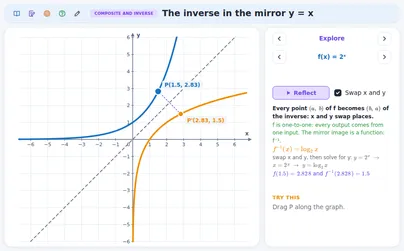
The graph of f⁻¹ is the graph of f reflected in the line y = x. The coordinates swap: the point (a, b) on f becomes (b, a) on f⁻¹.
xyf(a,b)(b,a)f⁻¹
Example
has the point , so has the point :
xy(2,7)(7,2)
Definition

One-to-one and the horizontal line test

An inverse function exists only when f is one-to-one: different inputs give different outputs. On the graph: no horizontal line meets it twice.
xy✘xy✔
Example
gives 4 for both 2 and −2, so it is not one-to-one and has no inverse:
xy−242
Rule

Restrict the domain

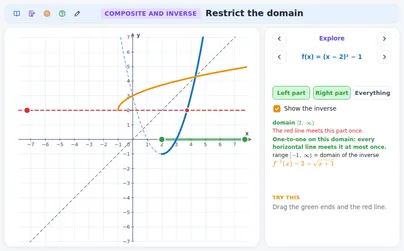
Cut the graph at the turning point to get a one-to-one piece. For (x − p)² + q on x ≥ p the inverse is p + √(x − q). The domain of f⁻¹ is the range of f.
xy(p,q)(q,p)
Example
on has range , so has domain . :
xy(6,10)(10,6)
Special case

Self-inverse functions

Some functions are their own inverse: f(f(x)) = x. Their graph is symmetric in the line y = x. Examples: f(x) = a − x and f(x) = k/x.
xyxy
Example
: and , so :
xy(2,3)(3,2)
Tip

Going back in real life

Convert and convert back, or ask the backwards question (“how far for €20?”): that is the inverse. Undo the steps in the opposite order: first add the fee back, then divide by the rate.
x×kkx−ckx−cy+cy+c÷k(y+c)/k
Example
. For 68 °F: first , then :
20×1.836+326868−3236÷1.820

Exercises

and . Find and . Easy
Show solution
: first , then .
2g: +46f: ×3−117
: first , then .
2f: ×3−15g: +49
Answer → and
Check: 17 and 9 are different, so the order matters.
. Find and the formula of . Easy
Show solution
f does: , then . The inverse undoes the last step first: , then .
x×22x+52x+5x−5x−5÷2(x−5)/2
.
.
xy
Answer → ;
Check: .
Does (all x) have an inverse function? Easy
Show solution
Try two inputs: and .
Two different inputs give the same output: the horizontal line meets the graph twice.
xy−353
So f is not one-to-one.
Answer → no, f is not one-to-one
Check: restrict the domain to and there is an inverse.
and . Solve . Medium
Show solution
.
xg: −2x−2f: x²(x−2)²
, so or .
or .
xy−195
Answer → or
Check: and .
. Find the formula of and . Medium
Show solution
Swap x and y: .
Solve for y: , so .
.
xy
Answer → ;
Check: .
for . Find , its domain and . Hard
Show solution
The lowest value of f is 3 at , so the range is : the domain of is .
xy
Swap: , so . Because : .
, so .
xy
Answer → with ;
Check: .
Are you a teacher?

Start live lessons with these applications for your whole class. Free to try for one month.

Try it free

Fits these school years

IB (MYP, Diploma): MYP 5, Diploma, year 1

Cambridge International: IGCSE, AS Level, A Level

Netherlands: Vmbo gt (years 3-4), Havo · Mathematics B, Vwo · Mathematics A, Vwo · Mathematics B, Vwo · Mathematics C, Vmbo kb (years 3-4)

Türkiye (MEB): Year 10 (MEB), Year 11 (MEB)

England (GCSE, A Level): Year 11 (GCSE), Year 12 (A Level), Year 13 (A Level)

USA (Common Core): Algebra 2, Precalculus

What the applications of this topic teach 6 applications

Two machines in a row: f(g(x))

  • Seeing that in fg(x) function g works first and f last
  • Writing fg(x) as one formula
  • Working out fg(a) and gf(a) and seeing the order matters

The undo machine: inverse as reverse steps

  • Undoing the steps of a function in the opposite order
  • Finding f⁻¹(b) by going back through the steps
  • Building the inverse machine of a function and testing it

The inverse in the mirror y = x

  • Seeing the graph of f⁻¹ as the reflection of f in y = x
  • Finding the mirror point (b, a) and reading f⁻¹ values
  • Telling from the graph whether f has an inverse function

Restrict the domain to get an inverse

  • Using the horizontal line test on a part of a graph
  • Restricting the domain so that a function has an inverse
  • Knowing that the domain of f⁻¹ is the range of f

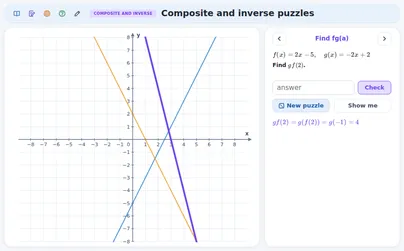
Composite and inverse puzzles

  • Working out fg(a) by going through g first, then f
  • Finding the formula of an inverse function and a value f⁻¹(b)
  • Writing f(g(x)) as one formula

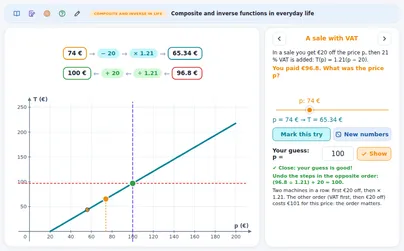
Composite and inverse functions in everyday life

  • Reading a two-step model: conversion with a fee, discount and VAT
  • Answering the backwards question with the inverse
  • Seeing that the order of two steps changes the result