Interactive Lessons

Combining functions

Lecture notes

Definition

Sum and difference of functions

The sum and the difference of two functions and are made value by value: and . On the graph, at every the height of is stacked on the height of (or taken off it).
Example
and at : and , so and .
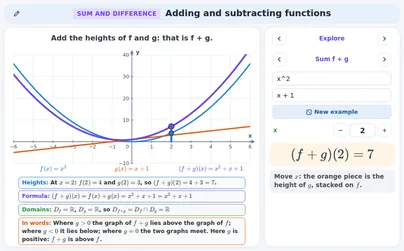
xyfgf+g
Definition

Product and quotient of functions

The product and the quotient are made value by value too: and , and the quotient only where .
Example
and at : and , so the product is and the quotient is . At we have : there is no quotient.
Definition

The domain of the result

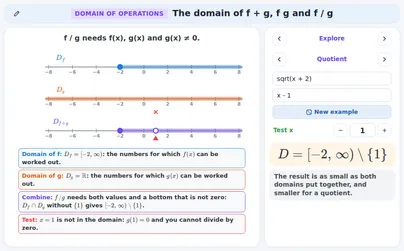
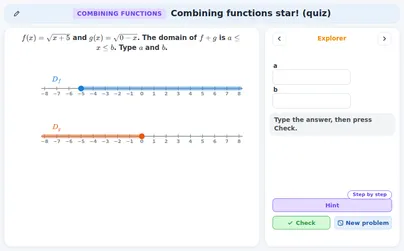
A number is allowed in , and only when both and can be worked out: . The intersection holds the numbers that are in both domains.
Example
has and has . So is defined for : .
−4−20246x≥−2−4−20246−∞<x<∞−4−20246x≥−2
Rule

The domain of a quotient

For take and then leave out every with , because you cannot divide by zero. Solve first, then remove those numbers.
Example
and : and , so .
−202468x≥0−202468x≠3−202468x≥0,x≠3
Rule

Reading the graph of f + g and f − g

Where the graph of lies above the graph of , where it lies below, and where the two graphs meet. In the same way exactly where the graphs of and meet. and are opposites: mirror images in the -axis.
Example
and : is zero at and , exactly where the graphs of and meet: at and at .
xyfgf-g
Rule

The formula of a sum or difference

Write and add the like terms. For a difference put in brackets, , so that the minus sign works on every term of .
Example
and : . Check at : and .
Rule

A product: zeros and signs

A zero of or of is a zero of , because a product with a zero factor is zero. The product is positive where and have the same sign and negative where the signs differ. The degrees add: a line times a line is a parabola.
Example
and : with zeros and . Between and we have and , so : for example at the product is .
xyfgfg
Rule

A quotient: zeros and vertical asymptotes

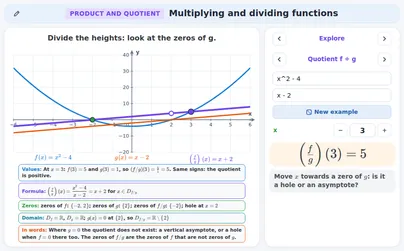
The zeros of are the zeros of where is not zero. Where and the graph has a vertical asymptote: the values grow without end on both sides of that line.
Example
and : has the zero . At we have but : a vertical asymptote at .
xyf/g
Rule

A quotient: a hole when both are zero

If and , the factor is in both. After cancelling it the quotient is a simpler formula, and the graph is that of the simpler formula with one point missing: a hole at . A hole is not an asymptote.
Example
and : for . The graph is the line with an open dot at .
xyf/g
Rule

Revenue: price times quantity

When the price depends on the number sold, the revenue is a product of two functions: . If the price falls as grows, the revenue first rises and then falls: it is a parabola.
Example
A price euro: . euro. The revenue is zero at and , so it is largest halfway, at : euro.
nyR
Rule

Profit: revenue minus cost

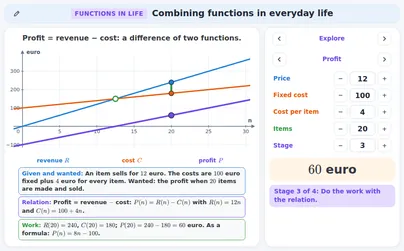
Profit is a difference of two functions: . The profit is positive where the revenue graph lies above the cost graph. The break-even point is where the two graphs meet: , so .
Example
and : . gives : and euro.
nyRC
Rule

Average cost: cost divided by quantity

The average cost per item is a quotient of two functions: , with . With fixed cost and cost per item, : it falls as grows and gets close to , but never reaches it.
Example
: euro and euro. Always : the average cost comes close to euro, the cost per item.
nyA
Tip

Check with one number

Pick one in the domain. Work out and separately, combine them, and compare with your formula at the same . If the two differ, the formula has a slip.
Example
and , formula for . At : , , and . The formula passes the check.
Tip

Choose the operation from the words

“Together” or “total” means add; “how much more” means subtract; “price times how many” means multiply; “per item” or “on average” means divide. Name the two functions first, then choose the operation.
Example
A club has euro fixed cost and euro per member: . “Per member” means divide: , and euro.
Tip

The product is not the composite

In this topic multiplies the two values. The composite puts into (see the application machine-chain and the topic “Composite and inverse functions”). They are different functions.
Example
and at : , but .
Watch out!

The union instead of the intersection

is the intersection , not the union. A number that one of the two functions cannot take is not allowed in the sum, however well the other works.
Example
needs and needs . Together: . The number is fine for , but has no square root: is not in .
−4−202468x≥−2−4−202468x≤6−4−202468−2≤x≤6
Watch out!

The minus sign on every term

In the minus sign works on all of . Put in brackets and change the sign of every term of . Writing for forgets the sign of the .
Example
and : . At : , and . The wrong formula would give .
Watch out!

f − g is not g − f

The order matters for a difference and for a quotient. and are opposites; and have different domains and different graphs. Only the sum and the product do not depend on the order.
Example
and : and ; at they are and . And exists for every , but does not exist at .
Watch out!

Cancel and forget the hole

After cancelling, the simpler formula may be defined at a number where the original quotient is not. The domain of comes from the original , not from the cancelled formula. Always find the zeros of before you cancel.
Example
, and gives at . But the quotient does not exist at : .
Special case

Domains that barely meet

The intersection can be a single number, or empty. If it is empty, the sum, product and quotient exist nowhere and there is no new function.
Example
needs and needs . Only is left: and .
Special case

A constant function as the second function

If for every , then is the graph of moved up by and is stretched by the factor . If , then is zero everywhere and exists nowhere.
Example
and : , the parabola moved up by ; , three times as high.

Exercises

and . Find and . Easy
Show solution
and .
and .
Answer → and
Check: is negative, so at the graph of lies below the graph of ().
and . Find the domain of . Easy
Show solution
needs , so . can take every : .
.
Answer → , so
Check: at we get ; at we would need , which does not exist.
and . Find the formula of and the value . Easy
Show solution
.
.
Answer → and
Check: . The zeros of are and , the zeros of and of .
and . For which does not exist? Find . Easy
Show solution
when , so .
and , so .
Answer → not at ;
Check: is the zero of , and , so the graph has a vertical asymptote there.
and . Find the formula of and the values of where the graphs of and meet. Medium
Show solution
.
The graphs meet where : .
or .
Answer → ; the graphs meet at and
Check: and .
and . Find the domain of . Medium
Show solution
needs : . works for every .
: , so or . Both are in , so both must go.
without and .
Answer → with and
Check: at we have and , so the quotient exists.
A shop sells at the price euro when items are sold. Find the revenue and the number of items that gives the largest revenue. Medium
Show solution
. , so .
at and , so the largest value is halfway, at .
, so .
Answer → euro; the largest revenue is euro at
Check: and , both below .
Simplify and say where the graph has a hole. Medium
Show solution
, so the quotient is for .
At the bottom and the top are both : a hole, not an asymptote.
The height of the hole is .
Answer → with a hole at the point
Check: is not allowed in the original, but every other gives the same value as .
and . Find , and the value . Hard
Show solution
needs : . needs : . So .
−4−202468x≥−2−4−202468x≤6−4−202468−2≤x≤6
For the quotient also . , so goes: .
.
Answer → ; ;
Check: at the sum is , fine, but the quotient would be .
and . For find the zero, the asymptote and the hole. Hard
Show solution
and , so for . Its zero is .
At : and , an asymptote. At : both are , a hole of height .
xyf/g
Answer → zero ; asymptote ; hole at
Check: and .
The price is euro and the cost is euro. Find , the break-even numbers and the largest profit. Hard
Show solution
, so .
at and ; the largest profit is halfway, at : .
nyRC
Answer → break-even at and ; largest profit euro at
Check: .
The cost is euro. Find , the with euro, and the value comes close to for very large . Hard
Show solution
, so .
gives , so .
For very large the term is almost : comes close to .
Answer → euro; ; comes close to euro
Check: .
Are you a teacher?

Start live lessons with these applications for your whole class. Free to try for one month.

Try it free

Fits these school years

IB (MYP, Diploma): Diploma, year 1

Netherlands: Year 3 (havo, vwo), Vmbo kb (years 3-4), Vmbo gt (years 3-4), Havo · Mathematics B, Vwo · Mathematics A, Vwo · Mathematics B, Vwo · Mathematics C

Türkiye (MEB): Year 11 (MEB)

England (GCSE, A Level): Year 12 (A Level)

USA (Common Core): Algebra 2

What the applications of this topic teach 4 applications

Adding and subtracting functions: heights, formula, domain

  • Adding and subtracting two functions value by value
  • Seeing on the graph how the height of g is stacked on f
  • Finding the domain of f + g as the shared domain

Multiplying and dividing functions: zeros, signs, holes

  • Multiplying and dividing two functions and writing the formula
  • Finding the zeros of f · g and where the product is positive
  • Telling a hole from a vertical asymptote of f/g
  • Finding the domain of f/g without the zeros of g

The domain of f + g, f g and f / g

  • Saying when f + g, f − g, f · g and f/g exist
  • Finding the domain of a sum, product and quotient on number lines
  • Writing a domain in interval notation

Combining functions in everyday life

  • Building revenue, profit and average cost from two functions
  • Reading the break-even point and the best number of items
  • Saying why the average cost has no value at n = 0