Interactive Lessons
Lecture notes Exercises

Transforming graphs

Lecture notes

Definition

The parent graphs

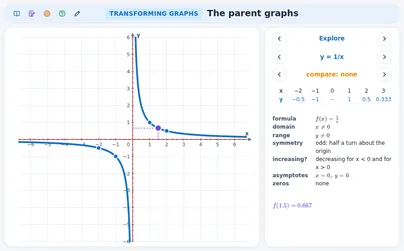
Seven graphs are the building blocks: y = x, x², x³, √x, 1/x, |x| and 2ˣ. Know their shape and their key points, for example (0, 0), (1, 1) and the asymptotes. Every other graph in this topic is one of them, moved, stretched or mirrored.
xyxxyx²xyx³xy√xxy1/xxy|x|xy2ˣ
Example
y = 2ˣ at and y = √x at :
24510xy38524xy93
Rule

Translation: f(x − h) + k

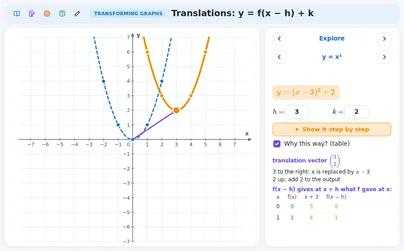
y = f(x − h) + k is the graph of f moved h to the right and k up, the vector (h, k). Every point goes from (x, y) to (x + h, y + k).
xyhk
Example
moves the point of f to:
−2246848xy
Watch out!

The sign inside the bracket turns

f(x + h) moves the graph to the LEFT, f(x − h) to the right: the new graph needs an input that is h larger (or smaller) to give the same output. A number outside f (+ k) simply moves the graph up.
xyf(x+h)xyf(x)+k
Example
: the point of f with now sits at .
−26848xy4121
Rule

Stretches: a·f(x) and f(bx)

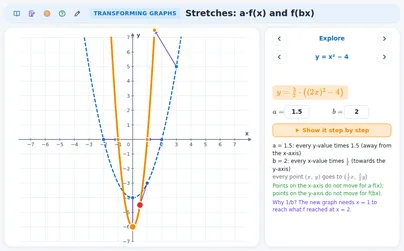
y = a·f(x) stretches from the x-axis: every y is multiplied by a. y = f(bx) stretches from the y-axis: every x is divided by b. Points on the axis you stretch from stay where they are.
xya·f(x)xyf(bx)
Example
takes to ; takes to :
xy3·f(x)xyf(2x)
Rule

Reflections

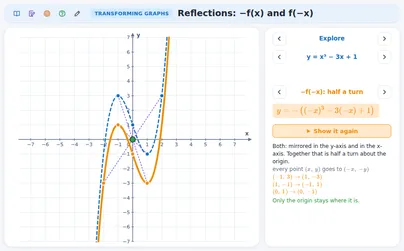
y = −f(x) mirrors in the x-axis (y changes sign), y = f(−x) mirrors in the y-axis (x changes sign), y = −f(−x) does both: half a turn about the origin. Points on the mirror line stay.
xy−f(x)xyf(−x)xy−f(−x)
Example
The point goes to under :
xy(3,−2)(3,2)
Rule

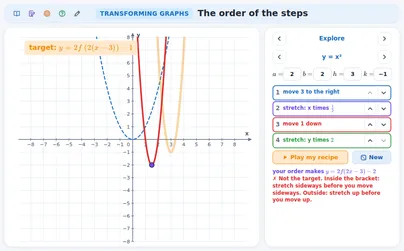
The order of the steps

In y = a·f(b(x − h)) + k, do x first: divide by b, then add h. Do y after it: multiply by a, then add k. Inside the bracket the stretch comes before the move, outside the bracket too.
x÷bx÷b+hx÷b+hy×aay+kay+k
Example
takes the point with first to 2, then to 3:
4÷22+13
Definition

Even and odd functions

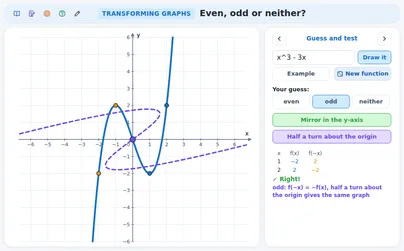
f is even when f(−x) = f(x): the graph is its own mirror image in the y-axis. f is odd when f(−x) = −f(x): the graph turns onto itself by half a turn about the origin. Most functions are neither.
xyf(x)xy−f(x)
Example
is odd: is the opposite of .
xy28−2−8
Tip

Zeros and asymptotes move with the graph

Every zero and every asymptote is moved like any other point of the graph: + h for f(x − h), ÷ b for f(bx). −f(x) and a·f(x) keep the zeros.
xyhk
Example
f has a zero at , so has its zero at ; has the asymptotes and :
xy63xy42
Tip

Read a transformation from a graph

Find a key point of the parent on the new graph and see where it went: how far sideways (h), how far up or down (k), is it further from an axis (a, b), is it flipped? The start point (0, 0) of y = √x shows h and k at once.
xyhk
Example
The orange root graph starts at , so and :
xy3−2

Exercises

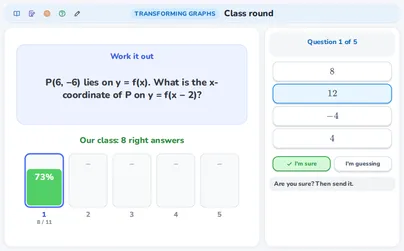
The point lies on . Where does it go on ? Easy
Show solution
: the graph moves 4 to the right, so x becomes .
+ 2 outside f: 2 up, so y becomes .
xy55
Answer →
Check: the sign inside the bracket is the opposite of the move.
and . Find and for . Easy
Show solution
.
.
xy(2,3)(−1,−4)(2,−3)(−1,4)
Answer → and
Check: the graph is mirrored in the x-axis, so every y changes sign.
The point lies on . Where does it go on ? Medium
Show solution
: x is divided by 3, so x becomes .
: y is multiplied by 2, so y becomes .
xy(6,4)(2,8)
Answer →
Check: sideways it is divided, up and down it is multiplied.
f has the zeros and . What are the zeros of and of ? Medium
Show solution
g moves 3 to the right: and .
xy−2147
h divides x by 2: and .
xy−2−124
Answer → g: and ; h: and
Check: .
f is odd and . What are and ? Medium
Show solution
Odd: , so .
xy(2,−3)(−2,3)
An odd graph goes through the origin: , so .
Answer → and
Check: the points and are half a turn apart.
The point lies on . Where does it go on ? Hard
Show solution
x first: divide by 2, ; then move 3 to the right, .
y next: multiply by −2, ; then add 1, .
xy(8,3)(7,−5)
Answer →
Check: the − sign in −2 also mirrors the graph in the x-axis.
The graph of f is stretched from the y-axis by the factor 1/3, then moved 2 to the left, then mirrored in the x-axis. Write the new formula and find where goes. Hard
Show solution
Stretch by 1/3 from the y-axis: . Then 2 to the left, inside the bracket: . The mirror in the x-axis puts a minus in front: .
x: , then .
y: 4 becomes −4.
xy(6,4)(0,−4)
Answer → ; goes to
Check: the stretch comes before the move, so the 2 stays inside .
Are you a teacher?

Start live lessons with these applications for your whole class. Free to try for one month.

Try it free

Fits these school years

IB (MYP, Diploma): MYP 5, Diploma, year 1, Diploma, year 2

Cambridge International: IGCSE, AS Level

Netherlands: Havo · Mathematics B, Vwo · Mathematics A, Vwo · Mathematics B, Vwo · Mathematics C, Year 3 (havo, vwo)

Türkiye (MEB): Year 10 (MEB), Year 11 (MEB), Year 9 (MEB)

England (GCSE, A Level): Year 11 (GCSE), Year 12 (A Level)

USA (Common Core): Algebra 1, Algebra 2, Precalculus

What the applications of this topic teach 8 applications

The parent graphs

  • Recognising the seven parent graphs by shape and key points
  • Giving the domain, range, symmetry and asymptotes of a parent graph
  • Working out f(x) of a parent graph for given x-values

Translations: y = f(x − h) + k

  • Moving a graph with y = f(x − h) + k and giving the vector (h, k)
  • Saying why f(x − 3) moves to the right
  • Finding the image of a key point under a translation

Stretches: a·f(x) and f(bx)

  • Stretching a graph up and down with a·f(x) and sideways with f(bx)
  • Saying which points stay where they are
  • Finding the image of a key point under a stretch

Reflections: −f(x) and f(−x)

  • Mirroring a graph with −f(x), f(−x) and −f(−x)
  • Saying which points stay on the mirror line
  • Working out g(a) from a table of f for a reflection

The order of the steps

  • Putting the four steps of y = a·f(b(x − h)) + k in order
  • Saying why the stretch comes before the move
  • Writing the formula that a list of steps makes

Even, odd or neither?

  • Testing whether a function is even, odd or neither
  • Linking even and odd to mirror and half-turn symmetry
  • Using symmetry to find values like f(−a) and f(0)

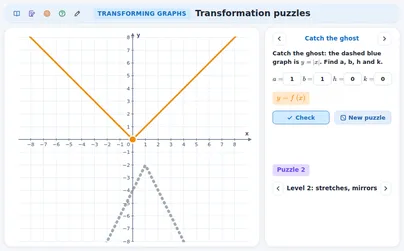
Transformation puzzles

  • Finding a, b, h and k so that a graph lies on the ghost graph
  • Following a point through a given formula
  • Choosing the right order of the steps

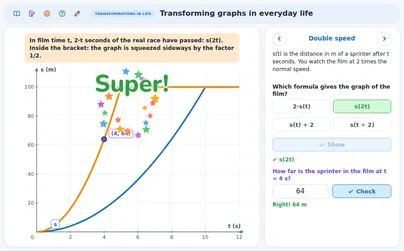
Transforming graphs in everyday life

  • Seeing a moved, stretched or mirrored graph in everyday situations
  • Choosing the formula of the new graph: t − 15, 2t, 0.8·P
  • Reading a value of the new function from the old one