Square root and rational functions
Lecture notes
Definition
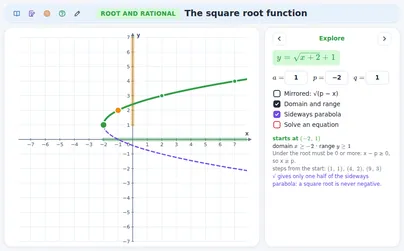
In y = a√(x − p) + q the graph starts at the point (p, q). The inside of the root must be 0 or more, so the domain is x ≥ p. A square root is never negative: for a > 0 the graph goes up (range y ≥ q), for a < 0 it goes down (range y ≤ q). The mirror image √(p − x) goes to the left.
Example
starts at , so and . At :
Rule
The sideways parabola
The graph of y = √x is the top half of the parabola x = y² lying on its side. The bottom half would be y = −√x. A square root gives only one answer, the one that is 0 or more.
Example
The point is on the top half, on the bottom half; √9 is only 3:
Rule
Root equations
Get the root alone on one side, square both sides, solve the new equation and then check the answer in the original equation. A square root is never negative, so if the root alone equals a negative number there is no solution.
Example
: root alone , square , so :
Watch out!
A false solution
Squaring can create an answer that the root equation does not have: (−3)² and 3² are both 9. So always put the answers back in the original equation. An answer that fails is a false solution and is thrown away.
Example
gives , so or . ✔ : . ✘ : , not −1:
Definition
Inverse proportion
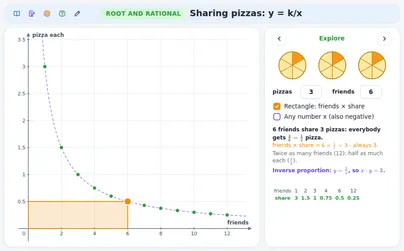
When x gets twice as big, y gets half as big: the product x · y stays the same number k. Then y = k/x. A table is an inverse proportion when every pair gives the same product. The graph is a hyperbola with the asymptotes x = 0 and y = 0.
Example
6 workers need 4 days. How long do 3 workers need? :
Rule
The hyperbola y = a/(x − p) + q
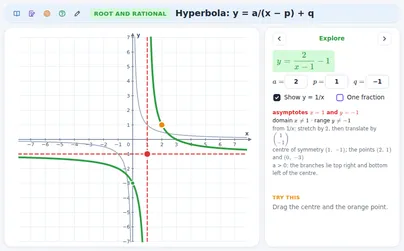
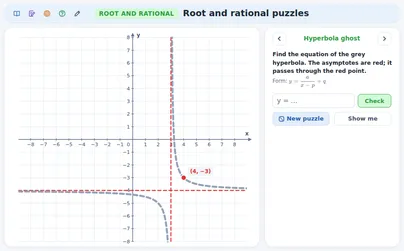
It is 1/x stretched by a and moved p to the right and q up. The asymptotes are x = p and y = q, the domain is x ≠ p, the range is y ≠ q. For a > 0 the branches lie top right and bottom left of the centre (p, q), for a < 0 top left and bottom right.
Example
has the asymptotes and . At :
Rule
The y-intercept and the zero
For the y-intercept put in x = 0. For the zero make the fraction equal to −q: x − p = a ÷ (−q). Written as one fraction (qx + a − pq)/(x − p) the zero is in the numerator.
Example
: at the value is −1; the zero is at , so :
Rule
Vertical asymptotes
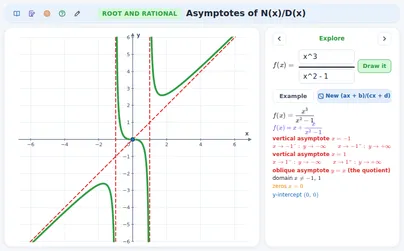
A rational function is N(x)/D(x) with polynomials N and D. A vertical asymptote is at every x where the denominator is 0 and the numerator is not. On each side of it the graph goes to +∞ or −∞: the sign of N/D decides which.
Example
: the denominator is 0 at and the numerator is 4, so is a vertical asymptote:
Watch out!
A hole is not an asymptote
Factor the numerator and the denominator first. A common factor cancels: at its zero the graph has a hole (one missing point), not an asymptote. Only a zero of the denominator that is left after cancelling gives a vertical asymptote.
Example
✘ has an asymptote at . ✔ It is : a hole at , no asymptote:
Rule
The horizontal asymptote
Compare the degrees of N and D. Degree N < degree D: the asymptote is y = 0. Equal degrees: y = the ratio of the leading coefficients. Degree N is 1 more than degree D: a slanted line (the quotient). More than that: no straight asymptote.
Example
: equal degrees, so ; the denominator is 0 at :
Tip
Near an asymptote and far away
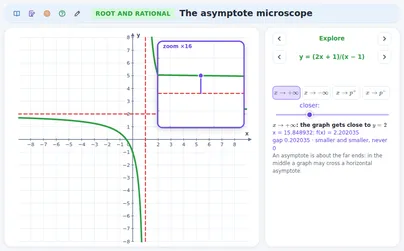
Near a vertical asymptote the denominator is tiny, so the fraction is huge and changes sign when you cross it. Far away the gap to a horizontal asymptote gets smaller and smaller but is never 0. A graph may cross its horizontal asymptote in the middle.
Example
: right of 2 the values are positive and grow, left of 2 they are negative:
Tip
Models with a fraction
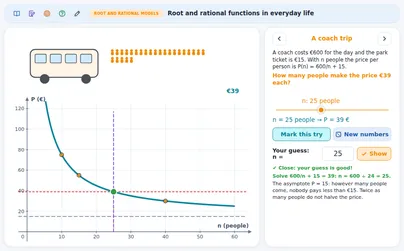
A cost shared by n people is P(n) = B/n + c: it never goes below c, the horizontal asymptote, so twice as many people do not halve the price. A mixture (A + x)/(V + x) never reaches 100 %. Always ask what the asymptote means in the story.
Example
A coach costs €240 and the ticket is €10. With 30 people €18 each, with 60 people not €9 but €14:
Tip
Models with a square root
In d = 3.57√h (the horizon) and T = 2π√(L/9.8) (the pendulum) a quantity grows with the square root: to double the result you need four times as much. The graph keeps rising but flatter and flatter.
Example
From 4 m high you see 7.14 km far, from 16 m high only twice as far, 14.28 km:
Exercises
Give the start point, the domain and the range of . Easy
Show solution
Write as : and , so the start point is .
The inside of the root is 0 or more: , so .
is negative, so the graph goes down from the start point: .
Answer → start ; domain ; range
Check: at the value is , which is below 5.
x and y are inversely proportional. When , . Find y when . Easy
Show solution
The product stays the same: .
Then .
Answer →
Check: x is 2.5 times as big and y is 2.5 times as small: .
Give the asymptotes of Easy
Show solution
Write as : . The denominator is 0 at .
: far away gets close to 0, so y gets close to −2.
Answer → and
Check: , so the branches lie top right and bottom left of .
Solve . Medium
Show solution
Get the root alone: .
Square both sides: , so and .
Check: .
Answer →
Check: and , .
Solve . What do you notice? Medium
Show solution
Get the root alone: .
A square root is never negative, so there is no solution.
Squaring anyway gives , so , but , not 2: a false solution.
Answer → no solution ( is a false solution)
Check: the left side is at least 4 for every x, and 4 is more than 2.
Find the vertical and the horizontal asymptote and the hole of . Medium
Show solution
Factor: and .
The factor cancels: a hole at . What is left is .
gives the vertical asymptote . Degree N < degree D: .
The hole is at .
Answer → vertical asymptote , horizontal asymptote , hole at
Check: and , so makes both zero.
The hyperbola has the asymptotes and and goes through . Find a and the y-intercept. Hard
Show solution
The asymptotes give and : .
Put in : , so and .
y-intercept: gives .
Answer → ; y-intercept −4
Check: , and lies top right of the centre .
Interactive applications for this topic
Free applications open with a free student account. Teachers can use all applications in a live lesson.
FreeThe square root function y = a√(x − p) + q
PlusSharing pizzas: inverse proportion y = k/x
PlusThe hyperbola y = a/(x − p) + q
PlusAsymptotes and holes of a rational function
PlusThe asymptote microscope
PlusRoot and rational puzzles
PlusRoot and rational functions in everyday life
PlusRoot and rational star! (quiz)
PlusClass round: the whole class at once
Are you a teacher?
Start live lessons with these applications for your whole class. Free to try for one month.
Try it freeFits these school years
IB (MYP, Diploma): MYP 5, Diploma, year 1, MYP 4, Diploma, year 2
Cambridge International: IGCSE, AS Level, Lower Secondary, stage 9
Netherlands: Year 2, Year 3 (havo, vwo), Vmbo kb (years 3-4), Vmbo gt (years 3-4), Havo · Mathematics B, Vwo · Mathematics B, Year 1, Havo · Mathematics A, Vwo · Mathematics A, Vwo · Mathematics C
Türkiye (MEB): Year 10 (MEB), Year 7 (MEB), Year 12 (MEB)
England (GCSE, A Level): Year 11 (GCSE), Year 12 (A Level), Year 9, Year 10 (GCSE), Year 13 (A Level)
USA (Common Core): Algebra 2, Precalculus
What the applications of this topic teach 7 applications
The square root function y = a√(x − p) + q
- Giving the start point, domain and range of y = a√(x − p) + q
- Telling from the formula where the graph goes
- Solving a root equation and spotting a false solution
Sharing pizzas: inverse proportion y = k/x
- Seeing that doubling x halves y and x · y stays the same
- Telling from a table whether it is an inverse proportion
- Finding k and missing values of an inverse proportion
The hyperbola y = a/(x − p) + q
- Reading the asymptotes x = p and y = q from y = a/(x − p) + q
- Saying the domain, range and centre of a hyperbola
- Finding the y-intercept and fitting a, p and q to a graph
Asymptotes and holes of a rational function
- Finding vertical asymptotes and telling a hole from an asymptote
- Finding the horizontal asymptote by comparing degrees
- Saying where the graph goes on each side of a vertical asymptote
The asymptote microscope
- Seeing that the gap to an asymptote shrinks but is never 0
- Saying where f(x) goes for very big or small x
- Explaining why a graph may cross its horizontal asymptote
Root and rational puzzles
- Finding y = a/(x − p) + q from its asymptotes and a point
- Finding y = a√(x − p) + q from the start point and another point
- Finding the asymptotes of (ax + b)/(cx + d)
Root and rational functions in everyday life
- Reading a model with a fraction or a root in a real situation
- Saying what an asymptote means in a story
- Guessing the x that reaches a target and comparing it with the exact answer