Interactive Lessons

Rotate and enlarge on the grid

Lecture notes

Definition

Rotation (turn) about a centre

A rotation turns a whole shape about a fixed point, the centre O. O stays where it is. The shape keeps its size and goes round the same way. You need an angle, a direction and a centre.
xyO
Example
A (3, 1) turns 90° clockwiseabout O (0, 0): A′ (1, −3)
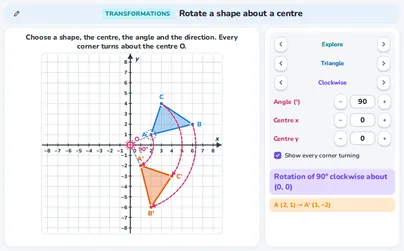
xyO(3,1)(1,−3)
Definition

Clockwise and anticlockwise

Clockwise is the way the hands of a clock go. Anticlockwise is the other way round. The same angle the other way gives a different image.
xyOAA′xyOAA″
Example
A (2, 0): 90° clockwise → (0, −2)90° anticlockwise → (0, 2)
xyO(2,0)(0,−2)xyO(2,0)(0,2)
Rule

Rotate about the origin: the rules

About the origin: 90° clockwise , 180° , 90° anticlockwise .
xy(x,y)(y,−x)(−x,−y)(−y,x)
Example
(3, 1) → 90° clockwise (1, −3)180° (−3, −1)90° anticlockwise (−1, 3)
xy(3,1)(1,−3)(−3,−1)(−1,3)
Rule

Rotate about another centre

Subtract the centre, turn, then add the centre again: turn the vector from O to A, and A′ is O plus the turned vector. For 90° clockwise about : .
xyOAA′
Example
O (1, 2), A (4, 3): A − O = (3, 1)turned (1, −3): A′ = (2, −1)
xyO(1,2)A(4,3)A′(2,−1)
Rule

Same distance from the centre

A turn keeps every point the same distance from the centre: . So A′ lies on the circle round O through A.
xyOAA′rr
Example
O (0, 0), A (3, 1), A′ (1, −3):9 + 1 = 1 + 9, both 10
xyO(3,1)(1,−3)√10√10
Rule

270° clockwise = 90° anticlockwise

A turn one way round equals a turn the other way round: the two angles make 360° together, . So there are two ways to say the same rotation.
xyOAA′90°270°
Example
A (3, 1): 270° clockwise= 90° anticlockwise = (−1, 3)
xyO(3,1)(−1,3)90°270°
Special case

A half turn is a point reflection

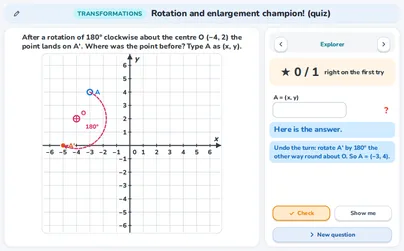
A half turn (180°) is the same both ways round. It is also a reflection in the point O: A, O and A′ lie on one line and O is the middle, .
xyOAA′
Example
O (1, 2), A (4, 3) → A′ (−2, 1)middle of A A′: (1, 2)
xyO(1,2)A(4,3)A′(−2,1)
Rule

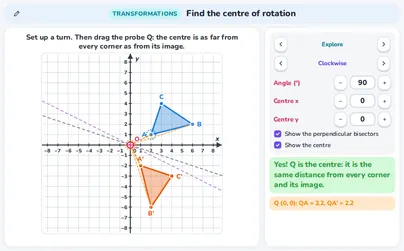
Find the centre of a rotation

The centre is the same distance from A and A′, and from B and B′. So it lies on the perpendicular bisector of A A′ and of B B′: the centre is where the two bisectors cross.
xyAA′BB′O
Example
A (4, 0) → A′ (0, 4): the line y = xB (3, 1) → B′ (−1, 3) meets it at O (0, 0)
xy(4,0)(0,4)(3,1)(−1,3)O
Rule

Describe a rotation completely

Always give the angle, the direction and the centre. “A rotation” or “a rotation of 90°” alone is not complete.
xyOα
Example
Rotation of 90° anticlockwiseabout (0, 0)
xyO(0,0)90°
Definition

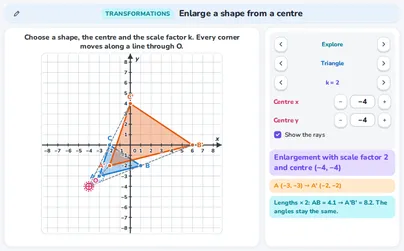
Enlargement

An enlargement scales a whole shape from a centre O by a scale factor k. Every point moves along a line through O. The image has the same shape (the angles stay the same) but a different size.
xyOAA′
Example
O (0, 0), :A (2, 1) → A′ (6, 3)
xyO(2,1)(6,3)
Rule

Scale factor and distances

The distance from the centre is multiplied by k: . About the origin ; about : .
xyOAA′OAk·OA
Example
: A (2, 1) → A′ (6, 3): A (2, 1) → A′ (4, 2)
xyO(2,1)(4,2)(6,3)k=3k=2
Special case

k between 0 and 1 (shrinking)

If k is between 0 and 1, the image is smaller than the object and lies between O and the object. k = 1 changes nothing; k bigger than 1 makes the image bigger. Fractions like 1/2 are fine.
xyOAA′
Example
: A (4, 2) → A′ (2, 1)
xyO(4,2)(2,1)
Special case

A negative scale factor

With a negative k the image is on the other side of O and upside down. k = −1 is a half turn; k = −2 also makes the image twice as big.
xyOAA′
Example
: A (3, 1) → A′ (−6, −2): A (3, 1) → A′ (−3, −1)
xyO(3,1)(−6,−2)(−3,−1)
Rule

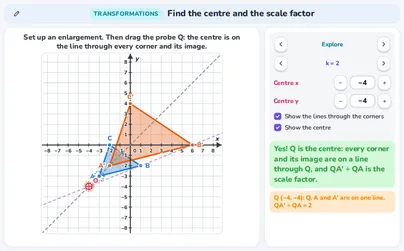
Find the centre and the scale factor

Draw the lines through A and A′ and through B and B′: they meet at the centre. The scale factor is (minus if the image is on the other side). The way back has scale factor .
xyOABA′B′
Example
A (3, 2) → A′ (5, 3), B (2, 3) → B′ (3, 5)lines meet at O (1, 1), k = 2
xyO(1,1)A(3,2)B(2,3)A′(5,3)B′(3,5)
Rule

Lengths × k, angles the same

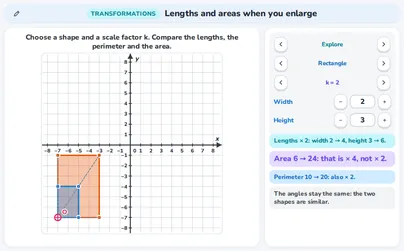
Every length (and the perimeter) is multiplied by k. The angles do not change, so the shapes are similar.
xyaka
Example
: AB = 4 → A′B′ = 6perimeter 10 → 15
xy46
Rule

Area × k × k

The area is multiplied by , not by k. A doubled length gives 4 times the area. (Volumes get ; that comes with the volume topic.)
Ak²A
Example
2 × 2 square, k = 3:area 4 → 36 (× 9)
436
Definition

Congruent or similar

Shapes that are the same size and shape are congruent: a rotated copy is congruent. Shapes with the same angles but a different size are similar: an enlarged copy is similar, not congruent.
3453456810
Example
Sides 3, 4, 5: rotated 3, 4, 5enlarged with k = 2: 6, 8, 10
3453456810
Rule

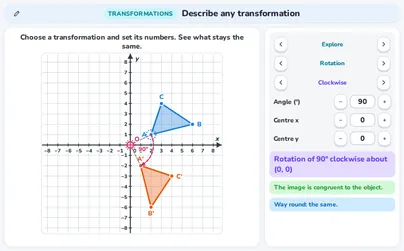
The four transformations compared

Translation, reflection and rotation keep the size (congruent); a reflection reverses the way round. An enlargement keeps the angles but changes the size (similar). Check the size and the way round of A, B, C.
xyxyxyxy
Example
Same size, same way round:translation or rotation
xyxy
Rule

Two transformations in a row

Two reflections in parallel mirrors at distance d make a translation by . Two mirrors crossing at an angle make a rotation by about the crossing. Two enlargements multiply: .
xym1m22d
Example
Mirrors x = 1 and x = 4:translation by 6 to the right
xyx=1x=46
Rule

A sequence of transformations

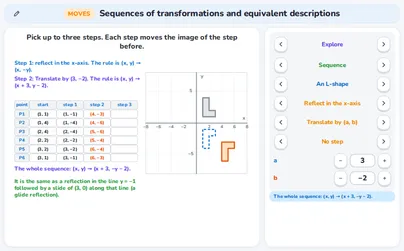
A sequence of transformations does one step after the other, and the order matters: reflect then translate is not the same as translate then reflect. Two reflections in parallel lines make one translation by twice the distance; two reflections in lines that meet make one rotation by twice the angle, about the point where they meet. In "Sequences of transformations and equivalent descriptions" you pick up to three steps in Sequence, two mirrors in Equivalent descriptions and build a sequence in Find the sequence.
Example
The point (2, 1) is translated by (3, −2) to (5, −1), reflected in the x-axis to (5, 1) and turned 90° anticlockwise about O to (−1, 5). Reflecting first gives (2, −1) and then translating gives (5, −3): another point. The mirror lines x = 1 and x = 4 are 3 apart, so the two reflections are one translation by 2 × 3 = 6.
Tip

Where next

Rotational symmetry of a shape is in Symmetry: mirror lines and rotation. Translations and reflections are in Translate and reflect on the grid. Scale drawings are in Ratio and proportion. Graphs moving is in Transforming graphs.
Example
Next: volumes and k³with the volume topic

Exercises

The point A (4, −1) is rotated 90° clockwise about the origin. Where does it land? Easy
xyOA
Show solution
The rule for 90° clockwise:
Here and , so the image is
xyOAA′
Answer → A′ (−1, −4)
Check: OA and OA′ are both .
The point A (2, 3) is enlarged from the origin with scale factor 3. Where does it land? Easy
xyOA
Show solution
Multiply both coordinates by k = 3
and
xyOAA′
Answer → A′ (6, 9)
A′ is 3 times as far from the origin as A.
Rotate A (4, 2) by 180° about the centre O (1, 1). Where is A′? Medium
xyOA
Show solution
A half turn: O is the middle of A and A′
xyOAA′
Answer → A′ (−2, 0)
Check the middle: and .
A (4, 6) is enlarged from the origin to A′ (2, 3). What is the scale factor? Medium
xyOAA′
Show solution
Compare one coordinate:
The other one agrees:
xyOAA′24
Answer → k = 1/2
k is between 0 and 1, so the image is smaller.
A rectangle of 3 by 2 is enlarged with scale factor 4. Give the sides and the area of the image. Hard
32
Show solution
Lengths × 4: and
Area:
32128696
Check with :
Answer → 12 by 8, area 96
The area is 16 times as big, not 4 times.
A (2, 0) turns to A′ (0, 2) about the origin. Describe the rotation completely. Hard
xyOAA′
Show solution
The rule for 90° anticlockwise is
fits
Centre: the origin (0, 0)
xyOAA′90°
Answer → 90° anticlockwise about (0, 0)
The same turn is 270° clockwise.
Are you a teacher?

Start live lessons with these applications for your whole class. Free to try for one month.

Try it free

Fits these school years

IB (MYP, Diploma): MYP 4, MYP 5, MYP 3

Cambridge International: Lower Secondary, stage 8, Lower Secondary, stage 9, IGCSE

Netherlands: Year 1, Year 2, Year 3 (havo, vwo), Vwo · Mathematics C

Türkiye (MEB): Year 8 (MEB), Year 9 (MEB), Year 10 (MEB)

England (GCSE, A Level): Year 8, Year 9, Year 10 (GCSE), Year 11 (GCSE)

USA (Common Core): Grade 8, Grade 7, Geometry

What the applications of this topic teach 8 applications

Rotate a shape about a centre

  • Rotating a point and a shape about the origin by 90°, 180°, 270°
  • Rotating about any centre on the grid
  • Knowing a rotation keeps distances from the centre, lengths and angles
  • Describing a rotation by angle, direction and centre

Find the centre of rotation

  • Finding the centre of a rotation on two perpendicular bisectors
  • Finding the angle and direction of a rotation
  • Checking a rotation by equal distances from the centre

Enlarge a shape from a centre

  • Enlarging a point and a shape from a centre with a scale factor k
  • Enlarging with a fractional scale factor
  • Knowing a negative scale factor puts the image on the other side
  • Knowing lengths scale by k and area by k × k

Find the centre and the scale factor

  • Finding the centre of an enlargement from object and image
  • Finding the scale factor as A′B′ ÷ AB
  • Describing an enlargement by scale factor and centre

Describe any transformation

  • Recognising translation, reflection, rotation or enlargement
  • Describing any of the four completely
  • Knowing which keep the size and which do not
  • Combining two transformations

Lengths and areas when you enlarge

  • Knowing lengths and perimeter are multiplied by k
  • Knowing the area is multiplied by k × k
  • Knowing the enlarged shape is similar, not congruent

Sequences of transformations and equivalent descriptions

  • Following a shape through up to three steps
  • Knowing two reflections give a translation or a rotation
  • Finding a sequence that maps a shape onto a target

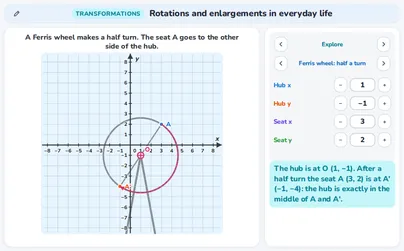
Rotations and enlargements in everyday life

  • Using rotations and enlargements: windmill, Ferris wheel, projector
  • Finding where a sail tip lands after quarter turns
  • Finding a projected corner with scale factor k