Interactive Lessons

Quadrilaterals and polygons: prove, classify and solve

Lecture notes

Definition

A quadrilateral and its diagonal

A quadrilateral has four corners and four sides. A diagonal joins two opposite corners and cuts it into two triangles, so the four angles add up to . Every proof in this subgroup starts from triangles.
ABCD
Example
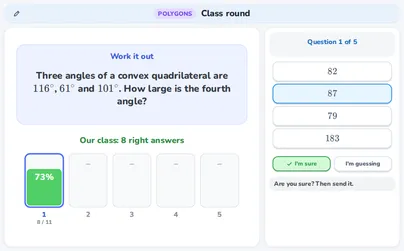
Three angles of a quadrilateral are , and . The fourth is .
78°104°95°?ABCD
Definition

The parallelogram

A parallelogram has two pairs of parallel sides. Then opposite sides are equal, opposite angles are equal and the diagonals bisect each other. It has no mirror line, unless it is a rhombus or a rectangle.
ABCDM
Example
Proof that opposite sides are equal: draw the diagonal AC. In triangles ABC and CDA the side AC is common and the alternate angles at A and at C are equal (two pairs of parallel sides), so the triangles are congruent by ASA. Then AB=CD and BC=DA.
ABCD
Rule

The rectangle

A rectangle is a parallelogram with four right angles. Its diagonals are equal and bisect each other, and it has two mirror lines: through the middles of opposite sides.
ABCD
Example
Proof that the diagonals are equal: in triangles ABC and DCB we have AB=DC, BC is common and angle B = angle C = , so they are congruent by SAS. Then AC=DB.
ABCD
Rule

The rhombus

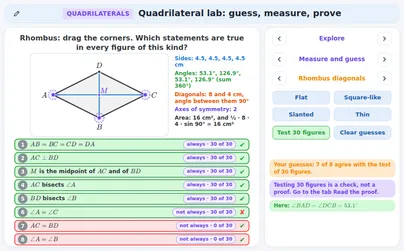
A rhombus has four equal sides. It is a parallelogram and also a kite. Its diagonals are perpendicular, bisect each other and bisect the angles; the two diagonals are its two mirror lines.
ABCDM
Example
Proof that the diagonals are perpendicular: in triangles ABM and ADM we have AB=AD, BM=DM and AM is common, so they are congruent by SSS. Then angle AMB = angle AMD, and together they make , so each is .
ABCDM
Rule

The square

A square is a rectangle and a rhombus at once: four equal sides and four right angles. Its diagonals are equal and perpendicular, and it has four mirror lines: both diagonals and both lines through the middles of the sides.
ABCD
Example
A square has a diagonal of . Its area is half the product of the diagonals: .
Rule

The trapezoid and its diagonals

A trapezoid has at least one pair of parallel sides. Its diagonals cut each other in the same ratio as the parallel sides: , because the triangles ABE and CDE are similar (AA, alternate angles).
ABCDE
Example
ABDC with AB=12 and DC=8. Then AE : EC = 12 : 8 = 3 : 2, so a diagonal of is cut into and .
ABCDE128
Rule

The isosceles trapezoid

An isosceles trapezoid has exactly one pair of parallel sides and two equal legs. The base angles are equal, the diagonals are equal and there is one mirror line: the perpendicular bisector of the parallel sides.
ABCD
Example
Proof that the diagonals are equal: in triangles ABC and BAD the side AB is common, BC=AD and the base angles at A and B are equal, so they are congruent by SAS. Then AC=BD.
Rule

The kite

A kite has two pairs of equal adjacent sides. One diagonal is its mirror line: it bisects the other diagonal at a right angle, so the diagonals are perpendicular. A kite is a triangle together with its mirror image in a side.
ABCDE
Example
A kite has AE=5, EC=16 and BE=ED=12 (the diagonals meet at E at a right angle). Then AB=13 and the area is .
ABCDE51612
Rule

The hierarchy of the quadrilaterals

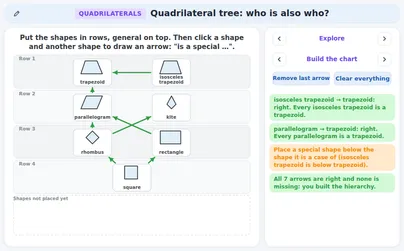
Arrows read “is also a”: a square is a rectangle and a rhombus, both are parallelograms; a parallelogram and an isosceles trapezoid are trapezoids; a rhombus is also a kite. What is true for a shape above is true for the shapes below it.
Example
A rhombus has perpendicular diagonals, because it is a kite. It also has parallel opposite sides, because it is a parallelogram. A kite is not always a parallelogram: its opposite sides are not parallel.
Rule

The area from the diagonals

In a convex quadrilateral with diagonals and that cross under the angle : area . The diagonals cut it into four triangles, and the formula adds their areas. For perpendicular diagonals .
30°ABCDE1210
Example
Diagonals and crossing under : area .
Rule

The diagonals of a parallelogram: four equal areas

The diagonals of a parallelogram cut it into four triangles of equal area. Each diagonal bisects the other, so the triangles on the same diagonal have equal bases and the same height. Each triangle is a quarter of the parallelogram.
SSSSABCD
Example
A parallelogram has area . Each of the four triangles has area .
Definition

Convex and concave polygons

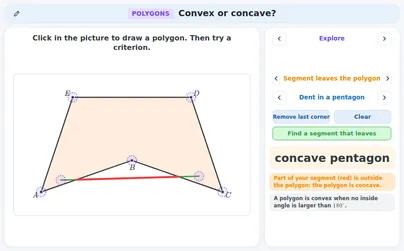
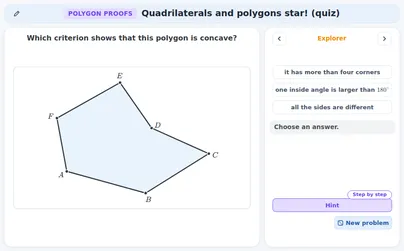
A polygon is convex when no inside angle is larger than ; otherwise it is concave and has a dent. In a convex polygon every segment between two points inside it stays inside.
Example
Three angles of a quadrilateral are , and . The fourth is , larger than : the quadrilateral is concave.
>180°ABCD
Rule

Three tests for a concave polygon

A polygon is concave if one of these holds: an inside angle is larger than ; a segment between two inside points leaves the polygon; a diagonal lies (partly) outside. The tests agree. One example is enough to show that a polygon is concave, but to show that it is convex you must check them all.
ABCDPQ
Example
In the quadrilateral ABCD with a dent at C the diagonal BD lies outside, while AC lies inside. One diagonal outside is enough: the quadrilateral is concave.
ABCD
Rule

Diagonals from one corner: and

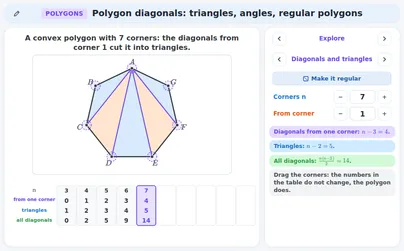
A convex polygon with corners has diagonals from one corner (not to itself and not to its two neighbours). They cut it into triangles. In all there are diagonals: corners times , and every diagonal is counted twice.
ABCDEF
Example
An octagon (): diagonals from one corner, triangles and diagonals in all.
ABCDEFGH
Rule

The sum of the inside angles

The triangles of a convex polygon have each, so the inside angles add up to . A regular polygon has equal angles: each inside angle is .
ABCDE
Example
A regular hexagon: in all, and for each angle.
Rule

The outside angles add up to

At every corner an inside angle and an outside angle make . Walking round a convex polygon you turn at every corner by the outside angle and come back facing the start: the outside angles add up to , whatever is. A regular polygon has outside angles .
72°ABCDE
Example
A regular polygon has outside angles of . Then : a decagon, with inside angles and diagonals.
36°
Rule

A regular polygon and its area

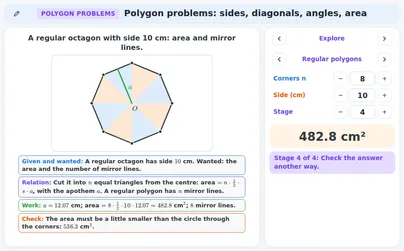
A regular polygon has equal sides and equal angles. Its centre cuts it into equal triangles; the height of each is the apothem . So area with side . A regular -gon has mirror lines.
60°
Example
A regular hexagon with side and apothem : area .
108.7
Rule

Regular polygons around a point

Around a point the angles must add up to exactly . Three regular hexagons (), four squares () or six triangles () fit without a gap. Three regular pentagons () leave a gap of .
120°120°120°
Example
A square () and a regular octagon () meet at a point. A third polygon needs : another octagon.
36°
Rule

Star patterns in Seljuk and Ottoman art

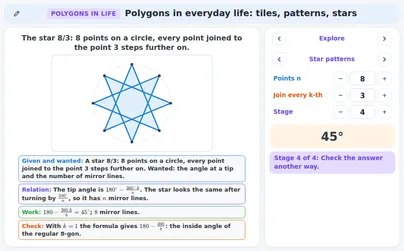
Put points on a circle and join every -th point: the star (written ). The angle at a tip is , and the star has mirror lines. With you get the regular polygon.
36°
Example
The star : the tip angle is , with mirror lines. The star has tips.
Tip

A hierarchy has shortcuts

An arrow from the square straight to the parallelogram is true, but it is not needed: the square is a rectangle, and a rectangle is a parallelogram. A good chart has only the arrows that are not already implied. To test an arrow “A is a B”, check that A has every property that defines B.
Example
Seven arrows are enough for the seven shapes. The dashed arrow from the square to the parallelogram is right, but it is a shortcut.
Tip

Measuring is a check, not a proof

Measure your own quadrilateral and the statement “the diagonals are equal” may hold in thirty figures and still fail in the thirty-first. A proof by triangles holds for every figure of the kind. Use measuring to guess, a proof to be sure, and a counterexample to refute: one figure where it fails is enough.
Example
A kite with a diagonal of and another of has equal diagonals, but it is not a rectangle. Equal diagonals do not prove a rectangle.
Watch out!

Two traps with diagonals

Perpendicular diagonals do not make a rhombus: a kite has them too. Equal diagonals do not make a rectangle: an isosceles trapezoid has them too. A shape is a rhombus when the diagonals also bisect each other, and a rectangle when they are equal and bisect each other.
Example
A quadrilateral has perpendicular diagonals of and that bisect each other: it is a rhombus with side , because .
Watch out!

The area formula and the dent

The proof of cuts the quadrilateral into four triangles at the point where the diagonals cross. That point must lie inside, so the proof is written for convex quadrilaterals. With a dent the diagonals do not cross inside and two lines of the proof stop being true. Judge a proof by where it breaks, not only by whether the result is true.
Example
A dart-shaped quadrilateral: the diagonal AC lies inside, but BD lies outside and the lines of the proof that need the crossing point E inside break.
Special case

The smallest polygons

A triangle has no diagonals () and is always convex. The smallest concave polygon is a quadrilateral. A square has four mirror lines and a parallelogram that is not a rhombus or a rectangle has none; a rectangle that is not a square has two.
Example
A concave quadrilateral has exactly one inside angle larger than : the other three add up to less than .
Tip

Where to look next

For a simpler first look at polygons open “Regular polygons and triangles by their angles” (polygon-properties) and “Angle problems in triangles and quadrilaterals” (polygon-angle-problems). For the classic pictures of the same shapes open quadrilateral-family, rhombus-diagonals, rectangle-diagonals, kite-diagonals, isosceles-trapezoid-diagonals, convex-concave-quadrilateral and convex-concave-figures. The conditions that prove a parallelogram are in parallelogram-tests, and regular-polygon-in-circle puts a regular polygon in a circle.
Example
After the proofs of this subgroup, parallelogram-tests shows the other direction: which facts are enough to know that a quadrilateral is a parallelogram.

Exercises

A parallelogram ABCD has . Find the other three angles. Easy
Show solution
Opposite angles are equal: .
Neighbouring angles add up to : .
.
Answer → and
Check: .
A rectangle is by . How long is a diagonal? Easy
Show solution
A diagonal cuts the rectangle into two right-angled triangles with legs and .
.
.
Answer →
Check: the other diagonal is also , because the diagonals of a rectangle are equal.
A convex polygon has corners. How many diagonals leave one corner and how many triangles do they make? Easy
Show solution
From one corner: diagonals.
Triangles: .
Answer → diagonals and triangles
Check: the ten triangles have , the angle sum of a dodecagon.
Three inside angles of a quadrilateral are , and . Find the fourth angle. Is the quadrilateral convex or concave? Easy
Show solution
The four angles add up to : .
An angle larger than means a dent: the quadrilateral is concave.
50°40°60°210°ABCD
Answer → , concave
Check: .
The diagonals of a rhombus are and . Find the side and the area. Medium
Show solution
The diagonals are perpendicular and bisect each other: four right-angled triangles with legs and .
ABCDM86
Side: .
Area: .
Answer → side , area
Check: four triangles of give .
In trapezoid ABCD with ABDC we have AB=12 and DC=8, and the diagonals meet at E. The diagonal AC is long. Find AE and EC. Medium
ABCDE128
Show solution
The triangles ABE and CDE are similar (AA, alternate angles), so .
AC is split in parts of .
and .
Answer → AE and EC
Check: and , the ratio of the parallel sides.
The diagonals of a kite meet at E at a right angle. AE=5, EC=16 and BE=ED=12. Find the side AB and the area. Medium
ABCDE51612
Show solution
Triangle AEB is right-angled: , so .
and .
Area: .
Answer → , area
Check: the four triangles give .
The diagonals of a convex quadrilateral are and and they cross under . Find the area. Medium
30°ABCDE1210
Show solution
Use area .
, so area .
Answer →
Check: with perpendicular diagonals () the area would be , twice as much: a small angle gives a thin quadrilateral.
A regular polygon has outside angles of . Find the number of corners, the inside angle and the number of diagonals. Medium
Show solution
The outside angles add up to : .
36°
Inside angle: .
Diagonals: .
Answer → corners, inside angle , diagonals
Check: , the same inside angle.
Find the tip angle and the number of mirror lines of the star . Medium
Show solution
Tip angle: .
36°
The star looks the same after a turn to the next point, so it has mirror lines.
Answer → and mirror lines
Check: with the formula gives , the inside angle of the regular octagon.
An isosceles trapezoid has parallel sides and and legs . Find its height and its area. Hard
ABCD14653
Show solution
The mirror line makes the two ends equal: each end sticks out .
A leg, the height and the end form a right-angled triangle: , so .
Area: .
Answer → height , area
Check: a rectangle by plus two triangles each gives .
A convex polygon has diagonals. How many corners does it have, and what is the sum of its inside angles? Hard
Show solution
, so .
Two numbers that differ by with product : , so .
Angle sum: .
Answer → corners, angle sum
Check: .
A square, a regular octagon and a third regular polygon meet at a point without a gap. Which polygon is the third? Hard
90°135°?
Show solution
The angles must add up to . The square has and the octagon has .
The third angle is .
The inside angle belongs to the regular octagon.
Answer → another regular octagon
Check: .
Prove that the diagonals of a rectangle ABCD are equal. Hard
ABCD
Show solution
Take the triangles ABC and DCB. Opposite sides of a rectangle are equal: .
The side BC is common to both triangles.
Both angles at B and C are right angles: .
So the triangles are congruent (SAS) and .
Answer → , by congruent triangles (SAS)
Note: the proof works for every rectangle. Measuring one rectangle would only be a check. The proof also works for a square.
Are you a teacher?

Start live lessons with these applications for your whole class. Free to try for one month.

Try it free

Fits these school years

IB (MYP, Diploma): MYP 1, MYP 2, MYP 3

Cambridge International: Lower Secondary, stage 9, IGCSE

Netherlands: Year 1, Vwo · Mathematics B, Vwo · Mathematics D, Year 3 (havo, vwo)

Türkiye (MEB): Year 11 (MEB)

England (GCSE, A Level): Year 10 (GCSE), Year 11 (GCSE), Year 12 (A Level)

USA (Common Core): Geometry

What the applications of this topic teach 6 applications

Quadrilateral lab: guess, measure and prove

  • Dragging an own quadrilateral and reading sides, angles and diagonals
  • Guessing which statements always hold and finding a counterexample
  • Putting the lines of a proof by triangles in order

Quadrilateral tree: who is also who?

  • Naming the seven special quadrilaterals and their properties
  • Finding which shapes always have the chosen properties
  • Building the hierarchy chart of “is also a”
  • Explaining why one shape is not always another

Convex or concave? Draw your own polygon

  • Telling a convex polygon from a concave one
  • Trying three criteria on an own polygon
  • Naming a polygon by its corners and its kind

Polygon diagonals: triangles, angles, regular polygons

  • Finding the diagonals from one corner and all diagonals of a polygon
  • Using the angle sum (n − 2) · 180°
  • Finding angles, mirror lines and area of a regular polygon

Polygon problems: sides, diagonals, angles, area

  • Writing what is given and wanted in a polygon problem
  • Choosing the relation and working it out
  • Checking an answer with another fact

Polygons in everyday life: tiles, patterns, stars

  • Working out how many tiles a floor needs, with extra for cutting
  • Saying which regular polygons fit around a point
  • Finding the tip angle and mirror lines of star patterns