Interactive Lessons

Likelihood and the probability scale

Lecture notes

Definition

The five words of likelihood

How likely an event is, is told with five words: impossible, unlikely, an even chance, likely, certain. As numbers ( is the probability): , , , and .
0121
Example
A die shows a 4: unlikely, .An even number: an even chance,
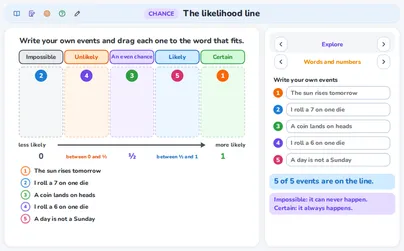
01211612
Rule

Impossible and certain

Impossible means it can never happen (), certain means it always happens (). The other three words sit in between: the closer to certain, the more likely.
0121
Example
A die shows a 7: impossible.A die shows 6 or less: certain
0/66/6
Definition

An even chance

An even chance means the event is as likely to happen as not: half of all outcomes. .
1/21/2
Example
A fair coin lands on heads:1 out of 2, an even chance
1/2
Rule

More, less or equally likely

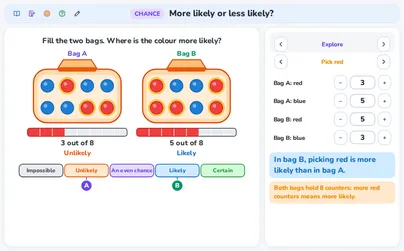
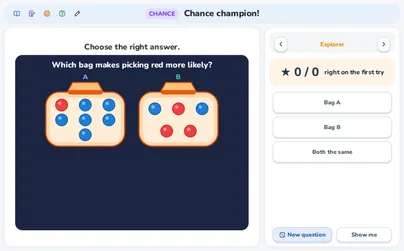
Compare the share of the counters, not their number: a bigger bag can hold more red counters and still give a smaller chance. Compare and as and .
36410
Example
3 red of 6 against 4 red of 10:the first bag is more likely
33A46B
Rule

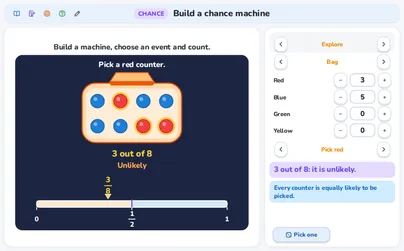
Read “k out of n” by counting

When every outcome is equally likely, count the outcomes that make the event happen () and all outcomes (). The chance is out of , or . “1 in 4” means .
kn
Example
3 red among 8 counters:3 out of 8, , unlikely
38
Definition

Equally likely outcomes

A machine is fair when every counter, sector, face or side has the same chance: equal sectors, a fair die, a fair coin. Only then can you count “k out of n”.
Example
A spinner with 4 equal sectors:every sector has a 1 in 4 chance
1/41/41/41/4
Watch out!

One pick proves nothing

One result does not show the likelihood: an unlikely event can happen and a likely event can miss. The likelihood belongs to the machine, not to one pick.
120
Example
1 red among 20 counters: unlikely,but one pick can still be red
Definition

The probability scale

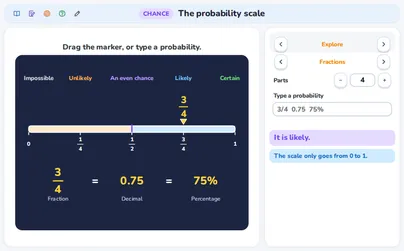
The probability scale is a number line from 0 to 1. Impossible is at 0, an even chance at , certain at 1. The five words sit along it, and .
00.51
Example
A probability of 0.9 is near 1:likely
00.510.9
Rule

Fraction, decimal and percentage

A probability can be a fraction, a decimal or a percentage: . Divide , then . Backwards: .
34=0.75=75%
Example
3415
Rule

Place an event on the scale

Count “k out of n”, write it as a fraction, a decimal or a percentage and mark it on the scale. Then read the word: below is unlikely, above is likely.
0121kn
Example
3 red and 7 blue: 3 out of 10 = 0.3,between 0 and 1/2: unlikely
0121310
Watch out!

Never below 0 or above 1

A probability is never below 0 and never above 1 (never above 100%). A value such as cannot be a probability: no event is more than certain.
−1012✘✘
Example
, and are no probabilities;0 and 1 are
−1012−0.31.2150%
Tip

Change the machine, change the chance

To change the likelihood, change the machine: add counters of the colour, colour more sectors or choose more faces. For red and blue (with ) add red counters for an even chance.
Example
2 red and 5 blue: add 3 red,then 5 red and 5 blue
2+55+5
Tip

Chance in everyday life

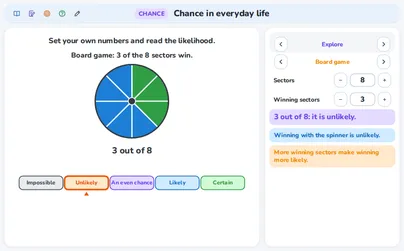
A raffle, a weather forecast and a board game hide the same idea: favourable out of all. A forecast of 30% rain is : 3 out of 10.
30%=310
Example
20 tickets sold, you hold 1:, unlikely
1/20 = 5%
Tip

What comes next

Experiments and relative frequency come next, then the formula for and the complement, then combined events with tables and tree diagrams. Fractions, decimals and percentages have their own lessons.
Example
Rolling the die 60 timesis an experiment: next lesson

Exercises

A bag has 3 red and 5 blue counters. What is the chance of picking red? Write it as “k out of n”. Easy
Show solution
Count the red counters:
123456783+5=8
Count all the counters:
The chance is 3 out of 8, or
38
Answer → 3 out of 8
The second number counts ALL counters, not only the blue ones.
Write as a decimal and as a percentage. Easy
Show solution
Divide:
34
Multiply by 100: %
75%
Answer → 0.75 and 75%
A percentage is a number out of 100.
Bag A has 3 red counters out of 6. Bag B has 4 red counters out of 10. In which bag is picking red more likely? Medium
AB
Show solution
Compare the shares, not the numbers: and
33A46B
Use the common denominator 30: and
15301230
, so bag A has the bigger share
Answer → bag A
Bag B has more red counters (4 against 3), but a smaller share.
The forecast says 30% chance of rain. Write it as a fraction in simplest form and say which word fits. Medium
Show solution
A percentage is out of 100:
30100
Divide top and bottom by 10:
, so rain is unlikely
0121310
Answer → 3/10: unlikely
Compare with (50%) to choose the word.
A bag has 2 red and 5 blue counters. How many red counters must you add to make red an even chance? Hard
Show solution
An even chance means as many red as blue,
The blue counters stay 5, so red must be 5:
5−2=3
Check: 5 red and 5 blue gives
510=12
Answer → 3 red counters
Adding red also changes the total: check with the new numbers.
A fair spinner has 8 equal sectors and 3 of them are red. What is the chance of red as a percentage? Hard
Show solution
3 out of 8 is
38
Divide:
Multiply by 100: %
012137.5%
Answer → 37.5%
37.5% is less than 50%, so red is unlikely.
Are you a teacher?

Start live lessons with these applications for your whole class. Free to try for one month.

Try it free

Fits these school years

IB (MYP, Diploma): PYP, MYP 1, MYP 2, MYP 3

Cambridge International: Primary, stage 5, Primary, stage 6, Lower Secondary, stage 7, Lower Secondary, stage 8, Lower Secondary, stage 9

Netherlands: Groep 6, Groep 7, Groep 8, Year 1, Year 2, Year 3 (havo, vwo)

Türkiye (MEB): Year 5 (MEB), Year 6 (MEB), Year 7 (MEB), Year 8 (MEB)

England (GCSE, A Level): Year 5, Year 6, Year 7, Year 8, Year 9

USA (Common Core): Grade 5, Grade 6, Grade 7, Grade 8

What the applications of this topic teach 5 applications

The likelihood line

  • Using the words impossible, unlikely, even chance, likely and certain
  • Placing own events on a likelihood line
  • Ordering events from least to most likely
  • Knowing impossible is 0, an even chance is 1/2 and certain is 1

More likely or less likely?

  • Telling which of two bags makes a colour more, less or equally likely
  • Comparing the share of counters, not their number
  • Reading “k out of n” by counting counters
  • Changing a bag to make an event more or less likely

Build a chance machine

  • Reading “k out of n” from a bag, spinner, die or coin
  • Knowing a fair machine has equally likely outcomes
  • Placing a chance on the scale 0 – 1/2 – 1 with its word
  • Seeing that one pick does not show the likelihood

The probability scale

  • Knowing the probability scale from 0 to 1 and its words
  • Writing a probability as fraction, decimal and percentage: 0.25 = 1/4 = 25%
  • Placing an event on the scale from its description
  • Using the scale for a weather forecast in per cent

Chance in everyday life

  • Matching everyday situations to a likelihood word
  • Reading the chance in a prize draw or board game by counting
  • Changing the numbers to make winning more likely
  • Reading a weather forecast in per cent