Interactive Lessons
Lecture notes Exercises

Function basics

Lecture notes

Definition

Function

A rule that gives every input exactly ONE output: a machine with numbers going in and coming out.
xfy
Example
Machine: × 2, then + 1. Put in 3:

3×26+17
Definition

Domain and range

The domain is the set of all inputs; the range is the set of all outputs.
123246xy
Example
for x from 0 to 3:
−112436xy39
Rule

Function notation

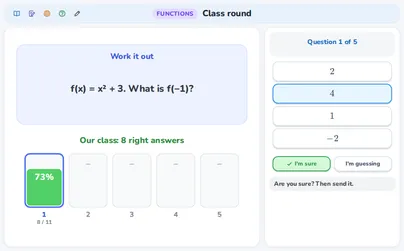
f(a) = b means: input a gives output b. Put the number in place of every x.
xyfab
Example
, find :
1235−2246812xy410
Rule

Solving f(x) = k

The output is given, the input is asked: set the formula equal to k and undo the steps.
xyxk
Example
and :
1245369xy311
Rule

Vertical line test

A graph is a function when NO vertical line meets it twice: every x has at most one y.
xy✔xy✘
Example
The circle at :
xy34−4✘
Rule

Pairs and arrows

In a set of pairs or an arrow diagram every input needs exactly one arrow. An output without an arrow is allowed.
123468✔123468✘
Example
Pairs , , :
12567✘
Rule

One-to-one

One-to-one: different inputs always give different outputs (no horizontal line meets the graph twice). Many-to-one: two inputs share an output, but it is still a function.
xy✔xy✘
Example
:
8xy24−2
Rule

Interval notation

≤ and ≥ give a square bracket, < and > a round one. ∞ always gets a round bracket.
01234x≥101234x>1
Example
012345672<x≤5
Rule

Which x is allowed?

Under a square root the number must be 0 or more. You cannot divide by 0.
xyxy
Example
:
2468−1123xy
Rule

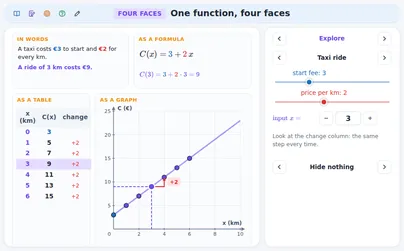
Four faces

One function can be told in words, a formula, a table and a graph. In a table: the same step each time is a line, the same factor each time is exponential.
x1234y2468+1+2+1+2+1+2✔x1234y24816+1×2+1×2+1×2
Example
Table , , :
12344812xy+1+3
Tip

Read f(x) = k on a graph

Draw the line : every point where it meets the graph is a solution. Count them.
xyk
Example
and : the line meets twice.
36xy39−3
Tip

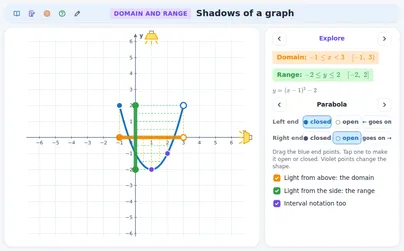
Domain and range are shadows

Domain: the shadow of the graph on the x-axis. Range: the shadow on the y-axis, from the lowest to the highest point. Look at the top too, not only at the ends.
24−224xy
Example
for : ends 3 and 0, lowest point −1.
134−224xy2−1
Watch out!

Input and output swapped

: the 3 is the input, the 7 is the output.
x=3fy=7
Example
:
6848xy37✘
Watch out!

Brackets with a negative input

Put a negative number in with brackets, or the minus sign is lost.
−2x²4✔
Example
, :
−22−6−336xy✔✘
Special case

Open and closed ends

A closed dot ● belongs to the graph (square bracket); an open dot ○ does not (round bracket). A graph that goes on for ever gets ∞.
xy
Example
, no end:
01234567x>3

Exercises

. Find and . Easy
Show solution
.
42x−53
.
xy43−1−7
Answer → ,
Check: the inputs differ by 5, the outputs by .
Is a function? Is it one-to-one? Easy
1234357
Show solution
The inputs 1, 2, 3, 4 each appear once: a function.
The output 3 appears twice (inputs 1 and 3).
1234357
Answer → a function, but many-to-one
Check: a one-to-one function would have 4 different outputs.
A taxi ride of x km costs euros. You paid 13 euros. How many km did you ride? Medium
Show solution
Set : .
Undo the + 3: .
13−310÷25
Undo the × 2: .
2851020xy513
Answer → 5 km
Check: .
What is the domain of ? Medium
Show solution
Under the root: .
, so .
369−11234xy
Answer → , that is
Check: exists; does not.
Find the range of for . Hard
Show solution
The lowest point is the vertex , inside the domain: .
xy12
The ends: and .
The highest value is the bigger end: 11.
xy6112
Answer → , that is
Check: would be wrong, because it misses the vertex.
How many solutions has for , with , and ? Hard
Show solution
: : two solutions.
: : one solution.
: has : none.
xy−3−4−5
Answer → 2, 1 and 0 solutions
Check: the lowest point of the parabola is : below it the line misses the graph.
Are you a teacher?

Start live lessons with these applications for your whole class. Free to try for one month.

Try it free

Fits these school years

IB (MYP, Diploma): MYP 4, MYP 5, Diploma, year 1

Cambridge International: Primary, stage 6, Lower Secondary, stage 7, Lower Secondary, stage 8, Lower Secondary, stage 9, IGCSE, AS Level

Netherlands: Groep 7, Groep 8, Year 1, Year 2, Year 3 (havo, vwo), Havo · Mathematics A, Vwo · Mathematics A, Vwo · Mathematics B, Vwo · Mathematics C, Vmbo bb (years 3-4), Vmbo kb (years 3-4), Vmbo gt (years 3-4), Havo · Mathematics B

Türkiye (MEB): Year 5 (MEB), Year 9 (MEB), Year 10 (MEB), Year 8 (MEB)

England (GCSE, A Level): Year 6, Year 7, Year 8, Year 9, Year 10 (GCSE), Year 11 (GCSE), Year 12 (A Level)

USA (Common Core): Grade 5, Grade 8, Algebra 1, Algebra 2

What the applications of this topic teach 8 applications

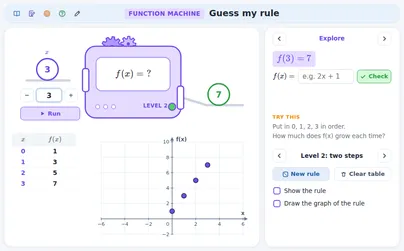
Function machine: guess my rule

  • Finding the output of a function machine for any input
  • Guessing the rule from inputs and outputs in a table
  • Knowing that a machine may refuse an input: the domain

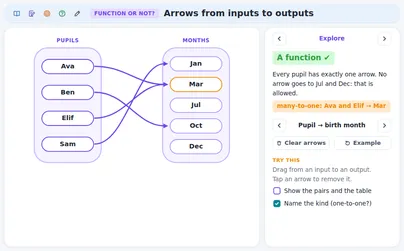
Arrows: function or not?

  • Telling from arrows whether a relation is a function
  • Telling one-to-one from many-to-one
  • Drawing arrows that meet conditions

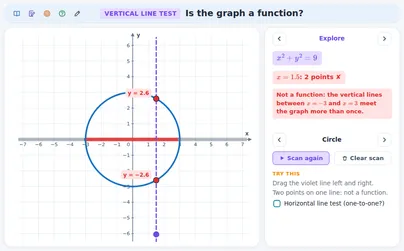
The vertical line test

  • Using the vertical line test to decide if a graph is a function
  • Using the horizontal line test for one-to-one
  • Knowing why open and closed dots matter

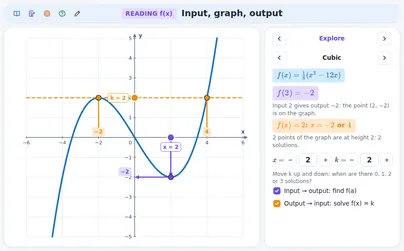
Reading f(x) on a graph

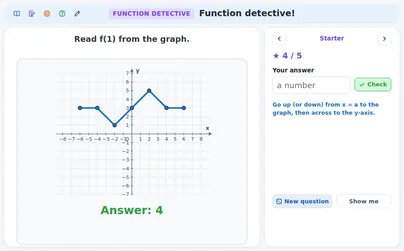
  • Reading f(a) from a graph
  • Finding every x with f(x) = k from a graph
  • Saying what f(9) = 14 means in a story

Domain and range: shadows of a graph

  • Reading the domain and the range from a piece of graph
  • Writing domain and range with inequalities and interval notation
  • Telling open, closed and endless ends

One function, four faces

  • Moving between words, formula, table and graph of one function
  • Telling from a table whether the step or the factor is constant
  • Building the formula from the words

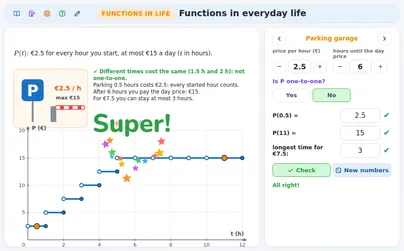
Functions in everyday life

  • Using function notation in a story: C(5) = 13
  • Saying which inputs make sense and which outputs are possible
  • Solving f(x) = k in a story

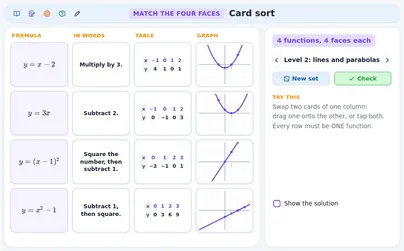
Match the four faces (card sort)

  • Matching the words, table, graph and formula of one function
  • Telling a line from a parabola from an exponential graph
  • Checking a match with a point of the graph