Interactive Lessons

Exponential functions

Lecture notes

Definition

Exponential growth

In an exponential function equal steps in x multiply y by the same number b. The start value a is y at ; b is the growth factor.
xyaabab²ab³×b×b×b
Example
gives 3, 6, 12, 24: every step × 2:
xy361224×2×2×2
Rule

Growth or decay

is growth: y gets bigger. is decay: y gets smaller. changes nothing.
xyb>1b<11
Example
: 80, 40, 20. It halves every step:
xy804020×0.5×0.5
Rule

Percentage and growth factor

+p % per step means . −p % per step means . Changing by a percentage is multiplying.
b1p/100b1−p/100
Example
+6 % gives × 1.06; −20 % gives × 0.8:
1.061+0.0610.80.2
Rule

Finding a value

To find y at x, multiply the start value a by b, x times. For a different time step, use a power of b.
aabab²…abˣ012…xxy×b×b
Example
at : :
51545012xy×3×3
Definition

The asymptote

bˣ is never 0. The graph of comes closer and closer to the x-axis but never touches it. With the range is .
xyy=0
Example
at is small but not 0:
xy−30.3753
Rule

Doubling time and half-life

The time for × 2 (or × ½) is the same wherever you start. After m doubling times the amount is 2ᵐ times as big.
T2T3Txy×2×2
Example
It doubles every 3 hours: after 12 hours that is 4 doublings:
36912481216xy124816
Rule

Finding b from two values

Divide the two y-values. If x goes up by k steps, that ratio is b to the power k. Take the k-th root to get b.
xykx₁x₂y₁y₂y₂÷y₁
Example
and : , so :
xy3×8648
Rule

Compound interest and e

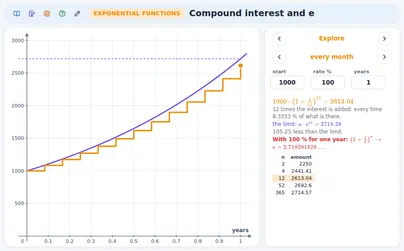
With interest added n times a year, the amount grows as . More often gives only a little more and closes in on .
xyn=1n=12e
Example
€1000 at 10 % a year, added once a year: after 2 years:
xy100011001210
Watch out!

Percentages do not cancel

+10 % and then −10 % does not bring you back: the second percentage is taken of a bigger amount. Multiply the factors.
100+10%110−10%99✘
Example
, not 100:
100110100+1011099−11
Tip

Exponential beats linear

Adding the same amount is slow, multiplying by the same factor is fast. However strong the linear plan, 2ˣ passes it in the end.
xy2ˣax
Example
2ˣ against 1000x: at it is behind, at it is ahead:
xy÷1000
Tip

Answer by trying

For “when is it more than …?” try whole steps one by one until the value passes the target. The step before it is still under the target.
xynn+1c
Example
€500 at 4 % a year, past €600? After 4 years €585, after 5 years €608:
xy45585608600

Exercises

A quantity starts at 200 and grows by 5 % every step. What is the growth factor and the value after 2 steps? Easy
Show solution
.
After 2 steps: .
200210220.5012xy×1.05×1.05
Answer → ; the value is 220.5
Check: and .
. Is it growth or decay? Find y at , and . Easy
Show solution
is bigger than 1, so it is growth.
: (the start value). : .
: .
xy412108
Answer → growth; , 12 and 108
Check: , every step × 3.
A phone costs €600 and loses 20 % of its value every year. What is it worth after 3 years? What is the asymptote? Medium
Show solution
.
.
xy600480384307.2
The value gets closer to 0 but never reaches it: the asymptote is .
xyy=0
Answer → €307.20; the asymptote is
Check: .
Bacteria double every 4 hours. There are 50 now. How many after 12 hours, and after how many hours are there 1600? Medium
Show solution
12 hours is doublings: .
5010020040004812hn×2×2×2
, so 5 doublings.
hours.
xy12204001600
Answer → 400 bacteria; 20 hours
Check: 50, 100, 200, 400, 800, 1600 is five doublings.
. Find a and b. Hard
Show solution
From to are 3 steps: .
xy3×276162
So , because .
, so .
xy26162
Answer → and
Check: .
€2000 earns 3 % interest a year, also on the interest. After how many whole years is there more than €2200? Hard
Show solution
, so .
Try: is about 2185, still under 2200.
is about 2251, over 2200.
xy34218522512200
Answer → after 4 years
Check: 3 years is not enough (2185), 4 years is (2251).
Are you a teacher?

Start live lessons with these applications for your whole class. Free to try for one month.

Try it free

Fits these school years

IB (MYP, Diploma): MYP 4, MYP 5, Diploma, year 1

Cambridge International: Lower Secondary, stage 9, IGCSE, AS Level

Netherlands: Year 2, Year 3 (havo, vwo), Vmbo kb (years 3-4), Vmbo gt (years 3-4), Havo · Mathematics A, Havo · Mathematics B, Vwo · Mathematics A, Vwo · Mathematics B, Vwo · Mathematics C

Türkiye (MEB): Year 11 (MEB)

England (GCSE, A Level): Year 9, Year 10 (GCSE), Year 11 (GCSE), Year 12 (A Level)

USA (Common Core): Grade 8, Algebra 1, Algebra 2, Precalculus

What the applications of this topic teach 9 applications

Fold paper to the moon

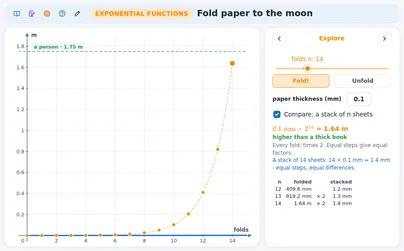
  • Seeing that every fold multiplies the thickness by 2
  • Comparing a stack of n sheets with n folds
  • Saying how many folds pass a landmark

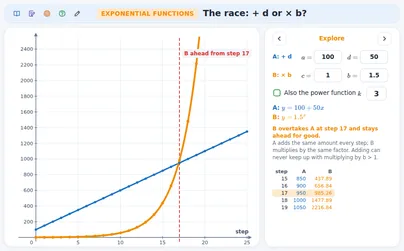
The race: linear against exponential

  • Telling plan A adding the same amount from plan B multiplying
  • Saying who is ahead at a step and when B overtakes A
  • Working out the values of A and B at a step

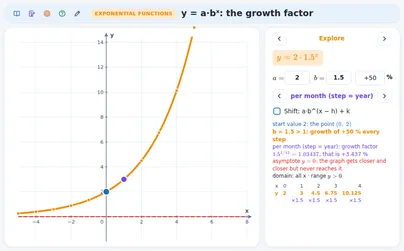
y = a·bˣ: growth factor and percentage

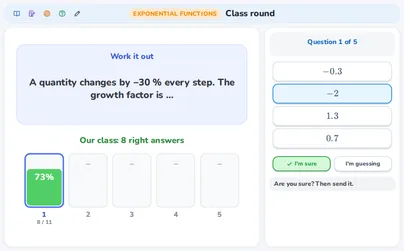
  • Turning a percentage per step into the growth factor b and back
  • Telling growth from decay for y = a · bˣ and finding the asymptote
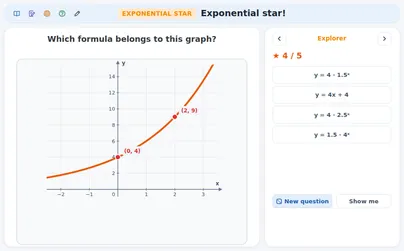
  • Finding a and b of a curve through two points

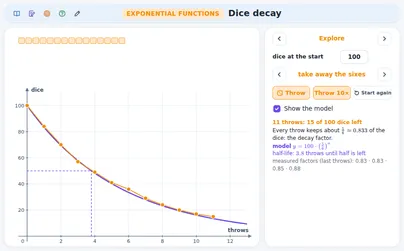
Dice decay: a real experiment

  • Seeing that every throw keeps the same fraction, not the same number
  • Estimating how many dice are left after n throws
  • Seeing that chance moves the real count around the model

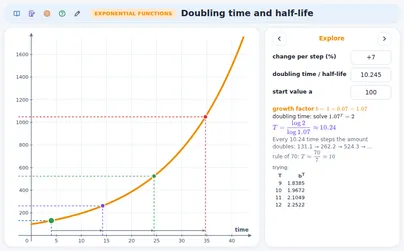
Doubling time and half-life

  • Knowing the doubling time or half-life is the same from any start
  • Working out the amount after m doubling times
  • Finding the time to a given amount by counting doublings

Compound interest and the number e

  • Seeing that interest on interest multiplies the amount each time
  • Working out the amount with interest added n times a year
  • Seeing that adding more often closes in on the continuous amount

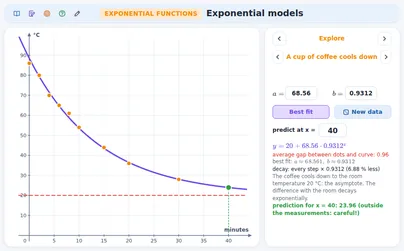
Exponential models: fit the data

  • Setting a and b so the curve fits the dots and reading the gap
  • Knowing a is about the value at x = 0 and b the ratio of neighbours
  • Using the model for a prediction and knowing its limits

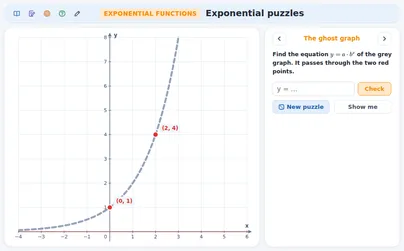
Exponential puzzles

  • Finding y = a · bˣ from two marked points of a graph
  • Turning a percentage into a growth factor, also per month from per year
  • Working out an amount after doubling times or half-lives

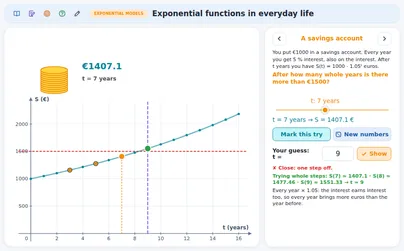
Exponential functions in everyday life

  • Reading an everyday situation as y = a · bᵗ
  • Finding after how many whole steps the target is passed
  • Knowing a model holds only for a while