Interactive Lessons

Translate and reflect on the grid

Lecture notes

Definition

Translation (slide)

A translation slides a whole shape the same distance in the same direction. Every point moves in the same way; the shape is not turned and not flipped.
xy
Example
A house slides 3 rightand 2 up
xy32
Definition

Column vector (a, b)

A translation is written as a column vector (a, b). The top number a says how far right (+) or left (−), the bottom number b how far up (+) or down (−).
xyab
Example
is 3 right,2 down
xy3−2
Definition

The image A′

The shape after the move is the image. Its corners get primes: A goes to A′, B to B′, C to C′. After a translation the image is congruent to the object and goes round the same way.
xyABCA′B′C′
Example
Triangle ABC → A′B′C′:same size, same way round
xyABCA′B′C′
Rule

The vector from object to image

Compare one corner with its image. The first number is x′ − x (right or left), the second is y′ − y (up or down). Every other corner gives the same vector.
xyAA′x′−xy′−y
Example
:
123456−11234xyAA′3−2
Rule

The way back

The move that undoes a translation is the opposite vector: change the sign of both numbers.
xyAA′v−v
Example
back:
123456−11234xyAA′(3,−2)(−3,2)
Rule

Two translations and n times

Two translations in a row are one translation by the sum: add the tops and add the bottoms. The same vector n times: multiply both numbers by n.
xyAA′A″vwv+wxyvnv
Example
3 × =
xyAA′A″(2,1)(3,−4)(5,−3)xy(2,−1)(6,−3)
Rule

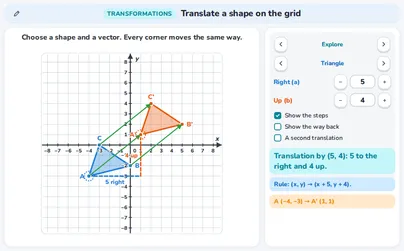
The rule (x, y) → (x + a, y + b)

On the grid a translation by (a, b) adds a to every x and b to every y.
xyPP′ab
Example
xy(2,5)(6,2)4−3
Definition

Reflection (mirror image)

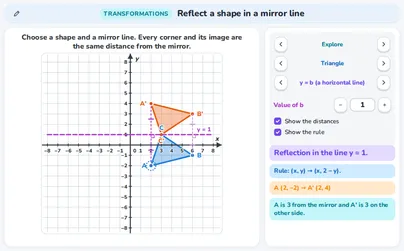
A reflection flips a shape over a mirror line. The image is congruent to the object but turned the other way round: A, B, C go round one way and A′, B′, C′ the other way.
xyABCA′B′C′
Example
ABC anticlockwise →A′B′C′ clockwise
xyABCA′B′C′
Rule

The mirror is the perpendicular bisector

The mirror line is the perpendicular bisector of A and A′: halfway between them and at right angles to the line AA′. So A and A′ are the same distance from the mirror, on opposite sides.
xyAA′Mdd
Example
A is 3 from the mirror,so
xyAA′M33
Rule

Reflect in the axes

In the x-axis the sign of y changes: . In the y-axis the sign of x changes: .
xy(x,y)(x,−y)(−x,y)
Example
xy(3,5)(3,−5)(−3,5)
Rule

Reflect in x = a and y = b

Count the distance to the line and go as far on the other side. In x = a: . In y = b: .
xyx=aPP′ddxyy=bPP′dd
Example
xyx=3(1,4)(5,4)22xyy=2(1,4)(1,0)22
Rule

Reflect in y = x and y = −x

In y = x the two numbers swap: . In y = −x they swap and both signs change: .
xy(x,y)(y,x)xy(x,y)(−y,−x)
Example
xy(2,5)(5,2)xy(2,5)(−5,−2)
Rule

Find the mirror line

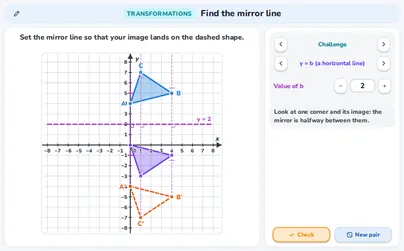
Join A and A′ and find the middle M. The mirror goes through M at right angles to AA′. If AA′ goes across, the mirror is x = a; if it goes up and down, the mirror is y = b.
xyAA′M
Example
A (1, 3), A′ (5, 3): the mirror is
xyx=3(1,3)(5,3)(3,3)
Special case

Points on the mirror stay

A point on the mirror line is its own image. Count the corners on the line: those corners do not move.
xyA=A′BCB′C′
Example
1 corner on the mirror:1 stays, 2 move
xyA=A′BCB′C′
Watch out!

Translation or reflection?

Look at the order of A, B, C. The same way round and the same vector for every corner: a translation. The other way round: a reflection. A bigger or smaller shape is neither.
xyABCA′B′C′xyABCA′B′C′
Example
ABC anticlockwise, A′B′C′clockwise: a reflection
xyABCA′B′C′
Rule

Describe completely

A translation needs the vector, a reflection needs the mirror line with its equation. “A translation” or “a reflection” alone is not a complete description.
xyvxym
Example
Translation by Reflection in x = 4
xy(3,−2)xyx=4
Watch out!

Translation then reflection: the order

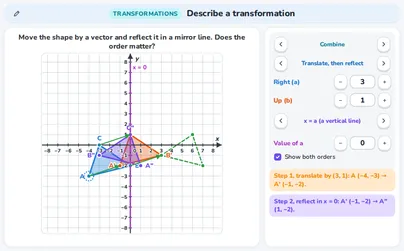
Do the moves one after the other: A goes to A′ and then to A″. Do both orders and compare. The order often matters; it does not when the vector lies along the mirror line.
xyAA′A″xyAA′A″
Example
A (1, 2): move (3, 0), y-axis → reflect first, then move →
xy(1,2)(4,2)(−4,2)xy(1,2)(−1,2)(2,2)
Tip

Where next

The mirror lines of a shape are in Symmetry: mirror lines and rotation. Points in four quadrants are in Coordinates in four quadrants. Moving a graph is in Transforming graphs. Rotation and enlargement come next.
Example
Next: rotation andenlargement

Exercises

The point (2, −1) is moved by the vector (3, 4). Where does it land? Easy
Show solution
Add the first number to x:
xy(2,−1)(5,3)34
Add the second number to y:
Answer → (5, 3)
Right and up are positive, left and down negative.
Reflect the point (4, 1) in the x-axis and then in the y-axis. Give both images. Easy
xy(4,1)
Show solution
In the x-axis the sign of y changes:
In the y-axis the sign of x changes:
xy(4,1)(4,−1)(−4,1)
Answer → (4, −1) and (−4, 1)
The axis you reflect in keeps its own number.
A (2, 5) is moved to A′ (−1, 1). Which vector does that? Which vector brings A′ back to A? Medium
−224123456xyAA′
Show solution
First number:
Second number:
−224123456xyAA′−3−4
The way back has the opposite signs:
Answer → (−3, −4); back (3, 4)
Always image minus object, never the other way round.
Reflect the point (1, 4) in the line x = 3. Medium
xyx=3(1,4)
Show solution
The distance from x = 1 to the line x = 3 is 2
Go 2 more on the other side:
xyx=3(1,4)(5,4)22
y stays 4
Answer → (5, 4)
Check: 3 is halfway between 1 and 5.
A (−2, 1) has the image A′ (4, 1) in a mirror line. Which line is it? Hard
−2242xyAA′
Show solution
A and A′ have the same y, so AA′ goes across and the mirror is a vertical line x = a
The middle:
−2242xyx=1AA′M33
Answer → x = 1
Check the distances: A is 3 left of the line, A′ is 3 right.
Move A (1, 2) by (3, 0) and then reflect in the y-axis. Then reflect first and move after. Does the order matter? Hard
Show solution
Move first: , then the y-axis: (−4, 2)
Reflect first: (−1, 2), then move:
xy(1,2)(4,2)(−4,2)xy(1,2)(−1,2)(2,2)
(−4, 2) and (2, 2) are different points
Answer → yes, (−4, 2) or (2, 2)
The order does not matter only when the vector lies along the mirror line.
Are you a teacher?

Start live lessons with these applications for your whole class. Free to try for one month.

Try it free

Fits these school years

IB (MYP, Diploma): MYP 4, MYP 5, MYP 1, MYP 2, MYP 3

Cambridge International: Primary, stage 6, Lower Secondary, stage 7, Lower Secondary, stage 8, Lower Secondary, stage 9

Netherlands: Groep 8, Year 1, Year 2, Year 3 (havo, vwo)

Türkiye (MEB): Year 7 (MEB), Year 8 (MEB)

England (GCSE, A Level): Year 6, Year 7, Year 8, Year 9

USA (Common Core): Grade 8, Grade 6

What the applications of this topic teach 5 applications

Translate a shape on the grid

  • Translating a point and a shape by a column vector
  • Finding the vector from object to image and naming images A′, A″
  • Giving the way back and the one vector of two translations
  • Writing a translation as the rule (x, y) → (x + a, y + b)

Reflect a shape in a mirror line

  • Reflecting a shape in the axes and in x = a, y = b, y = x, y = −x
  • Knowing the mirror line is the perpendicular bisector of A and A′
  • Using the reflection rules such as (x, y) → (x, −y)
  • Knowing a reflection keeps lengths and angles but turns the way round

Find the mirror line

  • Finding the mirror line from a point and its image
  • Naming the mirror line with its equation
  • Finding the mirror line of a whole shape and its image

Describe a transformation

  • Translating then reflecting, and telling if the order matters
  • Telling a translation from a reflection by the way round
  • Describing a move completely

Translations and reflections in everyday life

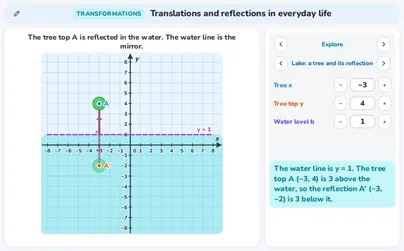
  • Using translations and reflections in a ship on a map, a lake, a butterfly
  • Finding where a ship or robot ends after one or two moves