Interactive Lessons

Show with algebra that a property always holds

Lecture notes

Definition

Even number

An even number is made of pairs. Every even number can be written as 2n, where n is a whole number.
2n
Example
Is 18 even? It is made of pairs:

2×9
Definition

Odd number

An odd number is pairs and one left over. Every odd number can be written as 2n + 1.
2n+1
Example
Is 21 odd? Pairs and one left over:
2×10+1
Definition

Consecutive numbers

Consecutive numbers follow each other: n, n + 1, n + 2. Three consecutive numbers that start at 5 are 5, 6 and 7.
nn+1n+2+1+1
Example
Four consecutive numbers starting at 8 are 8, 9, 10 and 11:
891011+1+1+1
Definition

Proof

A proof is an argument that works for every number, not only for the numbers you tried. A letter stands for every number, so a calculation with a letter can be a proof.
aa+bb2a+2b
Example
Claim: the sum of two even numbers is even. Tests like are not enough, but letters cover all:
22+334+6
Definition

Counterexample

A counterexample is one number for which a claim is false. One counterexample is enough to show that a claim is not true.
n3940f16011681✔✘
Example
Claim: “ is always odd”. Try : is even, so the claim is false:
n123n²+34712✘✔✘
Rule

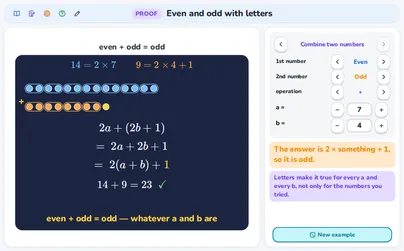
Even + even

Even plus even is even: two times a whole number.
aa+bba+ba+b
Example
Add 12 and 20 with letters, and :
66+10106+106+10
Rule

Odd + odd

Odd plus odd is even: the two ones make a pair.
aa+bb+a+b+a+b+
Example
Add 7 and 9: and . The two ones make a pair:
33+44+3+4+3+4+
Rule

Even + odd

Even plus odd is odd: two times a whole number plus one.
aa+bb+
Example
Add 6 and 9: and . One 1 is left over:
33+44+
Rule

Products

Even times anything is even. Odd times odd is odd: (2a + 1)(2b + 1) is 2 times a whole number plus 1.
2b12a14ab2b2a1
Example
Multiply 3 and 5: and . The product is odd; 4 times 7 is even:,
41218421
Rule

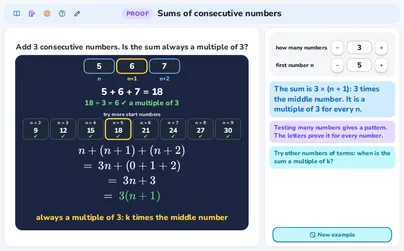
Three consecutive numbers

Add them with letters, collect the n’s and take out the common factor: the sum is always a multiple of 3.
nnn0+1+2
Example
Take 9, 10 and 11, starting at . Collect the ’s:, here
91011+1+13×10
Rule

k consecutive numbers

The sum of k consecutive numbers is always a multiple of k when k is odd, and never when k is even.
k3456s6101521✔✘✔✘
Example
Seven consecutive numbers starting at 1 add up to a multiple of 7. Four numbers (1, 2, 3, 4) do not:, but
k74s2810✔✘
Rule

Take out the factor

To show that a number is a multiple of m, write it as m times a whole number: take the common factor out.
32n36n9
Example
Show that is a multiple of 4. Take out the common factor 4:
42n38n12
Rule

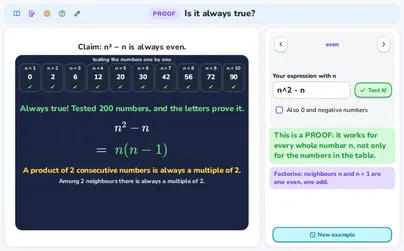
Neighbours

The product of two neighbouring numbers is always even, because one of them is even.
345678
Example
Neighbours 7 and 8, one is even, so the product is even. In letters:, here
7856
Rule

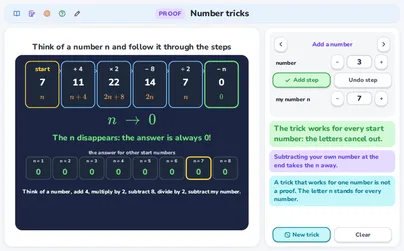
Number trick

Follow the letter n through the steps of a number trick. When the n disappears, everyone gets the same answer.
n2n+6n+33×2+6÷2−n
Example
Think of , add 4, double it, subtract . What is left?, e.g. :
59188+4×2−10
Rule

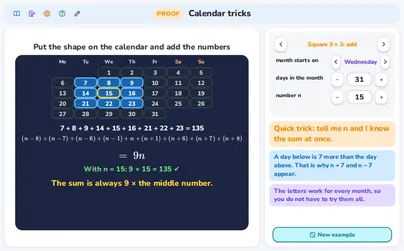
Calendar

On a calendar the day below is 7 more. A 3 × 3 square adds up to 9 times its middle number.
n−8n−7n−6n−1nn+1n+6n+7n+8
Example
A 3 × 3 square with middle number 20 has the sum:
121314192021262728
Tip

Test first, then prove

Try a few numbers first to find a pattern. Then use a letter to prove it.
n258s91827✔✔✔
Example
Sum of 3 consecutive numbers, test: , . Pattern: multiples of 3. Now prove it:
n25s918✔✔
Tip

Look for the factor

To prove “a multiple of 3”, try to write the answer as 3 times something.
nnn
Example
Prove that is a multiple of 6. Try to write it as 6 times something:
62n312n18
Tip

Small and odd numbers

To find a counterexample, try 0, 1, 2 and 3 first, and also some odd numbers.
012345678
Example
Claim: “ is always prime”. Try 0, 1, 2 and 3 first, then some odd numbers like 5: is prime, but
n56f1321✔✘
Watch out!

Examples are not a proof

Many examples that work prove nothing: n² + n + 41 is prime for n = 1 up to 39, but not for n = 40.
n123940f434716011681✔✔✔✘
Example
is prime for to , yet for :
n3941f16011763✔✘
Watch out!

Use different letters

Two numbers that can be different need two letters: 2a + 2b, not 2a + 2a. With one letter you only prove it for equal numbers.
aaaa✘aa+bb✔
Example
To show that the sum of two even numbers is even, write 8 + 10:✘ (only equal numbers) ✔ , here ,
4444✘44+55✔
Watch out!

One number can break it

A claim can work for many numbers and still be false: “n² is bigger than n” fails for n = 1.
−112342468xy
Example
Claim: “”. It works for () and (), but for :, not bigger
1234561218xy
Special case

Zero and negative numbers

Zero is even. Letters also work for negative numbers: −3 is odd.
−5−3035
Example
Is 0 even? Is −5 odd? and
−505
Special case

Four consecutive numbers

The sum of 4 consecutive numbers is never a multiple of 4: the bracket 2n + 3 is odd.
nnnn
Example
Four consecutive numbers 3, 4, 5, 6 add up to 18, not a multiple of 4. In letters:, with :
3456+1+1+118

Exercises

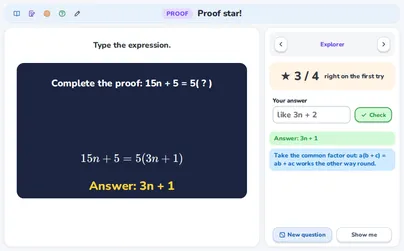
Show that the sum of two even numbers is even. Use and . Easy
aa+bb
Show solution
a+ba+b
is a whole number, so is even
Answer → always even
Check: and .
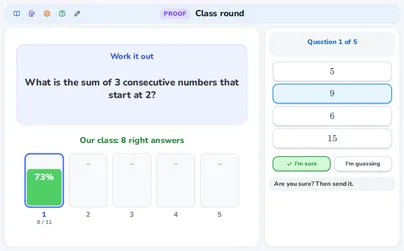
Show that the sum of 3 consecutive numbers is a multiple of 3. Medium
nn+1n+2+1+1
Show solution
nnn
nnn
Answer → always a multiple of 3
Check: and .
Is always even? Try first, then prove it. Medium
nn
Show solution
: , which is even
34
and are neighbours: one of them is even, so the product is even
34
Answer → always even
Check: .
Find a counterexample to: “ is always prime”. Hard
n123940f43471601?
Show solution
up to all give primes
:
n123940f434716011681✔✔✔✘
, so it is not prime
Answer → is a counterexample
Check: .
Number trick: think of , double it, add 6, halve it and subtract . What do you get? Hard
n???×2+6÷2−n
Show solution
n2n+6n+33×2+6÷2−n
Answer → always
Check: with you get , , and .

Interactive applications for this topic

Free applications open with a free student account. Teachers can use all applications in a live lesson.

About the free account and Plus

Are you a teacher?

Start live lessons with these applications for your whole class. Free to try for one month.

Try it free

Fits these school years

IB (MYP, Diploma): MYP 2, MYP 3, MYP 4

Cambridge International: Lower Secondary, stage 8, Lower Secondary, stage 9, IGCSE

Netherlands: Year 2, Year 3 (havo, vwo), Year 1, Havo · Mathematics A, Havo · Mathematics B, Vwo · Mathematics A, Vwo · Mathematics B, Vwo · Mathematics C

Türkiye (MEB): Year 7 (MEB), Year 8 (MEB)

England (GCSE, A Level): Year 8, Year 9, Year 10 (GCSE)

USA (Common Core): Grade 8, Algebra 1
What the applications of this topic teach 5 applications

Even and odd with letters

  • Writing even and odd numbers with a letter: 2n and 2n + 1
  • Showing with letters that even + odd is odd
  • Knowing that a letter stands for every number

Sums of consecutive numbers

  • Writing consecutive numbers as n, n + 1, n + 2
  • Showing that the sum of 3 consecutive numbers is a multiple of 3
  • Knowing that testing many numbers is not a proof

Is it always true?

  • Testing a claim with many numbers and finding a counterexample
  • Showing with letters that a claim about even or odd always holds
  • Stating a conjecture and testing it before proving it

Number tricks

  • Following the letter n through the steps of a number trick
  • Seeing when the n disappears and the answer is always the same
  • Building an own number trick and proving it with n

Calendar tricks

  • Seeing algebra in a calendar
  • Using n for any number on a calendar
  • Showing that a calendar pattern always holds