Interactive Lessons

Shape puzzles, tilings and models

Lecture notes

Definition

The seven tangram pieces and their size

A tangram has seven flat pieces: two large triangles, one medium triangle, two small triangles, one square and one parallelogram. Together they make a square. We measure a piece in small triangles: the whole tangram is 16 small triangles.
4421122
Example
Large triangles 4 and 4, medium triangle 2, small triangles 1 and 1, square 2, parallelogram 2. small triangles.
Rule

The size of a piece: count the small triangles

Two small triangles make a medium triangle, a square or a parallelogram. Two medium triangles make a large triangle. So a small triangle counts 1, a medium triangle, a square and a parallelogram count 2, and a large triangle counts 4.
42122
Example
A figure uses a large triangle, a square and a small triangle → small triangles.Small triangles left → .
Rule

Turning, sliding and flipping: the size stays the same

You may turn a piece (key R), slide it and flip it over (key F). The piece keeps its size. Only the parallelogram looks different when you flip it: its mirror image slants the other way, and some figures need that.
22
Example
A parallelogram is 2 small triangles. Flipped over it is still 2 small triangles.
Rule

Filling a figure: no gap and no overlap

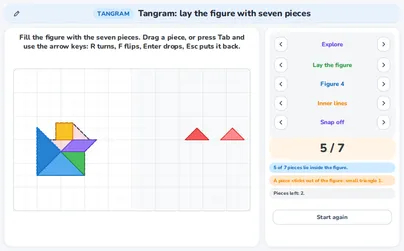
To lay a figure, every piece must lie inside it, no piece may lie on another and no gap may stay. The tool shows an overlap, a gap or a piece that sticks out. Look at a gap: its corners and sides tell which piece fits.
Example
The gap in the picture has 3 corners and 3 sides: it is a triangle. A small triangle fits.
Rule

All seven pieces: a square, a rectangle, a triangle or a parallelogram

With all seven pieces you can also make a square, a rectangle, a triangle or a parallelogram. The area is always the same, because the pieces are the same: 16 small triangles.
Example
The square of the seven pieces is 16 small triangles. The triangle of the seven pieces is 16 small triangles too.
Rule

Your own figure: add the small triangles

For a figure of your own, add the sizes of the pieces you used. Pieces that you did not use do not count.
4122
Example
A large triangle, a small triangle, a parallelogram and a square → small triangles.
Rule

Copying a triangle on grid paper: move every corner the same way

To copy a triangle on grid paper, move every corner the same number of squares to the right (or left) and up (or down). Then the copy has the same size and the same shape. Write a corner as (x, y): x is across and y is up.
ABCA'
Example
Triangle ABC has A = (1, 1), B = (4, 1) and C = (2, 3). Move it 3 to the right and 2 up → and .A = (1, 1) → A’ = (4, 3)B = (4, 1) → B’ = (7, 3)C = (2, 3) → C’ = (5, 5)
Definition

A tiling covers the plane without gaps and without overlap

A tiling covers a floor or a wall with tiles of the same or of different shapes: no gaps and no tiles on top of each other. Squares, regular hexagons and equilateral triangles can each cover the plane alone.
Example
A floor of 10 by 6 square tiles needs tiles.
Rule

Around every point the angles make 360°

Where the corners of tiles meet in a point, the angles around that point must make exactly 360°. Less than 360° leaves a gap, more than 360° makes tiles overlap. 4 squares make .
90°90°90°90°
Example
3 regular hexagons meet in a point → .6 equilateral triangles meet in a point → .
120°120°120°
Rule

The angle of a regular polygon: 180° − 360° ÷ n

A regular polygon has equal sides and equal angles. With n corners, each angle is . The angle of the triangle is 60°, of the square 90°, of the pentagon 108°, of the hexagon 120° and of the octagon 135°.
60°90°108°120°135°
Example
A regular hexagon has → , then .
Rule

Which regular shapes tile alone: 360° ÷ the angle must be whole

A regular shape covers the plane alone only when 360° ÷ the angle is a whole number: that many shapes fit around a point. This works for the triangle (6), the square (4) and the hexagon (3). It does not work for the pentagon → is not a whole number.
108°108°108°
Example
Three pentagons → and is left. That is a gap.Four pentagons → , more than 360°: they overlap.
Rule

Two shapes together: square and octagon, triangle and hexagon

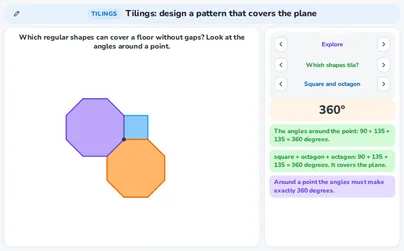
Different regular shapes can also meet in one point when their angles add up to 360°. Square and octagon: one square and two octagons. Triangle and hexagon: two triangles and two hexagons around every point.
90°135°135°
Example
Square and octagon → .Triangle and hexagon → .
60°120°60°120°
Rule

Every quadrilateral tiles: turn it half a turn

Every quadrilateral covers the plane, even a lopsided one. Turn a copy half a turn about the middle of a side and fit it against the tile; repeat. The four angles of a quadrilateral add up to 360°, and all four meet around every point.
dbac
Example
A tile with the angles 90°, 45°, 135° and 90° → .Around each point these four angles meet once each.
90°45°90°135°
Rule

Sliding a piece: the tile changes, the area does not

To make a tile of your own, cut a piece off one side and slide it to the opposite side. The tile gets a new shape, but nothing is added or taken away: the area stays the same, and the new tile still covers the plane.
Example
A square tile of 16 squares: cut off a triangle of 1 square and slide it to the top. squares.
Rule

Colouring a tiling: neighbours get different colours

Colour the tiles so that tiles that share a side have different colours, using as few colours as you can. A pattern of squares needs 2 colours, a pattern of triangles needs 2 colours and a pattern of regular hexagons needs 3 colours.
Example
Three hexagons around a point all touch each other, so they need 3 different colours. A pattern of squares only needs a chessboard of 2 colours.
Definition

Cutting and moving: the area stays the same

When you cut a figure into pieces and move the pieces into a new figure, the area does not change: you have the same squares, only in another place. Check by counting the squares before and after.
Example
A rectangle of 4 by 3 is cut into two pieces of 6 squares. The pieces make a rectangle of 6 by 2. and squares.
Rule

A rectangle along a diagonal: two equal triangles

Cut a rectangle along a diagonal: you get two triangles that are exactly the same. Each triangle is half of the rectangle. The triangle has the same base b and height h as the rectangle, so its area is half of b × h.
43
Example
A rectangle of 4 by 3 is squares. A triangle is half → squares.
Rule

A triangle in four triangles

Join the middles of the three sides of a triangle: the triangle falls into four small triangles of the same size. Each one is a quarter of the whole triangle.
4444
Example
A triangle of 16 squares in four pieces → squares each.
Rule

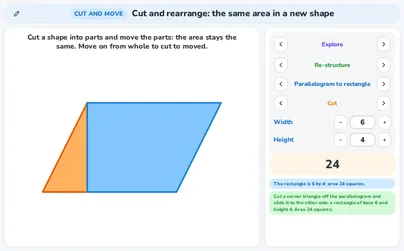
A parallelogram becomes a rectangle

Cut a small triangle off one side of a parallelogram and slide it to the other side: you get a rectangle with the same base and the same height. So the area is base × height.
53
Example
A parallelogram with base 5 and height 3 → squares.
53
Rule

An L-shape: cut it into rectangles in two ways

An L-shape is easy to measure when you cut it into rectangles. You can cut it in two ways; the pieces are different, but the total area is the same.
126126
Example
An L-shape of 6 by 4 with a corner of 3 by 2 missing.Cut across → squares.Cut up and down → squares.
Rule

The same area, another perimeter

Rectangles with the same area can have different perimeters. The longer and thinner the rectangle, the longer the perimeter. The perimeter is the distance around the figure.
P=26P=14P=16
Example
12 squares as 2 by 6 → .12 squares as 3 by 4 → .12 squares as 1 by 12 → .
Rule

A fraction of a shape: cut it into equal parts

Cut a shape into equal parts: each part is a fraction of the whole. For n equal parts each part is 1/n of the whole and has the area A ÷ n. Equal parts have the same area.
4
Example
A shape of 24 squares cut into 6 equal parts: each part is 1/6 of the whole. squares.
Definition

The net of a box

The net of a box is the box cut open and laid flat: a flat pattern of squares that folds into the box. A box has 6 faces, in 3 pairs of opposite faces that are the same size. The lid and the bottom are one pair, the front and the back another, the left and the right a third.
ABCDEFDEA
Example
A box 3 by 2 by 1: two faces of 3 by 2, two faces of 3 by 1 and two faces of 2 by 1.The net has squares.
Rule

The surface area: the squares of the net

The surface area of a box is the number of squares of its net. Add the areas of the three different faces and double the sum.
663322
Example
A box 3 by 2 by 1 → , and . squares, as many as the squares of the net.
Rule

A cube has 11 nets

Six squares that touch along whole sides make a shape of six squares (a hexomino): there are 35 different ones. Only 11 of them fold into a cube, the other 24 do not. The tool folds a net by rolling it over the cube in whole numbers, so its answer is exact.
Example
35 shapes of 6 squares, 11 of them are nets of a cube. shapes are not nets.
Watch out!

Six squares in a row do not fold into a cube

Not every set of six squares is a net. Six squares in a row do not fold into a cube: after four squares the strip has gone round the cube, so the fifth square lands on the first and the sixth on the second. Then two faces are covered twice and two faces are missing.
Example
Squares 1 and 5 land on the same face.Faces covered: 4 of 6, so faces are missing.
Rule

Glue flaps: the border divided by 2

A net of a box needs flaps to glue it together. Every flap joins two edges of the border of the net, so the number of flaps is the length of the border (in unit edges) divided by 2.
Example
The border of the cube net in the picture is 14 unit edges long → flaps.The net of the box 3 by 2 by 1 has a border of 22 → flaps.
Rule

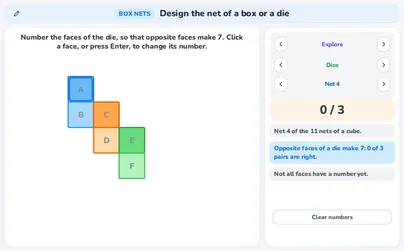
A die: opposite faces make 7

On a die the numbers on opposite faces add up to 7: 1 and 6, 2 and 5, 3 and 4. When you design the net of a die, put the numbers so that this stays true after folding.
345261
Example
, and .In the net in the picture the top arm is 1, so the bottom arm is 6.
Rule

Which face is opposite? One face lies between

In a straight row of three squares of a cube net, the first and the third face are opposite: one face lies between them. Opposite faces never touch when the cube is folded. The two arms of a cross are opposite each other.
CEDBFA
Example
In the cross with the faces A to F: B, C and D are in a row, so B is opposite D. C, D and E are in a row, so C is opposite E. A is opposite F.
Definition

A scale: model : real

A scale 1 : s says how much smaller a model is than the real thing. The first number is the model and the second number is the real thing, always in the same unit. At the scale 1 : 50, 1 cm on the model is 50 cm in real life.
0015021003150cmcm
Example
At 1 : 50 the model lengths 1 cm, 2 cm and 3 cm are 50 cm, 100 cm and 150 cm in real life..
Rule

The length of the model: the real length divided by s

To find a length on the model, change the real length to the unit of the model and divide by s. To go back, multiply by s. Work in centimetres, then you make fewer mistakes.
00630012600cmcm
Example
A shed is 6 m long. At 1 : 50 → and .The shed is also 4 m wide and 3 m high → and .
Rule

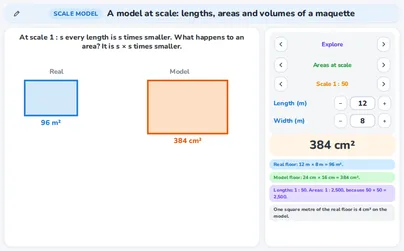
Areas: divide by s × s

At the scale 1 : s every length is s times smaller, so every area is s × s times smaller. Draw it: a model of 1 square next to a real shape of s × s squares. At 1 : 50 the area is times smaller.
161
Example
The floor of the shed → .At 1 : 50 the model floor is ..
Rule

Volumes: divide by s × s × s

A volume has three lengths, so at the scale 1 : s a volume is s × s × s times smaller. At 1 : 10 that is times smaller. A model that holds 2 000 cm³ stands for a real tank of .
271
Example
A model tank at 1 : 10 holds 2 000 cm³.The real tank holds ., so that is 2 m³.
Watch out!

Half the lengths is not half the area

Halving the lengths does not halve the area: the area becomes a quarter and the volume an eighth. Do not use the length scale for areas and volumes.
214181
Example
At 1 : 2 lengths become 2 times smaller, areas 4 times and volumes 8 times. and .
Rule

Choosing a scale so that the model fits the sheet

To fit a maquette on a sheet of paper, find the sizes of the model for a scale and compare them with the A4 sheet: 297 mm by 210 mm. Try the scales from the biggest model to the smallest and take the first one that fits. The model may be turned on the sheet.
A4240×1601:250
Example
A school site is 60 m by 40 m. In millimetres: 60 000 mm by 40 000 mm.At 1 : 200 → and . 300 is more than 297: too big.At 1 : 250 → and . That fits.
A4300×2001:200A4240×1601:250
Definition

Building layer by layer: a step plan

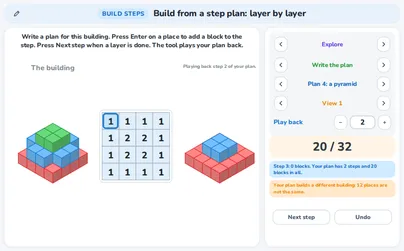
A step plan builds a building layer by layer, like the booklet of a block set. Step 1 puts the blocks of the first layer on the ground, step 2 puts blocks on top of them, and so on. Each layer has its own colour: red, blue, green, yellow.
1+62+33+1
Example
Plan 2, a staircase, has 3 steps with 6, 3 and 1 blocks. blocks.
Rule

The blocks of step n: the places that are at least n high

In step n a block goes on every place of the plan that is at least n blocks high. Count those places to get the blocks of the step. Add the steps to get the total.
321210100
Example
Plan 2 (heights 3 2 1 / 2 1 0 / 1 0 0): step 2 needs the places that are 2 or higher: 3, 2 and 2, so 3 blocks.Step 1: 6 places, step 2: 3, step 3: 1.
Rule

A block never floats: do the steps in order

A block never floats: it stands on the ground or on another block. So the steps must be done in order: step 2 sits on the blocks of step 1, step 3 on step 2. If you swap two steps, a block hangs in the air.
1+92+1
Example
Plan 1, a ring, has 9 blocks in step 1 and 1 block in step 2 → .The block of step 2 sits on the middle block of step 1.
Rule

From the top: the plan view with heights

In the plan view every place has a number: how many blocks stand there. Such a number plan shows the whole building, and the numbers added up are the blocks. A top view without numbers cannot tell the heights.
1221233223321221
Example
Plan 4, a pyramid with 4 rows of 4 places: 1 2 2 1 / 2 3 3 2 / 2 3 3 2 / 1 2 2 1.The rows add up to 6, 10, 10 and 6 → blocks.
Rule

Writing the plan: the other way round

You can also write a plan for a building you see: for each step, say on which places the blocks go. The tool builds your plan again, step by step, and tells you whether it is the same building. Start with the ground layer and go up.
1+122+4
Example
The gate (plan 6): 1 1 1 1 / 2 0 0 2 / 2 0 0 2 / 1 1 1 1.Step 1: 12 places, a ring. Step 2: the 4 places with height 2. blocks.
Tip

Building with real blocks: in the classroom

The tool builds on the screen. Real building stays a classroom activity: give the pupils real blocks and the step plan, let them build the building layer by layer and compare it with the picture. The plan on the screen and the real blocks follow the same steps.
1+82+4
Example
The fort (plan 3) has 8 blocks in step 1 and 4 blocks in step 2. real blocks for every group.
Tip

Everything is our own and exact

All tangram figures, tilings, nets, models and building plans in these tools are our own and made for this site: no figure comes from a book. A net is folded by exact rolling over the box in whole numbers, so the answer “closed box” or “two faces land together” is always right. The tangram figures were found by an exact search: each one can really be laid with the seven pieces.
Example
All 35 shapes of 6 squares were tried → .Every tangram figure is covered: 16 of 16 small triangles.

Exercises

A tangram figure uses a large triangle, a medium triangle and a square. How many of the 16 small triangles of the tangram are left? Easy
422
Show solution
A large triangle is 4 small triangles, a medium triangle is 2 and a square is 2.
The figure uses small triangles.
What is left → small triangles.
8 small triangles
Check → the pieces left are a large triangle (4), two small triangles and a parallelogram (2) → .
What is the angle of a regular hexagon? Easy
Show solution
A regular hexagon has corners. Its angle is .
.
.
120°120°120°
120°
Check → → three hexagons fit around a point.
A rectangle is 5 by 4 squares. It is cut along a diagonal. How many squares is one triangle? Easy
54
Show solution
The rectangle has squares.
A diagonal cuts it into two equal triangles.
One triangle is half → squares.
10 squares
Check → two triangles of 10 squares make squares again.
A box is 4 by 3 by 2. What is its surface area, in squares? Easy
432
Show solution
The three different faces → , and .
Add them → .
There are two of each face → .
52 squares
Check → .
A gym is 30 m long. The model has the scale 1 : 50. How long is the model of the gym, in centimetres? Easy
Show solution
Change to centimetres → .
Divide by 50 → .
00301500603000cmcm
60 cm
Check → .
Plan 2 has the heights 3 2 1 / 2 1 0 / 1 0 0. How many blocks does step 2 need? Easy
321210100
Show solution
Step 2 needs the places that are at least 2 high.
Those places are 3, 2 and 2: three places.
321210100
So step 2 needs 3 blocks.
3 blocks
Check → step 1 has 6 blocks and step 3 has 1 → , and the heights as well.
Triangle ABC has A = (2, 1), B = (5, 1) and C = (3, 4). It is moved 4 to the right and 2 up. Where is the copy of C? Medium
ABC
Show solution
Every corner moves 4 to the right and 2 up → and .
C = (3, 4).
The copy of C → and .
ABCA'B'C'
C’ = (7, 6)
Check → A’ = (6, 3) and B’ = (9, 3). The side AB is long and the side A’B’ is long: the same.
A square and two equal regular shapes meet in a point. What is the angle of each of the two shapes? Medium
Show solution
The angles around a point make 360°.
The square has 90°, so is left for the two shapes.
The two shapes are equal → .
90°135°135°
135° (regular octagons)
Check → , and a regular octagon has the angle .
An L-shape is 7 by 5 with a corner of 4 by 3 missing. What is its area? Medium
75342
Show solution
Cut the L-shape into two rectangles.
The bottom rectangle is 7 by 2 → squares.
The top rectangle is 3 by 3 → squares.
149
Add them → squares.
23 squares
Check → the other way: the whole rectangle , minus the missing corner → .
The net of a die has 4 on the top arm, then 5 1 2 6 in the row and 3 on the bottom arm. Do all pairs of opposite faces make 7? Medium
162534
Show solution
The two arms of the cross are opposite → .
In the row the first and the third square are opposite → .
The second and the fourth square are opposite → .
Yes, all three pairs make 7.
Check → three pairs of 7 make , and .
At the scale 1 : 50 the floor of a model is 96 cm². How many square metres is the real floor? Medium
Show solution
At 1 : 50 every area is times smaller.
The real floor is .
, so .
24 m²
Check → the shed floor is , and its model is .
Plan 6 has the heights 1 1 1 1 / 2 0 0 2 / 2 0 0 2 / 1 1 1 1. How many blocks does the building have? Medium
1111200220021111
Show solution
Step 1: the places that are at least 1 high. That is a ring of 12 places.
Step 2: the places that are at least 2 high. Those are 4 places.
Add the steps → blocks.
1+122+4
16 blocks
Check → add the numbers row by row → .
Triangle ABC has A = (1, 5), B = (3, 2) and C = (6, 4). It is moved 2 to the right and 1 down. Write the three corners of the copy. Hard
ABC
Show solution
Right makes x bigger and down makes y smaller → and .
A’ has and , so A’ = (3, 4).
B’ has and , so B’ = (5, 1).
C’ has and , so C’ = (8, 3).
ABCA'B'C'
A’ = (3, 4), B’ = (5, 1), C’ = (8, 3)
Check → from A to B you go 2 to the right and 3 down; from A’ to B’ you go to the right and down: the same.
Three triangles, a square and one more regular shape meet in a point. Which shape is missing? Hard
60°60°60°90°?
Show solution
The angles around a point make 360°.
Three triangles → . The square: 90°.
Together → .
Missing → . That is the angle of a square.
60°60°60°90°90°
a square
Check → → three triangles and two squares fit around a point.
A parallelogram has base 9 and height 4. It is cut and slid into a rectangle, and the rectangle is cut along a diagonal. How many squares is each triangle? Hard
94
Show solution
The parallelogram becomes a rectangle of 9 by 4 → squares.
94
A diagonal cuts the rectangle into two equal triangles.
Each triangle is half → squares.
94
18 squares
Check → two triangles of 18 squares make squares, the area of the parallelogram.
A box is 4 by 3 by 2. Its net has 52 squares. Five faces of the net are laid down with 46 squares. How many squares does the sixth face have? Hard
Show solution
The net has squares in all.
The five faces laid down have 46 squares.
The sixth face → squares.
A face of 6 squares is the face of 3 by 2.
6 squares
Check → the six faces → .
At the scale 1 : 20 a model box holds 500 cm³. How many cubic metres does the real box hold? Hard
Show solution
At 1 : 20 a volume is times smaller.
The real box holds .
, so .
4 m³
Check → a real box of is 4 m³. At 1 : 20 it is .
Plan 4 is a pyramid with 32 blocks. Pia has placed step 1 (16 blocks) and 9 blocks of step 2. How many blocks are still missing? Hard
1221233223321221
Show solution
Pia has placed blocks.
The plan has 32 blocks.
Missing → blocks.
7 blocks
Check → step 2 has 12 blocks, so are missing there, and step 3 has 4 blocks → .
Are you a teacher?

Start live lessons with these applications for your whole class. Free to try for one month.

Try it free

Fits these school years

IB (MYP, Diploma): PYP, MYP 1

Cambridge International: Primary, stage 4, Primary, stage 5, Primary, stage 6, Lower Secondary, stage 7

Netherlands: Groep 5, Groep 6, Groep 7, Year 1, Groep 8, Year 2, Year 3 (havo, vwo), Vwo · Mathematics C

Türkiye (MEB): Year 3 (MEB), Year 4 (MEB), Year 5 (MEB), Year 6 (MEB), Year 7 (MEB)

England (GCSE, A Level): Year 4, Year 5, Year 6, Year 7

USA (Common Core): Grade 3, Grade 4, Grade 5, Grade 6, Grade 7

What the applications of this topic teach 6 applications

Tangram: lay the figure with seven pieces

  • Laying a figure with the seven pieces with no gap or overlap
  • Knowing each piece's size in small triangles
  • Making a square, rectangle, triangle and parallelogram
  • Copying a triangle on grid paper

Tilings: design a pattern that covers the plane

  • Covering a floor with squares, triangles or hexagons
  • Knowing the angle of a regular polygon: 180° − 360° ÷ n
  • Telling which regular shapes tile alone or in pairs
  • Making an own tile and colouring a tiling with few colours

Cut and rearrange: the same area in a new shape

  • Knowing that cutting and moving pieces keeps the area
  • Cutting a rectangle, triangle, parallelogram or L-shape into pieces
  • Knowing the same area may have another perimeter
  • Naming a part of a shape as a fraction of the whole

Design the net of a box or a die

  • Laying out the net of a box or a die
  • Working out the surface area of a box from its net
  • Knowing a cube has 11 nets and opposite die faces make 7
  • Telling which face is opposite which in a net

A model at scale: lengths, areas and volumes of a maquette

  • Knowing a scale 1 : s is model : real
  • Knowing areas change by s × s and volumes by s × s × s
  • Choosing a scale so a model fits on an A4 sheet
  • Designing a maquette of a house or school site

Build from a step plan: layer by layer

  • Following a step plan and building layer by layer
  • Knowing step n puts a block on every place at least n high
  • Reading the plan view and adding numbers to get the blocks
  • Writing a step plan for a building