Interactive Lessons
Lecture notes Exercises

Rates and compound measures

Lecture notes

Definition

A rate

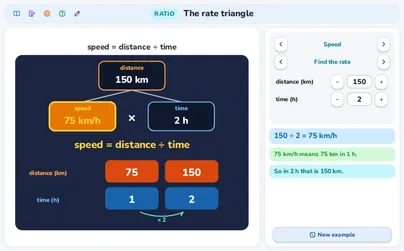
A rate compares two different quantities. It tells you how much for 1. km/h
001752150hkm÷2÷2
Example
6 kg of rice costs €15. Price for 1 kg: €/kg

0012.5615kg€÷6÷6
Definition

Compound units

The unit has two parts: km/h is “kilometres per hour”, g/cm³ is “grams per cubic centimetre”.75 km/h means 75 km in 1 hour.
0751501 h1 h
Example
A heart beats 70 times/min: 70 beats in 1 minute.In 2 minutes: beats
0701401 min1 min
Definition

The same triangle for every rate

speed = distance ÷ time, density = mass ÷ volume, pressure = force ÷ area, price per kg = cost ÷ amount, flow = volume ÷ time.
dvtmρVFpA
Example
A piece of metal: 54 g, 20 cm³.density = g/cm³
54 g?20 cm³
Rule

The total

total = rate × amount. km in 3 hours
?753
Example
A job pays €14 per hour. Working 6 hours: euros
?146
Rule

The amount

amount = total ÷ rate. hours for 225 km
22575?
Example
A phone plan costs €9 per month. You paid €63 in total. months
639?
Rule

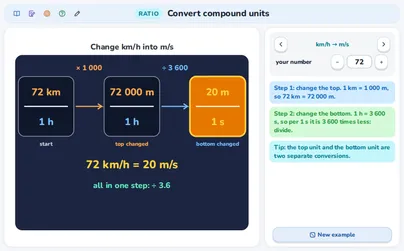
Convert a compound unit

Change the top unit and the bottom unit one after the other.72 km/h: m/s
72 km/h×100072 000 m/h÷360020 m/s
Example
A train at 90 km/h. In m/s: m/s
90 km/h×100090 000 m/h÷360025 m/s
Rule

Average speed

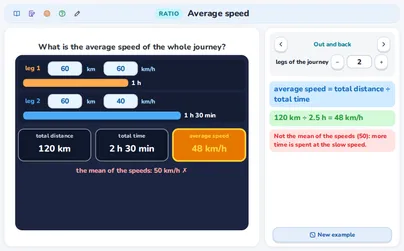
average speed = total distance ÷ total time. km/h
1234080160xy2.5120
Example
40 km in 2 hours, then 20 km in 1 hour. km/h
00240360hkm
Tip

km/h and m/s

km/h → m/s: divide by 3.6. m/s → km/h: multiply by 3.6.
72 km/h÷3.620 m/s20 m/s×3.672 km/h
Example
A cyclist sprints at 15 m/s. In km/h: km/h
15 m/s×3.654 km/h
Tip

Compare rates

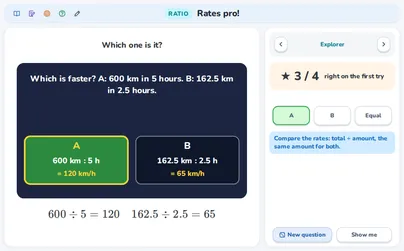
Work out the amount for 1 of both and compare. and : the first is faster.
h2131km15075220≈73.3÷2÷2÷3÷3
Example
Shop A: 3 kg for €6. Shop B: 5 kg for €9. and : B is cheaper per kg
kg3151€6291.8÷3÷3÷5÷5
Watch out!

Not the mean of the speeds

60 km out at 60 km/h and 60 km back at 40 km/h.The mean of the speeds is , but the average speed is km/h. More time is spent at the slow speed.
30405060705048
Example
60 km at 30 km/h (2 hours), then 60 km at 60 km/h (1 hour).✘ ✔ km/h
2030405060704540
Watch out!

Same units first

Do not mix hours and minutes, or litres and millilitres.6 l/min is 360 l/h, not 6 l/h.
min160l6360×60×60
Example
A tap gives 5 l/min. How many litres in 2 hours?✘ ✔ litres
min12l510×2×2✘min1120l5600×120×120✔
Special case

Floating and sinking

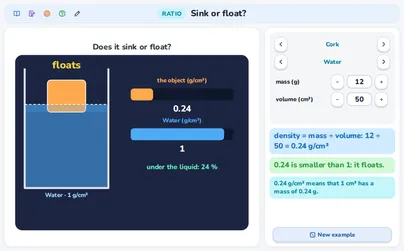
Density = mass ÷ volume. Water has 1 g/cm³.: smaller than 1, so cork floats, with 24 % under the water.
ρ<1
Example
A stone: 50 g, 20 cm³.: more than 1, so it sinks
ρ>1
Special case

A bath with the plug out

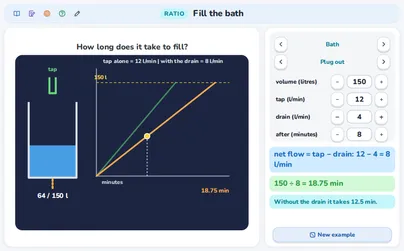
net flow = tap − drain. l/min, so minutes. When the drain is as fast as the tap, the bath never fills.
12 l/min4 l/min8 l/min
Example
A tank of 90 litres, tap 10 l/min, drain 10 l/min. l/min → it never fills
10 l/min10 l/min0
Rule

The price of 1

To find the price of 1, divide the total price by the amount. It works for a price per piece, per kilogram, per litre, per metre, per hour or per m². 3 kg of apples cost €4.50, so 1 kg costs €1.50.
kg€34.501?÷3÷3
Example
Ribbon: 4 m cost €6, so 1 m costs €1.50.
m€4611.50÷4÷4
Rule

The price of an amount

When you know the price of 1, multiply it by the amount. Cloth costs €18 per metre, so 4 m cost €72.
m€1184?×4×4
Example
A garden helper earns €12 an hour: 6 hours.
h€112672×6×6
Rule

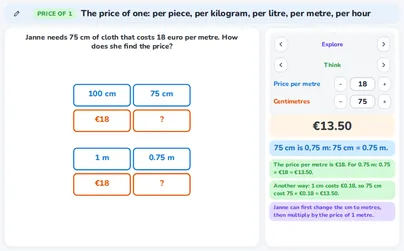
A part of a unit: 75 cm of cloth

The cloth costs €18 per metre and you need 75 cm. Change to metres first: 75 cm is 0.75 m. Then multiply. Or find the price of 25 cm and take 3 of them. and
m€1180.254.500.75?÷4×3÷4×3
Example
Ribbon costs €8 per metre and you need 50 cm, which is 0.5 m.
m€180.54÷2÷2
Rule

Better buy: the price of 1

To compare two offers, work out the price of 1 for both. 3 kg for €4.50 is €1.50 a kilo and 5 kg for €7 is €1.40 a kilo: the second offer is cheaper per kilo.
kg€34.5011.50÷3÷3kg€5711.40÷5÷5
Example
Juice: 2 L for €3 or 5 L for €7. and
L€2311.50÷2÷2L€5711.40÷5÷5
Watch out!

A bigger pack is not always cheaper

Look at the price of 1, not at the size of the pack. 4 kg for €5 is €1.25 a kilo, but 6 kg for €8.10 is €1.35 a kilo: the bigger pack costs more per kilo.
kg€4511.25÷4÷4kg€68.1011.35÷6÷6
Example
Rice: 2 kg for €3 or 5 kg for €8.50. and
kg€2311.50÷2÷2kg€58.5011.70÷5÷5
Definition

Speed: how far in one hour

A speed in km/h tells how many kilometres you go in 1 hour. A walker does about 5 km/h: 5 km in 1 hour, 10 km in 2 hours, 15 km in 3 hours. and
hkm15210315×2×3
Example
A cyclist does about 15 km in 1 hour: 30 km in 2 hours.
hkm115230×2×2
Definition

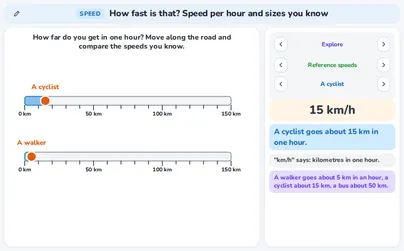
Speeds you know

Learn a few speeds by heart: a walker about 5 km/h, a runner about 10 km/h, a cyclist about 15 km/h, a bus about 50 km/h and a train about 130 km/h. They help you check whether an answer makes sense.
0204060801001201405A10B15C50D130E
Example
Is 40 km/h a good speed for a cyclist? A cyclist does about 15 km/h, so 40 km/h is much too fast.
01020304015A40B
Rule

Distance in a time: speed times time

The distance is the speed times the time. For minutes, change to hours first: 30 minutes is half an hour. A cyclist at 15 km/h for 2 hours and 30 minutes goes 37.5 km.
hkm1152300.57.50×2÷2
Example
A walker at 5 km/h for 90 minutes: 90 minutes is 1.5 hours.
hkm151.57.50×1.5×1.5
Rule

How long does it take? Distance divided by speed

The time is the distance divided by the speed. A bus at 50 km/h needs 0.4 hour for 20 km, and 0.4 hour is 24 minutes.
hkm1500.420
Example
A cyclist at 15 km/h rides 30 km. hours
hkm115230×2×2
Tip

Sports day: 100 m in 20 seconds

How fast is a runner who needs 20 seconds for 100 m? An hour has 3 600 seconds, which is 180 times 20 seconds. So in 1 hour the runner goes 180 times 100 m: 18 000 m is 18 km. The speed is 18 km/h.
sm201003 60018 000×180×180
Example
A skater needs 30 seconds for 100 m: 12 000 m in an hour, so 12 km/h.
sm301003 60012 000×120×120

Exercises

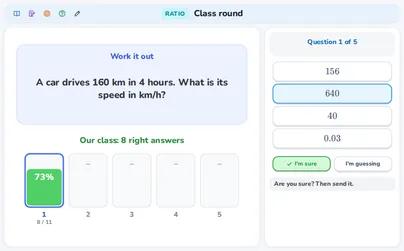
A car drives 150 km in 2 hours. What is its speed? Easy
150?2
Show solution
001752150hkm÷2÷2
Answer → 75 km/h
Check: .
Change 72 km/h into m/s. Medium
72 km/h? m/s
Show solution
top: 72 km = 72 000 m ()
72 km/h×100072 000 m/h
bottom: 1 h = 3600 s ()
72 km/h×100072 000 m/h÷360020 m/s
Answer → 20 m/s
Shortcut: .
A bath of 150 litres. The tap gives 12 l/min, the plug is out and 4 l/min run away. How long does it take to fill? Medium
12 l/min4 l/min?
Show solution
net flow = l/min
12 l/min4 l/min8 l/min
Answer → 18.75 minutes
Without the drain: minutes.
You drive 60 km at 60 km/h and 60 km back at 40 km/h. What is the average speed? Hard
1234080120160xy
Show solution
out: h, back: h
total: h, 120 km
1234080120160xy
Answer → 48 km/h
Not 50: the mean of the speeds is wrong.
Apples cost €3.60 for 3 kg. What does 1 kg cost? Easy
kg€33.601?÷3÷3
Show solution
Divide the price by the amount.
€1.20 a kilo
Check → .
Cloth costs €12 per metre. You need 75 cm. What do you pay? Medium
m€1120.75?
Show solution
Change to metres. 75 cm is 0.75 m.
Multiply.
m€1120.759×0.75×0.75
Or find the price of 25 cm. and 75 cm is 3 times as much.
m€1120.2530.759÷4×3÷4×3
€9
Check → both ways give €9.
Which is cheaper per litre: 2 litres of juice for €3 or 5 litres for €7? Medium
L€231?L€571?
Show solution
The price of 1 litre of the first offer.
The price of 1 litre of the second offer.
Compare. €1.40 is less than €1.50.
L€2311.50÷2÷2L€5711.40÷5÷5
5 litres for €7
Check → 5 litres at €1.50 would cost €7.50, which is more than €7.
A walker goes 5 km per hour. How far does the walker go in 45 minutes? Medium
minkm60545?
Show solution
45 minutes is 0.75 hour.
The distance is the speed times the time.
hkm150.753.75×0.75×0.75
3.75 km
Check → in a whole hour the walker goes 5 km, so in three quarters of an hour a bit less: 3.75 km.
A train goes 120 km in 1 hour and 30 minutes. What is its speed in km/h? Hard
hkm1.51201?
Show solution
1 hour and 30 minutes is 1.5 hours.
The speed is the distance divided by the time.
hkm1.5120180÷1.5÷1.5
80 km/h
Check → .
Are you a teacher?

Start live lessons with these applications for your whole class. Free to try for one month.

Try it free

Fits these school years

IB (MYP, Diploma): MYP 1, MYP 2, MYP 3, MYP 4, MYP 5, PYP

Cambridge International: Lower Secondary, stage 8, Lower Secondary, stage 9, IGCSE, Primary, stage 4, Primary, stage 5, Primary, stage 6

Netherlands: Groep 8, Year 1, Year 2, Year 3 (havo, vwo), Vmbo bb (years 3-4), Vmbo kb (years 3-4), Vmbo gt (years 3-4), Havo · Mathematics A, Vwo · Mathematics A, Vwo · Mathematics C, Groep 5, Groep 6, Groep 7

Türkiye (MEB): Year 7 (MEB), Year 8 (MEB), Year 4 (MEB), Year 5 (MEB), Year 6 (MEB)

England (GCSE, A Level): Year 8, Year 9, Year 10 (GCSE), Year 4, Year 5, Year 6

USA (Common Core): Grade 7, Grade 8, Grade 4, Grade 5, Grade 6

What the applications of this topic teach 7 applications

The rate triangle: speed, density, price, flow
  • Working out a rate, a total or an amount from the other two
  • Comparing places by people per km²
  • Comparing densities: grams per cm³

Convert compound units

  • Changing the top unit and the bottom unit of a rate
  • Changing km/h into m/s and back
  • Changing density, flow and pressure units

Average speed of a journey

  • Working out the time of every leg of a journey
  • Working out average speed: total distance ÷ total time
  • Knowing that average speed is not the mean of the speeds

Fill the bath: flow and time

  • Working out how long it takes to fill: volume ÷ flow
  • Working out the net flow: tap minus drain
  • Reading a volume–time graph of a flow

Sink or float? Density

  • Working out a density: mass ÷ volume
  • Knowing that something floats when its density is below the liquid's
  • Comparing two densities

The price of one: per piece, kilogram, litre, metre, hour
  • Finding the price of 1: per piece, kilogram, litre, metre or hour
  • Finding the price of an amount, also of part of a unit like 75 cm
  • Comparing two offers with the price of 1
  • Using the ratio table: the same step in both rows

How fast is that? Speed per hour and sizes you know
  • Knowing reference speeds: walker, cyclist, bus, train
  • Finding how long a trip takes: distance divided by speed
  • Working out fuel use per 100 km
  • Giving a speed in m/s and in km/h