Interactive Lessons

Solve direct proportion

Lecture notes

Definition

The ratio table

Two rows. Multiply or divide both rows by the same number.
481020×2×2
Example
2 boxes hold 18 eggs. How many eggs are in 6 boxes? eggs

261854×3×3
Definition

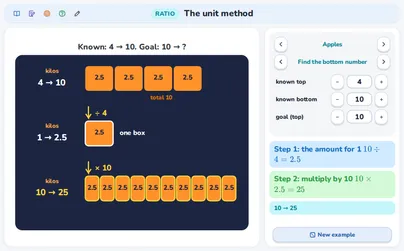
The unit method

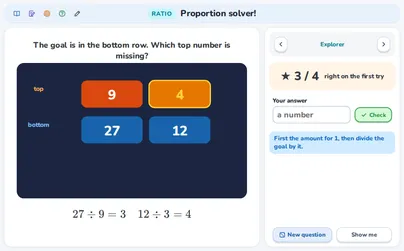
First the amount for 1, then scale up.
4110102.525÷4÷4×10×10
Example
5 notebooks cost €15. What do 8 notebooks cost? → €24
51815324÷5÷5×8×8
Definition

Two multipliers

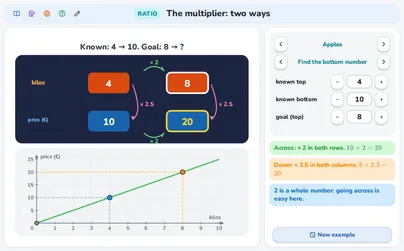
Across: the same factor in both rows.Down: in both columns.
x24y612×2×2×3
Example
In the table and :across , down (because )
x36y1224×2×2×4
Rule

Build up

Use friendly steps: , , , .Stop when the goal is in the table.
241251030×2×2×3×3
Example
1 ticket costs €4. What do 30 tickets cost? → €120
11030440120×10×10×3×3
Rule

Down to 1

Divide by the top number: the bottom is the amount for 1.
41102.5÷4÷4
Example
4 kg of potatoes cost €6. What does 1 kg cost? → €1.50 per kg
kg41€61.5÷4÷4
Rule

The goal in the bottom row

Divide the goal by the amount for 1.
1162.540×16×16
Example
1 sticker costs €0.50. How many stickers do you get for €6? stickers
1120.56×12×12
Tip

Check your answer

The amount for 1 times the top must give the bottom.
0012.5410×4×4
Example
Answer: 1 pen costs €1.20, so 5 pens cost €6.Check: ✔
0011.256×5×5
Tip

The best buy

Compare the price for the same amount: 1 kg or 100 g.The lowest price for that amount wins. and
kg2131€52.562÷2÷2÷3÷3
Example
Juice: 1 L for €1.80 or 2 L for €3.20? per litre → the 2 L bottle wins
L121€1.83.21.6÷2÷2
Watch out!

Adding is not scaling

3 pens cost €6. Then 6 pens cost €12, not €9.Both rows , not .
3669+3+3✘36612×2×2✔
Example
4 cupcakes need 2 eggs. How many eggs for 8 cupcakes?✘ eggs ✔ eggs
4826+4+4✘4824×2×2✔
Watch out!

The biggest pack

A big pack is not always the cheapest.150 g for €1.35 beats 500 g for €5.50. and per 100 g
g150100500100€1.350.95.51.1÷1.5÷1.5÷5÷5
Example
Rice: 1 kg for €2 or 5 kg for €12?✘ the big bag ✔ per kg, more than €2
kg151€2122.4÷5÷5
Special case

Whole things

A recipe needs 3.5 eggs for 7 people? Take 4 or 3, because you cannot use half an egg in a cake of this size. or
Example
50 children go on a trip. A bus takes 15 children. → 4 buses, not 3.33
Special case

Round at the end

Keep all the decimals in the working. only in the last line.
31610≈3.3320÷3÷3×6×6
Example
3 pizzas cost €20. What do 6 pizzas cost?, not
31620≈6.6740.02÷3÷3×6×6✘362040×2×2✔
Rule

Estimate a population: mark and recapture

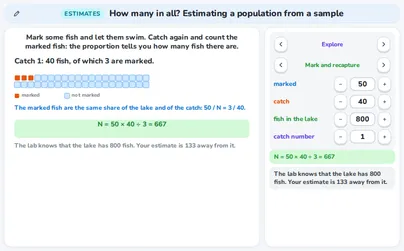
To count animals that you cannot all catch, mark some, let them go and catch again. The marked animals are the same share of the whole group and of the catch, so with marked, caught and marked among them. So . It is only an estimate: another catch gives another number, a bigger catch is steadier, and with there is no estimate. A sample of a group works the same way.
Example
50 fish are marked. A catch of 40 fish has 5 marked ones, so and fish. A sample works the same way: 12 of 50 pupils like pizza; in a school of 600 pupils about pupils do.

Exercises

A ratio table has . Find Easy
4810?
Show solution
is
4810?×2
481020×2×2
Answer →
Check: and .
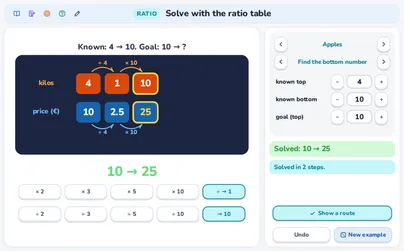
4 kg of apples cost €10. What do 10 kg cost? Medium
kg410€10?
Show solution
1 kg:
kg41€102.5÷4÷4
10 kg:
kg4110€102.525÷4÷4×10×10
Answer → €25
Check: .
6 pens cost €9. How many pens can you buy for €24? Medium
6?924
Show solution
1 pen:
6191.5÷6÷6
611691.524÷6÷6×16×16
Answer → 16 pens
Check: .
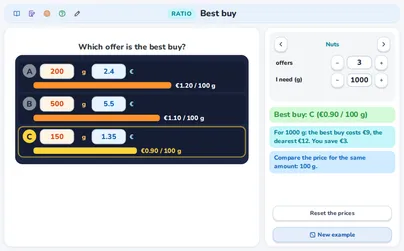
Which is the best buy? A: 500 g for €5.50, B: 150 g for €1.35. Hard
Show solution
A: per 100 g
g500100€5.51.1÷5÷5
B: per 100 g
g500100€5.51.1÷5÷5g150100€1.350.9÷1.5÷1.5
Answer → B (€0.90 per 100 g)
Check: .
Are you a teacher?

Start live lessons with these applications for your whole class. Free to try for one month.

Try it free

Fits these school years

IB (MYP, Diploma): MYP 1, MYP 2, MYP 3

Cambridge International: Lower Secondary, stage 8, Lower Secondary, stage 9, Lower Secondary, stage 7, IGCSE

Netherlands: Groep 8, Year 1, Year 2, Year 3 (havo, vwo), Vmbo bb (years 3-4), Vmbo kb (years 3-4), Vmbo gt (years 3-4)

Türkiye (MEB): Year 7 (MEB), Year 8 (MEB)

England (GCSE, A Level): Year 8, Year 9, Year 7

USA (Common Core): Grade 7, Grade 6, Grade 8

What the applications of this topic teach 6 applications

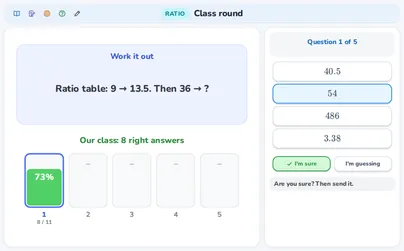
Solve with the ratio table

  • Solving a proportion problem with a ratio table
  • Building up with friendly steps: × 2, × 3, × 10, ÷ 2
  • Going down to 1 and then up to the goal

The unit method: first find the amount for 1
  • Finding the amount for 1, the unit amount
  • Scaling up from 1 to the goal
  • Finding how many items the money buys

The multiplier: two ways to one answer

  • Finding the multiplier across, the same in both rows
  • Finding the multiplier down: the amount for 1
  • Choosing the easier way for the numbers

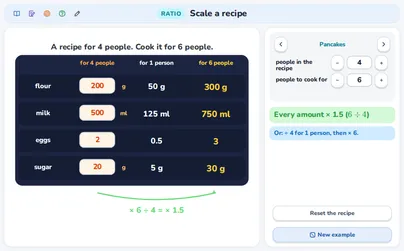
Scale a recipe

  • Scaling a recipe to any number of people
  • Finding the amount for 1 person
  • Knowing when to round an amount, such as eggs

Best buy: compare prices for the same amount
  • Finding the price for the same amount
  • Saying which offer is the best buy
  • Knowing that a big pack is not always the cheapest
  • Comparing “4 for the price of 3” with “50% off”

How many in all? Estimating a population from a sample
  • Estimating how many animals there are from a marked catch
  • Scaling a sample up to a whole group
  • Explaining why the answer is only an estimate