Interactive Lessons

Perimeter and area of rectangles

Lecture notes

Definition

Perimeter: walk around

The perimeter is the distance all the way around a shape. Add all the sides, in cm or m.
7544
Example
Sides 5, 3 and 4 cm: cm
4 cm3 cm5 cm
Rule

Perimeter on a grid

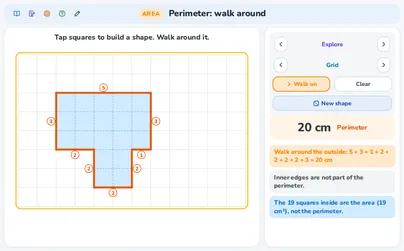
Walk around the outside and count the edges of the squares. Edges inside the shape are not part of the walk.
12345678910
Example
An L of 3 squares: 8 edges around, so 8 cm.
12345678
Rule

A missing side

Missing side = perimeter − the sum of the other sides.
abc?
Example
Perimeter 20 cm, sides 5, 6 and 4 cm: cm
6 cm4 cm5 cm?20 cm
Definition

Area: squares inside

The area is the space inside a shape. Count the unit squares that cover it, in cm² or m².
1234567891011121 cm1 cm1 cm²
Example
3 rows of 4 squares: squares = 12 cm²
433×4=12
Rule

The unit decides the number

Use squares of the same size. A big tile covers more than a small square, so you need fewer of them. 1 cm² is a square of 1 cm by 1 cm.
246
Example
6 big tiles of 4 small squares: small squares
6×4=24
Rule

Half squares

Two half squares make one square. Count the full squares, then the halves divided by 2.
6+4÷2
Example
5 full and 4 half squares: cm²
5+4÷2
Tip

Estimate an irregular shape

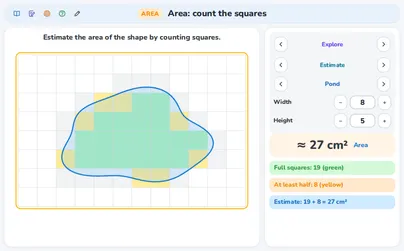
Count the full squares and the squares that are at least half inside. Do not count the smaller parts.
9+6
Example
18 full and 7 at least half:, about 25 cm²
18+7
Watch out!

Area is not perimeter

Area counts squares (cm²). Perimeter is a length (cm). They are different measures: do not mix them up.
cm²cm
Example
A rectangle of 5 by 3 cm:area 15 cm², perimeter 16 cm
5 cm3 cm15 cm²5 cm3 cm16 cm
Rule

Rectangle: length × width

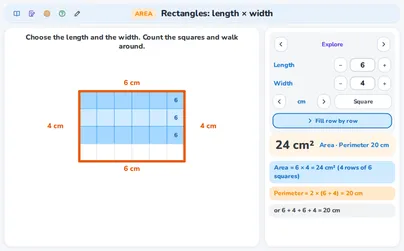
The squares sit in rows. Area = length × width.
63
Example
7 by 4 cm: cm²
7 cm4 cm7×4=28
Rule

Rectangle: the perimeter

A rectangle has two lengths and two widths. Perimeter = 2 × (length + width).
6633
Example
7 by 4 cm: cm
7 cm7 cm4 cm4 cm
Definition

A square

All four sides are equal. Area = side × side. Perimeter = 4 × side.
aa×a
Example
Side 6 cm: cm² cm
6 cm6 cm6×6=36
Rule

A side from the area or the perimeter

Width = area ÷ length. Width = half the perimeter − length. A square: the side is the root of the area or a quarter of the perimeter.
6 cm?30 cm²6 cm?18 cm
Example
Area 24, length 6: Perimeter 20, length 7:
6 cm?24 cm²7 cm?20 cm
Special case

Same area, different perimeter

Many rectangles have the same area. The long thin one has the longest perimeter, the one most like a square has the shortest.
Example
Area 12:: 26 cm, : 16 cm,: 14 cm
26 cm16 cm14 cm
Special case

Same perimeter, different area

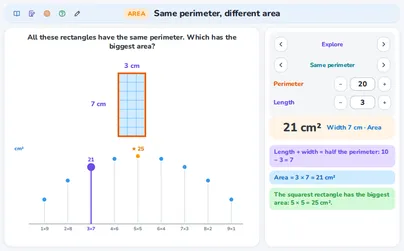
With a fixed perimeter the square gives the biggest area. The more it looks like a square, the bigger the area.
Example
Perimeter 16 cm:, , cm²
12 cm²15 cm²16 cm²
Rule

L-shapes: missing sides

Look at the opposite sides. The sides going one way must add up to the same length as the opposite sides.
92??46
Example
Outside 12 m, a part of 5 m: m is missing
12 m?5 m
Rule

Split or take away

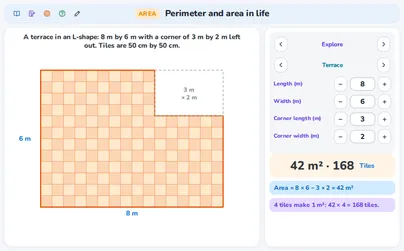
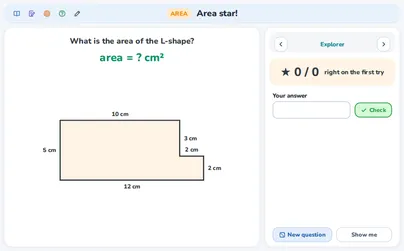
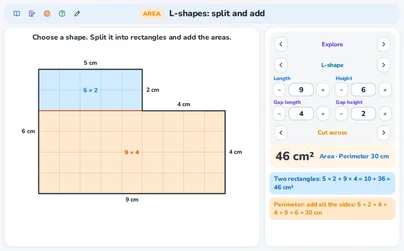
Cut the L-shape into two rectangles and add their areas, or take the gap away from the big rectangle. Both ways give the same area.
94269632
Example
10 by 8 m, a corner of 4 by 3 m left out: m²
10 m8 m4 m3 m
Tip

Problems: round up

A fence goes around: perimeter. Carpet, paint and tiles cover: area. You buy whole panels and whole tins, so a part counts as a whole one.
1234
Example
35 m of fence, panels of 2 m:, so 18 panels
123456789101112131415161718

Exercises

A rectangle is 8 cm by 5 cm. Find the area and the perimeter. Easy
8 cm5 cm
Show solution
Area:
8 cm5 cm8×5=40
Perimeter:
8 cm8 cm5 cm5 cm
Answer → area 40 cm², perimeter 26 cm
Area in cm² (squares), perimeter in cm (a length).
A shape has 7 full squares and 6 half squares. What is the area? Easy
Show solution
Two halves make one square:
Answer → 10 cm²
A half square is not a whole one.
A rectangle has an area of 36 cm² and a length of 9 cm. Find the width and the perimeter. Medium
9 cm?36 cm²
Show solution
First the width:
9 cm4 cm36 cm²
Then the perimeter:
9 cm9 cm4 cm4 cm
Answer → width 4 cm, perimeter 26 cm
Always find the missing side first.
Rectangles with whole sides have a perimeter of 24 cm. Which has the biggest area? Medium
7 cm5 cm6 cm6 cm
Show solution
Length + width is half the perimeter:
,
35 cm²36 cm²
Answer → the square, 6 by 6: 36 cm²
The more it looks like a square, the bigger the area.
An L-shape is a rectangle of 10 m by 8 m with a corner of 4 m by 3 m left out. Find the area and the perimeter. Hard
10 m8 m4 m3 m
Show solution
Big rectangle: . Gap:
10 m8 m4 m3 m8012
Area:
The corner does not change the walk around:
Answer → area 68 m², perimeter 36 m
Take away the area of the gap, not its sides.
A room of 4.5 m by 3 m gets a carpet. One m² costs € 8. What does the carpet cost? Hard
Show solution
Area: m²
Price:
Answer → € 108
A carpet covers the floor: area, not perimeter.
A garden of 12 m by 7 m gets a fence with a gate of 3 m. Fence panels are 2 m long. How many panels do you buy? Hard
12 m7 m3 m
Show solution
Fence: m
Panels:
A part of a panel is a whole panel: round up
123456789101112131415161718
Answer → 18 panels
A fence is a perimeter, and the gate is not fenced.
Are you a teacher?

Start live lessons with these applications for your whole class. Free to try for one month.

Try it free

Fits these school years

IB (MYP, Diploma): PYP, MYP 1, MYP 2, MYP 3

Cambridge International: Primary, stage 4, Primary, stage 5, Primary, stage 6, Lower Secondary, stage 7

Netherlands: Groep 5, Groep 6, Groep 7, Groep 8, Vmbo bb (years 3-4), Vmbo kb (years 3-4), Vmbo gt (years 3-4), Vwo · Mathematics C, Year 1

Türkiye (MEB): Year 3 (MEB), Year 4 (MEB), Year 5 (MEB), Year 6 (MEB)

England (GCSE, A Level): Year 4, Year 5, Year 6, Year 7

USA (Common Core): Grade 3, Grade 4, Grade 5

What the applications of this topic teach 7 applications

Perimeter: walk around the shape

  • Finding the perimeter of any shape by adding all its sides
  • Finding the perimeter of a shape on a grid by walking around it
  • Finding a missing side from the perimeter
  • Estimating the perimeter of a curved shape with a string

Area: count the squares

  • Finding the area of a shape by counting unit squares
  • Counting full squares and half squares
  • Estimating the area of an irregular shape
  • Knowing that area counts squares and is not the perimeter

Rectangles: length × width and the perimeter
  • Finding the area of a rectangle: length × width, and of a square
  • Finding the perimeter of a rectangle with 2 × (length + width)
  • Telling area from perimeter and which one a question asks
  • Finding the missing side from the area or the perimeter

Same perimeter, different area (and the other way round)
  • Finding the other side and the area from the perimeter and length
  • Knowing that rectangles with the same perimeter may differ in area
  • Knowing that rectangles with the same area may differ in perimeter
  • Making a rectangle with a given perimeter and a given area

L-shapes: missing sides, split and add

  • Finding the missing sides of an L-, U- or T-shape
  • Finding the area of an L-shape by splitting or by taking a gap away
  • Finding the perimeter of such a shape

Perimeter and area in everyday life

  • Using length × width for a floor, a wall or a garden
  • Telling a fence (perimeter) from carpet, paint and tiles (area)
  • Finding the area of an L-shaped terrace and the number of tiles
  • Rounding up when part of a pack is a whole pack

Shape builder (puzzles)

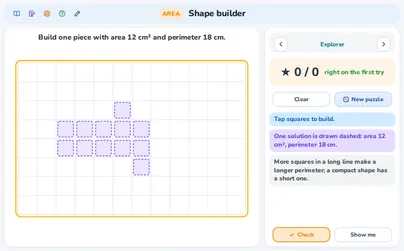
  • Building a shape on a grid with a given area and perimeter
  • Counting squares for area and walking around for perimeter
  • Knowing that shapes with the same area may have different perimeters