Interactive Lessons

Units and conversion

Lecture notes

Definition

Reading a scale

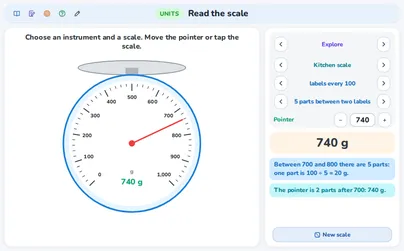
Read the labelled marks next to the pointer first. Then count the small parts after the lower label.
100200?
Example
Labels 200 and 300, pointer on the 3rd small mark after 200

200300123?
Rule

One small part

Divide the distance between two labels by the number of parts.
200300?100
Example
: one part is 20 g. g
200260300202020100
Tip

A ruler that does not start at 0

Subtract the two readings: end minus start.
0123456789101112b−a
Example
A pencil from 3 cm to 11 cm: cm
01234567891011128 cm
Definition

Metric units

Know the usual relations: 1 km = 1000 m, 1 m = 100 cm, 1 cm = 10 mm, 1 kg = 1000 g, 1 L = 1000 mL.
kmmcmmm×1000×100×10
Example
Rule

The metric staircase

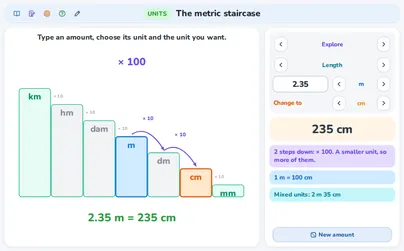
Every step is × 10. To a smaller unit: multiply, you get more of them. To a bigger unit: divide.
kmhmdammdmcmmm×10÷10×10÷10×10÷10×10÷10×10÷10×10÷10
Example
kghgdagg×10×10×10×1000
Rule

Decimals and mixed units

Change the small part to the big unit and add: 35 cm is 0.35 m.
0121 m40 cm
Example
01232 m35 cm
Watch out!

The zero trap

Grams make 3 decimals of a kilogram, so , not 0.5.
05001000✔✘
Example
✘ ✔
300035004000✔✘
Definition

Money

1 euro = 100 cents. Cents are hundredths of a euro.
1€=100c
Example
305 cents → euros
1 €1 €1 €5 c
Rule

Choose a unit

Pick the unit that gives a handy number: not too many zeros, not a tiny fraction.
Example
A pencil: 18 cm, not 0.00018 km
0246810121416182018 cm
Tip

Benchmarks

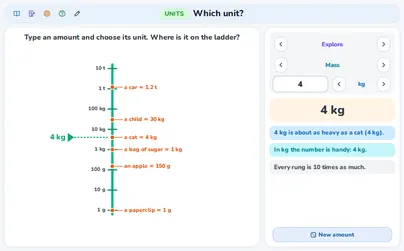
Compare with things you know: a door is about 2 m, a bag of sugar is 1 kg, a carton is 1 L.
Example
A house is about 4 doors high: m
2 m2 m2 m2 m8 m
Definition

Temperature

Temperature is measured in °C. Ice melts at 0 °C, the body is 37 °C, water boils at 100 °C.
0 °C37 °C100 °C
Example
A warm room: 20 °C. A freezer: −18 °C.
020 °C−18 °C
Definition

Telling the time

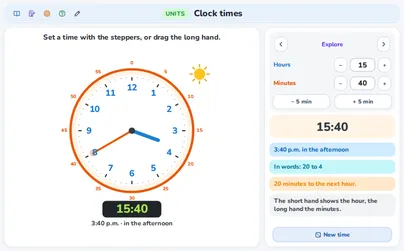
The short hand shows the hour, the long hand the minutes. The long hand on 3 is 15 minutes.
12369152:15
Example
9:15 = quarter past 99:45 = quarter to 10
12369159:1512369459:45
Rule

12 and 24 hours

After noon add 12 to the hour, . After midnight the hours start again at 0.
06121824+12416
Example
4:40 p.m. → → 16:4012:05 a.m. → → 00:05
06121824+124:4016:40
Definition

Units of time

60 s = 1 min, 60 min = 1 h, 24 h = 1 day, 7 days = 1 week. A year has 365 days (366 in a leap year).
Example
200 min = 3 h 20 min
06012020060606020
Rule

How long does it take?

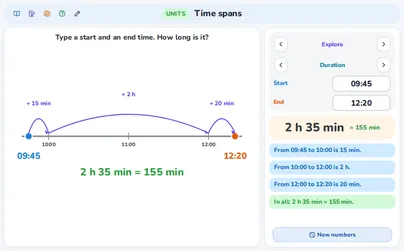
Go to the next whole hour first, then add the rest.
7:4010:0020120208:0010:20
Example
9:45 to 11:15 → min = 1 h 30 min
9:4511:001560159010:0011:15
Watch out!

Time is not decimal

An hour has 60 minutes, not 100. Do not subtract times like decimals. Remember .
Example
✘ 11:15 − 9:45 = 1:70✔ 1 h 30 min
Rule

Timetables

Find the first ride that gets you there in time. The ride takes end minus start.
8:008:108:208:308:40e−sseD
Example
Be there by 8:30: the bus 8:05 → 8:21 is fine, the bus 8:20 → 8:36 is late.The first ride takes min.
8:008:108:208:308:40168:058:218:308:008:108:208:308:408:208:368:30
Tip

Imperial units

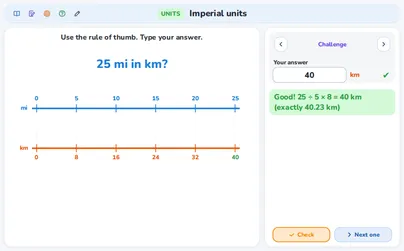
Know 12 in = 1 ft, 3 ft = 1 yd, 16 oz = 1 lb. To go to metric use 5 miles ≈ 8 km and 1 kg ≈ 2.2 lb.
0058mikm
Example
10 miles → km
00581016mikm×2×2
Rule

Square units

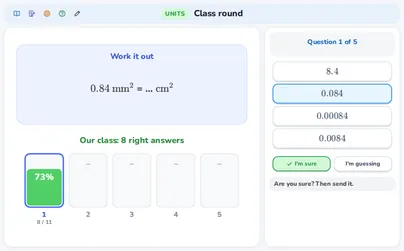
Area uses two lengths, so the length step is squared: × 100 per step.
×10×10×100
Example
100 cm100 cm10 000 cm²
Rule

Cube units and litres

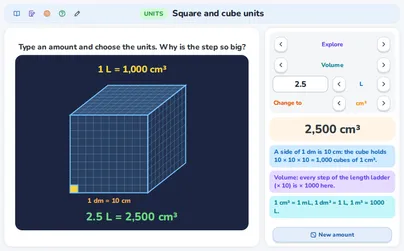
Volume uses three lengths: × 1000 per step. 1 dm³ = 1 L and 1 cm³ = 1 mL.
10 cm10 cm1dm³=1L
Example
1 m1 m1000 L
Definition

Prefixes

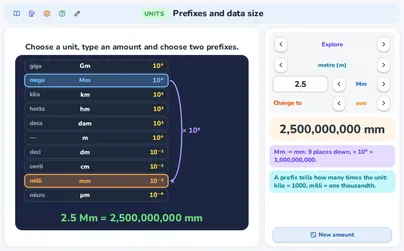
A prefix tells how many times the unit: kilo 1000, centi one hundredth, milli one thousandth, mega a million.
Mk1cm×1000×1000×100×10
Example
Mk1×1000×1000×10⁶1m×1000÷1000
Rule

Data size

1 kB = 1000 B, 1 MB = 1000 kB, 1 GB = 1000 MB. If whole files must fit, round down.
BkBMBGB×1000×1000×1000
Example
photos of 8 MB
GBMB×1000

Exercises

A scale has labels every 100 g with 5 parts between two labels. The pointer is 3 parts after 200 g. What does it show? Easy
200300?
Show solution
One part: g
20030020100
Reading: g
200260300202020
Answer → 260 g
First find what one small part is worth.
Write 4.5 km in metres. Easy
Show solution
A metre is a smaller unit, so multiply
kmhmdamm×10×10×10×1000
Answer → 4500 m
3 steps down the staircase: three times × 10.
Write 3 kg 50 g in kilograms. Medium
Show solution
kg
kgg×1000÷1000
30003050310050 g
Answer → 3.05 kg
Grams need three decimals: 50 g is 0.050 kg.
A film starts at 9:45 and ends at 11:15. How long is it? Medium
9:4511:15
Show solution
To the whole hour: 9:45 → 10:00 is 15 min
Then 10:00 → 11:00 is 1 h and 11:00 → 11:15 is 15 min
9:4511:0015601510:0011:15
min
9:4511:001560159010:0011:15
Answer → 90 min = 1 h 30 min
Never subtract the times like decimals.
A train leaves at 22:40 and the ride takes 95 minutes. When does it arrive? Hard
Show solution
22:40 + 20 min = 23:00
min left: 23:00 + 75 min = 24:15
22:4023:00207500:00
Past midnight the clock starts again: 00:15
22:4023:00207500:1500:00
Answer → 00:15
Use the whole hour as a stepping stone.
How many cm² is 2.5 m²? Hard
1m²1m²½m²
Show solution
1 m = 100 cm, so 1 m² = 100 × 100 = 10 000 cm²
100 cm100 cm10 000 cm²
10 00010 0005 000
Answer → 25 000 cm²
For area the step is × 100, not × 10 (volume: × 1000).
Are you a teacher?

Start live lessons with these applications for your whole class. Free to try for one month.

Try it free

Fits these school years

IB (MYP, Diploma): PYP, MYP 1, MYP 2, MYP 3

Cambridge International: Primary, stage 4, Primary, stage 5, Primary, stage 6, Lower Secondary, stage 7, Lower Secondary, stage 8

Netherlands: Groep 5, Groep 6, Groep 7, Year 1, Vmbo bb (years 3-4), Vmbo kb (years 3-4), Vmbo gt (years 3-4), Groep 8, Havo · Mathematics A, Vwo · Mathematics A, Vwo · Mathematics C, Year 2, Year 3 (havo, vwo)

Türkiye (MEB): Year 3 (MEB), Year 4 (MEB), Year 5 (MEB), Year 6 (MEB), Year 7 (MEB)

England (GCSE, A Level): Year 4, Year 5, Year 6, Year 7, Year 8, Year 9

USA (Common Core): Grade 3, Grade 4, Grade 5, Grade 6

What the applications of this topic teach 11 applications

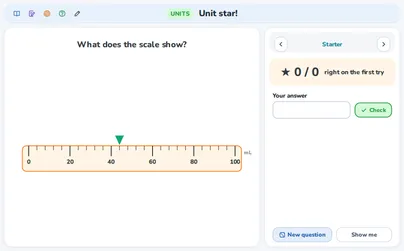
Read the scale: ruler, kitchen scale, jug, thermometer
  • Reading a scale on a ruler, kitchen scale, jug and thermometer
  • Finding what one small part is worth and reading to the nearest mark
  • Estimating a reading between two marks
  • Reading an odometer and a clinical thermometer to a tenth

The metric staircase: km, m, cm, mm, kg, g, L, mL
  • Knowing how the metric units are related
  • Changing units by × and ÷ 10, 100 and 1 000
  • Changing mixed units into one unit and avoiding the zero trap
  • Comparing amounts in different units in the same unit

Which unit? Estimate with things you know
  • Choosing a fitting unit for a measurement
  • Estimating with benchmarks: a door is about 2 m
  • Judging whether a measurement is sensible

Clock times: analogue, digital, 12 and 24 hours
  • Telling the time on an analogue clock to the minute
  • Writing the time digitally and changing between 12-hour and 24-hour

Time spans: durations, converting time, timetables
  • Knowing the units of time and how they are related
  • Changing between units of time, also mixed: 200 min = 3 h 20 min
  • Finding how long something lasts, also past midnight
  • Reading a timetable and choosing the ride that arrives in time

Inches, feet, pounds and pints: imperial units
  • Knowing imperial units for length, mass and capacity
  • Changing between imperial units, also mixed
  • Using rules of thumb between imperial and metric

Square and cube units: why × 100 and × 1000
  • Knowing area units and changing between them
  • Knowing volume units and their link with litres
  • Explaining why a step is × 100 for area and × 1 000 for volume

Prefixes: kilo, mega, milli … and data size
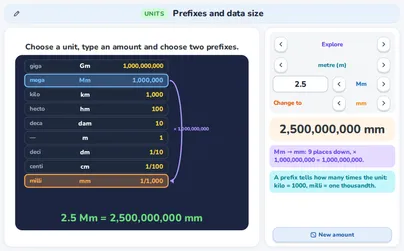
  • Knowing the metric prefixes as a system for any unit
  • Changing between prefixes using powers of ten: kW to W, MB to GB
  • Knowing data sizes and solving how many photos fit on a card

Prefixes: kilo, mega, milli … and data size, primary school edition
  • Knowing the metric prefixes as a system for any unit
  • Changing between prefixes by multiplying or dividing by powers of ten
  • Knowing data sizes and solving how many photos fit on a card

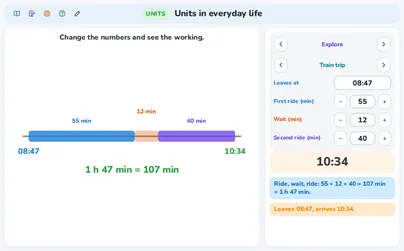
Units in everyday life

  • Changing units inside a problem: grams, litres, kilometres
  • Working with money in euros and cents and finding the change
  • Working out an arrival time and a journey time past midnight

Equal measures (puzzles)

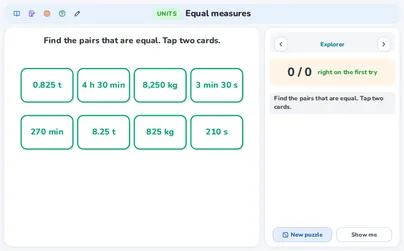
  • Matching equal amounts in different units: 2.5 kg = 2500 g
  • Ordering amounts given in different units
  • Matching area and volume units: 1 m² = 10 000 cm²