Interactive Lessons
Lecture notes Exercises

Estimating area and angle: tiles, wedges and why we need standard units

Lecture notes

Definition

Area and a unit tile

The area of a floor is how many unit tiles cover it, with no gaps and no overlap. The tile you count with is the unit of area.
Example
A floor is covered by 12 square tiles.
123456789101112
Rule

Count by rows

Do not count tile by tile. Count the tiles in one row, count the rows and multiply. For a floor that is not a rectangle, cut it into rectangles first.
ab
Example
5 tiles in a row and 4 rows.
545×4=20
Definition

Estimate

An estimate is a careful guess. Look at the tile in the corner, see how many fit along one side, and multiply. It is checked afterwards by covering and counting.
ab
Example
About 6 tiles along the bottom and about 4 rows.
646×4=24
Rule

Judge the estimate

Compare the estimate with the count. The difference is how far off you were. A good estimate is within 10% of the count.
dce
Example
Estimate 22, count 20: 2 too high.
182022242
Rule

A bigger tile needs fewer tiles

The floor stays the same. A smaller tile needs more tiles, a bigger tile fewer. The number of tiles depends on the unit, so always say which tile you used.
82
Example
A floor of 24 squares and big tiles of 4 squares.
246
Tip

Change the tile

To change the tile, start from the squares. A domino is 2 squares: divide the squares by 2. A triangle tile is half a square: multiply the squares by 2.,
121/2
Example
A floor of 24 squares: dominoes and triangles.
24÷21224×248
Watch out!

Count tiles, not squares

Do not mix up the number of tiles with the number of squares they cover. 12 domino tiles cover 24 squares, not 12.
3×2=6
Example
✘ 12 dominoes cover 12 squares.✔ 12 × 2 = 24 squares.
12×2=24
Definition

Angle and wedge

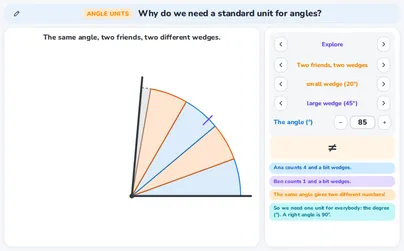
To measure an angle with a wedge, lay equal wedges from the bottom ray and count how many fit until the other ray. The wedge is the unit of angle.
12
Example
A wedge of 30° fits 3 times into a right angle.
30°30°30°
Rule

Whole wedges and a bit

Divide the angle by the wedge. The whole number is the number of wedges, the rest is what is left over.
wwr
Example
An angle of 85° and a wedge of 20°.
20°20°20°20°5°
Rule

A bigger wedge fits fewer times

For the same angle, a bigger wedge gives a smaller number and a smaller wedge a bigger number.
20°20°20°30°30°
Example
A right angle: wedges of 30° and 45°.
30°30°30°45°45°
Watch out!

Two numbers, one angle

If two friends measure the same angle with different wedges, they get different numbers. Nobody made a mistake: the units are different.
32
Example
✘ Ana counts 3 and Ben counts 2, so one is wrong.✔ 3 × 30 = 90 and 2 × 45 = 90.
30°30°30°3×3045°45°2×45
Definition

The degree

So that everybody gets the same number, we agree on one standard unit: the degree (°). A right angle is 90° and a full turn is 360°.
90°360°
Example
Four right angles make a full turn.
90°90°90°90°
Special case

Not even one wedge

When the angle is smaller than the wedge, no whole wedge fits. The number of whole wedges is 0 and the whole angle is left over.
a
Example
An angle of 15° and a wedge of 20°.
15°

Exercises

A floor needs 18 square tiles. How many domino tiles (2 squares each) cover it? Easy
18
Show solution
A domino is 2 squares: share the squares into pairs.
9
Answer → 9 domino tiles
Check: 9 × 2 = 18.
An angle of 60° is measured with wedges of 20°. How many wedges fit? Easy
60°
Show solution
How many times does the wedge fit into the angle? Divide.
20°20°20°
Answer → 3 wedges
Check: 3 × 20 = 60.
A floor has 5 tiles in a row and 4 rows. How many tiles cover it? Easy
54
Show solution
Equal rows: multiply the tiles in a row by the number of rows.
1234567891011121314151617181920
Answer → 20 tiles
Check: 20 ÷ 4 = 5.
A floor needs 24 square tiles. How many big square tiles (4 squares each) cover it? Medium
Show solution
Each big tile covers 4 squares.
6
Answer → 6 big tiles
A bigger tile needs fewer tiles.
Ana measures a right angle with wedges of 30° and Ben with wedges of 45°. How many wedges does each count, and who counts more? Medium
90°
Show solution
A right angle is 90°. Divide it by each wedge.
30°30°30°
45°45°
3 is more than 2.
Answer → Ana 3, Ben 2: Ana counts more
A smaller wedge fits more often.
A floor needs 20 tiles. Tom estimated 22. How many percent is he off, and is it a good estimate? Medium
2022
Show solution
The difference between the estimate and the count:
22022
As a part of the count:
18202224
Answer → 10% off: within 10%, so a good estimate
A good estimate is within 10% of the count.
An angle of 100° is measured with wedges of 30°. How many whole wedges fit, and how many degrees are left? Hard
100°
Show solution
Divide the angle by the wedge: 3 whole wedges.
30°30°30°?
What is left over:
30°30°30°10°
Answer → 3 whole wedges and 10° left
Check: 3 × 30 + 10 = 100.
A floor needs 40 square tiles. Tom estimated 36, Mia 45 and Ali 41. Who is closest, and how far off is that estimate? Hard
36454140
Show solution
Find the difference between each estimate and the count.
45140
The smallest difference is 1.
Answer → Ali, 1 off
Ali is 1 ÷ 40 off, much less than 10%.
A floor is covered with 12 big square tiles (4 squares each). How many domino tiles (2 squares each) cover the same floor? Hard
Show solution
First find the squares of the floor.
Then share the squares into dominoes of 2.
24
Answer → 24 domino tiles
A smaller tile needs more tiles: 24 is more than 12.

Interactive applications for this topic

Free applications open with a free student account. Teachers can use all applications in a live lesson.

About the free account and Plus

Are you a teacher?

Start live lessons with these applications for your whole class. Free to try for one month.

Try it free

Fits these school years

IB (MYP, Diploma): PYP

Cambridge International: Primary, stage 4, Primary, stage 5

Netherlands: Groep 6, Groep 7, Groep 5

Türkiye (MEB): Year 4 (MEB), Year 3 (MEB), Year 5 (MEB), Year 6 (MEB)

England (GCSE, A Level): Year 4, Year 5

USA (Common Core): Grade 3, Grade 4

What the applications of this topic teach 3 applications

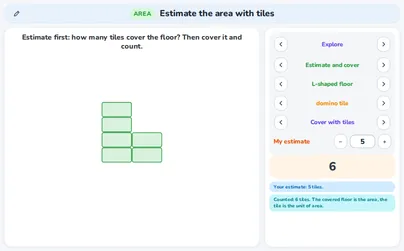
Estimate the area with tiles

  • Using a sample tile to say how many tiles cover a floor
  • Estimating the area of a floor in a non-standard unit
  • Comparing an estimate with the count

Why do we need a standard unit for angles?

  • Setting a rule for measuring an angle with wedges
  • Measuring an angle with wedges of 20°, 30°, 45° or a square corner
  • Explaining why the degree is needed

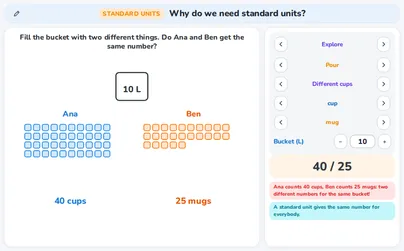
Why do we need standard units? Cups, hand spans and stones

  • Explaining why standard units are needed
  • Seeing that a bigger measure gives a smaller number
  • Knowing that a standard unit gives everybody the same number