Interactive Lessons

Inverse proportion

Lecture notes

Definition

Inverse proportion

When one number is multiplied, the other is divided by the same number.
26124×3÷3
Example
24 sweets shared: 4 kids get 6 each. With twice as many kids: kids → each

66664×2333333338
Definition

The number that stays the same

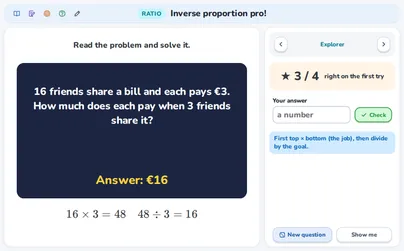
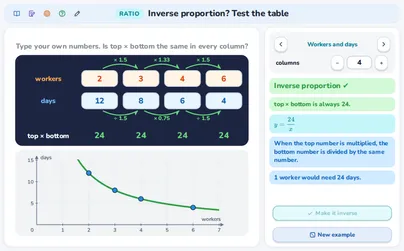
top × bottom is the same in every column.
122248324
Example
Rectangles with area 36 cm².
94366636
Definition

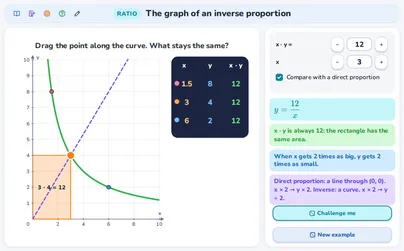
The formula and the graph

The graph is a curve that never touches the axes.
2468101224681012xyy=24/x
Example
Rectangles with area 36: .Width → length
246810681012xyy=36/x123
Rule

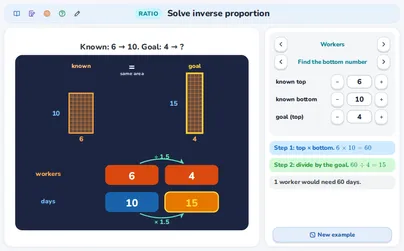
Step 1: the job

Multiply top × bottom. 6 workers need 10 days: worker-days
10 d660
Example
3 painters need 10 hours for a fence. painter-hours
10 h330
Rule

Step 2: divide

Divide the job by the new number. days for 4 workers
10 d66015 d460
Example
Cleaning a park: 4 helpers need 12 hours. With 6 helpers: → hours
12 h4488 h648
Rule

Speed and time

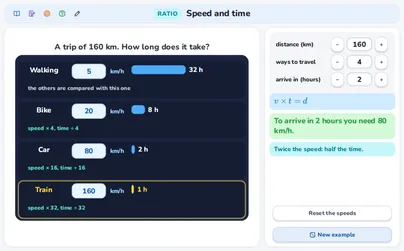
distance = speed × time, so time = distance ÷ speed. hours
2 h90 km/h180 km
Example
A bike ride of 30 km. How long at 10 km/h? hours
3 h10 km/h30 km
Tip

The multiplier way

The top row × 1.5, the bottom row ÷ 1.5.
461510×1.5÷1.5
Example
. What goes with 6? →
26186×3÷3
Tip

More or fewer?

More workers: fewer days. If your answer goes the wrong way, you multiplied where you had to divide.
0481212346
Example
5 pumps empty a pond in 12 hours. With 10 pumps the time must be less than 12: hours ✔
04812125610
Watch out!

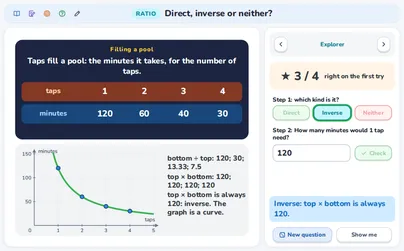
Direct or inverse?

3 workers need 12 days. Then 6 workers need 6 days, not 24.Double the workers: half the days.
361224×2×2✘36126×2÷2✔
Example
2 taps fill a bath in 20 minutes. With 4 taps?✘ ✔ minutes
242040×2×2✘242010×2÷2✔
Watch out!

Down is not always inverse

also goes down. But and : the product changes.
6810122410xy2846
Example
Sam has 12 stickers and gives away : . but → not inverse
6810121424612xy21048
Special case

Whole workers, whole days

60 worker-days ÷ 7 workers: daysIn real life: 9 days.
Example
Packing takes 40 person-hours. With 6 people: → plan 7 hours
Special case

Never 0

With 0 workers the job is never done. That is why the curve never touches the axes.
2468101224681012xy
Example
Sharing 30 sweets: 1 kid gets 30, 30 kids get 1 each. is impossible → no point at
102030102030xy

Exercises

An inverse table has . Find Easy
2312?
Show solution
12224
122248324
Answer →
Check: .
6 workers need 10 days. How many days do 4 workers need? Medium
6410?
Show solution
worker-days
10 d660
10 d66015 d460
Answer → 15 days
Check: fewer workers, more days, .
A car at 90 km/h needs 2 hours. How long does it need at 60 km/h? Medium
km/h9060h2?
Show solution
km
2 h90 km/h180 km
2 h901803 h60180
Answer → 3 hours
Check: slower, more time, .
5 taps fill a pool in 24 minutes. How many taps fill it in 8 minutes? Hard
5?min248
Show solution
245120
245120815120
Answer → 15 taps
Check: .
Are you a teacher?

Start live lessons with these applications for your whole class. Free to try for one month.

Try it free

Fits these school years

IB (MYP, Diploma): MYP 4, MYP 5

Cambridge International: Lower Secondary, stage 8, Lower Secondary, stage 9, IGCSE

Netherlands: Groep 8, Year 1, Year 2, Year 3 (havo, vwo), Havo · Mathematics B, Vwo · Mathematics A, Vwo · Mathematics C, Vmbo kb (years 3-4), Vmbo gt (years 3-4), Havo · Mathematics A

Türkiye (MEB): Year 7 (MEB), Year 8 (MEB)

England (GCSE, A Level): Year 8, Year 9, Year 10 (GCSE)

USA (Common Core): Grade 7, Grade 8
What the applications of this topic teach 5 applications

Inverse proportion? Test the table

  • Testing a table for inverse proportion
  • Working out top × bottom for every column
  • Telling inverse proportion from direct proportion

The graph of an inverse proportion: a curve

  • Seeing that top × bottom is the same everywhere on the curve
  • Knowing that the graph is a curve that never touches the axes
  • Telling the curve from the line of a direct proportion

Solve inverse proportion: workers, speed, time

  • Solving an inverse proportion with top × bottom
  • Finding the other number for a new top or bottom number
  • Using the multiplier: × in one row, ÷ in the other

Direct, inverse or neither?

  • Telling direct proportion, inverse proportion and neither
  • Finding the amount for 1, or the number that stays the same
  • Telling a proportional situation from one with a start amount

Speed and time: faster, shorter

  • Knowing that for a fixed distance higher speed means less time
  • Working out the time: distance ÷ speed
  • Working out the speed needed to arrive on time