Interactive Lessons
Lecture notes Exercises

Constructions: bisectors, triangle lines, congruent and similar triangles

Lecture notes

Definition

Compass and unmarked ruler

A compass draws a circle or an arc: every point of it is at the same distance from the centre. An unmarked ruler only draws straight lines through two points. Nothing is measured: the compass opening is copied from one place to another.
Example
Compass point on A, opening 4 cm: every point of the arc is 4 cm from A.
Definition

Perpendicular bisector

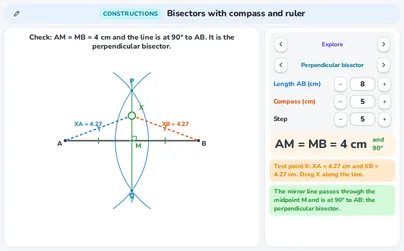
The perpendicular bisector of a segment AB goes through its midpoint M and is at 90° to AB. Every point X on it is as far from A as from B: . It is the mirror line of A and B.
Example
AB = 8: M is the midpoint.
Rule

Constructing the perpendicular bisector

Open the compass wider than half of AB. Draw arcs around A, then arcs with the same opening around B. They cross at P and Q. The ruler line PQ is the perpendicular bisector; it cuts AB at M.
Example
AB = 8 and opening 5 (more than 4): P and Q are 5 from A and 5 from B.
Rule

Why the construction works

P and Q are both as far from A as from B, so they lie on the mirror line of A and B. A line through two points is determined, so PQ is that mirror line. Each point X of it has = XB.
Example
AB = 8 and XM = 3:
Watch out!

The opening must be big enough

If the opening is exactly half of AB the arcs only touch at M. If it is smaller, the arcs never meet and there is no P and Q. Any opening bigger than half of AB works.
Example
AB = 8: opening 3 never meets, opening 4 only touches, opening 5 works.
Definition

Angle bisector

The angle bisector is the ray from the vertex O that cuts the angle in two equal parts: . Every point on it is at the same distance from both arms.
Example
An angle of 70°:
Rule

Constructing the angle bisector

Compass on the vertex O: an arc cuts the arms at P and Q, so . Compass on P, then on Q, with the same opening: the arcs cross at R. The ruler ray OR bisects the angle. The distance from a point X of it to an arm is .
Example
The angle is 60° and OX = 10:
Rule

The mirror line: fold it

Fold the paper so that A lands exactly on B: the crease is the perpendicular bisector of AB. Fold one arm of an angle onto the other: the crease is the angle bisector. The crease is always the mirror line.
Example
AB = 10: the crease is 5 from A and makes 90° with AB.
Rule

A ray of light in a mirror

The normal is the line at 90° to the mirror. The angle of incidence equals the angle of reflection, both measured from the normal. So the normal bisects the angle between the incoming and the reflected ray.
Example
Incidence 35°:
Definition

Median

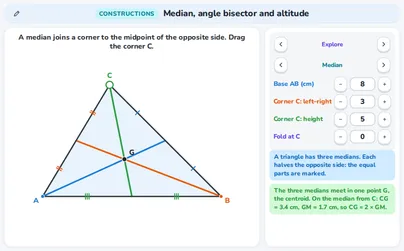
A median joins a vertex of a triangle to the midpoint of the opposite side. A triangle has 3 medians. The midpoint comes from the perpendicular bisector of that side.
Example
AB = 10: M is the midpoint, so the median from C ends 5 from A.
Definition

Angle bisector of a triangle

An angle bisector of a triangle cuts the angle at a vertex in two equal angles. It ends on the opposite side, but not at the midpoint. A triangle has 3 angle bisectors; they meet in the point I, inside the triangle.
Example
The angle at C is 50°: the bisector makes 25° and 25°.
Definition

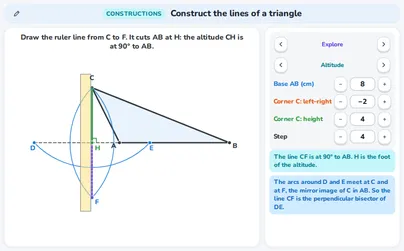
Altitude

An altitude goes from a vertex to the line of the opposite side and is at 90° to it. Its length is the height of the triangle and the shortest distance from the vertex to that line. A triangle has 3 altitudes; they meet in the point H.
Example
Base 10 and altitude 6:
Rule

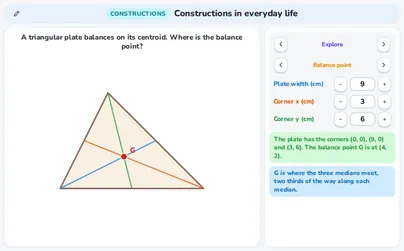
The centroid divides the median 2 : 1

The 3 medians meet in one point G, the centroid: the balance point of a flat triangle. It cuts each median in the ratio 2 : 1: and . With corners , , it is .
Example
Median CM = 9; corners (0, 0), (6, 0) and (3, 9):
Special case

Where the altitudes and bisectors meet

The 3 angle bisectors always meet inside the triangle (I). The 3 altitudes meet in H: inside an acute triangle, at the right-angle vertex of a right triangle, and outside an obtuse triangle.
Example
Right angle at C: the altitudes from A and B are the legs CA and CB, so H = C.
Special case

Obtuse triangle: the foot lies outside

In an obtuse triangle the foot of an altitude can lie on the extension of the side. Extend the side with a dashed line: the altitude is still at 90° to that line.
Example
A(0, 0), B(4, 0), C(-2, 3): the foot of the altitude from C is (-2, 0), left of A, so outside AB. The altitude is 3 long.
Rule

Altitude, bisector, median: h ≤ w ≤ m

From one vertex the altitude h is the shortest, the median m the longest and the angle bisector w is in between: . They are equal only when the triangle is isosceles at that vertex.
Example
Right angle at C with legs 6 and 8, hypotenuse 10:
Special case

Isosceles and equilateral triangles

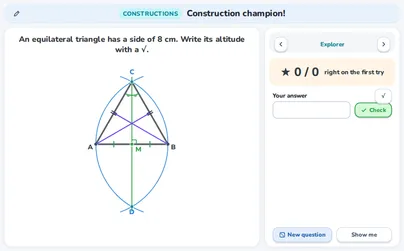
In an isosceles triangle the median, the altitude and the angle bisector from the apex are one line: the axis of symmetry. In an equilateral triangle this holds at every vertex. Altitude of an isosceles triangle: ; of an equilateral one: . Area .
Example
Base 10, legs 13:
Rule

Constructing the median

First the perpendicular bisector of AB: it gives the midpoint M. Then join C to M with the ruler. The two small triangles have equal bases AM = MB and the same height, so each has half of the area.
Example
Triangle with area 30: each half has
Rule

Constructing the altitude

Draw an arc around C that cuts the line AB at D and E. Draw arcs with the same opening around D and E: they cross at F, the mirror image of C. The ruler line CF is at 90° to AB and cuts it at the foot H. If the foot is outside AB, extend AB first.
Example
C is 6 above AB and the arc has radius 10:
Rule

Isosceles and equilateral by compass

Draw the base AB. Arcs with the same opening l around A and B cross at C: then AC = BC = l and the triangle is isosceles. The opening must be more than half of AB. With the opening AB the triangle is equilateral and every angle is 60°.
Example
AB = 8 and opening 5:
Rule

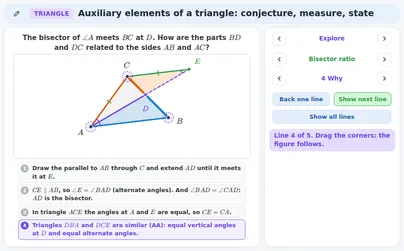
The angle bisector theorem

The bisector from meets at . It cuts in the same ratio as the two sides next to : the part at goes with , the part at goes with . The longer side gets the longer part.
ABCD
Example
In triangle , , and . Find ., so
6946ABCD
Watch out!

Which sides, which parts?

In the bisector theorem equals , the two sides that meet at , not . Keep the pairs together: the part at goes with and the part at goes with . Do not add the sides either, and do not turn the ratio round: the longer side gets the longer part.
Example
, and . Wrong: . Right: , so and .Check: because
6946ABCD
Rule

Equal distances from a bisector

Every point of an angle bisector is equally far from the two arms of the angle: , where and are the perpendiculars to the arms. The reason: the right-angled triangles and are congruent (AAS), because is shared and the angles at are equal.
ABCPEF
Example
is on the bisector of and . How far is from the other arm?
Rule

The incircle and the excircle

The 3 interior bisectors meet in one point . It is equally far from the three sides, so the circle with centre and radius touches all three sides: the incircle. With the area and the sides , , its radius is given below. The interior bisector at and the exterior bisectors at and meet in , the centre of an excircle.
ABCIr
Example
A right triangle has the legs 6 and 8 and the hypotenuse 10. Find ., so
Rule

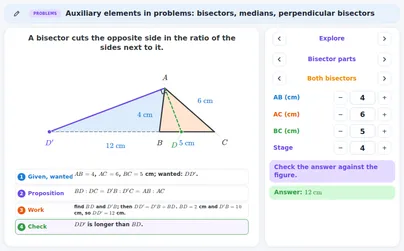
The exterior bisector

The bisector of the exterior angle at is at 90° to the interior bisector: the two halves make . It meets the line at outside the segment and cuts it in the same ratio as the sides: . When it is parallel to .
ABCDD'
Example
, and . lies beyond with , so . gives , so
4648ABCDD'
Rule

The circumcircle

Every point of the perpendicular bisector of a side is equally far from its two ends: . The 3 perpendicular bisectors of a triangle meet in one point : and , so . So is equally far from , and , and the circle with centre through the corners is the circumcircle.
ABCO
Example
is on the perpendicular bisector of and . Find .
Special case

Where the circumcentre lies

The circumcentre is inside an acute triangle, at the midpoint of the hypotenuse of a right triangle, and outside an obtuse triangle (beyond the longest side). The orthocentre moves in the same way. The incentre and the centroid are always inside the triangle.
ABCO
Example
A triangle has an angle of 110°. Where is ?The angle is obtuse, so lies outside the triangle
Rule

The median of a right triangle

In a right triangle the median to the hypotenuse is half of the hypotenuse. Complete the triangle to a rectangle: its diagonals are equal and cut each other in half, so , the midpoint of , is equally far from , and (the centre of the circumcircle). It works the other way round too: if a median is half of its side, the opposite angle is 90°.
ABCDM
Example
Right angle at , and . Find ., so
Rule

The altitudes and the big triangle

Draw the parallel to the opposite side through each corner. The three lines make a big triangle in which , and are the midpoints of the sides. An altitude of is at 90° to a side of the big triangle at its midpoint: it is a perpendicular bisector of . So the 3 altitudes meet in one point , the orthocentre.
ABCA'B'C'H
Example
Triangle has the sides 3, 4 and 5. Where is ?: the angle between the sides 3 and 4 is 90°, so is that corner
Watch out!

One example is not a proof

A guess that holds in one triangle can fail in another. Test it on an acute, a right-angled and an obtuse triangle, and on an isosceles one. If one triangle breaks it, it is false. If it holds in all of them, look for the reason before you call it a rule.
Example
Guess: the median from is half of . Take and :the median is 4 but half of is 3, so the guess is false (it only holds for a right angle at )
Tip

Solve a problem in four stages

Work every problem in the same four stages: given and wanted (write them next to the figure), the proposition that fits (bisector theorem, equal distances, the 2 : 1 point, the median of a right triangle), the work (one line per step) and the check (does the answer fit the figure: the longer side gets the longer part, is longer than ). If the data a proposition needs are not given, choose another one.
Example
The medians of triangle meet at and . Find .Given , wanted . Proposition . Work . Check:
Definition

Congruent triangles

Two triangles are congruent (≅) when all matching sides and all matching angles are equal. They may be turned or flipped over. Write the corners in matching order: means A matches D, B matches E, C matches F.
Example
If AB = 5 and ∠A = 40°, then DE = 5 and ∠D = 40°.
Rule

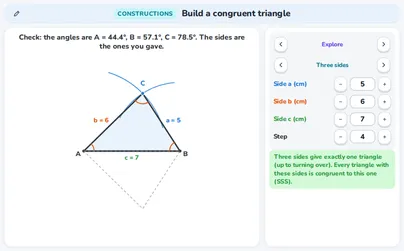
Building a triangle: SSS, SAS, ASA

Three sides (SSS): draw AB, then two arcs from A and B cross at C. Two sides and the angle between (SAS): draw AB, mark the angle with the protractor, copy the second side with the compass. Two angles and the side between (ASA): two rays from A and B cross at C; the third angle is . Each rule gives exactly one triangle (up to flipping).
Example
ASA with A = 50° and B = 60°:
Watch out!

No triangle

The arcs of SSS meet only when the two shorter sides together are longer than the longest: . For ASA the two rays meet only when . Otherwise the construction fails: no triangle.
Example
Sides 3, 4 and 8: 3 + 4 = 7 is less than 8, so the arcs never meet. Angles 100° and 80° add up to 180°: parallel rays.
Rule

Which data are enough?

SSS, SAS and ASA (also AAS) give exactly one triangle. Two sides and an angle that is not between them (SSA) can give two triangles: . Three angles (AAA) fix only the shape, not the size. Two sides, or one side and one angle, leave the triangle free.
Example
A = 30°, b = 10, a = 6:
Definition

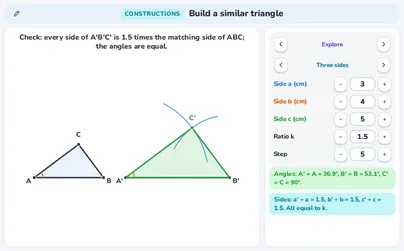
Similar triangles and the ratio k

Two triangles are similar (∼) when their matching angles are equal and their matching sides are in the same ratio . Write with the corners in matching order. With the triangles are congruent: congruent triangles are similar, not the other way round.
Example
ABC has sides 3, 4, 5 and k = 2:
Rule

AA, SSS and SAS for similarity

Two equal angles are enough (AA): the third angle follows and the shape is fixed. Three sides in the same ratio are enough (SSS). Two sides in the same ratio and the equal angle between them are enough (SAS). A side only sets the size. SSA can give two different shapes.
Example
Angles 40° and 70° in one triangle, 70° and 40° in another:
Rule

A parallel line cuts a triangle

If DE is parallel to BC, the small triangle ADE has the same angles as ABC, so and .
Example
AD = 3, AB = 9 and BC = 12:
Rule

Perimeter and area

With the ratio k the lengths, and so the perimeter, are multiplied by k. The area is multiplied by .
Example
k = 3, perimeter 12 and area 6:
Watch out!

Rectangles and rhombi

Similar polygons need equal angles AND proportional sides. All rectangles have equal angles (90°), but their sides need not be proportional. All rhombi have proportional sides, but their angles need not be equal. Neither one alone is enough.
Example
Rectangles 2 by 6 and 3 by 9 are similar (3 ÷ 2 = 9 ÷ 6). Rectangles 1 by 5 and 2 by 3 are not (2 ÷ 1 is not 3 ÷ 5).
Tip

Shadows and copies

The sun makes similar triangles of a tree and a stick: . A photocopy at 200% doubles every length (k = 2) and makes the area times as big.
Example
A stick of 2 casts a shadow of 3. The tree casts a shadow of 12:
Definition

Parallel, intersecting or skew lines in space

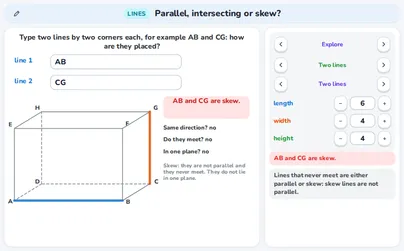
Two lines in space can be parallel (the same direction and they never meet), intersecting (they meet in one point) or skew (not parallel and they never meet: they do not lie in one plane). Skew lines exist only in space, not in a flat drawing. For a pair of edges of a box ask two questions: the same direction? Do they meet at a corner? In Two lines you type two lines by their corners.
Example
Take the edge AB of a box. Three edges are parallel to it (CD, EF, GH), four meet it at a corner (BC, DA, AE, BF) and four are skew to it (CG, DH, FG, HE): 3 + 4 + 4 = 11, the other 11 edges.
ABCDEFGH
Rule

Construct a perpendicular and a parallel with compass and straightedge

Perpendicular from P to a line: an arc round P cuts the line in A and B; the same opening round A and round B gives two arcs that cross at Q; the line PQ is perpendicular. Parallel through P: take a point A on the line; an arc round A with opening AP cuts the line in B; the same opening round B and round P gives Q; the line PQ is parallel. Both work because the four points form a rhombus. In Construct you do this step by step with your own line and point.
Example
Compass opening 4: then PA = PB = QA = QB = 4, so PAQB is a rhombus with side 4. The diagonals of a rhombus cross at 90°, so PQ is perpendicular to AB.

Exercises

AB = 10. The perpendicular bisector of AB cuts AB at M. How long is AM, and what is the smallest whole compass opening for which the arcs cross? Easy
Show solution
M is the midpoint:
The opening must be more than 5, so the smallest whole opening is 6
Answer → AM = 5 and opening 6
An opening of exactly 5 only touches at M.
The angle at C is 64°. The angle bisector cuts it in two equal angles. How big is each? Easy
Show solution
Answer → 32°
The bisector halves the angle.
The median CM is 12 long and G is the centroid. How long are CG and GM? Easy
Show solution
Answer → CG = 8 and GM = 4
G is two thirds of the way from the vertex: CG = 2 × GM.
In triangle the bisector of meets at . , and . Find and . Easy
812??ABCD
Show solution
.
is 5 parts of 3: and .
Answer → ,
Check: the longer side gets the longer part , and .
Right angle at , and , and is the midpoint of . Find the median and the radius of the circumcircle. Easy
1024ABCDM
Show solution
.
.
is the centre of the circumcircle, so .
Answer → ,
The median to the hypotenuse is half of it: .
is on the bisector of , and , with and . Find and . Easy
5?ABCPEF13
Show solution
is on the bisector, so .
In the right triangle : .
Answer → ,
is the hypotenuse, and are the legs: .
An isosceles triangle has a base of 16 and legs of 17. How long is the median to the base, and what is the area? Medium
Show solution
The median is also the altitude. Half of the base is 8
Answer → m = 15 and area 120
Use half of the base in the right triangle, not the whole base.
Triangle ABC has sides 4, 6 and 8. A similar triangle A'B'C' has a shortest side of 10. Find k, the other two sides and the ratio of the areas. Medium
Show solution
and
The area ratio is
Answer → k = 2.5, sides 15 and 20, area ratio 6.25
Divide the shortest by the shortest. The area ratio is k squared, not k.
DE is parallel to BC. AD = 4, DB = 6 and AC = 20. How long are AE and EC? Medium
Show solution
, so
Answer → AE = 8 and EC = 12
The ratio uses AB (the whole side), not DB.
In triangle , , and . The bisector of the exterior angle at meets the line at beyond . Find . Medium
696?ABCDD'
Show solution
Exterior bisector: .
Let . Then , because is beyond : .
, so .
Answer →
Check: . Write , not .
A right triangle has the legs 9 and 12 and the hypotenuse 15. Find the radius of its incircle. Medium
ABCI
Show solution
The area is .
The perimeter is .
.
Answer →
Check: the circle must fit in the triangle: is less than the shortest side 9.
In an acute triangle the angle at is . The altitudes from and meet at and the bisectors of and meet at . Find and . Medium
Show solution
The quadrilateral has the angles , and , so , and (vertical angles).
, so the halves at make .
.
Answer → and
Check: is inside the triangle, so is more than ; both angles are more than the angle at .
A triangle has sides 7 and 12 and a third side x. How many whole numbers x make a triangle? Hard
Show solution
The difference is and the sum is
x = 6, 7, …, 18, so values
Answer → 13 whole numbers
5 and 19 themselves are not allowed: the arcs would only touch.
Two similar triangles have areas 18 and 50. The first has a perimeter of 12. Find the ratio k and the perimeter of the second. Hard
Show solution
, so
Perimeter:
Answer → k = 5/3 and perimeter 20
Areas give k squared: take the square root before you use it for lengths.
A triangle has the corners A(0, 0), B(9, 0) and C(3, 6). Find the centroid G and the height of G above AB. Hard
Show solution
G = (4, 2): its height above AB is one third of the height of C
Answer → G = (4, 2), height 2
Average the coordinates of the three corners.
In triangle , , and . is the bisector and the median from , with and on . Find . Hard
1218ABCDM
Show solution
Bisector: , so .
Median: is the midpoint, so .
is between and : .
Answer →
Check: is nearer to than the midpoint is, because .
Ali says: “The circumcentre of a triangle is always inside the triangle.” Test it with the triangle with the sides 3, 4, 5 and with a triangle that has an angle of 110°. Hard
ABCO
Show solution
: the triangle is right-angled, so is the midpoint of the hypotenuse, on the triangle and not inside.
In the triangle with an angle of (obtuse) lies outside the triangle.
One example that breaks the claim is enough: the claim is false.
Answer → false: is inside only for an acute triangle
A claim that holds in many triangles is still not a proof; one counterexample is enough to reject it.
Are you a teacher?

Start live lessons with these applications for your whole class. Free to try for one month.

Try it free

Fits these school years

IB (MYP, Diploma): MYP 2, MYP 4, MYP 5, MYP 3

Cambridge International: Lower Secondary, stage 8, Lower Secondary, stage 7, Lower Secondary, stage 9, IGCSE

Netherlands: Year 1, Year 2, Year 3 (havo, vwo), Havo (all mathematics courses), Vwo · Mathematics B, Vwo · Mathematics D

Türkiye (MEB): Year 7 (MEB), Year 8 (MEB), Year 9 (MEB), Year 10 (MEB)

England (GCSE, A Level): Year 7, Year 8, Year 9, Year 10 (GCSE), Year 11 (GCSE)

USA (Common Core): Grade 7, Grade 8, Geometry

What the applications of this topic teach 9 applications

Bisectors with compass and ruler

  • Using the properties of the mirror line
  • Constructing a perpendicular bisector with compass and ruler
  • Constructing an angle bisector
  • Finding the mirror line by folding

Median, angle bisector and altitude

  • Recognising and drawing the median, angle bisector and altitude
  • Knowing where the medians, bisectors and altitudes meet
  • Knowing the foot of an altitude may lie outside a triangle
  • Finding triangle lines by folding paper

Construct the lines of a triangle

  • Constructing the median of a triangle
  • Constructing the angle bisector and the altitude with compass and ruler
  • Constructing the altitude when its foot lies outside the side
  • Building isosceles and equilateral triangles with equal arcs

Build a congruent triangle

  • Constructing a triangle from three sides (SSS)
  • Constructing a triangle from two sides and the angle between (SAS)
  • Constructing a triangle from two angles and the side between (ASA)
  • Stating the rules SSS, SAS, ASA and using the symbol ≅

Build a similar triangle

  • Building a similar triangle with a chosen ratio k
  • Knowing the similarity ratio and that matching angles are equal
  • Using the symbol ∼ with corners in matching order
  • Using a line parallel to a side to find a similar triangle

Constructions in everyday life

  • Using the perpendicular bisector to find a meeting point
  • Using the angle bisector to place a bench between two paths
  • Finding the balance point of a triangular plate with the medians
  • Copying a plot of land from three measured sides at a scale

Parallel, intersecting or skew? Lines and planes in a box

  • Telling parallel, intersecting and skew lines apart in a box
  • Saying how a line and a plane, and two planes, are placed
  • Constructing the perpendicular and the parallel through a point

Auxiliary elements of a triangle: conjecture, measure, state

  • Making a conjecture about triangle bisectors, medians and altitudes
  • Testing a conjecture on acute, right-angled and obtuse triangles
  • Stating the propositions: incircle, circumcircle, the 2 : 1 point
  • Giving the reason with congruent or similar triangles

Auxiliary elements in problems: bisectors, medians, perpendicular bisectors

  • Using the bisector theorem to find parts of a side
  • Using equal distances from a bisector and the radius of the incircle
  • Using the 2 : 1 point of the medians and the area of GBC
  • Finding the angle at the meeting point of altitudes or bisectors