Interactive Lessons

Term-to-term and position-to-term rules

Lecture notes

Definition

A sequence

A sequence is a list of numbers in order. Every number is a term. The position number n says which term it is.
581114…1234…nu
Example
The sequence has term 1 = 4.The 3rd term (n = 3) is 14.

4914191234n
Definition

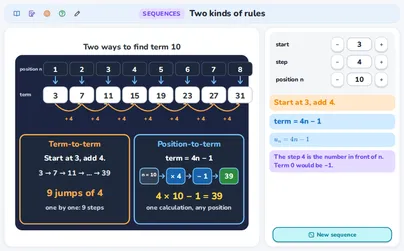
The term-to-term rule

The term-to-term rule says how to get from one term to the next. Start at 5 and add 3 each time.
581114+3+3+3
Example
Start at 10 and add 4 each time:
10141822+4+4+4
Definition

The position-to-term rule

The position-to-term rule says how to get a term from its position number n. It is also called the nth term. For 5, 8, 11, 14, … it is 3 × n + 2.
4×312+214
Example
For the nth term is .Term 4:
4×520−119
Rule

The nth term of a linear sequence

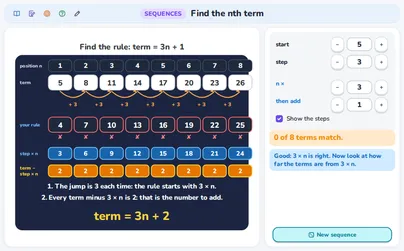
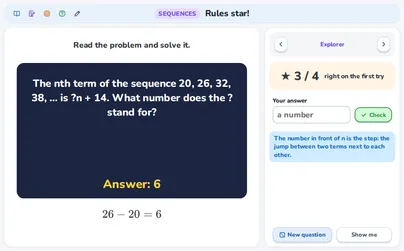
When the same number (the step) is added each time, the nth term is step × n + a last number. The step is the number in front of n.
n1234u581114+3+3+3
Example
The sequence adds 4, so the nth term is . ✔
n123u71115+4+4
Rule

The number in front of n

Subtract two terms next to each other: that jump is the number in front of n.
581114+38−5+311−8+314−11
Example
In subtract two terms next to each other: → 7n + …
61320+713−6+720−13
Rule

The last number

Term 1 minus the step gives the last number. It is the term "number 0", before the sequence starts.
258111401234n+3+3+3+3−3
Example
For the step is 7. →
−1613200123n+7+7+7−7
Rule

A far term

To find term 100 put 100 in the rule: one calculation, you do not need 99 jumps.
100×3300+2302
Example
The nth term is . What is term 40?
40×5200−2198
Rule

Which term is it?

Take the last number away, then divide by the number in front of n. A whole number (1 or more) means the number is a term.
302−2300÷3100
Example
The nth term is . Is 101 a term? → yes, term 16
101−596÷616
Rule

Decreasing sequences

When the terms go down, the step is negative. The sequence 20, 17, 14, … has the step −3 and the nth term −3n + 23.
12345651015nu23
Example
The sequence has step −4 and the nth term . ✔
12345102040nu34
Tip

Check with term 1 and term 2

Put n = 1 and n = 2 in your rule. You must get the first two terms.
1×33+25✔2×36+28✔
Example
Rule for ✔ ✔
1×44+37✔1×44✘
Tip

Look at the graph

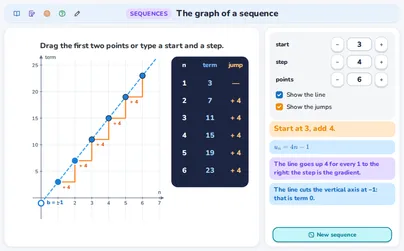
The points (n, term) lie on a straight line. The step is the gradient and the line cuts the vertical axis at the last number, term 0.
123455101520nu132
Example
The points of lie on a line that cuts the vertical axis at 1.
12345101520nu141
Watch out!

Do not swap the two numbers

3n + 2 is not the same as 2n + 3. The number in front of n is the step.
4×312+2144×28+311
Example
Term 5 of or ?✘ ✔
5×420+121✔5×15+49✘
Watch out!

Mind the minus sign

For 20, 17, 14, … the number in front of n is −3, not 3: the terms go down.
201714−317−20−314−17
Example
For the terms go down:✘ ✔
504540−545−50−540−45
Watch out!

Add 3 is not the nth term

“Add 3” is the term-to-term rule. The nth term of 5, 8, 11, … is 3n + 2, not 3n.
5811+3+31×33+25
Example
For “add 4” is the term-to-term rule.✘ gives 4 ✔ gives
71115+4+41×44+37
Special case

Sequences that are not linear

The jumps of 1, 4, 9, 16 are 3, 5, 7: they change. These sequences do not have the form step × n + a number.
14916357
Example
The triangle numbers have the jumps 2, 3, 4:
13610234
Special case

Rules in real life

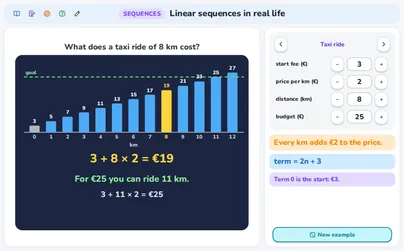
A start fee of 3 euros and 2 euros for every km is a linear sequence: term 0 is the start fee.
2468101520nu3
Example
A bike rental costs €5 plus €3 per hour: term 0 is 5, step 3. → €17 for 4 hours
12351025nu4175

Exercises

What is the term-to-term rule of ? What is the next term? Easy
491419?12345n
Show solution
The jump:
491419?+59−4+5+5
Add 5 each time, so the next term is
49141924+5+5+5+5
Answer → add 5; the next term is
Check: : every jump is 5.
Find the nth term of Medium
71115191234n
Show solution
The step is , so the rule starts with
7111519+411−7+4+4
Term 1 is 7, so the last number is
3711151901234n+4+4+4+4−4
Answer →
Check: .
The nth term of a sequence is . What is the 40th term? Medium
40×5?−2?
Show solution
Put in the rule:
40×5200−2?
40×5200−2198
Answer →
Check: term 1 is .
The nth term of a sequence is . Is 101 a term? If yes, which term? Hard
n×66n+5101
Show solution
101−596÷6?
: a whole number, so yes
101−596÷616
It is term 16
Answer → yes, term 16
Check: .
Find the nth term of Hard
302622181234n
Show solution
The terms go down by 4, so the step is and the rule starts with
30262218−426−30−4−4
Term 1 is 30, so the last number is
343026220123n−4−4−4+4
Answer →
Check: .

Interactive applications for this topic

Free applications open with a free student account. Teachers can use all applications in a live lesson.

About the free account and Plus

Are you a teacher?

Start live lessons with these applications for your whole class. Free to try for one month.

Try it free

Fits these school years

IB (MYP, Diploma): MYP 4, MYP 5

Cambridge International: Lower Secondary, stage 7, Lower Secondary, stage 8, Lower Secondary, stage 9, IGCSE

Netherlands: Groep 8, Year 1, Year 2, Year 3 (havo, vwo), Vwo · Mathematics A, Vwo · Mathematics C, Vwo · Mathematics D

Türkiye (MEB): Year 7 (MEB), Year 8 (MEB)

England (GCSE, A Level): Year 7, Year 8, Year 9

USA (Common Core): Grade 7, Grade 8, Algebra 1
What the applications of this topic teach 4 applications

Two kinds of rules

  • Telling the term-to-term rule of a sequence
  • Telling the position-to-term rule, the nth term
  • Knowing when to use which rule

Find the nth term

  • Finding the number in front of n from the jumps
  • Finding the last number of the nth term
  • Checking a rule with the first terms

The graph of a sequence

  • Plotting the terms of a sequence as points (n, term)
  • Seeing that the step is the gradient of the line
  • Seeing that the line cuts the vertical axis at term 0

Linear sequences in real life

  • Using a linear sequence in real life: start + step × n
  • Knowing that term 0 is the amount at the start
  • Finding how far a given budget or target gets