Interactive Lessons
Lecture notes Exercises

Surface area and volume

Lecture notes

Definition

Volume: counting cubes

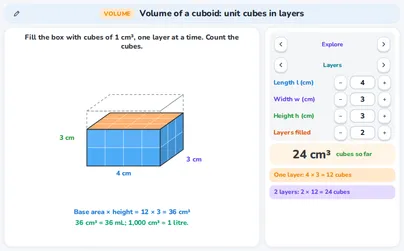
Volume is the space inside a solid. Fill it with unit cubes of 1 cm³ and count them. A box is filled layer by layer: first count the cubes in one layer, then the layers.
Example
Box 4 by 3 by 2: cm³
Rule

V = l × w × h

Multiply the length, the width and the height. The same number is the base area times the height. The unit is cm³.
lwh
Example
Box 5 by 4 by 3: cm³
5 cm4 cm3 cm
Rule

The cube: V = a³

A cube has three equal edges a, so V = a × a × a. Its volume is a cube number.
aaa
Example
Edge 3 cm: cm³
3 cm3 cm3 cm
Rule

A missing edge

Volume is a product, so undo it by dividing: h = V ÷ (l × w). Check by multiplying back.
Vlw?
Example
V = 60, l = 5, w = 4:
V=6054?
Rule

Same volume, different boxes

Many boxes have the same volume: split the volume into three whole-number factors. The shape changes, the volume stays.
1112134223
Example
V = 12:
Rule

L-shaped blocks

Split an L-shaped block into two boxes and add, or take a box away from one big box. Both ways give the same volume.
Example
Depth 2; tall part 3 long, 4 high; low part 2 long, 1 high: cm³
Rule

Litres

1 cm³ holds 1 mL, 1000 cm³ is 1 litre and 1 m³ is 1000 litres. Find the volume in cm³ first, then change the unit.
1 L10 cm10 cm10 cm
Example
Tank 40 by 25 by 20 cm: cm³ L
20 L40 cm25 cm20 cm
Definition

Surface area and the net

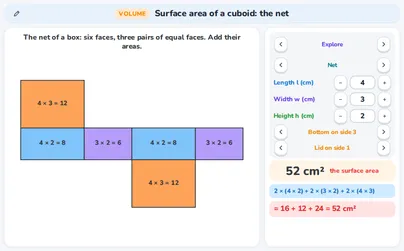
Open a box flat: the net has six faces in three pairs of equal faces. The surface area is the area of the whole net, in cm². A = 2(lw + lh + wh).
lwlwlhlhwhwh
Example
Box 5 by 4 by 3: cm²
202015151212
Rule

The cube: A = 6a²

A cube has six equal square faces, each a × a.
a²a²a²a²a²a²
Example
Edge 3 cm: cm²
999999
Rule

Same volume, different surface

Boxes with the same volume can have very different surface areas. The more spread out the box, the more surface; the box nearest to a cube has the least.
A=52A=98
Example
V = 24:
A=52A=98
Rule

A missing edge from A

Take the top and the bottom away: A − 2lw is the four sides. They make a strip as long as the distance round the base, so h = (A − 2lw) ÷ (2(l + w)).
lwlw2(l+w)h
Example
A = 94, l = 5, w = 4:
202054?
Definition

Prism: base area × length

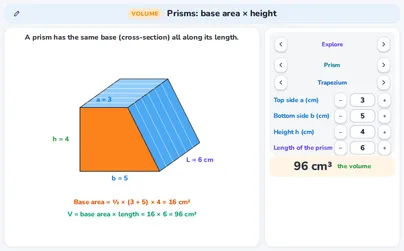
A prism has the same cross-section (the base) all along its length. Its volume is the base area times the length: fill it slice by slice, every slice the same.
BL
Example
Triangle base 6, height 4; length 10: cm³
1210
Rule

Base areas

Triangle ½bh. Trapezium ½(a + b)h. L-shape: the big rectangle minus the corner. Rectangle: l × w. Use the area rules of the plane shapes.,
bhhab
Example
Trapezium 3, 7, height 4; L-shape 6 by 5 minus 2 by 3:
4376523
Rule

Prism: surface area

The net of a prism is two bases and one strip of rectangles. The strip is as long as the perimeter of the base: A = 2 × base area + perimeter × length.
BBL
Example
Right triangle 3, 4, 5; length 10: cm²
3456610
Rule

A missing length

Undo the product again: length = V ÷ base area. For a missing side of the base, first find the base area from V ÷ length.
B?V
Example
V = 240, base area 12:
12?V=240
Definition

Cylinder: the net

The net of a cylinder is two circles and one rectangle. The rectangle is as long as the circumference, 2πr, and as high as the cylinder, h. by
2πrhr
Example
r = 3, h = 10: cm
6π103
Rule

Cylinder: surface area

Add two circles and the curved rectangle: A = 2πr² + 2πrh. Leave π in the answer, or give a decimal when asked.
2πr²2πr²2πrh
Example
r = 3, h = 10: cm²
9π9π60π
Rule

Cylinder: volume πr²h

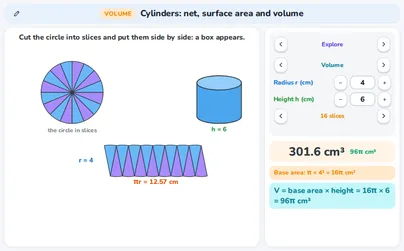
Cut the circle into slices and put them side by side: a box r by πr, and h high. So V = base area × height = πr²h.
hrπrrh
Example
r = 3, h = 10: cm³
1033π310
Rule

Cylinder: backwards

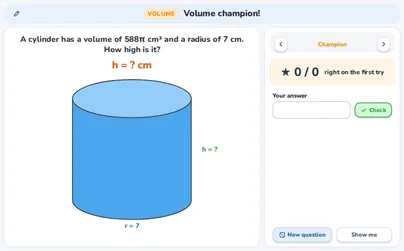
Height: h = V ÷ (πr²). Radius: r² = V ÷ (πh), then take the square root.,
?rV
Example
V = 90π, r = 3: cm
?3V=90π
Rule

Pyramid and cone: a third

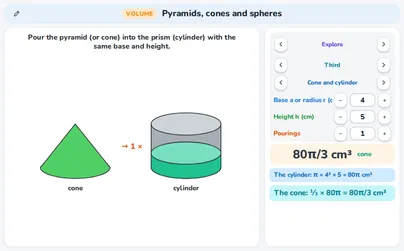
A pyramid holds a third of the prism with the same base and height; a cone a third of the cylinder. So V = ⅓ × base area × height.
1/311/31
Example
Square base 6, height 5; cone r = 3, h = 4:
543
Rule

Cone: curved surface πrs

The slant height s runs along the cone from the edge to the top. Curved surface = πrs. Total = πr² + πrs. Do not use the height h here.,
rhs
Example
r = 3, s = 5:
345
Rule

Pyramid: surface area

Square pyramid: the base a × a plus four triangles, each ½ × a × s, where s is the height of a side face.
sa
Example
a = 6, s = 5: cm²
536
Rule

Sphere: 4/3 πr³ and 4πr²

A sphere fits in a cylinder of radius r and height 2r and fills two thirds of it. V = 4/3 πr³ and the surface area is A = 4πr².,
r2r
Example
r = 3:
36
Rule

Hemisphere

A solid hemisphere has half the volume. Its surface is half the sphere (2πr²) plus the flat circle (πr²): A = 3πr².,
rA=3πr²
Example
r = 3:
3A=27π
Rule

Compound solids: add

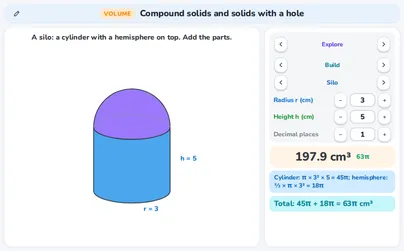
Split the solid into known parts and add their volumes: a silo is a cylinder and a hemisphere, a tent a cylinder and a cone, a house a cuboid and a pyramid. For the outside surface leave out the faces where the parts touch.
Example
Silo r = 3, cylinder 5 high, dome on top:
45π18π35
Rule

Take a part away

A hole through a block: volume of the block minus volume of the hole. A cut-off cone: the big cone minus the small cone on top.
Example
Block 10 by 8 by 5, hole r = 2: cm³
108552
Rule

A cut-off cone

Cut a cone at half its height: the top is a small cone with half the radius and half the height. Left: big cone minus small cone.
RrHh
Example
R = 6, H = 8; small cone r = 3, h = 4:
6384
Watch out!

Surface or volume?

Surface area is the outside (cm², two lengths multiplied). Volume is the inside (cm³, three lengths multiplied). Check the unit of your answer.,
cm²cm³
Example
Cube, edge 2:
222A=24V=8
Watch out!

Forgetting the third

Pyramid and cone need the ⅓. Cylinder and prism do not. A cone with the same base and height as a cylinder holds only a third of it.
11/3
Example
Cylinder 60 cm³ → cone: cm³
6020
Tip

Mass from volume

Mass = density × volume. This belongs to the topic of rates and compound measures, but you need the volume first.
V×ρm
Example
20 cm³ at 3 g per cm³: g
20 cm³×360 g
Tip

Doubling every edge

If every length doubles, the surface area is 4 times and the volume 8 times as big. Lengths × 2, areas × 4, volumes × 8., ,
aaaA×4V×82a2a2a
Example
Cube edge 2 → 4:
222V=64444

Exercises

A box is 6 cm long, 4 cm wide and 3 cm high. Find its volume. Easy
6 cm4 cm3 cm
Show solution
One layer: cubes
Answer → 72 cm³
Multiply the three edges.
A box is 6 cm long, 4 cm wide and 3 cm high. Find its surface area. Easy
6 cm4 cm3 cm
Show solution
, ,
242418181212
Answer → 108 cm²
Three pairs of faces: do not forget the 2.
A cylinder has a radius of 2 cm and a height of 5 cm. Write its volume in terms of π. Easy
5 cm2
Show solution
4π×5
Answer → 20π cm³
Square the radius first: 2 × 2 = 4.
A triangular prism has a triangle base of 6 cm and height 4 cm. It is 10 cm long. Find its volume and surface area if the triangle sides are 6, 5 and 5 cm. Medium
6410
Show solution
Base area:
655121210
Answer → V = 120 cm³, A = 184 cm²
The strip is as long as the perimeter.
A cylinder has a radius of 3 cm and a height of 10 cm. Write its total surface area in terms of π. Medium
10 cm3
Show solution
Two circles:
Curved:
9π9π60π
Answer → 78π cm²
Do not forget the two circles.
A cone has a radius of 3 cm and a height of 4 cm. Its slant height is 5 cm. Find its volume and its total surface area in terms of π. Medium
345
Show solution
345
345
Answer → V = 12π cm³, A = 24π cm²
Volume uses h, the curved surface uses s.
A cylinder has a volume of 90π cm³ and a radius of 3 cm. Find its height. Hard
?3V=90π
Show solution
90π÷9πh
Answer → 10 cm
The π cancels.
A silo is a cylinder with r = 3 cm and h = 5 cm with a hemisphere on top. Find its volume in terms of π. Hard
35
Show solution
Cylinder:
Hemisphere:
45π18π
Answer → 63π cm³
The dome is half a sphere: ⅔ πr³.
A box has a surface area of 94 cm², a length of 5 cm and a width of 4 cm. Find its height. Hard
A=945 cm4 cm?
Show solution
Top and bottom:
Four sides:
202054?
Answer → 3 cm
The distance round the base is 2 × (5 + 4) = 18.
Are you a teacher?

Start live lessons with these applications for your whole class. Free to try for one month.

Try it free

Fits these school years

IB (MYP, Diploma): MYP 1, MYP 2, MYP 3, MYP 4, MYP 5

Cambridge International: Primary, stage 6, Lower Secondary, stage 7, Lower Secondary, stage 8, Lower Secondary, stage 9, IGCSE

Netherlands: Groep 8, Year 2, Vmbo bb (years 3-4), Vmbo kb (years 3-4), Vmbo gt (years 3-4), Vwo · Mathematics C, Year 3 (havo, vwo), Havo (all mathematics courses)

Türkiye (MEB): Year 7 (MEB), Year 8 (MEB), Year 10 (MEB)

England (GCSE, A Level): Year 6, Year 7, Year 8, Year 9, Year 10 (GCSE), Year 11 (GCSE)

USA (Common Core): Grade 6, Grade 7, Grade 8, Geometry

What the applications of this topic teach 7 applications

Volume of a cuboid: unit cubes in layers

  • Filling a box with unit cubes and counting the volume
  • Counting one layer and the layers: V = l × w × h
  • Finding a missing edge from the volume
  • Finding boxes with whole-number edges and the same volume

Surface area of a cuboid: the net

  • Opening a box into a net with six faces
  • Finding the surface area from the net and with 2(lw + lh + wh)
  • Finding the surface area and volume of a cube
  • Telling surface (outside) from volume (inside)

Prisms: base area × height

  • Knowing a prism has the same cross-section all along
  • Finding the base area and the volume: base area × length
  • Finding the surface area from the net of a prism
  • Finding the length or a base side from the volume

Cylinders: net, surface area and volume

  • Naming the parts of a cylinder and unrolling it into a net
  • Finding the surface area from the net: 2πr² + 2πrh
  • Seeing the volume V = πr²h as base × height
  • Finding the height or radius from the volume

Pyramids, cones and spheres

  • Seeing that three pourings fill a prism: V = ⅓ × base × height
  • Finding the volume and surface area of a cone and a pyramid
  • Finding the volume and surface area of a sphere and hemisphere
  • Finding r or h of these solids from volume or surface area

Compound solids and solids with a hole

  • Splitting a compound solid into known parts and adding volumes
  • Finding the outside surface area, leaving out faces that touch
  • Taking a solid away: a round hole, a cut-off cone
  • Writing answers such as 240 − 16π

Volume and surface in everyday life

  • Finding the volume and glass of a fish tank
  • Finding the volume of a tin and the area of its label
  • Finding the air in a tent and the canvas
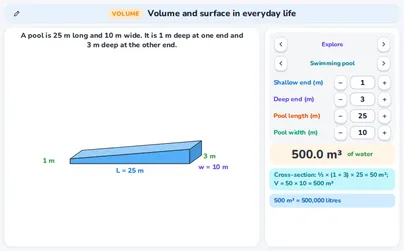
  • Finding the water in a pool with a sloping floor