Interactive Lessons

Quadratic expressions: expand, factorise and complete the square

Lecture notes

Definition

Quadratic expression

A quadratic expression has an x² term and no higher power of x: x² + 5x + 6 or 2x² − 3x + 1.
x²xxxxx
Example
Find the value of when :
−11235248xy46
Definition

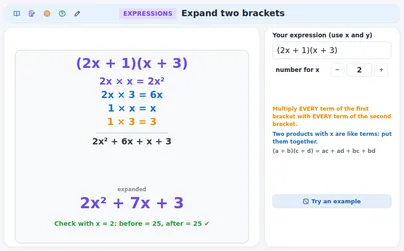
Expand two brackets

To expand (x + 2)(x + 3) is to multiply every term of the first bracket by every term of the second and collect the like terms.
(x+2)(x+3)
Example
Expand :
(x+4)(x+1)=x²+5x+4
Definition

Factorise a quadratic

To factorise a quadratic is to write it as a product of two brackets. It is the opposite of expanding.
x²xxxxxx2x3x²3x2x6
Example
Factorise . Two numbers with product 20 and sum 9: 4 and 5:
x4x5x²5x4x20
Definition

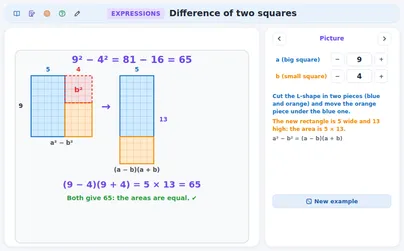
Difference of two squares

A square minus a square, a² − b². It factorises into two brackets that only differ in the sign.
aa−bbbab²a+ba−b
Example
Factorise . Here :
xx−777x7²x+7x−7
Definition

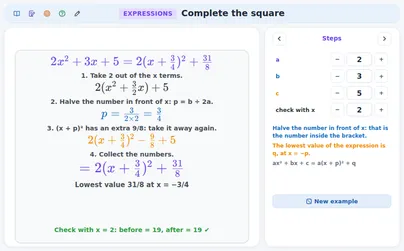
Completing the square

To complete the square is to write x² + bx + c as a square plus or minus a number.
x3x3x²3x3x9
Example
Complete the square for . Half of 4 is 2, and :
x2x2x²2x2x4
Rule

Area model

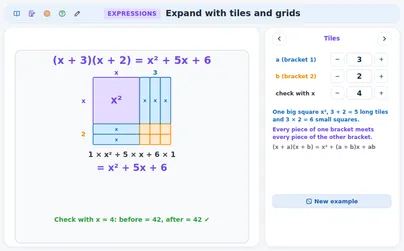
A rectangle with sides x + 3 and x + 2 is made of one x² square, 5 strips of x and 3 × 2 = 6 small squares.
x2x3x²3x2x6x²xxxxx
Example
A rectangle has sides and : one square, strips of and small squares:
x1x5x²5xx5x²xxxxxx
Rule

Every term meets every term

There are four products: x · x, x · 2, 3 · x and 3 · 2. Then collect the two x terms: 2x + 3x = 5x.
x3x2x²2x3x6
Example
Expand . Four products: , , , :
x4x2x²−2x4x−8
Rule

The pattern

For (x + a)(x + b) the number in front of x is a + b and the number term is a × b.
xaxbx²bxaxab
Example
Expand . Sum , product :
x2x7x²7x2x14
Rule

Squares

(x + a)² means (x + a)(x + a). The middle term is 2ax.
x5x5x²5x5x25
Example
Expand . The middle term is and :
x4x4x²4x4x16
Rule

Factorise x² + bx + c

Find two numbers that multiply to c and add to b. They go in the brackets.
x3x4x²4x3x12
Example
Factorise . Product 15, sum 8: 3 and 5:
x3x5x²5x3x15
Rule

The signs of the two numbers

When c is positive, both numbers have the sign of b. When c is negative, the two numbers have different signs.
x3x−5x²−5x3x−15
Example
Factorise . Product , sum : both negative, and :
x−2x−5x²−5x−2x10
Rule

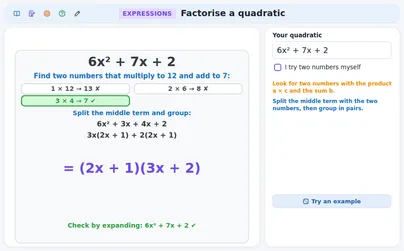
Factorise ax² + bx + c

Find two numbers that multiply to a × c and add to b. Split the middle term and group in pairs.
x32x12x²x6x3
Example
Factorise . and :
x23x43x²4x6x8
Rule

Difference of two squares

Take the square root of both terms: 4x² = (2x)² and 25 = 5². Then use the rule.
2x2x−5552x5²2x+52x−5
Example
Factorise . and :
3x3x−4443x4²3x+43x−4
Rule

Complete the square: the steps

Halve the number in front of x, write (x + p)² and take away the extra p².
x4x4x²4x4x16
Example
Complete the square for . Half of 10 is 5, and :
x5x5x²5x5x25
Tip

Mental maths

A difference of two squares makes a hard sum easy: 53² − 47² = (53 − 47)(53 + 47) = 6 × 100 = 600.
53647475347²1006
Example
Work out in your head:
653035356535²10030
Tip

The turning point

In (x + 3)² − 4 the lowest value is −4, at x = −3. The graph turns at the point (−3, −4).
−6−4−22−2246xy−3−4
Example
What is the lowest value of ? A square is never below 0, so it is 1, at :turning point
−11345−1234567xy21
Watch out!

Take out a common factor first

Always look for a common factor first: 2x² + 10x + 12 = 2(x² + 5x + 6) = 2(x + 2)(x + 3).
2x²+10x+122(x²+5x+6)2(x+2)(x+3)
Example
Factorise fully:✘ ✔
3x²−123(x²−4)3(x−2)(x+2)
Watch out!

(x + 3)² is not x² + 9

A square is two brackets: the middle term 6x must be there.
x3x3x²3x3x9
Example
Expand :✘ ✔
x−5x−5x²−5x−5x25
Special case

The middle terms cancel

In (x + 6)(x − 6) the terms +6x and −6x cancel, so there is no middle term.
x−6x6x²6x−6x−36
Example
Expand . The terms and cancel:
2x−32x34x²6x−6x−9
Special case

Some quadratics do not factorise

x² + 3x + 5 has no two whole numbers with product 5 and sum 3, so it does not factorise with whole numbers. A sum of two squares such as x² + 9 never factorises.
x²xxx✘
Example
Factorise . Product 7 only gives , and , not 5 → it does not factorise with whole numbers
x²xxxxx✘

Exercises

Expand . Easy
x2x3????
Show solution
, , and
x2x3x²3x2x6
Put them together:
Collect the like terms:
x²xxxxx
Answer →
Check: for both give 12.
Factorise . Medium
x²−x−x
Show solution
Find two numbers with product and sum
The pairs: and , and , and , and . Only and have sum
Write the brackets:
x3x−5x²−5x3x−15
Answer →
Check: and .
Factorise . Medium
2x2x−5552x5²
Show solution
Both terms are squares: and
Use with and
Write the brackets:
2x+52x−5
Answer →
Check: for both give .
Factorise . Hard
x²x²xxxxxxx
Show solution
Multiply : . Two numbers with product 6 and sum 7: 1 and 6
Split the middle term:
x²x²xxxxxxx
Group in pairs:
Take out the common bracket:
x32x12x²x6x3
Answer →
Check: for both give 25.
Write in the form . Hard
x²xxxxxx
Show solution
Half of 6 is 3, so :
x3x3x²3x3x9
has 9 too much: take 9 away
−62−2246xy−3−4
Answer →
The lowest point of the graph is .
Are you a teacher?

Start live lessons with these applications for your whole class. Free to try for one month.

Try it free

Fits these school years

IB (MYP, Diploma): MYP 4, MYP 5

Cambridge International: IGCSE, AS Level

Netherlands: Year 2, Year 3 (havo, vwo), Havo · Mathematics A, Havo · Mathematics B, Vwo · Mathematics A, Vwo · Mathematics B, Vwo · Mathematics C

Türkiye (MEB): Year 9 (MEB), Year 10 (MEB), Year 11 (MEB)

England (GCSE, A Level): Year 10 (GCSE), Year 11 (GCSE)

USA (Common Core): Algebra 1, Algebra 2
What the applications of this topic teach 6 applications

Expand with tiles and grids

  • Seeing (x + a)(x + b) as a rectangle
  • Expanding two brackets with tiles and with a grid
  • Knowing a minus times a minus is a plus

Expand two brackets

  • Expanding two brackets
  • Expanding a square like (x + 5)²
  • Seeing why a difference of two squares has no middle term

Factorise a quadratic

  • Factorising x² + bx + c
  • Factorising ax² + bx + c by splitting the middle term
  • Knowing when a quadratic does not factorise

Difference of two squares

  • Seeing a² − b² as a rectangle
  • Factorising a difference of two squares
  • Using it for mental sums

Complete the square

  • Completing the square for x² + bx + c
  • Writing ax² + bx + c as a(x + p)² + q
  • Finding the turning point from the completed square

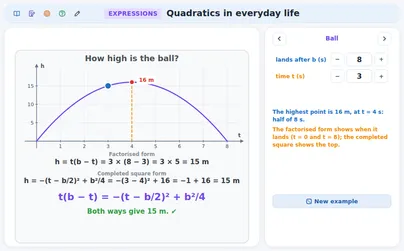
Quadratics in everyday life

  • Seeing an expanded form and a factorised form in a real situation
  • Using the factorised form and the completed square
  • Finding the highest point of a throw