Interactive Lessons

Quadratic equations: factorising, completing the square, the formula; number of solutions

Lecture notes

Definition

Quadratic equation

An equation that can be written as with a not 0. It has at most two solutions.
−224−4−2246xy
Example
is quadratic too:, so
−4−22−6−4−224xy
Definition

Discriminant

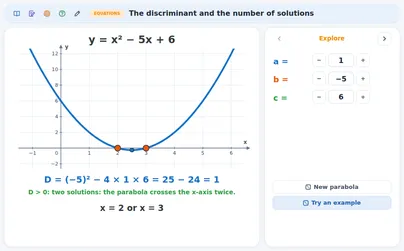
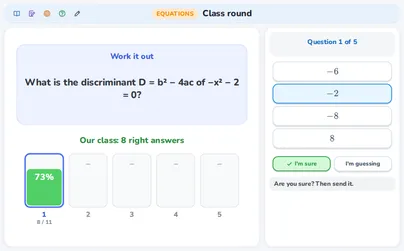
The number D = b² − 4ac. It tells you how many solutions the equation has, before you solve it.
246−4−2246xyD>0
Example
−112345−2−112345xyD=4
Definition

Completing the square

Writing x² + bx as a square of a bracket minus a number. It works for every quadratic equation.
x3x3x²3x3x9
Example
because
x4x4x²4x4x16
Rule

Make the right side 0

Move everything to the left first: . Only then you may factorise or use the formula.
x²=3x+4−3x−4x²−3x−4=0
Example
first becomes , so or
x²=2x+15−2x−15x²−2x−15=0
Rule

Zero product rule

If then or . So when you have factorised, solve each bracket = 0.
−5−4−3−2−11−11234xy
Example
or , so or
−224−10−55xy
Rule

Factorising when a = 1

Look for two numbers with product c and sum b: , because and .
x2x3x²3x2x6
Example
: product 12, sum 7 → 3 and 4
x3x4x²4x3x12
Rule

Factorising when a is not 1

Find two numbers with product a × c and sum b. Split the middle term and group: .
2x1x32x²6xx3
Example
: product , sum 10 → 4 and 6
3x4x23x²6x4x8
Rule

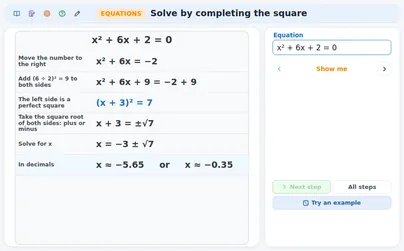
Completing the square: the steps

Divide by a, move the number to the right, add (b ÷ 2)² to both sides, write the left side as a square and take the square root: plus AND minus.
x²+6x=7+9(x+3)²=16√x+3=±4
Example
→ , , so or
x²−6x=7+9(x−3)²=16√x−3=±4
Rule

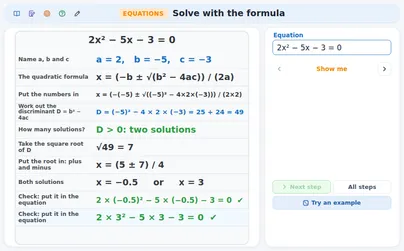
The quadratic formula

It always works. Put in a, b and c, with brackets round negative numbers.
−2246−10−55xy
Example
: , so or
−6−4−224−10−5xy
Rule

Number of solutions

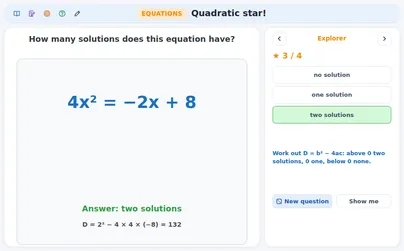
: two solutions (the parabola crosses the x-axis twice). : one solution (it touches the axis). : no solution (it misses the axis).
xyD>0xyD=0xyD<0
Example
: → no solution: → one solution
xyD<0xyD=0
Rule

Choose a method

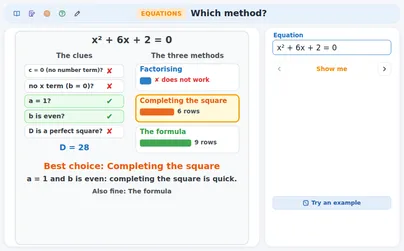
No number term () or no x term: easy by hand. D a perfect square: factorise. Otherwise the formula, or completing the square when and b is even.
Example
: no number term → : , not a square → the formula
Tip

Check your answers

Put each solution into the original equation. Both sides must be equal.
−224−6−4−22xy✔✔
Example
gave and ✔ and ✔
−224−8−6−4−22xy✔✔
Tip

D shows if factorising works

If D is a perfect square (0, 1, 4, 9, 16, 25 …) the equation can be factorised with whole numbers. If not, use the formula.
0491625
Example
: a square → factorise:
010203040507²
Watch out!

Forgetting plus and minus

From you get OR . Two numbers have the square 9.
−4−224−10−55xy
Example
✘ only ✔ : or
−6−336−20−1010xy
Watch out!

Dividing by x

Do not divide by x: you lose the solution . Take 3x to the left and factorise: .
−224−2246xy
Example
✘ : only ✔ : or
−2246−5510xy
Watch out!

The sign in D

When c is negative, ADDS. For : = 49, not .
−2−11234−55xyc
Example
✘ ✔
−6−4−224−10−55xyc
Watch out!

A right side that is not 0

does not mean . First bring the 6 to the left and tidy up.
2462468xy
Example
✘ or ✔ : or
−6−4−224481216xy
Special case

One solution

When both solutions are the same number: gives only .
246246xy
Example
: , so only
−8−7−6−5−4−3−2246xy
Special case

No solution

A square is never negative, so has no solution (among the real numbers).
−3−2−11232468xy✘
Example
gives : no solutionThe formula agrees:
−4−2244812xy✘
Special case

No number term

: take out x, so and or .
−2246−8−6−4−2246xy
Example
→ so or
−6−4−22−10−55xy
Special case

Real life

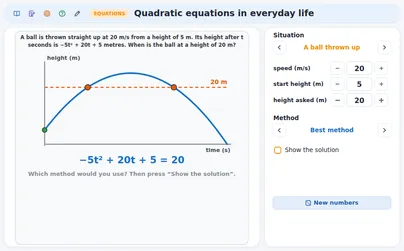
Check which answers fit the story: a length is never negative, and a ball can be at the same height twice (up and down).
12345101520th
Example
A field of by m has an area of 48 m²: or Only m fits: a length is never negative.
−10−8−40468✘✔

Exercises

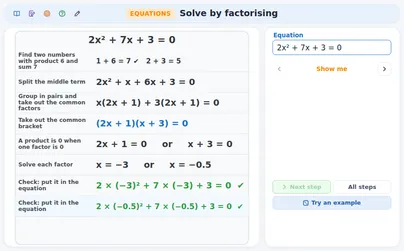
Solve by factorising. Easy
Show solution
Two numbers with product 6 and sum 5: 2 and 3
So
x2x3x²3x2x6
or
−4−224xy
Answer → or
Check: and .
Solve . Easy
Show solution
Take the square root of both sides: plus AND minus
or
−8−4048
Answer → or
Check: and .
Solve by factorising. Medium
Show solution
, sum 7: the numbers are 1 and 6
Split:
Group:
Take out the bracket:
2x1x32x²6xx3
Answer → or
Check: .
Solve by completing the square. Medium
Show solution
Move the number:
Add to both sides:
Write a square:
x3x3x²3x3x9
or
Answer → or (about −0.35 or −5.65)
The roots stay exact: is not a whole number.
Solve with the formula. Medium
Show solution
−224−55xy
Answer → or
Check: and .
How many solutions do and have? Medium
Show solution
First equation: , one solution
Second equation: , no solution
10xyD=0xyD<0
Answer → one solution and no solution
, so .
A garden is 5 m longer than it is wide. Its area is 104 m². How wide is it? Hard
Show solution
, so
x+5x10⁴
and
: or
−12−8−4048✘✔
Answer → the garden is 8 m wide and 13 m long
is negative: a width cannot be negative. Check: .
A ball is thrown up. Its height is metres. When is it at 20 m? Hard
Show solution
, so
1234102030th
Divide by 5: , so
Answer → after 1 s (going up) and after 3 s (coming down)
Check: and .
Are you a teacher?

Start live lessons with these applications for your whole class. Free to try for one month.

Try it free

Fits these school years

IB (MYP, Diploma): MYP 4, MYP 5

Cambridge International: IGCSE

Netherlands: Year 2, Year 3 (havo, vwo), Havo · Mathematics A, Havo · Mathematics B, Vwo · Mathematics A, Vwo · Mathematics B, Vwo · Mathematics C

Türkiye (MEB): Year 9 (MEB), Year 10 (MEB), Year 11 (MEB)

England (GCSE, A Level): Year 10 (GCSE), Year 11 (GCSE)

USA (Common Core): Algebra 1, Algebra 2
What the applications of this topic teach 6 applications

Solve by factorising

  • Bringing a quadratic equation to the form ax² + bx + c = 0
  • Factorising and using the zero product rule
  • Checking both solutions in the equation

Solve by completing the square

  • Dividing by a and moving the number to the right
  • Adding (b ÷ 2)² and writing a square
  • Taking the square root with plus and minus

Solve with the formula

  • Naming a, b and c and putting them into the formula
  • Working out the discriminant D = b² − 4ac with the signs right
  • Saying how many solutions there are before solving

The discriminant and the number of solutions

  • Working out D = b² − 4ac for any a, b and c
  • Knowing that D > 0 gives two solutions, D = 0 one and D < 0 none
  • Linking D to the parabola and the x-axis

Which method?

  • Seeing which method is quickest for an equation
  • Knowing five clues: c = 0, no x term, a = 1, b even, D a square
  • Giving a reason for the choice of method

Quadratic equations in everyday life

  • Writing a story as a quadratic equation
  • Solving it with a method of choice
  • Saying which solutions fit the story and which do not