Interactive Lessons

Area of triangles, parallelograms, trapezia and compound shapes

Lecture notes

Definition

Parallelogram: cut and move

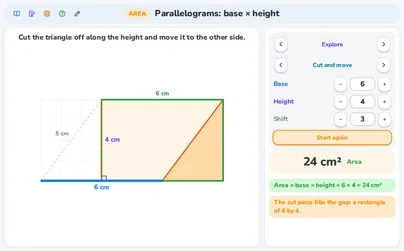
Cut a triangle off one side and move it to the other side: you get a rectangle. Area = base × height.
bhbh
Example
Base 8, height 5: cm²
8585
Definition

Base and height

The height meets the base at a right angle. Every side can be the base, and then it has its own height.
bch
Example
Base 10, height 6: area 60Slanted side 12, height 5:
106125
Rule

Height outside

Sometimes the height lies outside the shape. Make the base line longer: the height still counts.
bh
Example
Obtuse triangle, base 8, height 5:
85
Rule

Right triangle: half a rectangle

A right triangle is half of the rectangle made by its two sides at the right angle.
ab
Example
Sides 6 and 4:
64
Rule

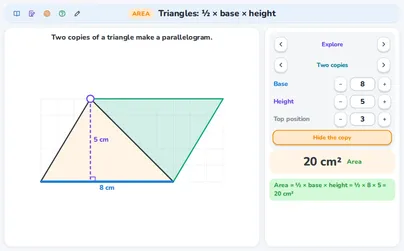
Triangle: ½ × base × height

Two copies of a triangle make a parallelogram, so a triangle is half of base × height.
bh
Example
Base 10, height 7:
107
Rule

Same base, same height

Triangles with the same base and the same height have the same area, wherever the top is on its parallel line.
bh
Example
Base 6, height 4:area every time
64
Rule

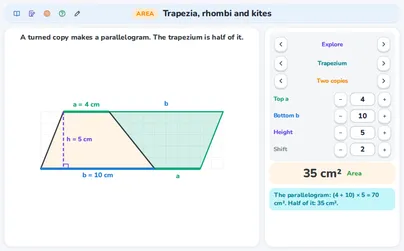
Trapezium

Two copies of a trapezium make a parallelogram with base a + b. Area = ½ × (a + b) × h.
baaba+bh
Example
a = 4, b = 10, h = 5:
1045
Rule

Kite and rhombus

The diagonals of a kite or rhombus fit in a rectangle, and the shape is half of it. Area = ½ × d₁ × d₂.
d₁d₂
Example
Diagonals 8 and 6:
86
Tip

Choose the formula

Choose the formula for the shape and use only the lengths it needs. A slanted side is not needed for the area.
bhbhbah
Example
Parallelogram, base 8, height 5, slanted side 6:, the 6 is not used
865
Rule

Work backwards

Put the numbers in the formula and find what is missing. For a triangle: height = 2 × area ÷ base.
b?A
Example
Area 30, base 12:
12?30
Rule

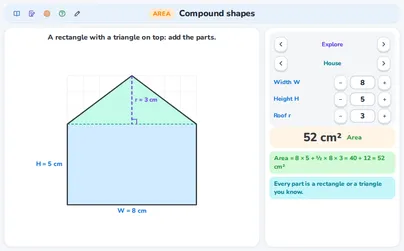
Compound shape: add

Cut the shape into rectangles and triangles you know. Find each area and add them.
Example
House 6 by 4, roof 3 high:
6 m4 m3 m
Rule

Compound shape: take away

Sometimes taking a part away is quicker: a corner that is cut off, or a pond. Splitting gives the same area.
Example
10 by 8, a corner 4 by 3 cut off:
10 m8 m4 m3 m
Rule

Box method on a grid

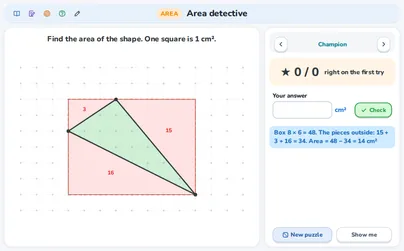
Draw the smallest rectangle around the shape. Take away the right triangles in the corners.
Example
Box 6 by 5 = 30, pieces 4 + 3 + 5 = 12:
65435
Watch out!

Perimeter: the height is not a side

For the perimeter add the sides around the outside. The height is inside the shape, so it does not count.
baah
Example
Sides 5, 5 and 6, height 4: cm
6554
Watch out!

Same unit first

Write every length in the same unit before you multiply. The area is then in square units (m²).
Example
Base 150 cm, height 2 m: m²
150 cm2 m
Tip

Problems: round up

Boxes and tins are sold whole. Divide the area by what one box covers and round UP.
123
Example
Floor 13.5 m², boxes of 2 m²:, so 7 boxes
1234567

Exercises

A parallelogram has a base of 9 cm, a height of 4 cm and slanted sides of 5 cm. Find the area and the perimeter. Easy
9 cm5 cm4 cm
Show solution
Area: (the slanted side is not used)
Perimeter:
9 cm5 cm5 cm
Answer → area 36 cm², perimeter 28 cm
The height is not a side.
A right triangle has sides of 6 cm and 8 cm at the right angle. What is its area? Easy
8 cm6 cm
Show solution
It is half of a rectangle of 6 by 8
8 cm6 cm
Answer → 24 cm²
Use the two sides at the right angle.
A triangle has a base of 12 cm. Its height of 5 cm is outside the triangle. Find the area. Medium
12 cm5 cm
Show solution
Make the base line longer: the height still counts
12 cm5 cm
Answer → 30 cm²
Base and height, not the slanted sides.
A trapezium has parallel sides of 7 cm and 11 cm and a height of 6 cm. Find the area. Medium
11 cm7 cm6 cm
Show solution
117711186
Answer → 54 cm²
Add the two parallel sides first.
A kite has diagonals of 10 cm and 9 cm. Find the area. Medium
109
Show solution
109
Answer → 45 cm²
The kite is half of the box around its diagonals.
A triangle has an area of 36 cm² and a base of 9 cm. How high is it? Hard
9 cm?36
Show solution
The area is half of base × height, so height = 2 × area ÷ base
9 cm836
Answer → 8 cm
Do not forget the 2: the area is only half.
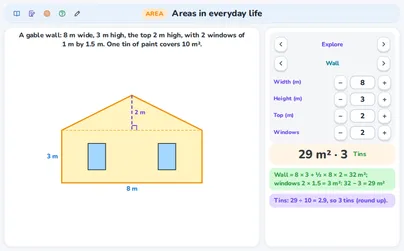
A gable wall is 6 m wide and 4 m high, with a triangle of 3 m on top. It has a window of 1 m by 2 m. How many m² do you paint? Hard
6 m4 m3 m
Show solution
Wall:
24 m²9 m²
Take the window away:
31 m²2 m²
Answer → 31 m²
A window gets no paint: take it away.
A room is a trapezium: 6 m and 4 m wide, 5 m deep. Laminate comes in boxes of 2 m². How many boxes do you buy? Hard
6 m4 m5 m
Show solution
Floor: m²
Boxes:
A part of a box is a whole box: round up
12345678910111213
Answer → 13 boxes
12.5 boxes is not enough: you need 13.
Are you a teacher?

Start live lessons with these applications for your whole class. Free to try for one month.

Try it free

Fits these school years

IB (MYP, Diploma): MYP 1, MYP 2, MYP 3

Cambridge International: Lower Secondary, stage 7, Lower Secondary, stage 8, Primary, stage 6

Netherlands: Year 1, Year 2, Vmbo bb (years 3-4), Vmbo kb (years 3-4), Vmbo gt (years 3-4), Groep 8, Vwo · Mathematics C

Türkiye (MEB): Year 6 (MEB), Year 7 (MEB)

England (GCSE, A Level): Year 6, Year 7, Year 8

USA (Common Core): Grade 6, Grade 7
What the applications of this topic teach 6 applications

Parallelograms: cut, move, base × height

  • Cutting a parallelogram into a rectangle: area = base × height
  • Finding the base and its perpendicular height
  • Using a height that lies outside the shape
  • Finding a missing height or base from the area

Triangles: half of base × height

  • Finding the base and perpendicular height of a triangle
  • Showing any triangle is half a parallelogram: ½ × base × height
  • Knowing triangles with the same base and height have the same area
  • Finding a missing height or base from the area

Trapezia, rhombi and kites

  • Finding the area of a trapezium: ½ × (a + b) × h
  • Finding the area of a kite or rhombus from its diagonals
  • Choosing the right formula and leaving out the slanted sides
  • Finding a missing side, height or diagonal from the area

Compound shapes: add and take away

  • Finding the area of a compound shape by cutting it into parts
  • Finding the area by taking a part away
  • Choosing the quicker way and the right formula for each part

Areas of shapes in everyday life

  • Finding the area of a floor, wall or lawn by adding or taking away parts
  • Writing every length in the same unit first
  • Solving problems with a price per m² and rounding up boxes
  • Telling the cloth of a sail (area) from its hem (perimeter)

Area detective (puzzles)

  • Finding a base and height on a grid by counting squares
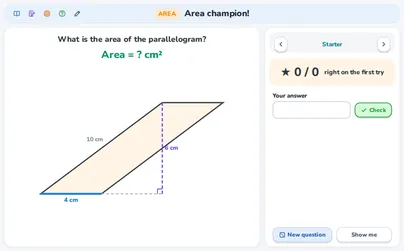
  • Finding the area of a parallelogram and a right triangle on a grid
  • Finding the area of a triangle whose height lies outside
  • Finding the area of a kite, rhombus or compound shape