Interactive Lessons

Vectors in 2D

Lecture notes

Definition

How far and which way, not where

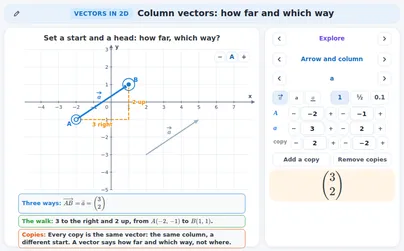
A vector is an arrow with a length and a direction. It does not say where it starts: every copy of the arrow with the same length and the same direction is the same vector.
aaa
Example
From to is : 4 right, 1 down.From to is right and : the same , so the same vector.
aaABCD
Definition

The column and AB

Write a vector as a column : is how far right (left if negative), how far up (down if negative). The vector from to is the head minus the start: .
xyaABxy
Example
and .: 5 left and 5 up.
−55aAB
Definition

i and j

is one step right and is one step up. Every vector is a number of steps of each: .
3i2ja
Example
is 3 steps right and 2 down: .The other way: .
3i−2ja
Definition

Equal and opposite vectors

Two vectors are equal when their columns are equal, wherever they start. The opposite has the same length and the other direction: both numbers change sign, and .
−aa
Example
, so ..
−aaa
Special case

The zero vector

is a move that goes nowhere. It has length and no direction, so no direction angle and no bearing. It is parallel to every vector and .
Example
: out and back is no move at all.The length is , but ask for its direction and the answer is: it has none.
Tip

Arrow, bold or underline

Books write a vector three ways: with an arrow , in bold (print) or underlined (handwriting). All three are the same vector; names it by its two points. The length is a plain number.
Example
The same vector: , , .Its length is , with no arrow inside the bars.
Rule

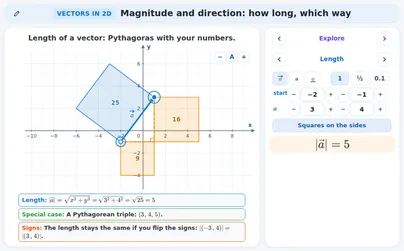
Length by Pythagoras

The two legs of the column and the arrow make a right triangle, so . Signs disappear when you square. Keep the exact surd, simplified (), and give the decimal when asked.
435
Example
..
−75√74
Tip

Pythagorean triples

Some columns have a whole-number length: , , , , and every multiple of them. Spot them and you skip the root.
12513
Example
is times and , so . is the triple : the length is .
−91215
Rule

Direction angle and quadrant

The direction angle is measured anticlockwise from the positive -axis. Take the acute angle : then , , or in the first, second, third or fourth quadrant.
xyxyθa
Example
: and , the second quadrant., so .
xy−43143.1°a
Definition

The bearing

A bearing is measured clockwise from north, in three digits (, ). It is the direction angle seen from the other side: bearing , plus if that is negative. Find out which one a question asks for before you start.
Nβa
Example
5 east and 2 south: .The angle below east is , so the bearing is (the direction angle is ).
5−2N111.8°a
Rule

Size and direction give the columns

A vector of length and direction angle has the column . With a bearing the roles swap: and (north is the direction).
xyxy60°r
Example
at : .Check: .
xy77√360°14
Tip

Exact values for 30, 45, 60

For the special angles keep surds: , , . Then the column is exact and you can check it with Pythagoras.
Example
at : .Check: .
xy5√25√245°10
Rule

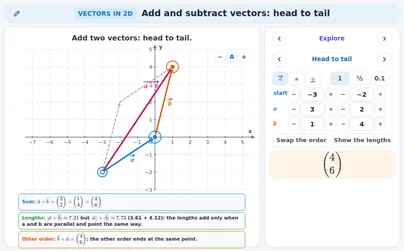
Adding: head to tail

To add , draw from the head of : the sum goes from the start of to the head of . With columns, add the top numbers and add the bottom numbers. The order does not matter.
a+babABC
Example
and ..
a+babABC
Watch out!

The lengths do not add

is usually smaller than : one side of a triangle is shorter than the other two together (the triangle inequality, ). They are equal only when the vectors point the same way.
534ABC
Example
and .✘ ✔ , less than .
13512ABC
Rule

The parallelogram

Draw and from the same start: they are two sides of a parallelogram. The diagonal from that start is . The opposite sides are equal vectors, so .
a+bab
Example
and ., and its length is .
a+bab
Tip

The parallelogram law

The other diagonal is . The squares of the two diagonals add up to twice the squares of the two sides: . Use it as a check of your arithmetic.
a−ba+bab
Example
, : and . and ✔.
a−ba+bab
Rule

Subtracting

: add the opposite of . In a picture with both from one start, is the arrow from the head of to the head of . Check: .
ba−baO
Example
, : , length .Check: ✔.
ba−baO
Rule

A chain and a closed chain

Any number of vectors can be put head to tail: the sum goes from the first start to the last head, and you get it by adding all the top numbers and all the bottom numbers. If the sum is you are back where you began: the chain is closed.
sabc
Example
: top , bottom .The sum is : three moves that end at the start.
abc
Rule

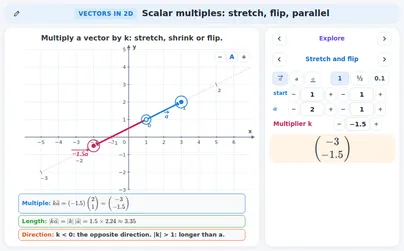
Multiplying by k

multiplies both numbers by and the length by : . For it stretches, for it shrinks, for it also flips to the opposite direction, and gives .
2a½a−aa
Example
and : . and : twice as long, flipped.
−2aa
Rule

Parallel vectors

and are parallel when for some number ( same direction, opposite). The test without dividing: . It also works when a number of the column is .
bca
Example
and : , parallel, with (opposite). and : , not parallel.
ba
Rule

Reaching a target

Two vectors that are not parallel reach every point: has exactly one solution . Write the two equations, one per row of the column, and solve them. By Cramer: , .
Tsatb
Example
, and : and .Adding gives , so and . Check: and ✔.
T3a2b
Definition

The unit vector

A unit vector has length . Divide a vector by its own length to get the unit vector in its direction: . Turn it round: , and is the vector of length in that direction.
ua
Example
, .; check: ✔.
ua
Definition

Displacement and distance

The displacement is the vector from the start to the end of a journey: the straight line, with a direction. The distance walked is the sum of the lengths of the legs. The distance is never shorter than the length of the displacement.
d123AB
Example
600 m east, then 800 m north: the distance walked is m.The displacement is m, of length m, at the bearing .
1000 m600 m800 mABC
Rule

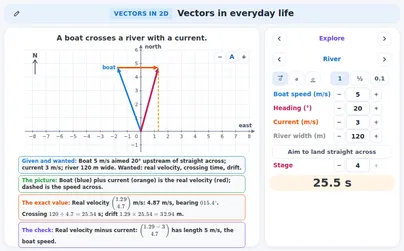
A boat in a current

The velocity over the ground is the boat’s velocity through the water plus the current: add the two vectors. The part across the river decides how long the crossing takes; the current only carries you along the bank. To land straight across, aim upstream: .
gbc
Example
A river 60 m wide, boat 5 m/s aimed straight across, current 2 m/s: time s, drift m.Ground velocity , speed m/s.
√295 m/s2 m/s
Watch out!

Wind FROM a bearing

“Wind from ” starts in the west and blows towards the east (). Turn the bearing round by before you draw the wind vector. The track is the direction of the ground velocity (air velocity + wind), not the direction the nose points (the heading).
ghw
Example
Aircraft 200 km/h, heading ; wind from at 50 km/h blows towards the east.✘ the wind pushes it west ✔ speed km/h, track (east of north).
206.220050
Tip

Which course needs what

A translation by a column vector is in the Cambridge IGCSE core. Adding, subtracting, multiples and the length come in the extended course, GCSE and UK AS. The plane with , , size and direction, and the unit vector belong to Cambridge A level (Paper 3), IB HL, wiskunde B vwo and the Common Core plus standards; in AP Precalculus it is an optional topic.
Example
A first question: translate by : .A later one: find , the bearing or and in .

Exercises

and . Write as a column. Easy
aAB
Show solution
The head minus the start: : .
: .
So 5 to the right and 3 down.
Check: plus the column is .
Find the length of . Easy
Show solution
Square both numbers: and .
Add: .
The root: .
Check: is a Pythagorean triple, and the minus sign changes nothing.
. Write , and . Easy
Show solution
: change both signs.
: double both numbers.
.
, ,
Check: .
Is the vector from to equal to the vector from to ? Easy
Show solution
First vector: .
Second vector: .
The columns are the same; the starts do not matter.
Yes, both are .
Check: both have length .
Write as a column and give its length. Easy
Show solution
is 4 to the right and is 3 down: the column is .
Length: .
.
and length
Check: .
Find the direction angle of (anticlockwise from the -axis). Easy
Show solution
Both numbers are negative: the third quadrant.
The acute angle: .
Third quadrant: .
Check: the arrow points to the south west, halfway between west () and south ().
A hiker walks 5 km east and then 12 km north. Find the distance walked, the length and the bearing of the displacement. Medium
?512ABC
Show solution
Distance walked: km. The displacement km has length km.
East of north: , so the bearing is .
Distance 17 km, displacement 13 km at the bearing .
Check: , as the distance is never shorter than the displacement.
A vector has length 20 and direction angle . Find its column exactly and to 2 decimals. Medium
Show solution
.
.
.
Check: .
For which are and parallel? Medium
Show solution
Parallel means : .
, so .
Then : .
Check: with , and the ratio gives in the second row.
Find and so that , with , and . Medium
Show solution
The two rows: and .
The determinant is . .
.
and
Check: and ✔.
and start at the same point. Find the vector from the head of to the head of and its length. Medium
b?a
Show solution
Head minus head: .
Length: .
, length
Check: ✔.
Find the unit vector of and the vector of length 20 in the same direction. Medium
Show solution
.
The unit vector: .
Length 20: .
and
Check: .
A river is 120 m wide. A boat does 4 m/s through the water and the current is 3 m/s. At what angle upstream of straight across must it aim to land straight across, and how long does the crossing take? Hard
√743
Show solution
The part along the bank must cancel the current: , so .
The part across the river is m/s.
Time: s.
upstream; s
Check: : the triangle of the speeds is right-angled.
An aircraft flies at 240 km/h through the air on the heading . The wind blows FROM at 60 km/h. Find the ground velocity, the ground speed, the track and the distance in 2 hours. Hard
?24060
Show solution
Wind from the south blows towards the north: . The air velocity is .
Ground velocity: km/h, speed km/h.
The track is . Distance: km.
km/h; km/h; track ; km
Check: the track is a little north of east, as the wind blows north.
Check the parallelogram law for and . Hard
Show solution
, so . , so .
Left side: .
Right side: .
: the law holds.
Check: and .
Vector has length 10 and direction angle ; vector has length 6 and direction angle . Find the length and the direction angle of . Hard
Show solution
and .
The sum: , with length .
Angle: .
Length , direction angle
Check: , as the triangle inequality says.
A drone flies , then , and then a third move that brings it back to the start. Find the third move and its length. Hard
ab?
Show solution
The chain is closed: .
.
, with length .
, length
Check: the top numbers and the bottom numbers .
and . What are the largest and the smallest possible values of , and when do they happen? Hard
Show solution
The triangle inequality: , equal when the vectors point the same way.
The other way: , equal when they point opposite ways.
Any angle in between gives a length between and .
Largest (same direction), smallest (opposite directions).
Check: with gives , with gives .
Are you a teacher?

Start live lessons with these applications for your whole class. Free to try for one month.

Try it free

Fits these school years

IB (MYP, Diploma): MYP 5, Diploma, year 1, Diploma, year 2

Cambridge International: IGCSE, A Level

Netherlands: Vwo · Mathematics B

England (GCSE, A Level): Year 10 (GCSE), Year 11 (GCSE), Year 12 (A Level)

USA (Common Core): Precalculus

What the applications of this topic teach 5 applications

Column vectors: how far and which way

  • Writing a vector as a column, as AB and with i and j
  • Saying when two vectors are equal or opposite
  • Moving a point by a vector and writing the way back

Magnitude and direction: how long, which way

  • Finding the length of a vector by Pythagoras
  • Finding the direction angle and bearing of a vector
  • Writing the column from size and direction

Add and subtract vectors: head to tail

  • Adding vectors head to tail and by columns
  • Subtracting as adding the opposite and using the parallelogram
  • Adding a chain of vectors and telling when it closes

Scalar multiples: stretch, flip, parallel

  • Multiplying a vector by k and seeing length and direction
  • Deciding whether two vectors are parallel with the ratio test
  • Reaching a target with s a + t b and writing a unit vector

Vectors in everyday life

  • Adding the legs of a journey as vectors
  • Finding the heading and crossing time of a boat in a current
  • Finding the ground velocity of an aircraft in a wind