A position vector says where a point is: it is the arrow from the origin O to the point. The point A(x,y) has the position vector OA=a=(xy), so the column is just the coordinates. Capital letters name points and lowercase letters name vectors.
Example
A(3,2) has the position vector a=(32).B(−2,4) has b=(−24), so 2 to the left and 4 up from O.
Special case
The origin has no arrow
The origin O is where every position vector starts, so its own position vector is the zero vector 0. If A is the origin, then a=0 and AB=b−0=b, so the displacement from O is the position vector of B. An arrow that starts anywhere else is a displacement, not a position vector.
Example
A is the origin O and B(5,−3). Then a=(00) and b=(5−3).AB=b−a=(5−3)−(00)=(5−3), which is b itself.
Rule
End minus start
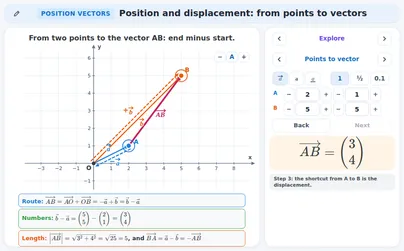
The vector from A to B is the end minus the start, AB=b−a. Go from A back to O (that is −a) and on to B (that is +b), so AB=AO+OB=−a+b. With coordinates, subtract the coordinates of A from those of B.
Example
A(−1,3) and B(4,1), so a=(−13) and b=(41).b−a=(1−34−(−1))=(5−2), which is 5 to the right and 2 down.
Watch out!
AB is not BA
BA=a−b=−AB has the same length as AB and the other direction. A common slip is to write a−b for AB, with the start first; the end comes first. To check, add the vector to the start. You must land on the end.
Example
A(2,5) and B(−1,1) give AB=(1−5−1−2)=(−3−4) and BA=(34).Check with the start. a+AB=(5+(−4)2+(−3))=(−11), and that is B.
Definition
The distance between two points
The distance between A and B is the length of the vector AB, so ∣AB∣=∣b−a∣=(xB−xA)2+(yB−yA)2. This is the distance formula in vector form. The order does not matter, because the squares remove the minus signs and ∣BA∣=∣AB∣.
Example
A(−2,1) and B(4,−7) give AB=(−7−14−(−2))=(6−8).The distance is ∣AB∣=62+(−8)2=100=10.
Rule
From the start and AB to the end
If you know the start A and the vector AB, the end is b=a+AB, so add the column to the coordinates of A. The other way round, the start is a=b−AB.
Example
A(−3,2) and AB=(5−4) give b=(2+(−4)−3+5)=(2−2), so the point is B(2,−2).Going back, b−AB=(−32), which is A again.
Rule
A moving point on a line
p=a+tv is the position vector of a point that starts at A (t=0) and moves along v. At t=1 it is at B=a+v, at t=2 it is twice as far and t=21 is halfway. All these points lie on the line through A with direction v, and a negative t goes the other way.
Example
A(1,−2) and v=(23). After t=1 the point is P(3,1) and after t=3 it is P(7,7).After t=1.5 it is at p=(−21)+1.5(32)=(42.5), so the point is P(4,2.5).
Rule
The fourth vertex of a parallelogram
Opposite sides of a parallelogram are equal vectors. Three points P, Q and R can be completed to a parallelogram in three ways. If X is opposite P, then PQ=RX, so x=q+r−p. Add the two neighbours of X and subtract the vertex opposite. Three points on a line give no parallelogram.
Example
P(1,1), Q(5,2) and R(3,5) with X opposite P give x=(5+3−1,2+5−1)=(7,6), so the point is X(7,6).The diagonals PX and QR have the same midpoint M(4,3.5), which checks the answer.
Rule
The midpoint is the average
The midpoint M of AB is halfway, so m=a+21AB=21(a+b). It is the average of the two position vectors, and in coordinates M(2xA+xB,2yA+yB). Then AM=MB.
Example
A(−3,2) and B(5,6). The coordinates are x=2−3+5=1 and y=22+6=4, so the point is M(1,4).Check with AM=(42) and MB=(42), which are equal.
Tip
Find the other end
Do you know the midpoint M and one end A? Go from A to M and then the same step again, so b=2m−a. To check, take the average of a and b. It must give m.
Example
A(1,−2) and the midpoint M(4,1) give b=2m−a=2(14)−(−21)=(74), so the point is B(7,4).The average of A and B is the midpoint M again, as it must be.
Rule
Dividing a segment: AP : PB = m : n
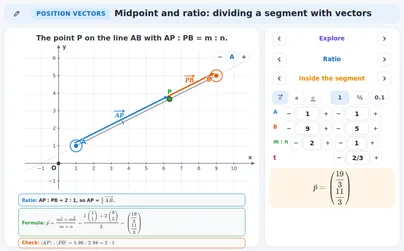
If P lies on AB with AP:PB=m:n, then AB is cut into m+n equal parts and AP is m of them, so AP=m+nmAB. This gives p=m+nna+mb. Note that a is multiplied by n and b by m.
Example
A(−2,1), B(7,4) and AP:PB=2:1 give p=31⋅(1−2)+2⋅(47)=31(912)=(43), so the point is P(4,3).Check. AP=(62) is twice PB=(31).
Watch out!
Parts, not fractions
AP:PB=1:3 does not mean that AP is a third of AB. The whole segment has 1+3=4 parts and AP is one of them, so AP=41AB. Count all the parts first. In the formula a gets the weight 3 and b the weight 1.
Example
A(0,2) and B(8,10) with AP:PB=1:3 give p=43a+b, so the point is P(2,4).A third of AB would wrongly give (38,314).
Rule
Outside the segment
If P is on the line AB but outside the segment, the lengths still have AP:PB=m:n, but the two parts point the same way, so p=m−nmb−na. For m>n the point P is beyond B and for m<n it is before A. For m=n there is no such point.
Example
A(1,2), B(4,5) and AP:PB=5:2 with P beyond B give p=5−25(54)−2(21)=31(2118)=(67), so the point is P(6,7).AP=(55) and PB=(−2−2) have the lengths 52 and 22.
Definition
The weighted mean
Points P1,P2,… with weights w1,w2,… have the centre of mass g=w1+w2+⋯w1p1+w2p2+⋯, a weighted mean of the position vectors. A heavy point pulls G towards itself, and equal weights give the plain average.
Example
The weights 3, 1 and 2 sit at P1(0,0), P2(8,0) and P3(2,6).g=3+1+23(00)+1(08)+2(62)=61(1212)=(22), so the point is G(2,2).
Definition
The centroid and its medians
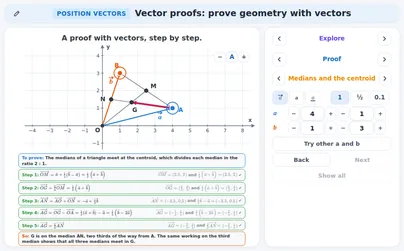
With three equal weights the centre of mass is the centroid G of the triangle, g=31(a+b+c). A median joins a vertex to the midpoint of the opposite side. The three medians meet in G, and G divides each median in the ratio 2:1, counted from the vertex.
Example
The triangle A(−2,1), B(7,2), C(1,6) has x=3−2+7+1=2 and y=31+2+6=3, so the centroid is G(2,3).The midpoint of BC is M(4,4), and AG=(24) is 32 of AM=(36).
Rule
Any vector of a diagram: go through O
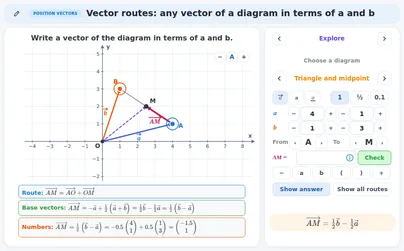
To write a vector of a diagram with a and b, go from the start to O and from O to the end, XY=XO+OY=−x+y. Write each position vector with a and b as the diagram says: a midpoint is half a vector, and a point on AB is a plus a part of AB. Then simplify.
Example
N is the midpoint of OB. Then AN=AO+ON=−a+21b.For a=(41) and b=(13) this is −(14)+21(31)=(−3.50.5), the same as N−A.
Tip
Equivalent writings and the simplest form
Many writings are the same vector, for example 21b−a, 21(b−2a) and −a+0.5b. For the simplest form multiply out the brackets, then collect the terms in a and in b, so that each letter appears once. To compare two answers, compare their coefficients of a and of b.
Example
2(a−b)+3(b−21a) has 2−23=21 for a and −2+3=1 for b, so the simplest form is 21a+b.For a=(42) and b=(26) both forms give (47).
Definition
Collinear points: AB = k AC
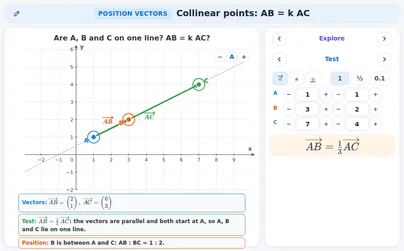
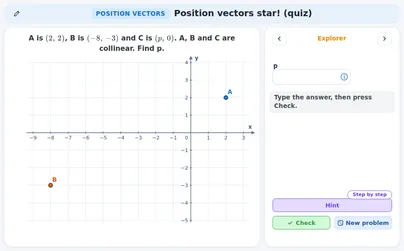
The points A, B and C lie on one line exactly when AB=kAC for some number k. The two vectors start at the same point A, so parallel means on one line. With columns the cross product is zero, x1y2−y1x2=0.
Example
A(1,2), B(4,3) and C(7,4) give AB=(31) and AC=(62).The cross product is 3⋅2−1⋅6=0 and AB=21AC, so the points are collinear.
Rule
Where B is: the value of k
The number k in AB=kAC shows where B is. For 0<k<1 it lies between A and C, for k=1 it is C, for k>1 it lies beyond C and for k<0 it lies before A. The ratio is AB:BC=∣k∣:∣1−k∣.
Example
A(0,1), C(4,3) and B(6,4) give AB=(63) and AC=(42), so k=23 and B is beyond C.Then AB:BC=23:21=3:1, as ∣AB∣=35 and ∣BC∣=5.
Rule
The missing value
If a coordinate is unknown, parallel (collinear) means that the cross product is 0, and that is an equation. Write AB and AC with the unknown, cross-multiply, solve, and then check that AC is a multiple of AB.
Example
A(1,−1), B(4,1) and C(10,q) give AB=(32) and AC=(9q+1).The cross product 3(q+1)−2⋅9=0 gives q+1=6, so q=5. Then AC=(96)=3AB.
Watch out!
A picture is not a proof
A drawing, or a check with numbers, shows one case. A proof keeps a and b as letters, so it holds for every triangle, every parallelogram and every choice. Measuring can find a mistake, but it never proves a statement.
Example
For a=(42) and b=(26) the midpoints give MN=(−12) and 21AB=21(−24)=(−12), equal here.Only the algebra −21a+21b=21(b−a) shows it for all a and b.
Rule
The midpoint theorem
In triangle OAB let M and N be the midpoints of OA and OB. Then MN=ON−OM=21b−21a=21(b−a)=21AB. So MN is parallel to AB and half as long.
Example
a=(62) and b=(28) give M(3,1) and N(1,4).MN=(−23) and AB=(−46), so MN=21AB.
Rule
The diagonals of a parallelogram
In the parallelogram OACB the diagonals are OC and AB, with c=a+b. The midpoint of OC is 21(a+b). The midpoint of AB is a+21(b−a)=21a+21b. They are the same point, so the diagonals bisect each other.
Example
a=(51) and b=(14) give C(6,5).The midpoint of OC is (3,2.5) and the midpoint of AB is (25+1,21+4)=(3,2.5), the same point.
Rule
The medians meet at the centroid
In triangle OAB let M be the midpoint of AB and N the midpoint of OB. The point G with OG=32OM=31(a+b) gives AG=31(b−2a), and AN=−a+21b. So AG=32AN and G lies on the median AN too. The same working shows the third median passes through G.
Example
a=(63) and b=(39) give 31(a+b)=G(3,4).AG=(−31) and AN=(−4.51.5), so AG=32AN.
Rule
The midpoints of a quadrilateral
Let ABCD be any quadrilateral and P, Q, R, S the midpoints of AB, BC, CD, DA. Then PQ=21(b+c)−21(a+b)=21(c−a) and SR=21(c+d)−21(d+a)=21(c−a). So PQ=SR and PQRS is a parallelogram.
Example
A(0,1), B(6,0), C(8,5) and D(1,6) give PQ=(42) and SR=(42).Both equal 21AC=21(84).
Rule
Equating coefficients
If a and b are not parallel and pa+qb=ra+sb, then p=r and q=s. A vector written in two ways gives two equations, one for the coefficients of a and one for those of b. Solve them for the unknown numbers.
Example
P is on OM with OM=2a+b and on AB. Then μ(2a+b)=(1−λ)a+λb gives 2μ=1−λ and μ=λ.So 3μ=1 and μ=λ=31, which gives p=32a+31b, the point P(4,2) for a=(61) and b=(04).
Rule
A trisected diagonal
In the parallelogram OACB let M be the midpoint of AC, so OM=a+21b. The line OM meets AB in P. Write OP twice, as μa+21μb and as (1−λ)a+λb, and equate the coefficients. This gives μ=1−λ and 21μ=λ, so λ=31 and μ=32. The line OM cuts AB into three equal parts.
Example
a=(63) and b=(06) give OM=(66), so OP=32OM=(44).On AB the point at 31 of the way is a+31(b−a)=(44) too, so the point is P(4,4).
Rule
The midline of a trapezium
In the trapezium OABC let OA=a, OC=b and CB=ka, so OB=b+ka. With M the midpoint of OC and N the midpoint of AB, MN=21(a+b+ka)−21b=21(1+k)a. So MN is parallel to OA and CB and equal to half their sum.
Example
a=(82), b=(15) and k=21 give B(5,6), M(0.5,2.5) and N(6.5,4).MN=(61.5)=43a, and indeed 21(1+21)=43.
Rule
Relative position and bearing
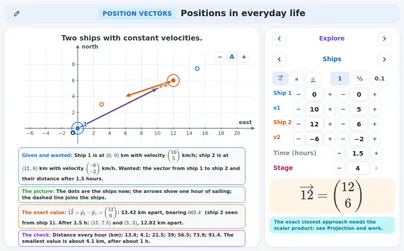
The vector from ship 1 to ship 2 is p2−p1, end minus start. Its length is the distance, and the bearing, measured clockwise from north, is 90° minus the direction angle. For a column (en) with an east part and a north part, tanβ=ne, and the quadrant decides the bearing.
Example
Ship 1 at (2,3) km and ship 2 at (10,9) km give p2−p1=(86) km.The distance is 82+62=10 km and tanβ=68, so the bearing is 53.1°.
Rule
Positions after t hours
A ship at p with velocity v is at p+tv after t hours. For two ships the vector between them is (p2−p1)+t(v2−v1) and the distance is its length. A table of distances shows about when they are closest; the exact answer needs the scalar product, which comes later.
Example
Ship 1 starts at P1(0,0) with (68) km/h and ship 2 at P2(20,8) with (6−4) km/h.The distances at t=0,1,2,3 h are about 21.5, 11.3, 8.9 and 17.9 km, so the table is smallest at t=2.
Tip
Which course needs what
Position vectors, AB=b−a and the length of AB are in Cambridge IGCSE extended, the UK A level, Cambridge A level (Paper 3), IB HL and, as components, in the Common Core standard N-VM.A.2. Writing vectors with a and b and proofs belong to Cambridge IGCSE extended, GCSE higher, A level and IB HL. The weighted mean for the centre of mass is in wiskunde B vwo. The midpoint and the ratio point with coordinates appear in year 10 of the MEB programme. The vector equation of a line and the scalar product come later.
Example
A first question asks for AB from A(1,2) and B(4,6), and the answer is (34).A later question asks to prove that MN is parallel to AB, or to find where two lines meet by equating coefficients.
Exercises
A(3,1) and B(−2,4). Write AB as a column. Easy
Show solution
The end minus the start, AB=b−a.
Subtract the coordinates, (4−1−2−3)=(3−5).
So 5 to the left and 3 up.
AB=(−53)
Check. The start plus the column must give the end, (1+33+(−5))=(−24), which is B.
A(−1,2) and B(4,−10). Find the distance AB. Easy
Show solution
Find AB, end minus start, (−10−24−(−1))=(−125).
The distance is the length of AB, 52+(−12)2=169=13.
AB=13
Check. (5,12,13) is a Pythagorean triple, and the minus sign changes nothing.
A(−2,5) and AB=(7−3). Find the point B. Easy
Show solution
The end is the start plus the vector, b=a+AB.
Add the parts, (5+(−3)−2+7)=(25).
B=B(5,2)
Check. B−A must give back AB, (2−55−(−2))=(7−3).
A(−4,3) and B(10,−5). Find the midpoint M of AB. Easy
Show solution
The midpoint is the average, m=21(a+b).
The coordinates are x=2−4+10=3 and y=23+(−5)=−1.
M=M(3,−1)
Check. AM=(7−4) and MB=(7−4) are equal.
P(−1,2), Q(4,0) and R(6,5) are three vertices of a parallelogram. The fourth vertex X is opposite P. Find X. Easy
Show solution
Opposite sides are equal vectors, so x=q+r−p.
Calculate the coordinates, (4+6−(−1),0+5−2)=(11,3).
X=X(11,3)
Check. The diagonals PX and QR have the same midpoint, M(5,2.5).
A point starts at A(1,4) and moves with v=(−21) per hour. Where is it after 3 hours? Easy
Show solution
After t hours the position is p=a+tv.
For t=3, p=(41)+3(1−2)=(7−5).
P(−5,7)
Check. p−a=(−63) is three times v.
A(−2,6) and B(10,−3). P lies on AB with AP:PB=1:2. Find P. Medium
Show solution
AB has 1+2=3 parts and AP is one of them. The formula is p=m+nna+mb with m=1 and n=2.
Calculate, p=32(6−2)+1(−310)=31(96)=(32).
P=P(2,3)
Check. AP=(−34) is half of PB=(−68).
M(3,−2) is the midpoint of AB and A(−1,4). Find B. Medium
Show solution
Go from A to M and the same step again, so b=2m−a.
Calculate, b=2(−23)−(4−1)=(−87).
B=B(7,−8)
Check. The average of A and B is (2−1+7,24+(−8))=(3,−2), which is M.
The weights 1, 2 and 3 sit at P1(−1,6), P2(2,0) and P3(1,−2). Find their centre of mass G. Medium
Show solution
The total weight is 1+2+3=6.
The weighted mean is g=1+2+31(6−1)+2(02)+3(−21)=61(06)=(01).
G=G(1,0)
Check. For x the sum is −1+4+3=6 and for y it is 6+0−6=0, and 6÷6=1.
A(1,0) and B(3,2). P lies on the line AB, beyond B, with AP:PB=3:1. Find P. Medium
Show solution
Outside the segment the formula is p=m−nmb−na with m=3 and n=1.
Calculate, p=3−13(23)−1(01)=21(68)=(34).
P=P(4,3)
Check. AP=(33) is three times as long as PB=(−1−1), and B lies between A and P.
OACB is a parallelogram, OA=a, OB=b and M is the midpoint of AC. Write BM with a and b. Medium
Show solution
Since AC=b, the midpoint has OM=a+21b.
Go through O, BM=BO+OM=−b+a+21b.
Collect the terms, a−21b.
BM=a−21b
Check with numbers. a=(14) and b=(31) give M(4.5,2.5) and BM=(−0.53.5), as a−21b.
A(1,1), B(4,3) and C(10,7). Are they on one line? If so, find k in AB=kAC and the ratio AB:BC. Medium
Show solution
AB=(23) and AC=(69).
The cross product 3⋅6−2⋅9=0 shows that the points are collinear, with k=31.
So B lies between A and C and AB:BC=31:32=1:2.
Collinear, k=31 and AB:BC=1:2
Check. BC=(46) is twice AB=(23).
A(−2,1), B(4,4) and C(p,10) lie on one line. Find p and the ratio AB:BC. Hard
Show solution
AB=(36) and AC=(9p+2).
Parallel means that the cross product is 0, so 6⋅9−3(p+2)=0. Then p+2=18 and p=16.
Now AC=(918)=3AB, so k=31 and AB:BC=1:2.
p=16 and AB:BC=1:2
Check. 3⋅6=18 and 3⋅3=9, so AC=3AB.
OACB is a parallelogram, OA=a, OB=b, and M, N are the midpoints of AC, CB. Prove that MN is parallel to AB and half as long. Hard
Show solution
With c=a+b the midpoints are m=a+21b and n=b+21a.
So MN=n−m=21b−21a=21(b−a)=21AB.
MN=21AB, so MN is parallel to AB and half as long.
Check with numbers. a=(15) and b=(42) give MN=(1.5−1.5)=21(3−3). One case only, the algebra proves all.
The vertices are A(−3,2), B(9,4), C(0,9). Find the centroid G and show that AG:GM=2:1, with M the midpoint of BC. Hard
Show solution
The centroid is the average of the vertices, x=3−3+9+0=2 and y=32+4+9=5.
The midpoint of BC is M(4.5,6.5), so AM=(4.57.5) and AG=(35)=32AM, which means AG:GM=2:1.
G(2,5) and AG:GM=2:1
Check. 32⋅7.5=5 and 32⋅4.5=3.
OACB is a parallelogram, OA=a, OB=b, and M is the midpoint of OA. The line BM meets the diagonal OC in P. Find OP with a and b. Hard
Show solution
On BM the point is 21λa+(1−λ)b and on OC it is μa+μb.
Equate the coefficients, μ=21λ and μ=1−λ, so λ=32 and μ=31.
OP=31(a+b)
Check with numbers. a=(36) and b=(63) put P at P(3,3) on both lines.
Ship 1 starts at S1(0,0) with (86) km/h, ship 2 at S2(12,5) with (4−2) km/h. After 2 hours find the vector from ship 1 to ship 2, the distance and the bearing. Hard
Show solution
After 2 hours the ships are at S1(12,16) and S2(8,13), so the vector is (−3−4) km.
The distance is (−4)2+(−3)2=25=5 km. It points south-west, so the bearing is 180°+tan−134=233.1°.
(−3−4) km, 5 km and the bearing 233.1°
Check. Both parts are negative, so the bearing lies between 180° and 270° (south-west).
A weight 1 sits at A(0,−1) and a weight w sits at B(6,5). Their centre of mass is G(4,3). Find w. Hard
Show solution
With g=1+wa+wb the x coordinates give 1+w6w=4.
So 6w=4(1+w), 2w=4 and w=2. The y coordinates agree, 1+2−1+5⋅2=3.
w=2
Check. G lies on AB and closer to the heavier point B.
Interactive applications for this topic
Free applications open with a free student account. Teachers can use all applications in a live lesson.