Interactive Lessons

Newton's laws of motion

Lecture notes

Definition

Newton's second law

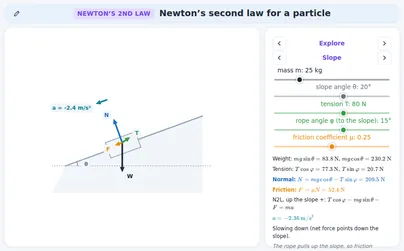
For a particle of constant mass, the net (resultant) force along a direction equals mass times acceleration in that direction: . Resolve every force along the direction of motion before applying the law.
Definition

Mass and weight

Weight is the force of gravity on a mass: . Mass (in kg) is constant; weight (in N) is a force. The reading of a scale under an accelerating body, the 'apparent weight', is the normal force - it is not always equal to .
Rule

On a slope

On an incline at angle , the weight resolves into down the slope and into the slope. The normal force balances the forces perpendicular to the slope; friction and any applied force act along the slope.
Rule

Connected particles

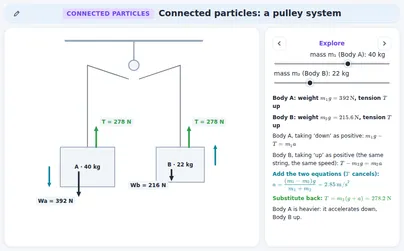
Two particles joined by a light, inextensible string over a pulley have the same speed and the same size of acceleration. Write Newton's second law once for each particle - the tension pulls on both, equal in size - and solve the two equations together.
Tip

Check the direction

Pick one direction as positive for each body and keep to it throughout. A negative answer for the acceleration simply means the motion is the other way round; the size of the answer does not change.

Exercises

Interactive applications for this topic

Free applications open with a free student account. Teachers can use all applications in a live lesson.

About the free account and Plus

Are you a teacher?

Start live lessons with these applications for your whole class. Free to try for one month.

Try it free

Fits these school years

Cambridge International: AS Level, A Level

England (GCSE, A Level): Year 12 (A Level), Year 13 (A Level)

What the applications of this topic teach 2 applications

Newton’s second law: forces on a particle

  • Identify the forces on a particle (weight, normal force, friction, tension) and resolve them along the direction of motion.
  • Apply Newton's second law, F_net=ma, to find the acceleration or a missing force.
  • Relate mass and weight, W=mg, and work out the apparent weight of a body accelerating vertically.

Connected particles: a pulley system

  • Draw the free-body diagram of each of two connected particles separately.
  • Write Newton's second law once for each body and solve the two equations together for the common acceleration.
  • Find the tension in a light, inextensible string connecting two masses over a frictionless pulley.