Interactive Lessons

Forces and equilibrium

Lecture notes

Definition

Listing the forces

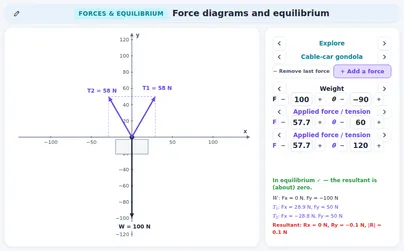
The first step in any mechanics problem is to list every force acting on the body, treating the body as a single particle: weight (always straight down), any normal reaction , any tension or applied force , and any friction or drag .
Rule

Force as a vector

A force of magnitude at angle (anticlockwise from the positive x-axis) has components and . The resultant of several forces is found by adding the components separately: , , and .
Rule

Equilibrium

A body is in equilibrium when the forces acting on it have a resultant of zero: it is at rest, or moving at constant velocity in a straight line. Equilibrium is about several forces on the same body; it says nothing about equal masses.
Definition

Newton's three laws

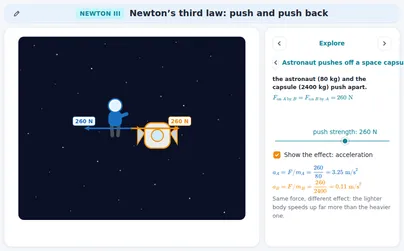
First law: a body stays at rest or moves at constant velocity unless a resultant force acts on it. Second law: a resultant force gives a body of mass an acceleration . Third law: if body A pushes or pulls on body B, body B pushes or pulls back on A with an equal and opposite force.
Tip

Check with a sketch

Before calculating, sketch the forces as arrows from one point. If the arrows look like they could form a closed polygon (nose to tail, ending back where they started), the particle is likely in equilibrium.
Tip

Spotting an action–reaction pair

The two forces of a third-law pair act on two different bodies, are the same kind of force (both pushes, or both the same type of pull), and are always equal in size and opposite in direction — for any masses, any speeds, whether the bodies are moving or not.
Watch out!

A common slip

Mixing up and for the x- and y-components is the most common error: is always measured from the positive x-axis, so the x-component always uses and the y-component always uses , whatever the force is called.
Watch out!

A common slip: two different kinds of pair

Do not confuse an action–reaction pair (two bodies, always equal by Newton's third law) with two forces that happen to balance on one body in equilibrium (one body, equal only because that body is not accelerating). Weight and the normal reaction on a resting object look alike but are an equilibrium pair, not an action–reaction pair: the reaction pair to weight acts on the Earth, not on the surface.

Exercises

Interactive applications for this topic

Free applications open with a free student account. Teachers can use all applications in a live lesson.

About the free account and Plus

Are you a teacher?

Start live lessons with these applications for your whole class. Free to try for one month.

Try it free

Fits these school years

Cambridge International: AS Level, A Level

England (GCSE, A Level): Year 12 (A Level)

What the applications of this topic teach 2 applications

Newton's third law: push and push back

  • State Newton's third law: every force has an equal and opposite reaction force.
  • Point to the action–reaction pair acting on two different bodies in a push-apart scenario.
  • Explain why an equal and opposite pair of forces still gives two different accelerations when the masses differ.

Force diagrams and equilibrium

  • List the forces acting on a body, treating it as a single particle.
  • Treat a force as a vector: resolve it into x and y components, F_x=Fcosθ, F_y=Fsinθ.
  • Add the components of every force to find the resultant, and use a zero resultant as the test for equilibrium.