Interactive Lessons

Coordinates in four quadrants

Lecture notes

Definition

The axes

Two number lines cross at a right angle: the x-axis goes across, the y-axis goes up and down. Together they make the coordinate plane.
−4−224−3−2−1123xy
Example
The point is 4 along the x-axis.The point is 3 up the y-axis.
−2246−2−112345xy(4,0)(0,3)
Definition

The origin

The axes cross at the origin. Its coordinates are 0 and 0.
xy(0,0)
Example
Start at the origin and go 2 to the right.You are at , not at the origin any more
xyO(2,0)
Definition

Coordinates

Two numbers tell where a point is: first how far along the x-axis, then how far up or down. They are the coordinates of the point.
−4−224−4−3−1123xy3−2(3,−2)
Example
A treasure lies at :5 along the x-axis, then 1 down
xy(5,−1)
Definition

Quadrants

The axes cut the plane into four quadrants. They are numbered anticlockwise, starting at the top right.
xy1234
Example
is in quadrant 1, in quadrant 2, in quadrant 3, in quadrant 4
xy(2,3)(−2,3)(−2,−3)(2,−3)
Rule

x first, then y

To plot (3, −2) start at the origin, go 3 to the right, then 2 down. The first number is always x, the second is always y.
xy(3,−2)32
Example
Plot : from the origin go 4 to the left,then 1 up
xy(−4,1)41
Rule

The signs

Right and up are positive. Left and down are negative. A negative x puts the point left of the y-axis, a negative y puts it below the x-axis.
xy+−+−
Example
: 2 to the left and 5 downLeft of the y-axis and below the x-axis
xy(−2,−5)
Rule

The quadrants and their signs

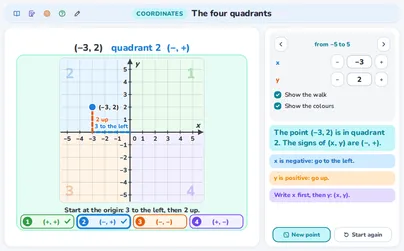
Quadrant 1 has (+, +), quadrant 2 has (−, +), quadrant 3 has (−, −) and quadrant 4 has (+, −).
xy(+,+)(−,+)(−,−)(+,−)
Example
has the signs quadrant 3
xy(−6,−1)(−,−)
Rule

Points on the axes

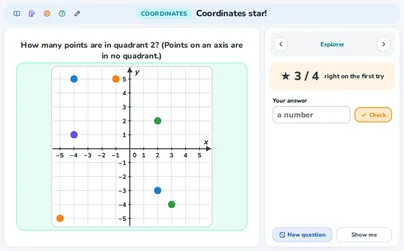
On the x-axis y is 0. On the y-axis x is 0. A point on an axis is in no quadrant.
−4−224−4−3−2−1123xy(4,0)(0,−3)
Example
: y is 0, so it is on the x-axis.: x is 0, so it is on the y-axis
−6−4−22−2−112345678xy(−5,0)(0,7)
Rule

Moving a point

Right and up add, left and down take away. From (2, −3) go 4 left and 5 up: change x by −4 and y by +5.
xy(2,−3)(−2,2)45
Example
From go 3 to the right and 6 down:
xy(−1,4)(2,−2)36
Rule

Distance on a line

Two points in the same row have the same y. The distance is the difference of the x-numbers: big minus small.
xy−34AB7
Example
and have the same y. How far apart?
xy−53AB8
Rule

The fourth corner

In a rectangle with sides along the axes, the fourth corner takes x from one corner and y from another. In a parallelogram the fourth corner is A + C − B.
246123456xyABC?
Example
are three corners of a rectangle.D takes x from A and y from C:
xyABCD
Rule

Shapes from points

Plot the corners in order and join them. Look at the sides: equal lengths, parallel sides and right angles tell you the name of the shape.
246123456xyABC
Example
joined in order:4 equal sides and 4 right angles a square
246−1123456xy
Tip

Along, then up or down

Read a point like a map: first walk along the x-axis, then go up or down. The helping lines show the walk.
−424−2−11245xy−23(−2,3)
Example
Find : walk 3 along the x-axis,then 4 down. The helping lines show the walk
xy3−4(3,−4)
Tip

Battleships

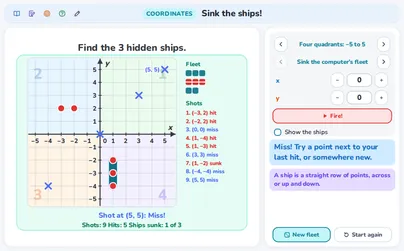
Name every shot with its coordinates, x first. After a hit, try the points next to it: a ship is a straight row.
24−3−2−1123xy
Example
A hit at . Try the points next to it:, , ,
xy(1,−1)(3,−1)(2,0)(2,−2)
Tip

Look at the scale

On a big board the numbers go up in steps of 2. Read the numbers on the axes before you count the lines.
−6−4−226−6−4246xy4−2(4,−2)
Example
The axis shows 0, 2, 4, 6 …: steps of 2.3 marks right of the origin is , not 3
2468−2−1123xy123
Watch out!

Swapping x and y

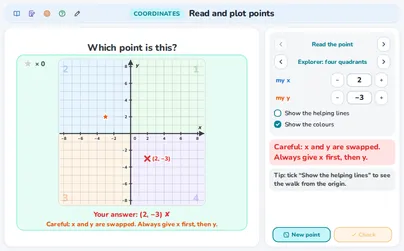
The points (2, 5) and (5, 2) are two different points. Always give x first.
−113467xy2552(2,5)(5,2)
Example
A treasure at :✘ 6 right and 1 up ✔ 1 right and 6 up
24682468xy✔✘
Watch out!

A wrong sign

The points (−3, 2) and (3, 2) are on different sides of the y-axis. The sign tells the side.
−4−224−11234xy(−3,2)(3,2)
Example
Plot :✘ 4 to the right, 3 up ✔ 4 to the left, 3 up
−6−4−224624xy✔✘
Watch out!

Counting from 1

You start at 0, the origin. The first mark to the right of the origin is 1, not 0.
−2−112345−11xyO
Example
Plot :✘ call the origin 1, stop at 2 ✔ the origin is 0, so go to the mark 3
−112345−11xy✘✔
Special case

No quadrant

The points (0, 5) and (−4, 0) are on an axis, so they are in no quadrant. The origin is on both axes.
xy(0,5)(−4,0)
Example
is on the y-axis, so it is in no quadrant. is on both axes
xy(0,−6)(0,0)

Exercises

Plot the point (4, 3). Easy
Show solution
Start at the origin
Go 4 to the right (x = 4)
Go 3 up (y = 3)
xy(4,3)
Answer → the point is in quadrant 1
Both coordinates are positive.
In which quadrant is (−2, 5)? Easy
Show solution
x is negative: the point is left of the y-axis
y is positive: the point is above the x-axis
xy(−2,5)
Answer → quadrant 2
The signs are (−, +).
A point is 3 to the left and 4 down from the origin. Give its coordinates. Medium
Show solution
Left is negative: x = −3
Down is negative: y = −4
xy(−3,−4)
Answer → (−3, −4), in quadrant 3
x first, then y.
Start at (2, −3). Go 4 to the left and 5 up. Where do you end? Medium
Show solution
x: 2 − 4 = −2
y: −3 + 5 = 2
xy(2,−3)(−2,2)
Answer → (−2, 2)
Check: from (−2, 2) go 4 right and 5 down to get back.
A (−3, −1), B (4, −1) and C (4, 3) are three corners of a rectangle. Find D and the sides. Hard
xyABC
Show solution
D takes x from A and y from C: D = (−3, 3)
xyABCD
AB: 4 − (−3) = 7 steps
BC: 3 − (−1) = 4 steps
Answer → D = (−3, 3)\; the sides are 7 and 4
A rectangle has opposite sides of equal length.

Interactive applications for this topic

Free applications open with a free student account. Teachers can use all applications in a live lesson.

About the free account and Plus

Are you a teacher?

Start live lessons with these applications for your whole class. Free to try for one month.

Try it free

Fits these school years

IB (MYP, Diploma): PYP, MYP 1, MYP 2, MYP 3

Cambridge International: Primary, stage 6, Lower Secondary, stage 7

Netherlands: Groep 7, Groep 8, Year 1, Vmbo bb (years 3-4), Vmbo kb (years 3-4), Vmbo gt (years 3-4)

Türkiye (MEB): Year 5 (MEB), Year 6 (MEB), Year 7 (MEB)

England (GCSE, A Level): Year 5, Year 6, Year 7

USA (Common Core): Grade 5, Grade 6

What the applications of this topic teach 5 applications

The four quadrants

  • Naming the quadrant of a point
  • Knowing the signs of x and y in each quadrant
  • Walking from the origin to a point: x first, then y

Read and plot points

  • Reading the coordinates of a point on the board
  • Plotting a point from its coordinates
  • Knowing that x comes first and y second

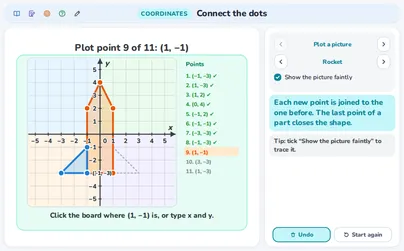
Connect the dots

  • Plotting a list of points in order
  • Joining points to make a shape
  • Naming a shape from its corners

Sink the ships!

  • Naming a point by its coordinates
  • Using hits and misses to search a board
  • Using negative numbers to place a ship in any quadrant

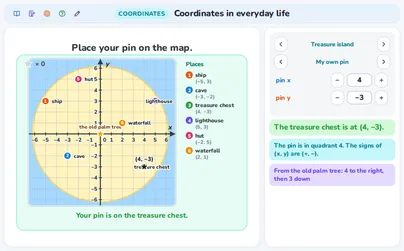
Coordinates in everyday life

  • Finding a place on a map from its coordinates
  • Giving the coordinates of a place on a map
  • Working out the steps from one place to another