Interactive Lessons
Lecture notes Exercises

The unit circle

Lecture notes

Definition

The unit circle

A circle with radius 1 around O. Turn from the positive x-axis, anticlockwise. The point at angle θ is
θxyPcosθsinθ
Example
θ = 60°:
60°xyP1/2√3/2
Definition

Every angle

Angles beyond 90°, negative angles and more than a turn all have a point. Add or take off whole turns of 360° to get 0° to 360°.
θxy−60°360°
Example
40°360°300°−60°
Rule

Quadrants and signs

All · Sin · Tan · Cos: in I all are positive, in II only sin, in III only tan, in IV only cos. The sign of x is cos, the sign of y is sin.
cossinAISIITIIICIV
Example
210° is in III:
210°xyPcos−sin−
Definition

The reference angle

The reference angle α is the acute angle to the x-axis:
ααθαθαθ
Example
150° is in II: 300° is in IV:
30°150°60°300°
Rule

Size and sign

The size of sin θ, cos θ and tan θ is the same as for α. The sign comes from the quadrant of θ.
αxyP−cosαsinα
Example
30°xyP−√3/21/2
Rule

Related angles

Same sin: 180° − θ (mirror in the y-axis). Same cos: 360° − θ (mirror in the x-axis). Same tan: θ + 180° (the opposite point).
θ180°−θ360°−θθ+180°
Example
θ = 40°:
40°140°320°220°
Definition

Exact values

For α = 0°, 30°, 45°, 60°, 90° the exact values are: is the same list backwards. In radians π/6, π/4, π/3 are 30°, 45°, 60°.
30°√3/21/245°√2/2√2/260°1/2√3/2
Example
: , III, so
45°xyP−√2/2−√2/2
Special case

On the axes

sin and cos are always between −1 and 1. On the y-axis cos θ = 0, so tan θ does not exist (90°, 270°).
xy(0,1)(1,0)(−1,0)(0,−1)x=1?
Example
, → does not exist
xy10x=1
Definition

tan and cot as lengths

Extend OP. It meets the line x = 1 at T: tan θ is the height of T. It meets y = 1 at K: cot θ is the x of K.
xyPTKtanθcotθ
Example
P = (3/5, 4/5):
xyPTK4/33/4
Rule

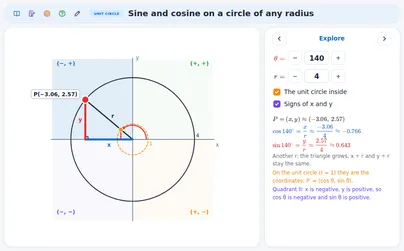
A bigger circle

On a circle with radius r the point is x = r cos θ, y = r sin θ, so cos θ = x ÷ r and sin θ = y ÷ r for every r. From a point:
θxyPxyr
Example
r = 4, θ = 120°:
θxyP−22√34
Rule

One ratio gives the others

Draw the right triangle of the reference angle and use Pythagoras for the third side. The signs come from the quadrant.
αxyPOAH
Example
in II:, so
xyP345
Tip

The angle of a point

For P(x, y) the reference angle comes from the lengths |x| and |y|:Find the quadrant from the signs of x and y, then use the rule for that quadrant.
αθxyPxy
Example
P(−3, 3): , II
45°135°xyP−33
Definition

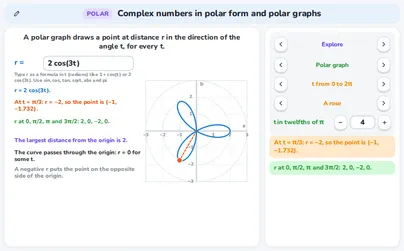
Complex numbers: modulus and argument

A complex number a + bi is the point (a, b). Its distance from the origin is the modulus r = √(a² + b²); its anticlockwise angle from the positive real axis is the argument θ (tan⁻¹ of b ÷ a, adjusted for the quadrant). Back: a = r cos θ, b = r sin θ. See Complex number and Polar to rectangular of "Complex numbers in polar form and polar graphs".
ReIm−2−1123456−2−112345653.13°r = 53 + 4iz = 3 + 4i: r = 5, θ = 53.13°
Example
For z = 3 + 4i: r = √(3² + 4²) = √25 = 5 and θ = tan⁻¹(4 ÷ 3) ≈ 53.13°. For z = −3 + 4i (second quadrant): θ = 180° − 53.13° = 126.87°. Back again: r = 5, θ = 120° give a = 5 × (−0.5) = −2.5 and b ≈ 4.33.
Watch out!

The usual mistakes

Forgetting the sign from the quadrant. Taking 90° − θ for the angle with the same sine. Measuring the reference angle to the y-axis.
60°✘30°✔
Example
✘ ✔
30°xyP−√3/21/2
Tip

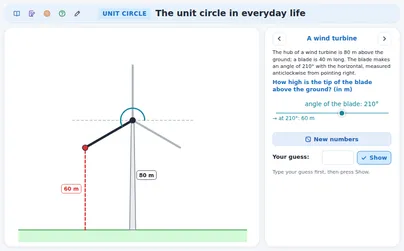
Turning in real life

A clock hand, a wind turbine blade or a bicycle valve moves round a centre. Its position is r cos θ and r sin θ, with signs.
θxyr·cosθr·sinθr
Example
Hand of 10 cm, 20 minutes: θ = 120° cm
θxy−55√310

Exercises

In which quadrant does 250° end? Are sin and cos positive or negative there? Easy
250°xyP
Show solution
, so the angle ends in quadrant III.
250°xyIII
In III only tan is positive.
So sin and cos are both negative: .
250°xyIIIcos−sin−
Answer → III; ,
Check: the point is left of and below O.
What is the reference angle of 300°? Easy
300°xyP
Show solution
: quadrant IV.
300°xyIV
In IV the reference angle is .
.
60°xy
Answer →
Check: 300° is 60° short of a full turn: .
Find the exact value of sin 210°. Medium
210°xyP?
Show solution
210° is in quadrant III, so sin is negative.
The reference angle is .
30°xy
, so .
210°xyP−1/2
Answer →
Check: the point is below the x-axis, so .
Which other angle from 0° to 360° has the same sine as 40°? Medium
40°xy?
Show solution
Same sine means the same height: the mirror image in the y-axis.
That is .
xy
.
40°140°xy
Answer →
Check: not (): that swaps sine and cosine.
and θ is in quadrant II. Find and . Hard
xyP3?5
Show solution
Draw the right triangle with opposite side 3 and hypotenuse 5.
Pythagoras: the third side is .
xyP345
In II cos is negative: .
.
Answer → ,
Check: .
A point lies on a circle around O. Find the angle θ of OP from 0° to 360°. Hard
xyP−33
Show solution
x is negative and y is positive: quadrant II.
The reference angle is .
45°xyP−33
In II: .
45°135°xyP−33
Answer →
Check: and , so .
Are you a teacher?

Start live lessons with these applications for your whole class. Free to try for one month.

Try it free

Fits these school years

IB (MYP, Diploma): MYP 5, Diploma, year 1, MYP 4, Diploma, year 2

Cambridge International: AS Level, IGCSE, A Level

Netherlands: Havo · Mathematics B, Vwo · Mathematics B

Türkiye (MEB): Year 11 (MEB), Year 10 (MEB)

England (GCSE, A Level): Year 12 (A Level), Year 11 (GCSE), Year 10 (GCSE), Year 13 (A Level)

USA (Common Core): Algebra 2, Precalculus, Geometry

What the applications of this topic teach 7 applications

Sine and cosine on a circle of any radius
  • Finding sin θ and cos θ of a point P(x, y) on a circle of any radius
  • Saying why the ratios stay the same when the circle gets bigger
  • Placing P so that sin θ or cos θ has a given value and sign

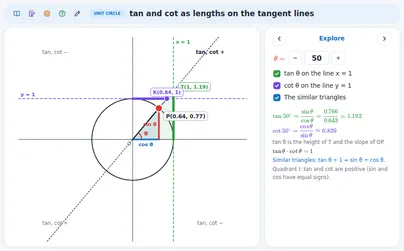
tan and cot as lengths on the tangent lines
  • Finding tan θ and cot θ as lengths on the lines x = 1 and y = 1
  • Explaining why tan θ = sin θ ÷ cos θ with similar triangles
  • Saying when tan θ or cot θ does not exist

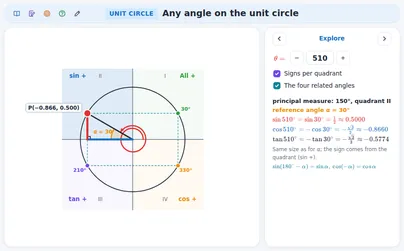
Any angle: quadrants, signs, reference angle
  • Finding the point (cos θ, sin θ) for any angle, also negative
  • Saying the quadrant, the signs and the reference angle
  • Finding other angles with the same sine, cosine or tangent

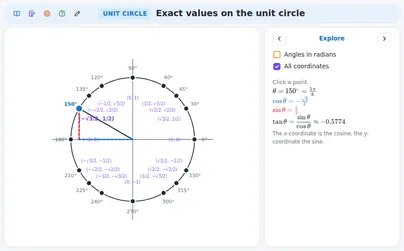
Exact values on the unit circle

  • Knowing the exact coordinates of the 16 special points of the unit circle
  • Finding exact cos θ, sin θ and tan θ of a special angle
  • Saying when tan θ does not exist

Complex numbers in polar form and polar graphs
  • Finding the modulus and argument of a complex number
  • Changing polar form into a and b with r cos θ and r sin θ
  • Reading the shape of a polar graph r = f(t)

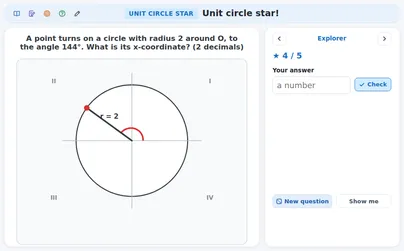
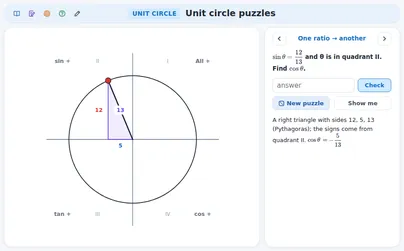
Unit circle puzzles

  • Finding one ratio from another with a right triangle and the quadrant
  • Finding a reference angle and an exact value
  • Finding the quadrant from the signs of two ratios

The unit circle in everyday life

  • Finding the position of a point turning round a centre
  • Saying what a negative answer means in the picture
  • Using the quadrant to check the sign before calculating