Interactive Lessons

The definite integral and area

Lecture notes

Definition

The area function A(x)

Fix a start and let the end move. The area under from to is a number for every , so it is a function of : . Where is below the axis the area counts as negative (cards on signed area).
xfx0xAx3
Example
and the start : (trapezium with heights and ), (a triangle with base and height : ), and .One formula fits all of them: .
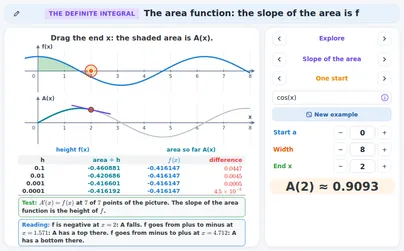
Rule

The slope of the area is f: A' = f

The slope of at is the height of at : . Why: a small step adds a thin strip of width and height about , so , and the quotient closes in on as gets smaller. This is the first half of the fundamental theorem.
Example
from , at : . The area from to , divided by : gives , gives , gives , gives .The differences with are , , , : they go to .
Rule

A rises, falls or has a top

Read the sign of : where the slope of is positive, so rises; where it falls. Where changes from plus to minus, has a top; from minus to plus, a bottom. A top of is where , not where is largest.
Example
is positive for and negative for . So rises up to and has its top there: . After that it falls: and . The area is not at : the part below the axis cancels the part above.
Tip

Another start moves A up or down

A different start gives another area function. Two of them differ by a constant, the area between the two starts: their graphs are the same curve moved up or down, with the same slope at every .
Example
with the start and with the start : . At the two values are and : the gap is , the area from to , and it is the same at every .
Rule

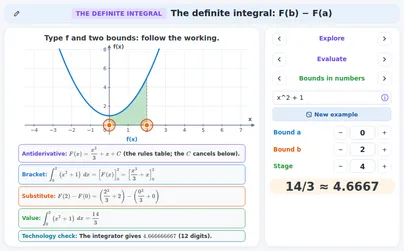
The fundamental theorem: F(b) − F(a)

If is an antiderivative of on (so ), then . The area function is an antiderivative of and , so the area from to is the change of any antiderivative. This is the second half of the fundamental theorem of calculus.
Example
: an antiderivative is , with and .So the integral is .
Tip

Why the constant C cancels

Every antiderivative has the form . In the stands in both brackets and cancels, so a definite integral has no . Take .
Example
With in the integral above: , the same as before.
Rule

The bracket and the four stages

Write in square brackets with the bounds: . Four stages: (1) find an antiderivative ; (2) write the bracket; (3) substitute: the upper bound first, then subtract the lower bound; (4) work out the value.
Example
: (1) , because . (2) . (3) . (4) .
Tip

Exact value or decimal

Exam papers often ask for an exact value: leave , , roots and fractions in the answer, and give a decimal only when it is asked for. A calculator or the integrator gives the decimal as a check. A whole number or a fraction is exact as it stands.
Example
(using ).: exact and whole.
Watch out!

Brackets round negative values

Put every value in brackets before you subtract, above all a negative one: with is . A quick test: if on the whole interval, the integral cannot be negative.
Example
with : ✔ .✘ : the sign of was lost, and cannot give a negative integral. ✘ : the bounds are the wrong way round.
Rule

Reversing the limits

Swapping the two bounds changes the sign: , because the bracket becomes . Equal bounds give : , a strip without width has no area.
Example
With : , and .
Rule

Splitting at a point c

A point cuts an integral in two: . It also works when lies outside ; then one of the two integrals has its bounds the other way round.
Example
: .With outside: .
Rule

Constant multiple and sum

A constant factor comes out and a sum splits: . There is no such rule for a product: .
Example
, so , and .But , not .
Special case

A jump inside the interval

A function that jumps still has an integral, as long as it stays finite: integrate each piece and add the pieces. At the jump itself the value of does not matter, a single point has no width. A function that runs off to infinity (a pole) is something else: see the card on refused cases.
Example
for and for (a jump from to at )..
Definition

The average value and the rectangle

The average value of on is . The rectangle with width and height has the same area as the region under : the bumps of the curve above the line fill exactly the dips below it.
xf33c
Example
on : the integral is , so .The rectangle wide and high has the area . The part above the line and the part below it are both , so .
Rule

Where f equals its average

A continuous takes its average value at least once: there is a point in with . In the picture it is where the curve crosses the line of the average; there can be more than one such point.
Example
For on solve : , which lies in . The other root, , lies outside the interval.
Definition

Signed area: above plus, below minus

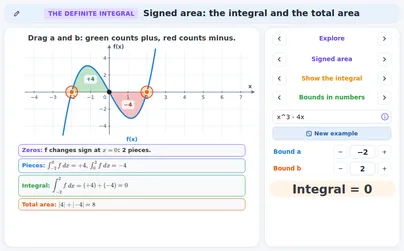
Between the curve and the -axis the area above the axis counts plus and the area below counts minus; the definite integral adds these signed pieces. First find the zeros of : between two zeros keeps its sign, so every piece has one sign.
xf11/6−9/211/614
Example
on has the zeros and (). With : (above), (below), (above).The integral is , and agrees.
Rule

Total area: add the absolute values

The total area (the real area between the curve and the axis) counts every piece as positive: . Split at the zeros, change the sign of every negative piece and add. The total area is never negative and is at least as large as .
Example
The same : .The integral was : two different questions with two different answers.
Watch out!

An integral of 0 is not an area of 0

Equal pieces above and below the axis cancel in the integral, but the area is still there. For an odd function () the integral over is always , and the total area is twice the area on one side.
xf+−
Example
on is odd, with the pieces and : the integral is , the total area is . while the total area is .
Definition

The area between two curves

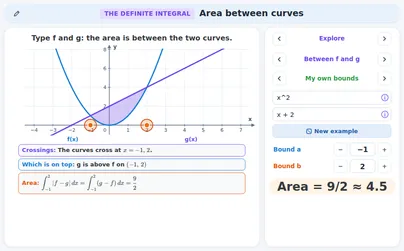
Where one curve lies above the other, the area between them is . Find the crossings for the bounds, check which curve is on top, then integrate top minus bottom.
xy
Example
Top , bottom . Crossings: gives and ..
Rule

Crossings inside: split and add

If the curves cross inside , the curve on top changes there. Split at every crossing, take top minus bottom on each piece, and add the pieces (this is ). The crossings are the zeros of .
xy03
Example
(orange) and (blue) on : , so they cross at and . With : on top on : . on top on : . on top on : .The area is .
Watch out!

The plain integral cancels

Do not integrate over the whole interval when the curves cross: where is negative the piece is subtracted instead of added, so the pieces partly cancel. The result can be far smaller than the area, even . Split at the crossings first.
Example
The same pair on : ✘ .✔ The area is .
Special case

Curves that only touch

Two curves can touch without crossing. Then has a double zero and does not change sign: the curve on top stays the same and there is nothing to split. The applications mark such a point as touching.
xy
Example
and touch at : . On the area is .
Rule

Along the y-axis: horizontal strips

Some regions are easier with horizontal strips. Write each curve as and integrate right minus left: . For the -axis . The bounds are values of .
xy2−1
Example
Right curve , left curve : they meet where , at and ..Vertical strips would need two integrals: .
Definition

Displacement and distance travelled

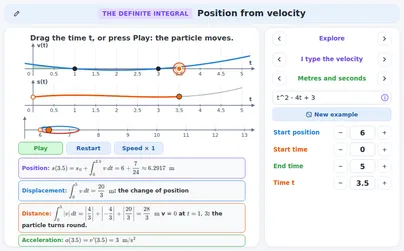
A particle moves on a line with velocity . Its displacement (the change of position) is : going back counts negative. The distance travelled is : find the times where (the particle turns round), split there and add the absolute values.
tv16−72ts420132
Example
m/s for s; at . With : m forward and m (back).Displacement: m. Distance: m.
Rule

Position and acceleration

The position is the start position plus the displacement: . The acceleration is the rate of change of the velocity, , and run backwards, . The start values and play the part of the constant.
Example
and give . With : , so (the turning point) and ; the displacement is .And the other way: , so m/s².
Tip

The unit of an integral

The unit of an integral is the unit of the integrand times the unit of the variable: a rate times a time. (mm per hour) × hours = mm; kW × hours = kWh; (m/s) × s = m. For an area under a graph of metres against metres it is m². The unit tells you what the number means; the average value has the unit of itself.
Example
Rain falls at mm per hour for hours: the total is mm.The average rate is mm per hour: the same unit as .
Special case

An integral with no formula

Not every integrand has an antiderivative in the rules table: has none that can be written with the usual functions, so there is no bracket to fill in. The definite integral still exists, and the integrator finds it from numbers to 12 digits. A decimal is then the answer.
xf120
Example
and .Twelve digits of the first: .
Special case

A pole inside: refused

If runs off to infinity at a point inside (a pole), the integral is an improper integral. The bracket then gives a meaningless number, so the applications refuse it and ask you to change the interval. Improper integrals come later in the course.
xf−110
Example
with : ✘ , a negative number for a function that is always positive. The pole at lies inside the interval, so the theorem does not apply.
Tip

Four everyday settings

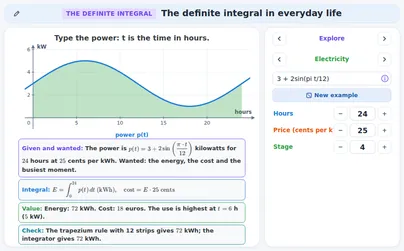
In everyday problems an integral adds up a rate over time or a width over a length. Rain (mm per hour gives mm), electricity (kW gives kWh, then a price), land (the area between a road and a river gives m², hectares and a value) and temperature (the average value). Always write the unit with the answer.
Example
Electricity: kW for hours gives kWh; at cents per kWh that is euros.Land: road , river , m: m², which is hectares; at euros per m² that is euros.Temperature: °C over hours: the integral is , so the average is °C.
Tip

Which course needs what

The definite integral with , the area under a curve and the properties are asked in every course (Cambridge AS, UK AS and A level, IB SL, AP Calculus AB, vwo B). The area between two curves is A level in England, but Cambridge AS and IB SL ask it earlier. Kinematics by calculus: Cambridge P4, UK A level, IB SL, AP AB. The -axis version is IB HL and AP; the average value and are AP and vwo B. Volumes and improper integrals come later; the vector part of kinematics belongs to Mechanics and Vectors.
Example
An exam asks: (every course); the area between and , (Cambridge AS, IB SL, UK A level, AP, vwo B); the distance travelled, m for on (Cambridge P4, UK A level, IB SL, AP AB).
Definition

Volume of a solid of revolution: discs and washers

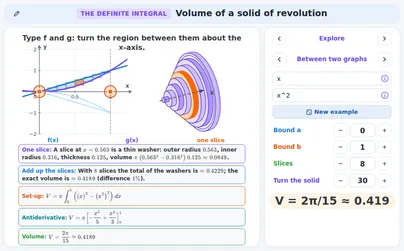
Turning the region under f(x), a ≤ x ≤ b, about the x-axis sweeps out a solid. A thin slice at x is a disc of radius f(x): the volume is π times the integral of f(x)². Between f and g the slices are washers with a hole. (discs) (washers)
RRr
Example
, :
1

Exercises

Evaluate . Easy
Show solution
An antiderivative is .
Substitute: and .
Subtract the lower value from the upper one: .
Check with geometry: the region is a trapezium with parallel sides and and width : .
Evaluate . Easy
Show solution
Raise the power by and divide: , so .
and . Put the negative value in brackets.
Subtract: .
Check: , so the integral must be positive ✔.
Let . Find a formula for , then and the slope of at . Easy
Show solution
An antiderivative of is , so .
.
The slope of the area function is the height of : .
, and
Check: the derivative of is and ✔.
. Find , and . Easy
Show solution
Swapping the bounds changes the sign: .
A constant factor comes out: .
Equal bounds: the width is .
, and
Check: and ✔.
and . Find and . Easy
Show solution
The point splits : .
Add: .
From to is the other way round, so the sign changes.
and
Check: and ✔.
The graph of lies above the axis from to and encloses an area of there. From to it lies below the axis and encloses an area of . Find and the total area. Easy
Show solution
The piece above the axis counts , the piece below counts .
The integral is the signed sum: .
The total area adds the absolute values: .
The integral is and the total area is .
Check: the total area is at least and is never negative ✔.
Find the exact value of . Medium
Show solution
The inner function is , so divide by : an antiderivative of is ().
Substitute: .
.
Check: the derivative of is ✔.
Find the exact value and the value to 4 decimals of . Medium
Show solution
An antiderivative of is (divide by the inner rate ).
Substitute: .
With : .
Check: is positive, so the integral is positive, and the curve climbs from to over a width of : a value of about is reasonable ✔.
Find the average value of on and the point in where equals it. Medium
Show solution
The integral: .
Divide by the width : .
Solve for .
and
Check: and lies in ✔.
Find the area between the line and the parabola . Medium
Show solution
Crossings: gives and . At the line is on top ().
Area with .
and .
Check with the parabola rule: the area between a parabola and a line that meet at two points a distance apart is ; here ✔.
Find and the total area between the curve and the -axis on . Medium
Show solution
The zeros are and ; between them. With : .
.
The integral adds the signs; the total area adds the absolute values.
The integral is and the total area is .
Check: ✔.
A particle has velocity m/s for s and starts at m. Find when it turns round, the displacement, the distance travelled and the final position. Medium
tv−635
Show solution
at (turn). With : and .
Displacement m; the pieces are and , so the distance is .
Final position: .
Turns at s; displacement m; distance m; final position m.
Check: the distance is at least the size of the displacement ✔.
Let for . At which is smallest, and what is that value? Hard
Show solution
: negative for , positive after, so is smallest at .
with .
.
Smallest at : .
Check: and are both larger ✔.
A student writes . Why can this not be right? Hard
Show solution
The integrand is positive for every , so a correct integral is positive; is negative.
The integrand runs off to infinity at (a pole), and lies inside ; jumps there.
So the theorem does not apply; the applications refuse this interval.
A pole at lies inside the interval, so the bracket gives a meaningless number.
Without a pole: , positive ✔.
Find the area enclosed by the curves and . Hard
xy
Show solution
Use horizontal strips. gives and ; at the line () is right of the parabola ().
Area with : .
Check: for such a parabola the area is with : ✔.
Find the area between and for . What does give? Hard
xy
Show solution
They cross at , , . With : , , .
on top on : ; on top on : ; on top on : .
Add the areas; the plain integral is .
Area ; the plain integral gives , wrong for an area.
Check: ✔.
A particle has acceleration m/s² for s, with and m/s. Find , the displacement and the distance travelled. Hard
Show solution
: it turns at and .
: , , .
Forward , back , forward .
Displacement m; distance m.
Check: ✔.
A heater uses the power kW for hours. Find the energy, the average power and the cost at cents per kWh. Hard
Show solution
Energy .
Average power energy time .
Cost .
Energy kWh; average power kW; cost euros.
Units: kW × hours = kWh; kWh × euros per kWh = euros ✔.
Are you a teacher?

Start live lessons with these applications for your whole class. Free to try for one month.

Try it free

Fits these school years

IB (MYP, Diploma): Diploma, year 1, Diploma, year 2

Cambridge International: AS Level, A Level

Netherlands: Vwo · Mathematics B

England (GCSE, A Level): Year 12 (A Level), Year 13 (A Level)

USA (Common Core): Calculus

What the applications of this topic teach 7 applications

The area function: the slope of the area is f

  • Seeing that the slope of the area function is the height of f
  • Explaining why the integral from a to b is F(b) − F(a)
  • Seeing that area functions with different starts stay equally apart

The definite integral: F(b) − F(a)

  • Evaluating a definite integral in four stages
  • Using the properties: reversing limits, splitting, constant multiple
  • Finding the average value of f as a rectangle height

Signed area: the integral and the total area

  • Finding the zeros of f and the signed pieces between them
  • Telling the integral from the total area
  • Reading the same picture as displacement and distance travelled

Area between curves

  • Finding the crossings of two curves and which is on top
  • Setting up the area as top minus bottom, split at crossings
  • Using horizontal strips and integrating along the y-axis

Volume of a solid of revolution: discs, washers and the y-axis

  • Set up the integral for the volume of a solid of revolution as thin discs (π times the integral of f²) or thin washers (π times the integral of the outer radius squared minus the inner radius squared).
  • Find the antiderivative when the rules table can integrate it, and write the volume as an exact multiple of π or as a decimal.
  • Turn a region about the y-axis by typing x as a function of y.

Position from velocity

  • Finding displacement and distance travelled from a velocity graph
  • Finding position from the start position and velocity
  • Reading the direction of motion and where the particle turns round

The definite integral in everyday life

  • Turning a rate or a width into a total with a definite integral
  • Finding an average value, a cost or a value from an integral
  • Checking the answer with the trapezium rule