

Similar triangles from a triangle: parallel lines and the altitude
This is a demo, open for everybody. A free account opens 140+ applications; Plus opens all of them.
Make a free account Log inWhat this application teaches
- I can build similar triangles from a triangle with a line parallel to a side, inside the triangle or beyond a corner, and with the altitude to the hypotenuse (MEB 9.4.3).
- I can check with the angles (AA) that two triangles are similar and read the scale factor from the ratios of matching sides (MEB 9.4.3).
- I can explain why a line that is not parallel gives no similar triangle and why two pairs of equal angles are enough (MEB 9.4.3).
- I can read three proofs of similarity, put their lines in order, give the reasons and say which line breaks when the figure changes (MEB 9.4.3).
- I can use similar triangles to find a missing side or angle.
How to use it
Aim: Build similar triangles on your own triangle and compare their angles and ratios. Then read, order and justify the proof of each construction and change the figure to see which line breaks.
- In Explore choose Build it and pick one of the 3 constructions: Parallel inside, Parallel outside or Altitude: three triangles. Drag the corners and the round handle on the side. Six rows compare the angles and the ratios of matching sides; the cards say whether the triangles are similar and give the scale factor.
- For the altitude press one of the 3 pairs, AHC and ACB, CHB and ACB or AHC and CHB, to compare it. Slide the point C along the circle: the three triangles change but keep the same shape.
- Press Tilt the line: the line is no longer parallel, the angles stop matching and the rows turn red. Press Make it parallel again to go back. What does this tell you about lines that are not parallel?
- Choose Read the proof, press Show next line, read the reason and the green or red note about your own figure (“This is true in your figure”), and drag the corners: every line is tested again.
- Choose Put in order and press Check the order. Choose Give the reasons, click the reason of a line, pick one from the list (two reasons belong to no line) and press Check the reasons. With Hint and Next step the tool puts a line in place or fills in a reason and locks it; Show answer shows everything.
- Choose Adapt it and press a case: for Parallel inside Near A, Near the base or Beyond A; for Parallel outside Beyond A, near, Beyond A, far or Inside; for the altitude Leg BC shorter, Equal legs or Leg AC shorter. Each line shows true or false, and a card says which line breaks and why.
- In Guess first, read the question, choose your answer, then look at the picture and the reason.
- In Practice choose a level (Starter, Explorer or Champion), type or choose your answer and press Check. If you are stuck, press Hint, then Next step opens the solution one step at a time. New problem gives another one.
Tip for teachers: Ask: “Is every line through D a good one?” Let pupils press Tilt the line and watch the angles: only the parallel keeps the shape. In the altitude, ask for two angles that two of the three triangles share.
Fits these school years
IB (MYP, Diploma): MYP 4, MYP 5, MYP 3
Cambridge International: Lower Secondary, stage 9, IGCSE
Netherlands: Year 2, Year 3 (havo, vwo), Vwo · Mathematics C
Türkiye (MEB): Year 9 (MEB)
England (GCSE, A Level): Year 9, Year 10 (GCSE), Year 11 (GCSE)
USA (Common Core): Geometry
Similar applications
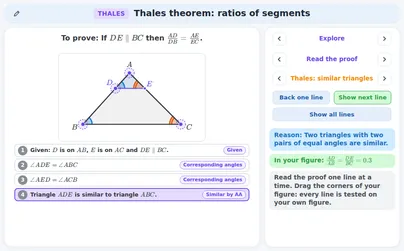 PlusThales theorem: ratios of segments and its proofs
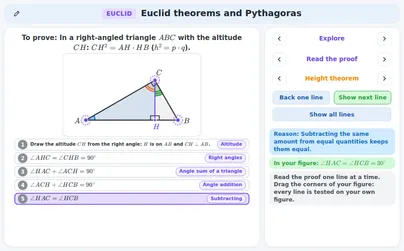 PlusEuclid theorems and Pythagoras: proofs, acute and obtuse triangles
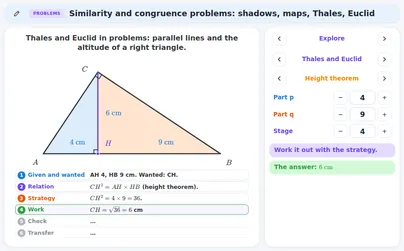 PlusSimilarity and congruence problems: shadows, maps, Thales, Euclid
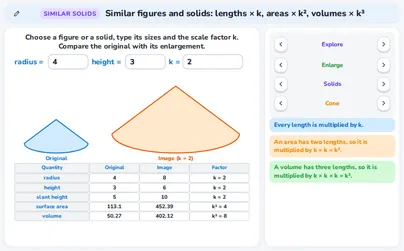 PlusSimilar figures and solids: lengths × k, areas × k², volumes × k³
 PlusThe golden section: a : b = (a + b) : a
Read the lecture notes: Similar triangles: Thales and Euclid