2.1aRelations and mapping diagrams
1Pupils show a relation as a table, graph, mapping diagram or list of points, move between these forms, and use a mapping diagram to decide whether it is a function.3


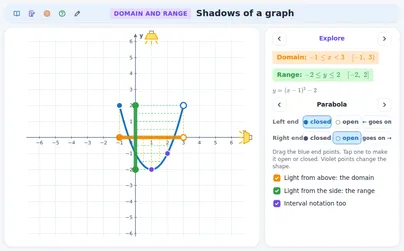 Domain and range: shadows of a graphSee domain and range as shadows of a graph on the axes, and write them with inequalities and in interval notation.Open
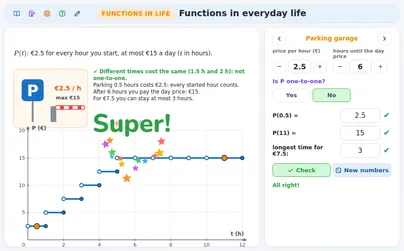 Functions in everyday lifeUse function notation in five everyday scenes: a taxi, a parking garage, a phone battery, the temperature in a day and a bouncing ball.Open
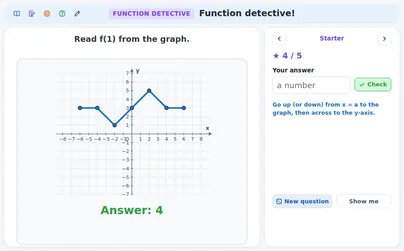 Function detective! (quiz) QuizEndless practice with a score on the topic ‘Function basics’.Open
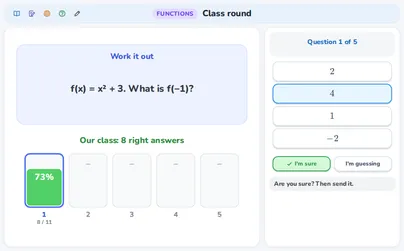 Class round: the whole class at once Class roundFive questions for the whole class at once: definitions, rules, true or myth, and sums.Open
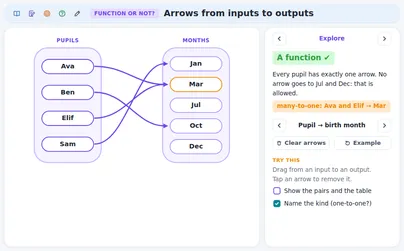 Arrows: function or not?Mapping diagrams: is it a function?Open
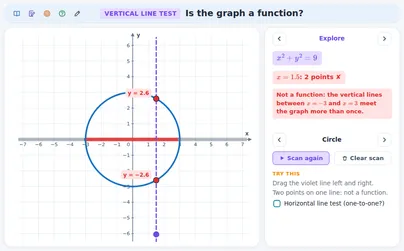 The vertical line testThe vertical line test: drag a vertical line over a graph; where it meets the graph twice, x has two outputs and the graph is not a function.OpenFunction detective! (quiz) QuizEndless practice with a score on the topic ‘Function basics’.OpenClass round: the whole class at once Class roundFive questions for the whole class at once: definitions, rules, true or myth, and sums.Open
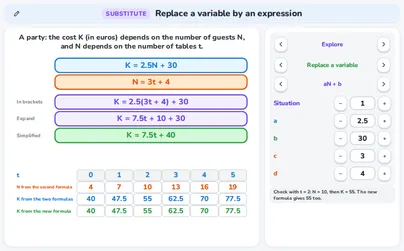 Replace a variable by an expressionLearn to replace a variable by an expression and back, in six situations, and to check the result with a number.Open
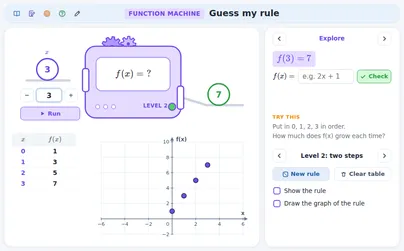 Function machine: guess my ruleFunction machine: Guess my rule.Open
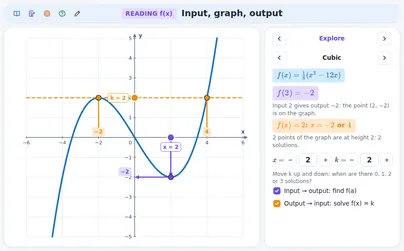 Reading f(x) on a graphReading f(x) on a graph.OpenFunction detective! (quiz) QuizEndless practice with a score on the topic ‘Function basics’.OpenClass round: the whole class at once Class roundFive questions for the whole class at once: definitions, rules, true or myth, and sums.OpenFunctions in everyday lifeUse function notation in five everyday scenes: a taxi, a parking garage, a phone battery, the temperature in a day and a bouncing ball.OpenDomain and range: shadows of a graphSee domain and range as shadows of a graph on the axes, and write them with inequalities and in interval notation.OpenFunction detective! (quiz) QuizEndless practice with a score on the topic ‘Function basics’.OpenClass round: the whole class at once – Function basics Class roundFive questions for the whole class at once: definitions, rules, true or myth, and sums.Open
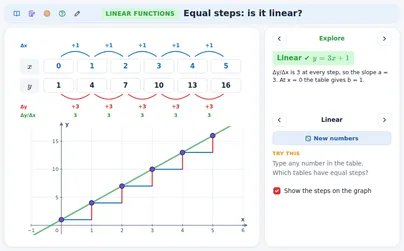 Equal steps: is the table linear?Equal steps: type a table and the application shows the steps Δx, Δy and Δy/Δx, and a staircase on the graph.Open
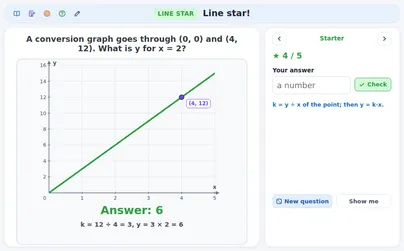 Line star! (quiz) QuizEndless practice with a score on the topic ‘Linear functions’.Open
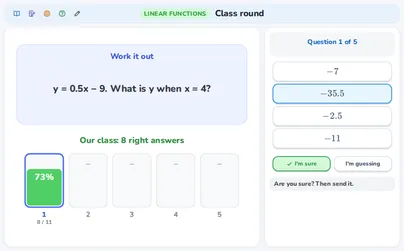 Class round: the whole class at once – Linear functions Class roundFive questions for the whole class at once: definitions, rules, true or myth, and sums.Open
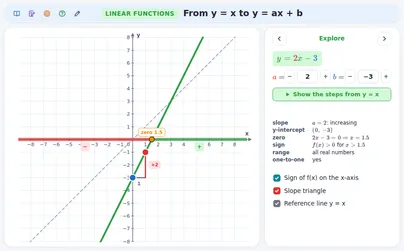 From y = x to y = ax + bFrom y = x to y = ax + b: the line y = x is multiplied by a (steeper, flatter or flipped) and then moved up or down by b.OpenLine star! (quiz) QuizEndless practice with a score on the topic ‘Linear functions’.OpenClass round: the whole class at once Class roundFive questions for the whole class at once: definitions, rules, true or myth, and sums.Open
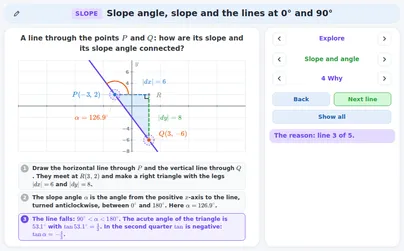 Slope angle and slope: tangent, quadrants, 0 and 90 degreesSee how the slope and the slope angle of a line are connected: guess, measure on your own line and state the rule, for angles from 0 to 180 degrees.Open
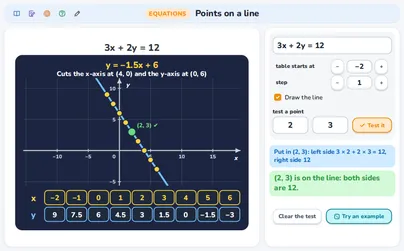 Points on a lineType your own equation with x and y (y = 2x + 1, 2x + y = 8, x − y = 2, x = 4 …).Open
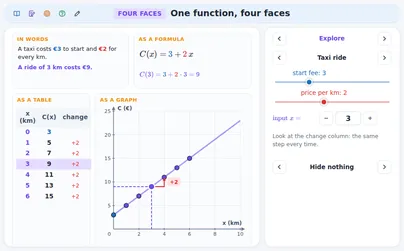
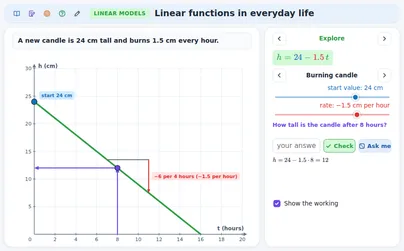 Linear functions in everyday lifeLinear models: a real situation as y = start value + rate × x.Open
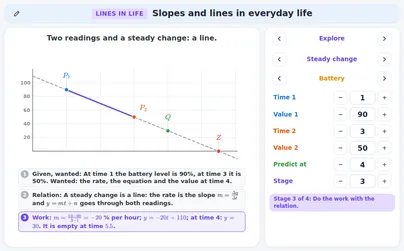 Slopes and lines in everyday lifeUse slopes and lines in three situations: the steepness of a roof, a ramp or a road, a steady change, and two streets.OpenLine star! (quiz) QuizEndless practice with a score on the topic ‘Linear functions’.OpenClass round: the whole class at once Class roundFive questions for the whole class at once: definitions, rules, true or myth, and sums.Open
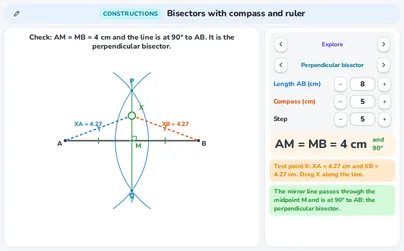 Bisectors with compass and rulerBuild the perpendicular bisector and the angle bisector step by step with a virtual compass and ruler, and find out why they work.Open
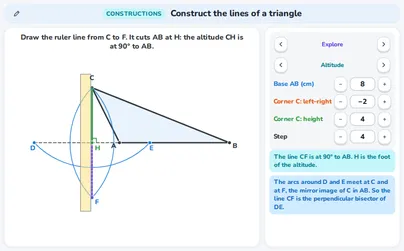 Construct the lines of a triangleConstruct the median, the angle bisector and the altitude of a triangle step by step, then build isosceles and equilateral triangles.Open
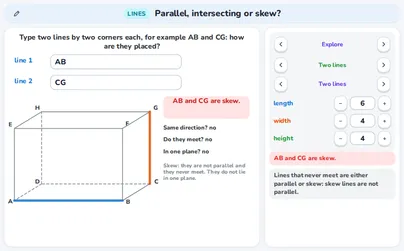 Parallel, intersecting or skew? Lines and planes in a boxA box has the corners A to H: ABCD is the bottom and EFGH the top, E above A.Open
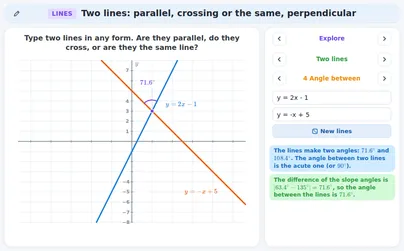 Two lines: parallel, crossing, the same, perpendicularTwo lines: parallel, crossing or the same?Open
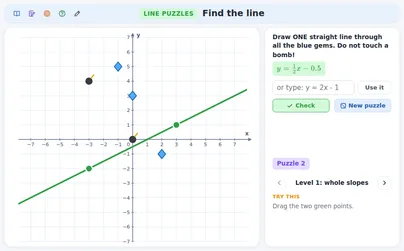 Line puzzles: gems and descriptionsLine puzzles: a game with two kinds of puzzle.OpenSlopes and lines in everyday lifeUse slopes and lines in three situations: the steepness of a roof, a ramp or a road, a steady change, and two streets.OpenLine star! (quiz) QuizEndless practice with a score on the topic ‘Linear functions’.Open
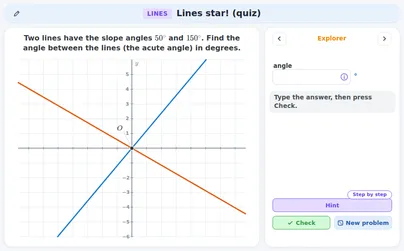 Lines star! (quiz) QuizEndless practice with a score on the topic ‘Slope angle, slope and positions of lines’.Open
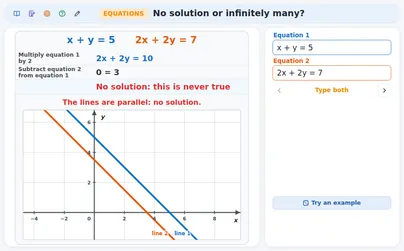 No solution or infinitely many?Type two equations (or let equation 2 be BUILT from equation 1) and see what elimination says.Open
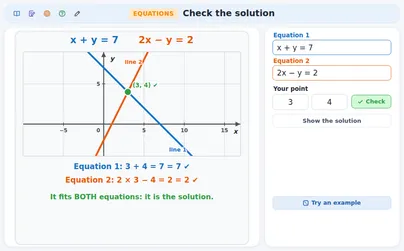
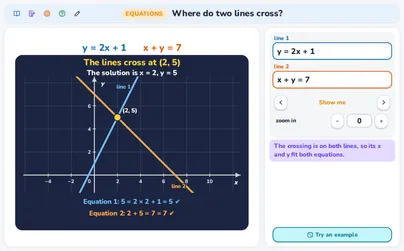 Where do two lines cross?Type two equations with x and y (y = 2x + 1 and x + y = 7, 3x + 2y = 12 and x − y = 1 …).Open
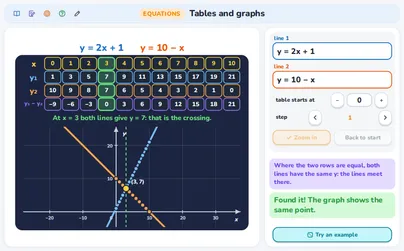 Tables and graphsType two equations (y = 2x + 1 and y = 10 − x …).Open
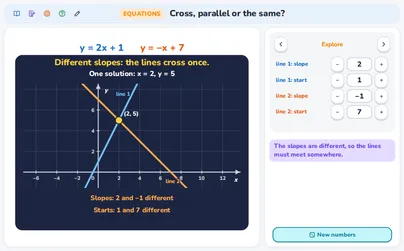 Cross, parallel or the same?Two lines y = mx + c: choose the slope m and the start c of each line with the steppers.Open
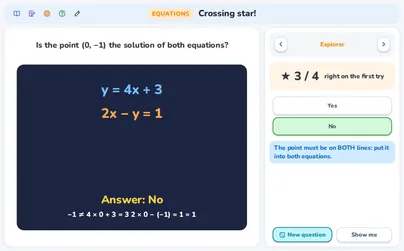 Crossing star! (quiz) QuizEndless practice with a score on the topic ‘Simultaneous equations: graphically, where two lines cross’.Open
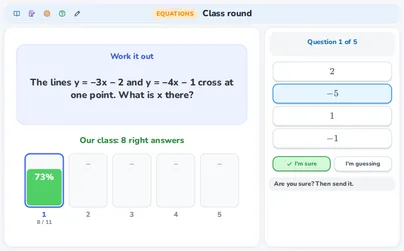 Class round: the whole class at once – Simultaneous equations: graphically, where two lines cross Class roundFive questions for the whole class at once: definitions, rules, true or myth, and sums.Open
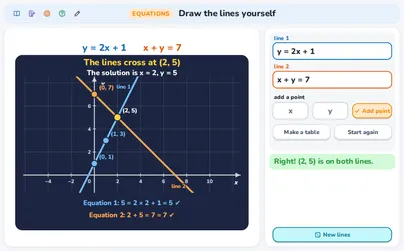 Draw the lines yourselfTwo equations are given (type your own, or press New lines).OpenTables and graphsType two equations (y = 2x + 1 and y = 10 − x …).OpenWhere do two lines cross?Type two equations with x and y (y = 2x + 1 and x + y = 7, 3x + 2y = 12 and x − y = 1 …).Open
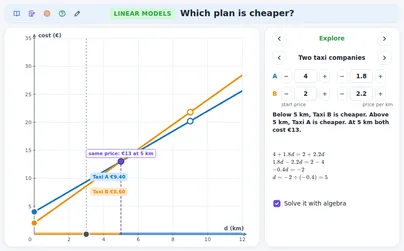
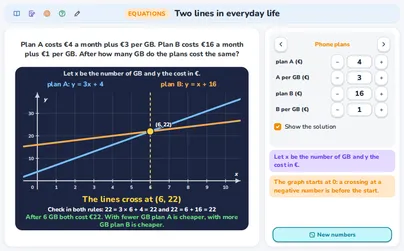 Two lines in everyday lifeFive situations with two rules and one graph: two phone plans, two cyclists, two plants, tickets for adults and children, and a filling and an emptying pool.OpenCrossing star! (quiz) QuizEndless practice with a score on the topic ‘Simultaneous equations: graphically, where two lines cross’.OpenClass round: the whole class at once – Simultaneous equations: graphically, where two lines cross Class roundFive questions for the whole class at once: definitions, rules, true or myth, and sums.Open
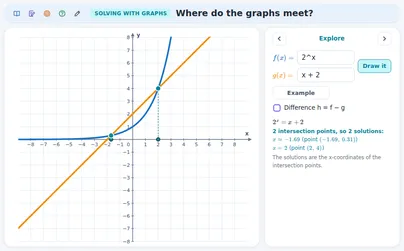 Where do the graphs meet? f(x) = g(x)Type two functions and see where their graphs meet.Open
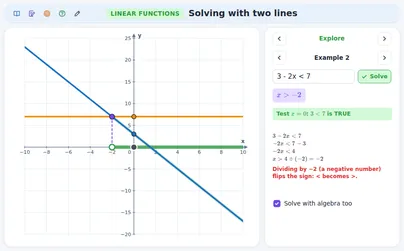
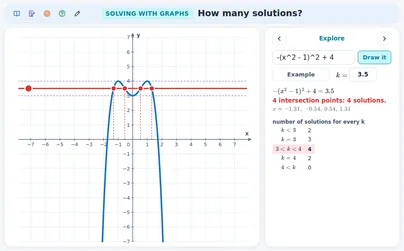
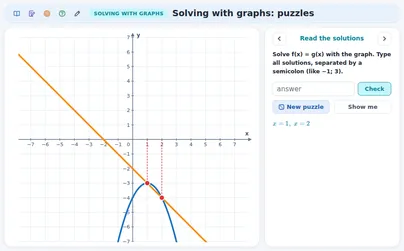 Solving with graphs: puzzlesPuzzles about solving with graphs, new ones every time.Open
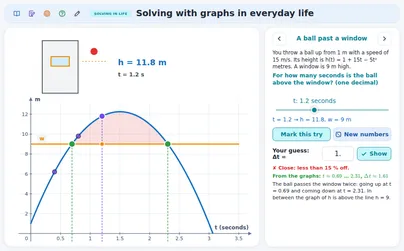 Solving with graphs in everyday lifeSolving with graphs in everyday life: a ball thrown past a window, a cup of tea that cools down, the break-even of a shop and two growing plants.Open
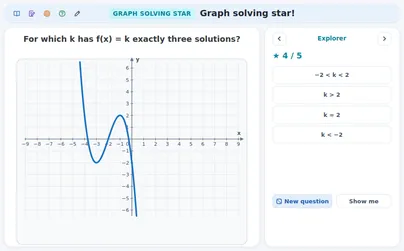 Graph solving star! (quiz) QuizEndless practice with a score on the topic ‘Solving with graphs’.Open
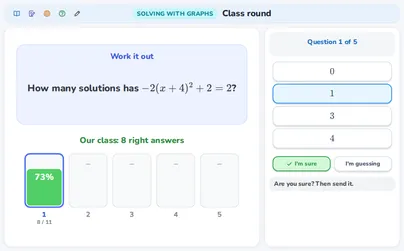 Class round: the whole class at once – Solving with graphs Class roundFive questions for the whole class at once: definitions, rules, true or myth, and sums.Open
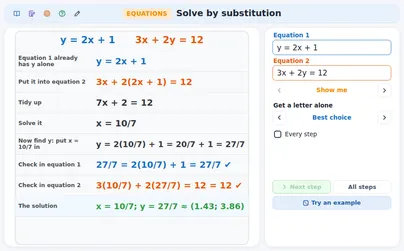 Solve by substitutionType two equations with x and y.Open
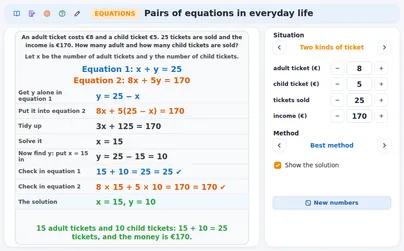 Pairs of equations in everyday lifeFive stories with your own numbers: two kinds of ticket, a mixture of nuts, ages, a boat on a river and a rectangle.Open
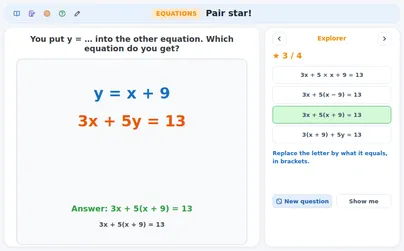 Pair star! (quiz) QuizEndless practice with a score on the topic ‘Simultaneous equations: elimination and substitution, in context’.Open
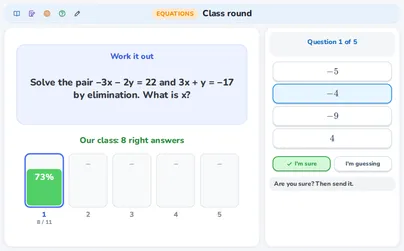 Class round: the whole class at once – Simultaneous equations: elimination and substitution, in context Class roundFive questions for the whole class at once: definitions, rules, true or myth, and sums.Open
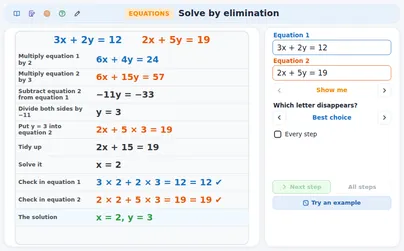 Solve by eliminationType two equations with x and y.OpenPairs of equations in everyday lifeFive stories with your own numbers: two kinds of ticket, a mixture of nuts, ages, a boat on a river and a rectangle.OpenPair star! (quiz) QuizEndless practice with a score on the topic ‘Simultaneous equations: elimination and substitution, in context’.OpenClass round: the whole class at once – Simultaneous equations: elimination and substitution, in context Class roundFive questions for the whole class at once: definitions, rules, true or myth, and sums.Open
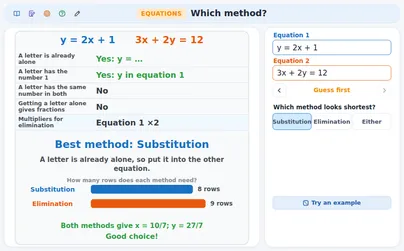 Which method?Look at two equations, spot the clues and choose the shortest method, substitution or elimination, with a reason.OpenPairs of equations in everyday lifeFive stories with your own numbers: two kinds of ticket, a mixture of nuts, ages, a boat on a river and a rectangle.OpenPair star! (quiz) QuizEndless practice with a score on the topic ‘Simultaneous equations: elimination and substitution, in context’.Open
These applications belong to the topic as a whole, not to one outcome.
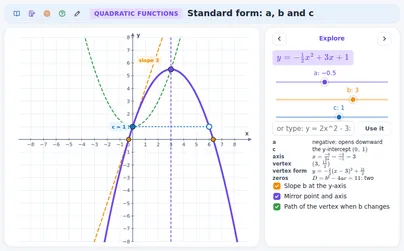 Standard form: what do a, b and c do?The parabola y = ax² + bx + c with sliders for a, b and c, the slope at the y-axis and the mirror point.Open
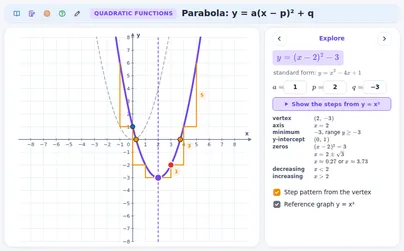 The parabola y = a(x − p)² + qThe parabola y = a(x − p)² + q, built from y = x² in steps, with its properties.Open
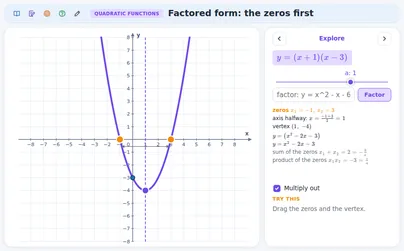 Factored form: the zeros firstDrag the two zeros and the vertex: the axis lies halfway, the formula multiplies out.Open
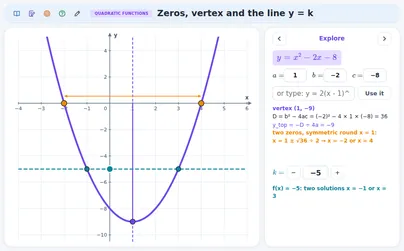 Zeros of a parabola: the graph viewThe zeros lie symmetric round the axis, the vertex is at height −D ÷ 4a, and the line y = k shows the solutions of f(x) = k.Open
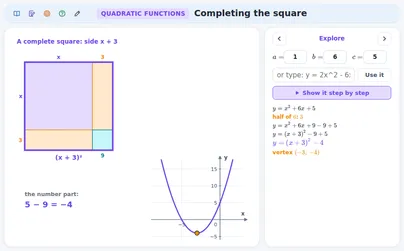 Completing the square with a picturex² + bx is a square and a strip; cut the strip in two halves and a corner (b ÷ 2)² is missing.Open
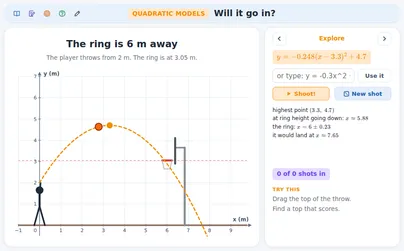 Will it go in? A basketball parabolaThe path of the ball is a parabola from the player's hands.Open
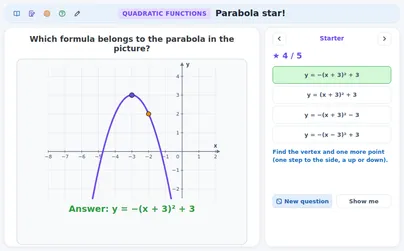 Parabola star! (quiz) QuizEndless practice with a score on the topic ‘Quadratic functions’.Open
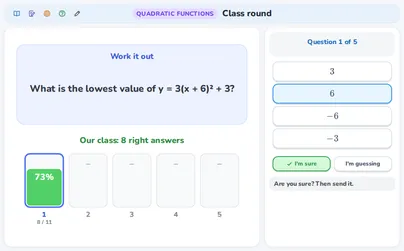 Class round: the whole class at once Class roundFive questions for the whole class at once: definitions, rules, true or myth, and sums.OpenStandard form: what do a, b and c do?The parabola y = ax² + bx + c with sliders for a, b and c, the slope at the y-axis and the mirror point.OpenThe parabola y = a(x − p)² + qThe parabola y = a(x − p)² + q, built from y = x² in steps, with its properties.Open
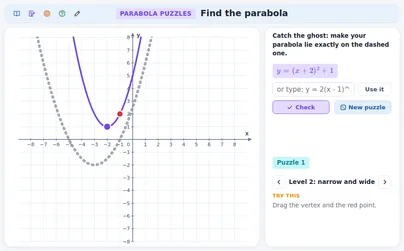 Parabola puzzles: ghosts and descriptionsA game: make your parabola lie on a dashed ghost, or build the parabola of a description (vertex and point, zeros and point, three points).OpenParabola star! (quiz) QuizEndless practice with a score on the topic ‘Quadratic functions’.OpenClass round: the whole class at once Class roundFive questions for the whole class at once: definitions, rules, true or myth, and sums.OpenFactored form: the zeros firstDrag the two zeros and the vertex: the axis lies halfway, the formula multiplies out.OpenWill it go in? A basketball parabolaThe path of the ball is a parabola from the player's hands.Open
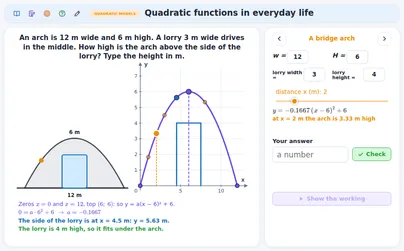 Quadratic functions in everyday lifeFive scenes with own numbers: a fence, a fence against a wall, a shop, a bridge arch with a lorry, a fountain.OpenParabola puzzles: ghosts and descriptionsA game: make your parabola lie on a dashed ghost, or build the parabola of a description (vertex and point, zeros and point, three points).OpenParabola star! (quiz) QuizEndless practice with a score on the topic ‘Quadratic functions’.OpenQuadratic functions in everyday lifeFive scenes with own numbers: a fence, a fence against a wall, a shop, a bridge arch with a lorry, a fountain.Open
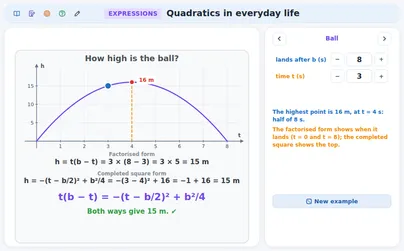 Quadratics in everyday lifeThree situations: a lawn that becomes longer and wider, a photo with a frame and a ball thrown up in the air.OpenParabola star! (quiz) QuizEndless practice with a score on the topic ‘Quadratic functions’.Open