Geometry
2.1aPolygons
1Pupils identify and classify polygons by the number of their sides and by whether they are regular, and name them from a description or a drawing.7
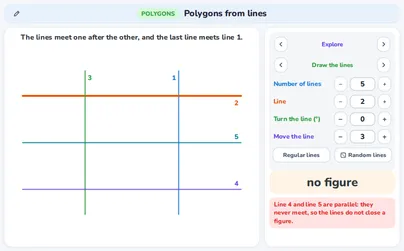 Polygons from linesPlace 3 to 8 lines by turning and moving them.Open
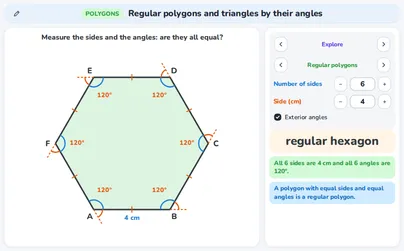 Regular polygons and triangles by their anglesExplore regular polygons, rectangles, rhombuses, diagonals and the angles of a triangle, and find what is true for all of them.Open
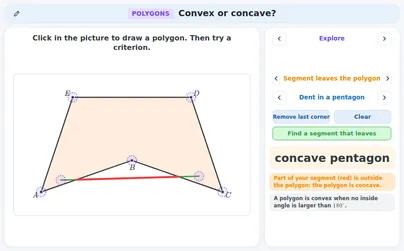 Convex or concave? Draw your own polygonDraw your own polygon by clicking, drag its corners and try three criteria.Open
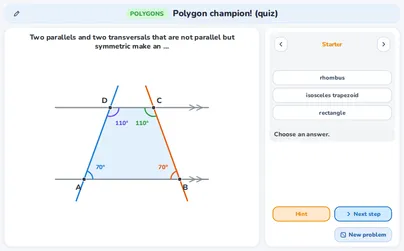 Polygon champion! (quiz) QuizEndless practice with a score on the topic ‘Lines, polygons and quadrilaterals: drawing, properties and angle problems’.Open
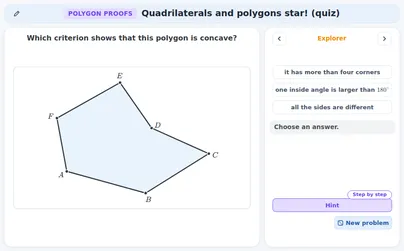 Quadrilaterals and polygons star! (quiz) QuizEndless practice with a score on the topic ‘Quadrilaterals and polygons: prove, classify and solve’.Open
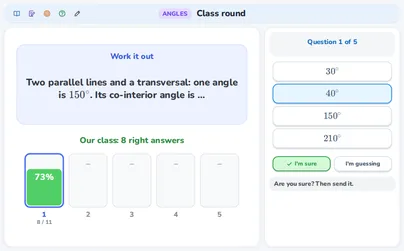
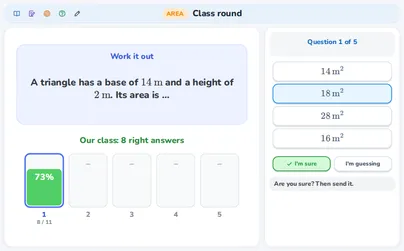
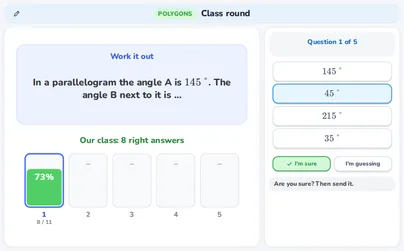 Class round: the whole class at once – Lines, polygons and quadrilaterals: drawing, properties and angle problems Class roundFive questions for the whole class at once: definitions, rules, true or myth, and sums.Open
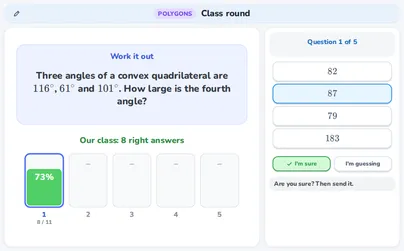 Class round: the whole class at once – Quadrilaterals and polygons: prove, classify and solve Class roundFive questions for the whole class at once: definitions, rules, true or myth, and sums.Open
2.1bTriangles
1Pupils classify triangles by their sides and by their angles, and explain why a triangle can have at most one right angle or one obtuse angle.4
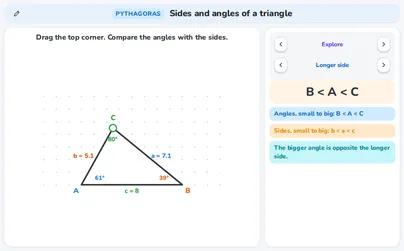 Sides and angles of a triangleBuild triangles from sticks and find out which sides are possible and which angle is the biggest.Open
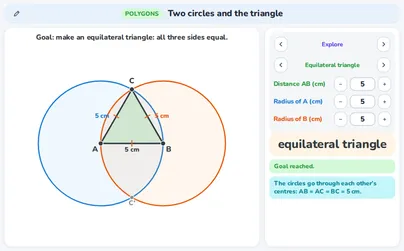 Two circles and the triangleChoose the distance between two centres and the two radii.Open
- Polygon champion! (quiz) QuizEndless practice with a score on the topic ‘Lines, polygons and quadrilaterals: drawing, properties and angle problems’.Open
- Class round: the whole class at once – Lines, polygons and quadrilaterals: drawing, properties and angle problems Class roundFive questions for the whole class at once: definitions, rules, true or myth, and sums.Open
2.1cTrapezoids
1Pupils identify trapeziums among quadrilaterals and say which property, a pair of parallel sides, makes a quadrilateral a trapezium and separates it from the other types.4
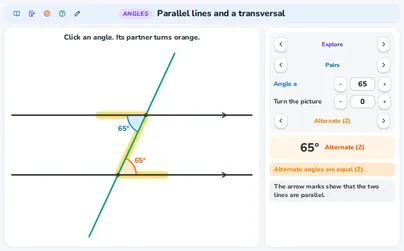
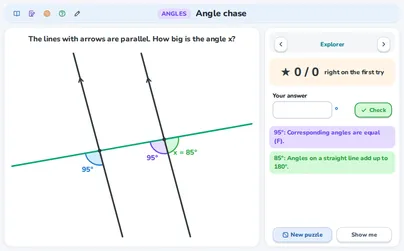
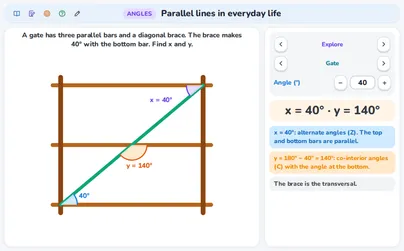
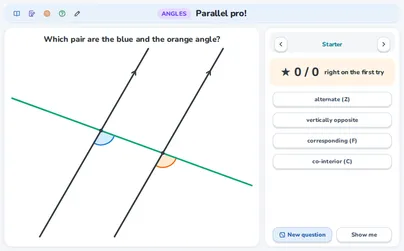
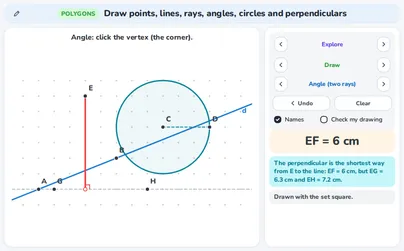
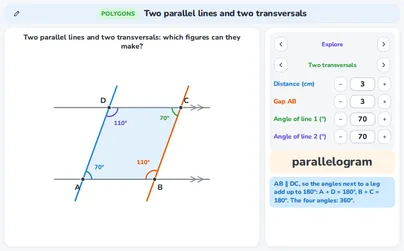 Two parallel lines and two transversalsChange the transversals between two parallel lines and see which figure they make, with all its angles.Open
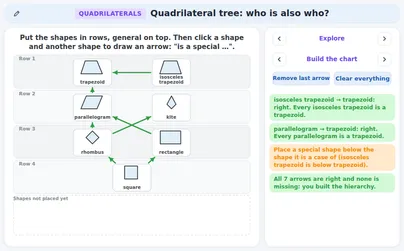 Quadrilateral tree: who is also who?Tick properties and see which of the seven shapes always have them all.Open
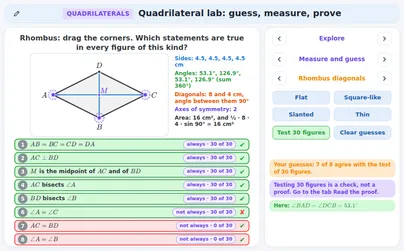 Quadrilateral lab: guess, measure and proveDrag your own quadrilateral of a family and read its measures.Open
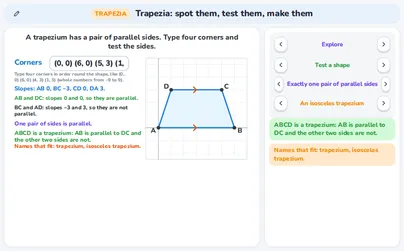 Trapezia: spot them, test them, make themLearn to spot, test and make trapezia: type four corners and the page tests the sides.Open
2.1dQuadrilaterals
1Pupils classify quadrilaterals by their sides, angles and diagonals, and decide which names fit a given figure.8
Lines, polygons and quadrilaterals: drawing, properties and angle problems4
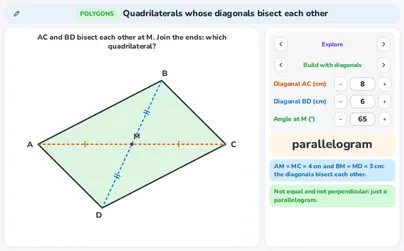 Quadrilaterals whose diagonals bisect each otherPlace two segments AC and BD so that they bisect each other at M.Open
- Trapezia: spot them, test them, make themLearn to spot, test and make trapezia: type four corners and the page tests the sides.Open
- Two parallel lines and two transversalsChange the transversals between two parallel lines and see which figure they make, with all its angles.Open
- Polygon champion! (quiz) QuizEndless practice with a score on the topic ‘Lines, polygons and quadrilaterals: drawing, properties and angle problems’.Open
Quadrilaterals and polygons: prove, classify and solve4
- Quadrilateral lab: guess, measure and proveDrag your own quadrilateral of a family and read its measures.Open
- Quadrilateral tree: who is also who?Tick properties and see which of the seven shapes always have them all.Open
- Quadrilaterals and polygons star! (quiz) QuizEndless practice with a score on the topic ‘Quadrilaterals and polygons: prove, classify and solve’.Open
- Class round: the whole class at once – Quadrilaterals and polygons: prove, classify and solve Class roundFive questions for the whole class at once: definitions, rules, true or myth, and sums.Open
2Pupils explain how the types of quadrilateral are related, for example that every square is also a rectangle and a rhombus, and use this to settle which statements are true.7
- Quadrilaterals whose diagonals bisect each otherPlace two segments AC and BD so that they bisect each other at M.Open
- Two parallel lines and two transversalsChange the transversals between two parallel lines and see which figure they make, with all its angles.Open
- Quadrilateral tree: who is also who?Tick properties and see which of the seven shapes always have them all.Open
- Quadrilateral lab: guess, measure and proveDrag your own quadrilateral of a family and read its measures.Open
- Polygon champion! (quiz) QuizEndless practice with a score on the topic ‘Lines, polygons and quadrilaterals: drawing, properties and angle problems’.Open
- Quadrilaterals and polygons star! (quiz) QuizEndless practice with a score on the topic ‘Quadrilaterals and polygons: prove, classify and solve’.Open
- Class round: the whole class at once – Quadrilaterals and polygons: prove, classify and solve Class roundFive questions for the whole class at once: definitions, rules, true or myth, and sums.Open
Applications that cover the topic in general10
These applications belong to the topic as a whole, not to one outcome.
Measuring and drawing angles7
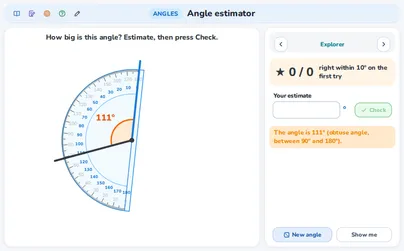 Angle estimator (puzzles)Estimate puzzles.Open
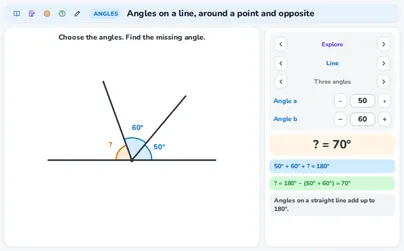 Angles on a line, around a point and oppositeFind missing angles.Open
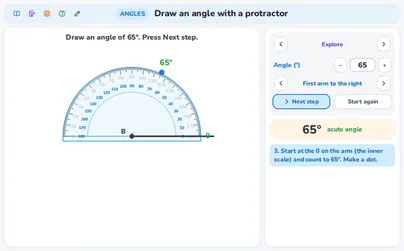 Draw an angle with a protractorDraw angles with a protractor.Open
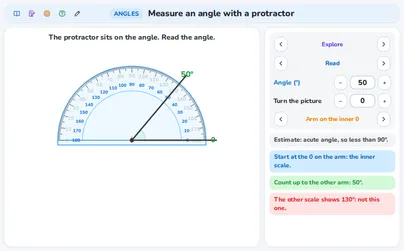 Measure an angle with a protractorLearn to read a protractor.Open
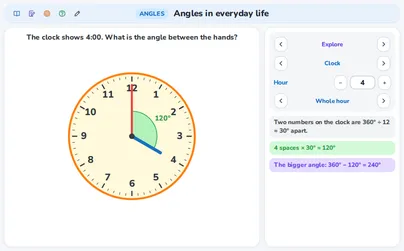 Angles in everyday lifeUse angles in real life.Open
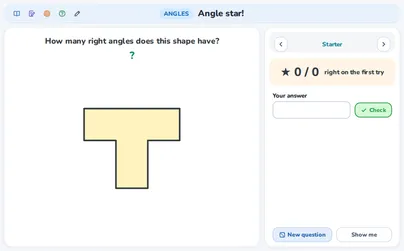 Angle star! (quiz) QuizEndless practice with a score on the topic ‘Measuring and drawing angles’.Open
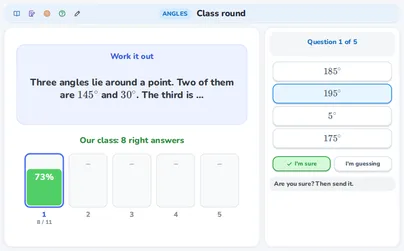 Class round: the whole class at once – Measuring and drawing angles Class roundFive questions for the whole class at once: definitions, rules, true or myth, and sums.Open
Quadrilaterals and polygons: prove, classify and solve3
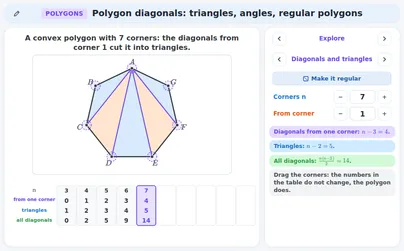 Polygon diagonals: triangles, angles, regular polygonsDrag the corners of your own convex polygon and watch the table of diagonals and triangles grow with the number of corners.Open
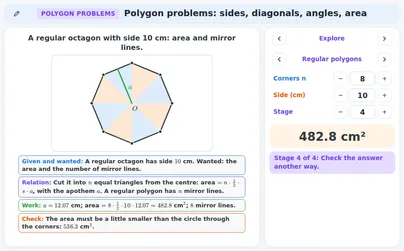 Polygon problems: sides, diagonals, angles, areaFour workbenches with your own numbers: sides and diagonals, angles, regular polygons and quadrilaterals.Open
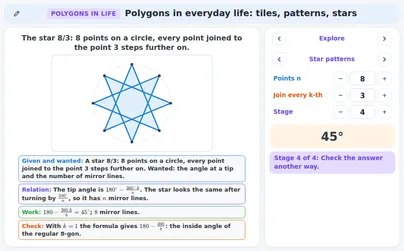 Polygons in everyday life: tiles, patterns, starsThree workbenches: floor tiles with your own measures, regular polygons around a point (do they fit, leave a gap or overlap?) and star patterns.Open