Interactive Lessons

Statistics and probability

Strand 4
19topics29content lines with applications51applications for AI HL

Topics in this strand

← Back to the overview
SL4.1Know sampling and data vocabulary: population, sample, random, discrete, continuousFully covered

Official programme: p. 57

← Back to the overview
SL4.2Present data in frequency tables, discrete or continuousSupport only
  1. 2Histograms

    No application yet for AI HL. You teach this content line in class.

  2. 3Use cumulative frequency graphs for median, quartiles, percentiles, range and IQR

    No application yet for AI HL. You teach this content line in class.

  3. 4Make and read box-and-whisker diagrams

    No application yet for AI HL. You teach this content line in class.

No application for AI HL teaches the topic directly; supporting applications exist.

Official programme: p. 58

← Back to the overview
SL4.3Use mean, median and modePartly covered
  1. 2Estimate the mean from grouped data

    No application yet for AI HL. You teach this content line in class.

  2. 3Modal class

    No application yet for AI HL. You teach this content line in class.

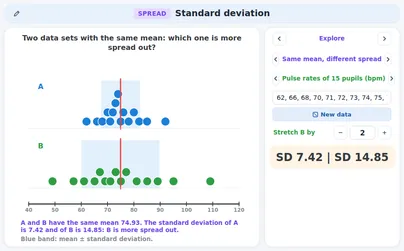
  3. 4Use IQR, standard deviation and variance as measures of spread2
  4. 5Know how adding or scaling every value changes the statistics

    No application yet for AI HL. You teach this content line in class.

  5. 6Quartiles of discrete data1

For the sub-bullets without an application for AI HL you complete the work in class.

Official programme: p. 58

← Back to the overview
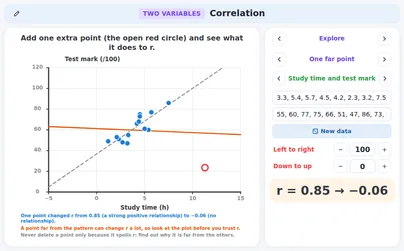
SL4.4Linear correlation of bivariate dataFully covered

Official programme: p. 59

← Back to the overview
SL4.5Know probability vocabulary: trial, outcome, equally likely, relative frequency, sample space, eventNo application yet for AI HL
  1. 2Define P(A) = n(A)/n(U)

    No application yet for AI HL. You teach this content line in class.

  2. 3Use complementary events A and A'

    No application yet for AI HL. You teach this content line in class.

  3. 4Expected number of occurrences

    No application yet for AI HL. You teach this content line in class.

No application yet for AI HL. This topic is taught in class.

Official programme: p. 60

← Back to the overview
SL4.6Use Venn, tree, sample space diagrams and tables for probabilitiesNo application yet for AI HL
  1. 2Use the addition rule for combined events: P(A or B)

    No application yet for AI HL. You teach this content line in class.

  2. 3Use mutually exclusive events: P(A and B) = 0

    No application yet for AI HL. You teach this content line in class.

  3. 4Use conditional probability P(A|B) = P(A and B)/P(B)

    No application yet for AI HL. You teach this content line in class.

  4. 5Use independent events: P(A and B) = P(A)P(B)

    No application yet for AI HL. You teach this content line in class.

No application yet for AI HL. This topic is taught in class.

Official programme: p. 60

← Back to the overview
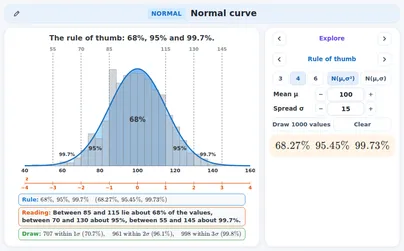
SL4.9The normal distribution and curveFully covered

Official programme: p. 62

← Back to the overview
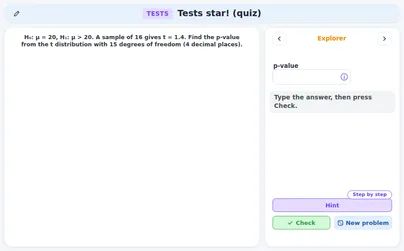
SL4.11State null and alternative hypotheses and significance levelsPartly covered

For the sub-bullets without an application for AI HL you complete the work in class.

Official programme: p. 63

← Back to the overview
AHL4.12HLDesign valid data collection such as surveys and questionnairesNo application yet for AI HL
  1. 2Select relevant variables from many

    No application yet for AI HL. You teach this content line in class.

  2. 3Choose relevant and appropriate data to analyse

    No application yet for AI HL. You teach this content line in class.

  3. 4Group numerical data into a chi-squared table and justify the grouping

    No application yet for AI HL. You teach this content line in class.

  4. 5Choose degrees of freedom when parameters are estimated from data

    No application yet for AI HL. You teach this content line in class.

  5. 6Definition of reliability and validity

    No application yet for AI HL. You teach this content line in class.

  6. 7Reliability tests

    No application yet for AI HL. You teach this content line in class.

  7. 8Validity tests

    No application yet for AI HL. You teach this content line in class.

No application yet for AI HL. This topic is taught in class.

Official programme: p. 64

← Back to the overview
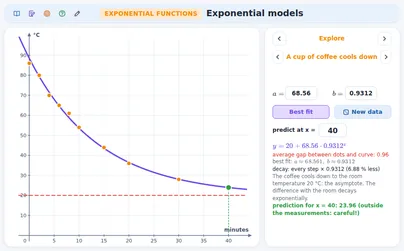
AHL4.13HLRegression with non-linear functionsSupport only
  1. 2Fit least-squares regression curves with technology

    No application yet for AI HL. You teach this content line in class.

  2. 3Use the sum of squared residuals as a measure of fit

    No application yet for AI HL. You teach this content line in class.

  3. 4Use the coefficient of determination R^2

    No application yet for AI HL. You teach this content line in class.

  4. 5Evaluate R^2 with technology

    No application yet for AI HL. You teach this content line in class.

Applications that cover the topic in general1

These applications belong to the topic as a whole, not to one content line.
No application for AI HL teaches the topic directly; supporting applications exist.

Official programme: p. 65

← Back to the overview
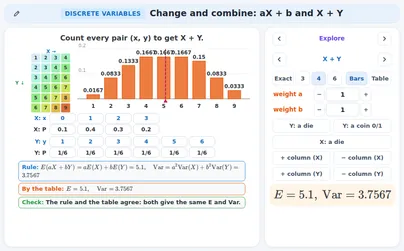
AHL4.14HLApply a linear transformation to one random variableFully covered

Official programme: p. 66

← Back to the overview
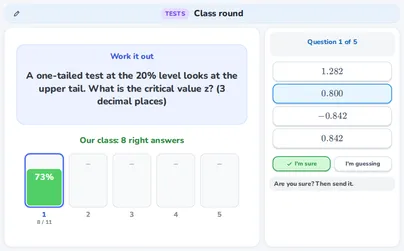
AHL4.18HLCritical values and critical regionsPartly covered

For the sub-bullets without an application for AI HL you complete the work in class.

Official programme: p. 68

← Back to the overview
AHL4.19HLTransition matricesNo application yet for AI HL
  1. 2Powers of transition matrices

    No application yet for AI HL. You teach this content line in class.

  2. 3Regular Markov chains

    No application yet for AI HL. You teach this content line in class.

  3. 4Initial state probability matrices

    No application yet for AI HL. You teach this content line in class.

  4. 5Find steady-state and long-term probabilities for Markov chains

    No application yet for AI HL. You teach this content line in class.

No application yet for AI HL. This topic is taught in class.

Official programme: p. 68