HL only, and outside the topics
These applications are tagged for the Diploma Programme. The first group serves only HL (AHL) topics, the second group fits no topic of the list. You can still use them.
HL only 54 applications
These applications work on topics that are in the HL list only (AHL), so they are not part of the SL topics. Use them to go beyond the SL list.
Absolute value and piecewise4
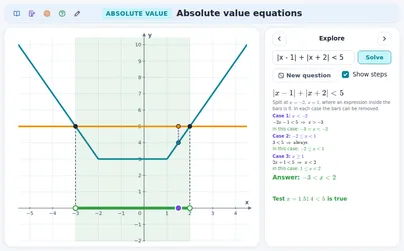 Absolute value equations and inequalitiesAbsolute value equations and inequalities.Open
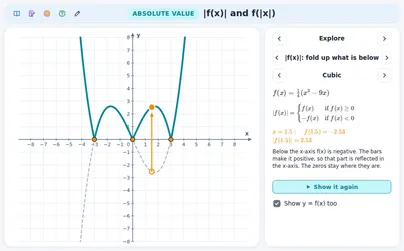 |f(x)| and f(|x|)|f(x)| and f(|x|).Open
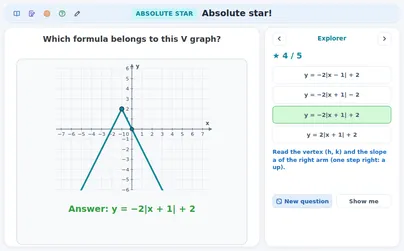 Absolute star! (quiz) QuizEndless practice with a score on the topic ‘Absolute value and piecewise’.Open
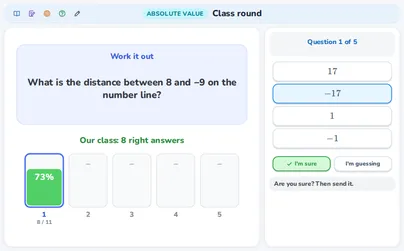 Class round: the whole class at once Class roundFive questions for the whole class at once: definitions, rules, true or myth, and sums.Open
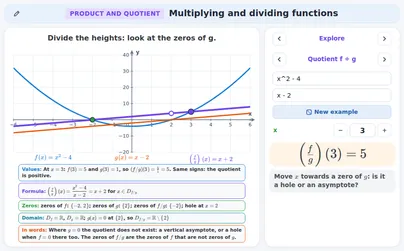
Composite and inverse functions1
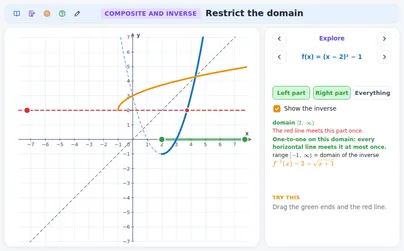
Polynomial functions7
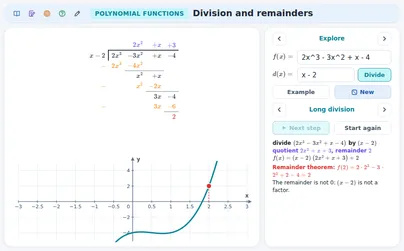 Division, remainder and factor theoremDivision and remainders: three ways to divide f(x) by a divisor, and the remainder theorem f(x) = d(x)·q(x) + r.Open
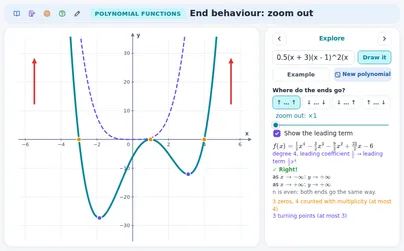 End behaviour: zoom outEnd behaviour: far away only the leading term counts.Open
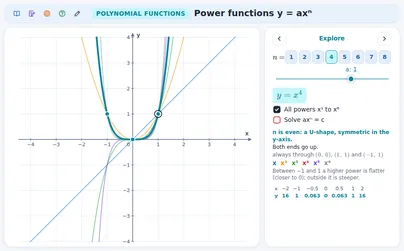 Power functions y = axⁿPower functions y = axⁿ: even n gives a U-shape, odd n an S-shape; all go through (0, 0) and (1, a).Open
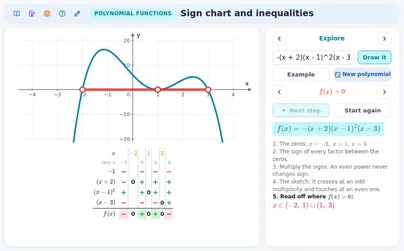 Sign chart and polynomial inequalitiesSign chart and inequalities: the zeros cut the number line into intervals, and in every interval f has one sign.Open
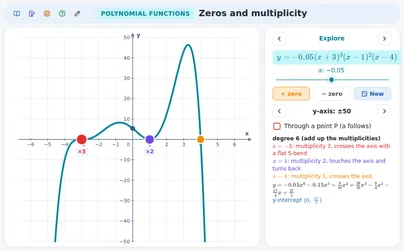 Zeros and multiplicity: beads on the axisZeros and multiplicity: every zero is a bead on the x-axis; its multiplicity m decides what the graph does there (odd: crosses, even: touches and turns back, 3: flat S-bend).Open
 Polynomial star! (quiz) QuizEndless practice with a score on the topic ‘Polynomial functions’.Open
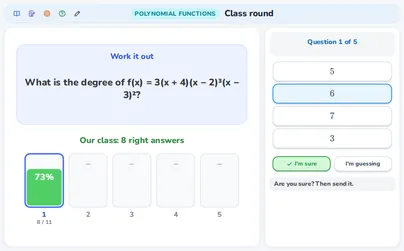 Class round: the whole class at once Class roundFive questions for the whole class at once: definitions, rules, true or myth, and sums.Open
Counting: combinations, Pascal's triangle and routes1
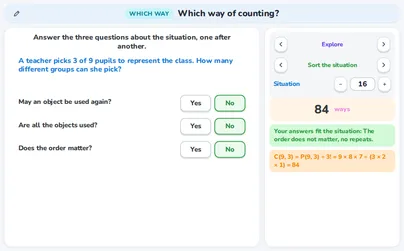
Discrete random variables2
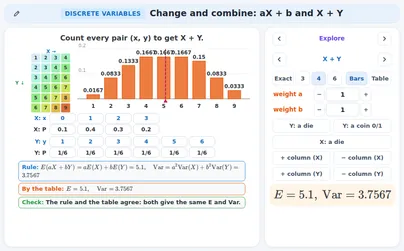 Change and combine: aX + b and X + YFour tabs for new variables made from old ones: aX + b, the sum X + Y, n copies and a joint table with covariance.Open
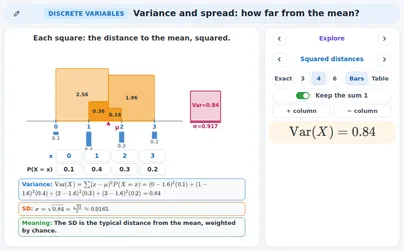 Variance and spread: how far from the mean?Three tabs for one idea, how far the values lie from the mean: the squared distances drawn as squares, the two routes to the variance, and two tables side by side.Open
Reciprocal and inverse functions4
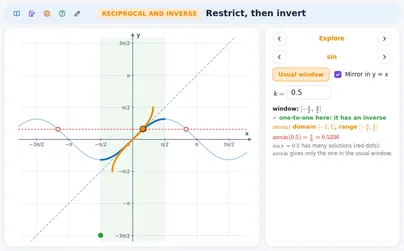 Restrict, then invert: arcsin, arccos, arctanDrag a window of length π along the graph of sin, cos or tan.Open
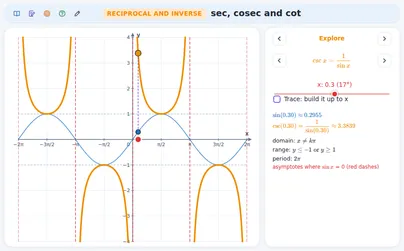 sec, cosec and cot: graphs from 1/cos, 1/sin, 1/tanThe graph of sec x, cosec x or cot x is made from the graph of cos, sin or tan: where the base is 0 there is an asymptote, and a small base value gives a big reciprocal.Open
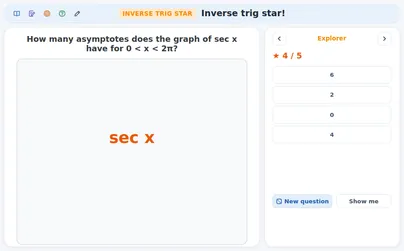 Inverse trig star! (quiz) QuizEndless practice with a score on the topic ‘Reciprocal and inverse functions’.Open
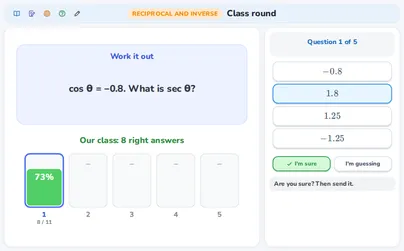 Class round: the whole class at once Class roundFive questions for the whole class at once: definitions, rules, true or myth, and sums.Open
Lines with vectors7
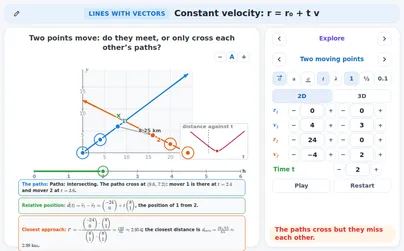 Constant velocity: r = r₀ + t vA moving point is a line with t as the time.Open
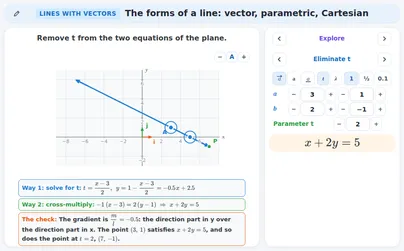 Forms of a line: vector, parametric, CartesianThree ways to write one line: the vector equation, the parametric equations and the Cartesian form.Open
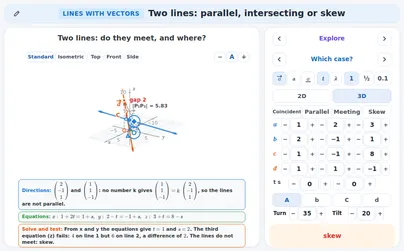 Two lines: parallel, intersecting or skewTwo lines, four cases.Open
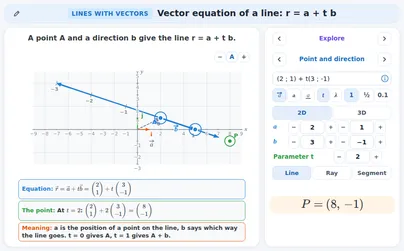 Vector equation of a line: r = a + t bA point A and a direction b give the line r = a + t b.Open
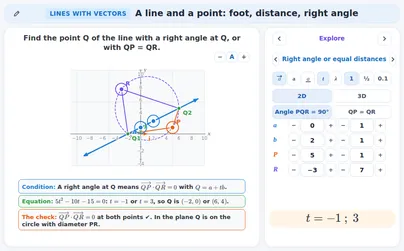
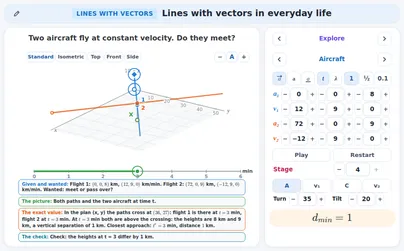 Lines with vectors in everyday lifeFour stories with lines in space: two aircraft, two ships, a laser ray in a hall and a pipe with a cable.Open
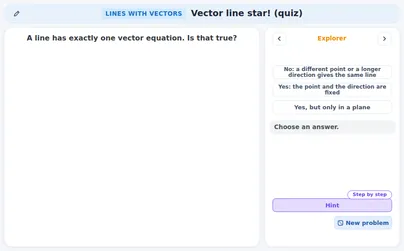 Vector line star! (quiz) QuizEndless practice with a score on the topic ‘Lines with vectors’.Open
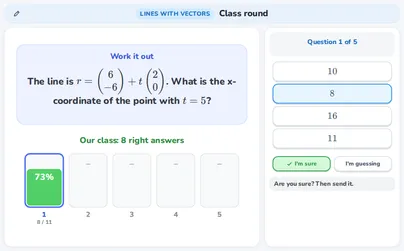 Class round: the whole class at once Class roundFive questions for the whole class at once: definitions, rules, true or myth, and sums.Open
Position vectors and geometry6
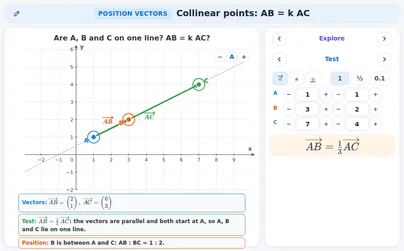 Collinear points: AB = k ACThree tabs: test three points of your own, find the value that makes them collinear, and test three points of a diagram by the coefficients of a and b.Open
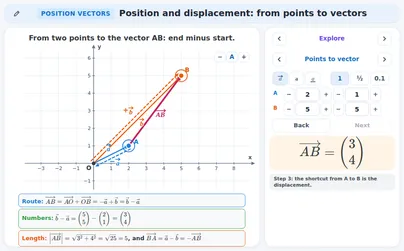 Position and displacement: from points to vectorsTwo points A and B and the origin O: see a = OA, b = OB and AB = b − a built step by step, then a moving point P = a + t v, and then the fourth vertex of a parallelogram.Open
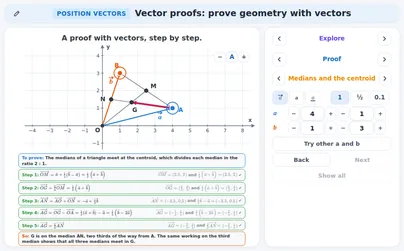 Vector proofs: prove geometry with vectorsSix theorems with your own vectors.Open
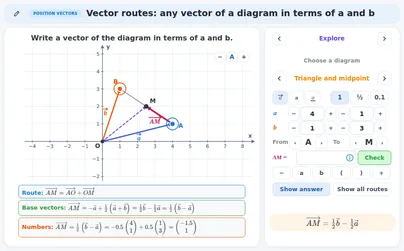 Vector routes: any vector of a diagram in terms of a and bSeven diagrams drawn from your own a and b.Open
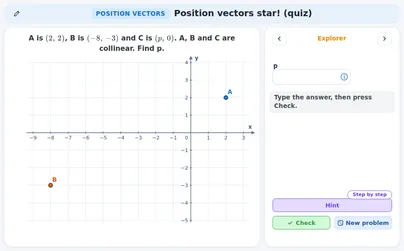 Position vectors star! (quiz) QuizEndless practice with a score on the topic ‘Position vectors and geometry’.Open
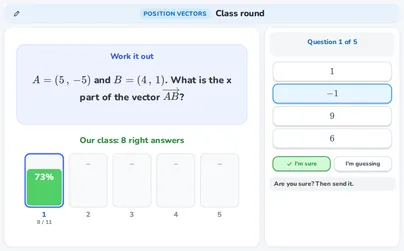 Class round: the whole class at once Class roundFive questions for the whole class at once: definitions, rules, true or myth, and sums.Open
Scalar product and 3D vectors6
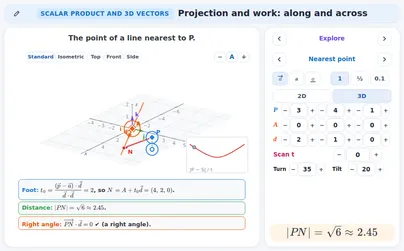
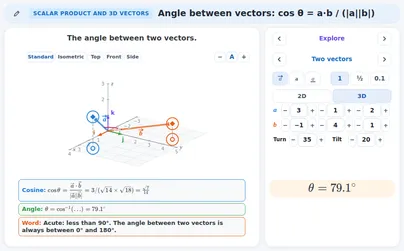 Angle between vectors: cos θ = a·b / (|a||b|)Four tabs: the angle between two vectors, perpendicular and parallel with an unknown k, the three angles of a triangle (with the trap shown) and the angle between two lines.Open
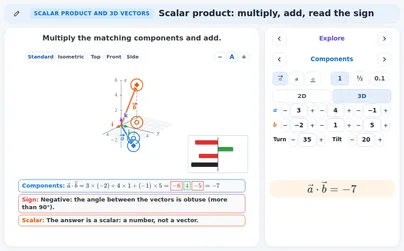 Scalar product: multiply, add, read the signFour views of one number: the matching components multiplied and added, the sizes and the angle, the rules of calculation, and the rectangle with its sign.Open
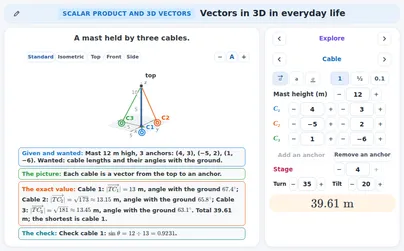
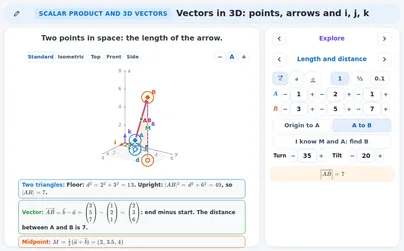 Vectors in 3D: points, arrows and i, j, kPut a point or an arrow in space and read how far along i, along j and up: the column, the length, the distance between two points and the midpoint, and the sum, the difference and multiples of vectors, all with your own numbers.Open
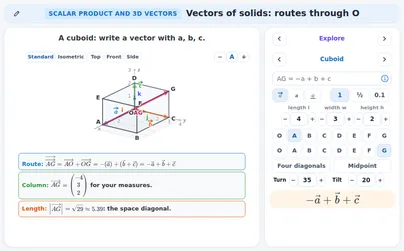 Vectors of solids: routes through OMake a solid with your own measures and write the vector between any two corners with the three edge vectors a, b and c.Open
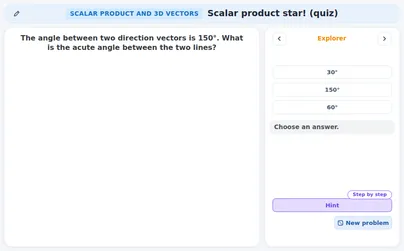 Scalar product star! (quiz) QuizEndless practice with a score on the topic ‘Scalar product and 3D vectors’.Open
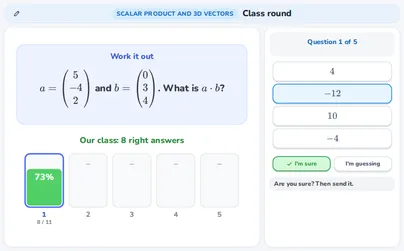 Class round: the whole class at once Class roundFive questions for the whole class at once: definitions, rules, true or myth, and sums.Open
Vectors in 2D6
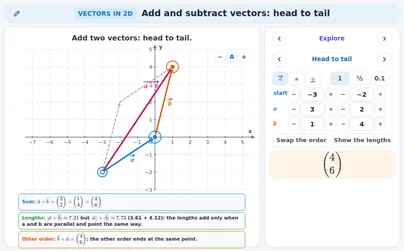 Add and subtract vectors: head to tailFour pictures of the same arithmetic: head to tail, the parallelogram, subtracting and a chain of vectors.Open
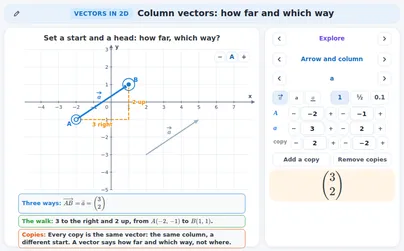 Column vectors: how far and which waySet a start and a head and read how far and which way: the arrow, its two legs and its column.Open
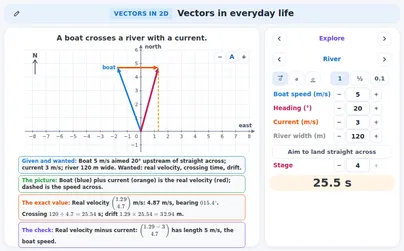
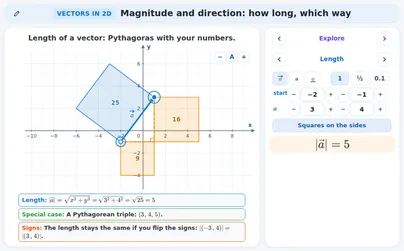 Magnitude and direction: how long, which wayFour tabs: the length of an arrow by Pythagoras, its direction as an angle or a bearing, the column from size and direction, and the sum of two vectors given by size and direction by two routes that must agree.Open
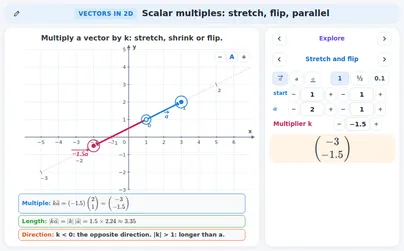 Scalar multiples: stretch, flip, parallelStretch, shrink and flip a vector with the number k, test for parallel vectors, steer s a + t b to a target and scale a vector to length 1.Open
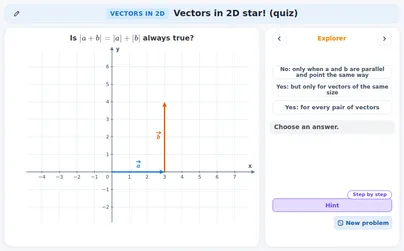 Vectors in 2D star! (quiz) QuizEndless practice with a score on the topic ‘Vectors in 2D’.Open
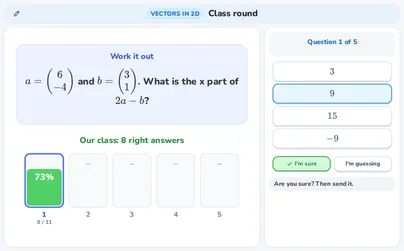 Class round: the whole class at once Class roundFive questions for the whole class at once: definitions, rules, true or myth, and sums.Open
Outside the topics 115 applications
These applications are tagged for AA SL, but not matched with any topic of the AA SL list (they may match a topic of the other level). You can still use them. They are grouped by group and subgroup.
Area under a curve5
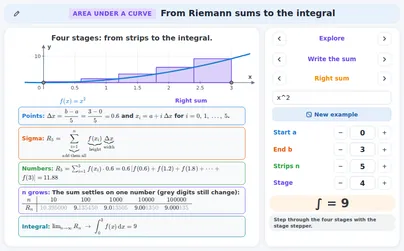 From Riemann sums to the integralFour stages take a Riemann sum from strips to the integral: the points, the sum in sigma notation, the sum with your own numbers and the limit written as an integral.Open
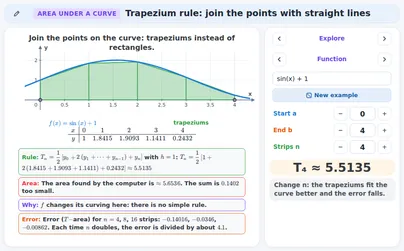 Trapezium rule: join the points with straight linesType a function and see the trapezia, the table of ordinates and the rule written with your numbers, with the exact area and the error.Open
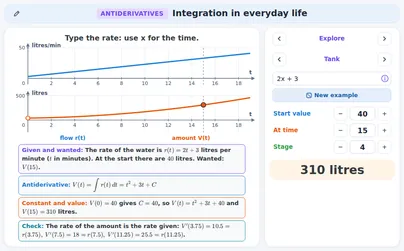
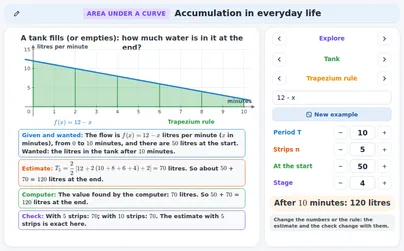 Accumulation in everyday lifeFive workbenches with a rate you type and your own numbers: a tank, electricity with a price, a journey, speed readings from a table and the visitors of a shop.Open
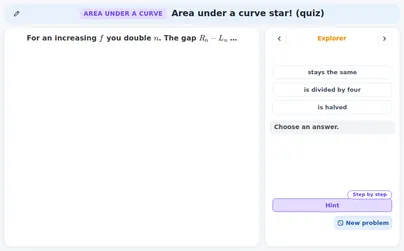 Area under a curve star! (quiz) QuizEndless practice with a score on the topic ‘Area under a curve’.Open
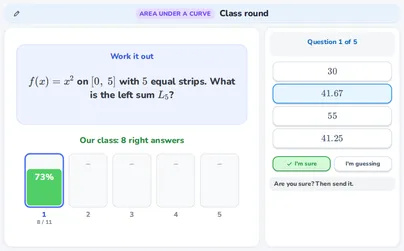 Class round: the whole class at once Class roundFive questions for the whole class at once: definitions, rules, true or myth, and sums.Open
Derivative toolkit and increment diagrams2
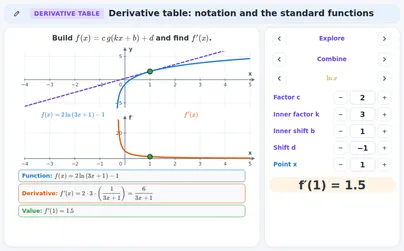 Derivative table: notation and the standard functionsThe derivative of the seven standard functions: notation, rule, graph and a check by a very small step.Open
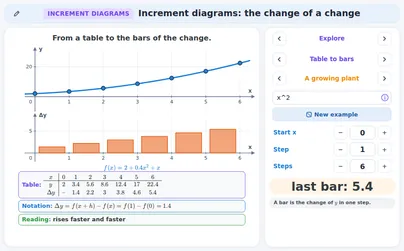 Increment diagrams: the change of a changeDraw the graph of y with a bar for the change in every step, for real situations and your own formula, and read how y changes.Open
Limits and continuity2
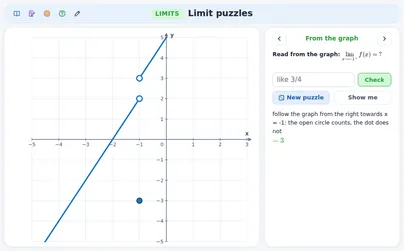
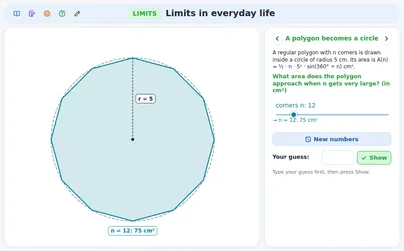
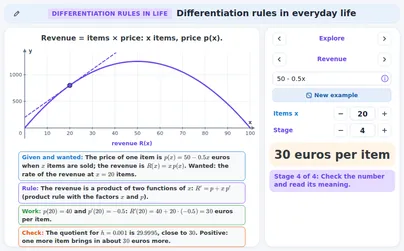
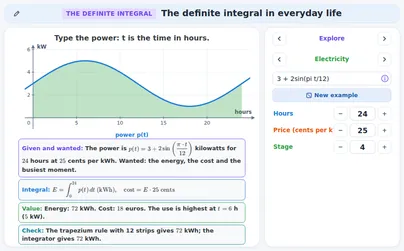
Special equations and inequalities, parameters and moving points6
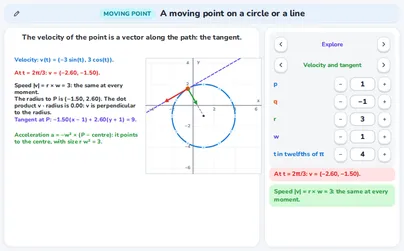 A moving point on a circle or a lineA point moving on a circle or a line given by x(t) and y(t): its position, the equation of the path, the velocity vector and the tangent line, and where a line path meets a circle.Open
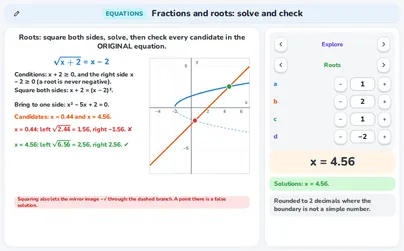 Fractions, roots and the checkLearn to solve equations with a fraction or a root and to check every candidate, in 3 forms with steppers and in your own equation.Open
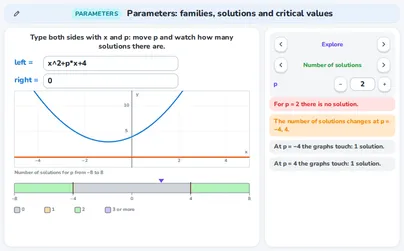 Parameters: families, solutions and critical valuesLearn to work with a parameter: a family of graphs, the number of solutions and the critical values, and the solution written as a formula in p.Open
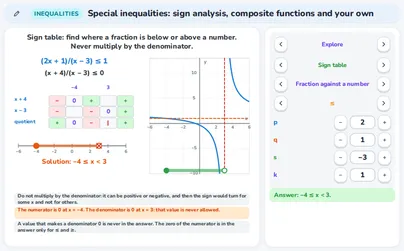 Special inequalities: sign analysis, composite functions and your ownLearn to solve inequalities with a fraction, with a composite function and of your own with a sign table and a number line.Open
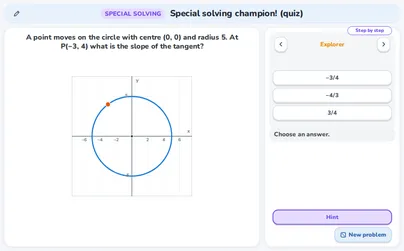 Special solving champion! (quiz) QuizEndless practice with a score on the topic ‘Special equations and inequalities, parameters and moving points’.Open
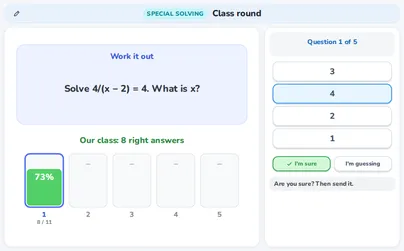 Class round: the whole class at once Class roundFive questions for the whole class at once: definitions, rules, true or myth, and sums.Open
Absolute value and piecewise5
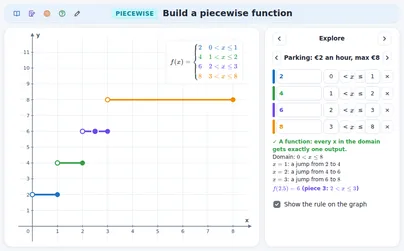 Build a piecewise functionPiecewise functions: build your own.Open
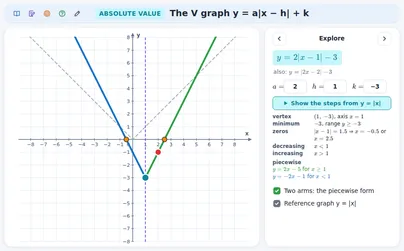 The V graph y = a|x − h| + kThe V graph y = a|x − h| + k starts from the reference graph y = |x|: multiply by a (steeper, flatter or upside down), move h to the right and k up.Open
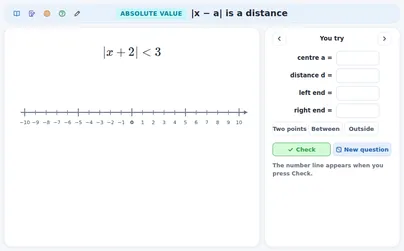 |x − a| is a distance|x − a| is a distance.Open
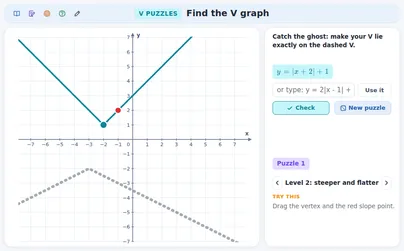 V puzzles: ghosts and descriptionsV puzzles: a game with two kinds of puzzle.Open
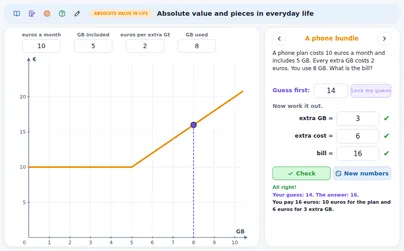 Absolute value and pieces in everyday lifeAbsolute value and pieces in everyday life: four situations with your own numbers: a tolerance (a bolt may be at most t mm off), a phone bundle (a price including some GB, then a price per extra GB), parking (a price per started hour with a maximum a day) and income tax in three brackets.Open
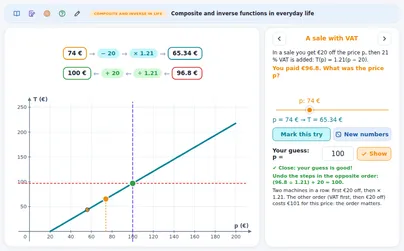
Exponential functions7
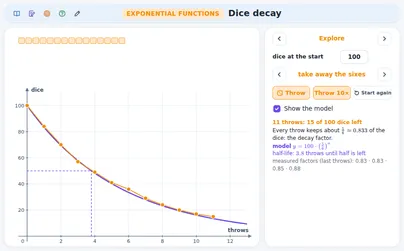 Dice decay: a real experimentA real experiment: throw N dice, take away the dice that show a six (or two or three faces) and throw the rest again.Open
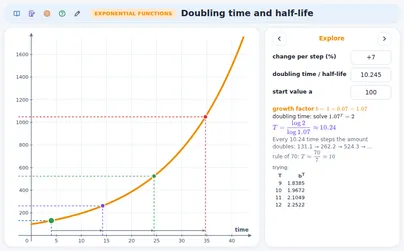 Doubling time and half-lifeDoubling time and half-life: type a percentage or the doubling time itself.Open
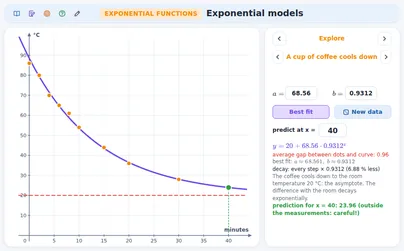 Exponential models: fit the dataExponential models: measurements of bacteria, a medicine in the blood or a cooling cup of coffee (or your own data).Open
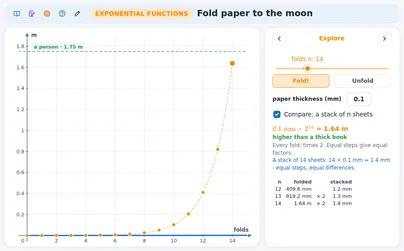 Fold paper to the moonFold a sheet of paper again and again: every fold doubles the thickness.Open
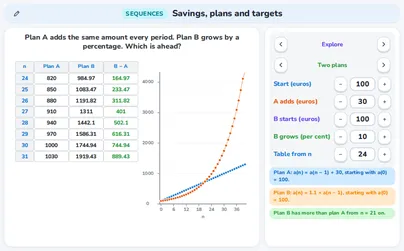
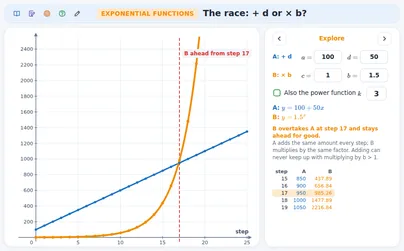 The race: linear against exponentialThe race: plan A adds d every step, plan B multiplies by b every step.Open
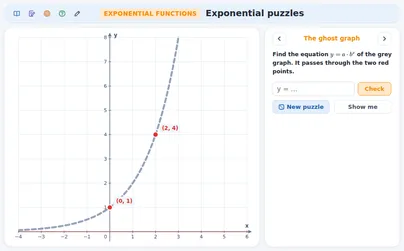 Exponential puzzlesExponential puzzles: a game with four puzzle types.Open
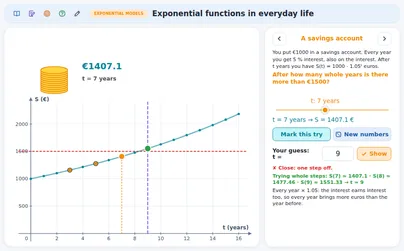 Exponential functions in everyday lifeExponential functions in everyday life: a savings account, a phone that loses value, a medicine in the blood and followers online.Open
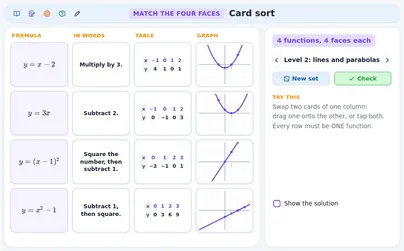
Linear functions4
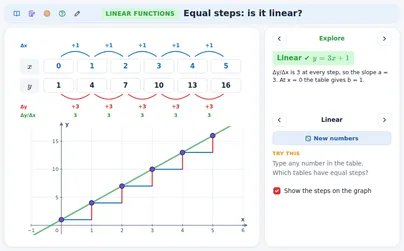 Equal steps: is the table linear?Equal steps: type a table and the application shows the steps Δx, Δy and Δy/Δx, and a staircase on the graph.Open
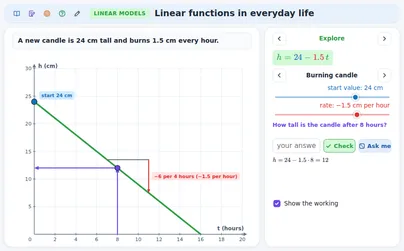 Linear functions in everyday lifeLinear models: a real situation as y = start value + rate × x.Open
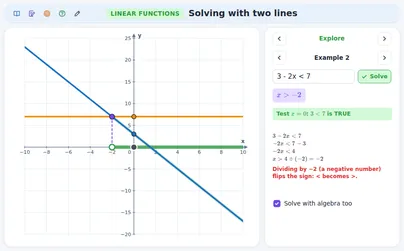 Solving equations and inequalities with linesSolving with two lines: type an equation or inequality (2x + 1 < x + 3).Open
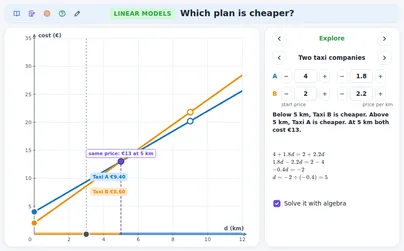 Which plan is cheaper?Which plan is cheaper?Open
Logarithms4
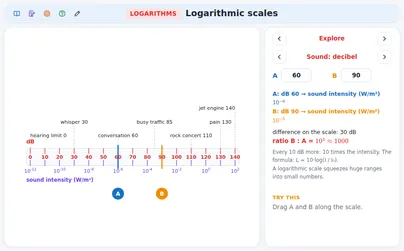 Logarithmic scales: pH, decibel, RichterOn a logarithmic scale the top line goes in equal steps and the real quantity underneath goes in powers of ten.Open
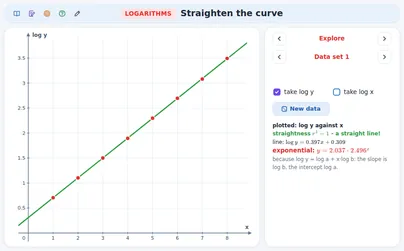 Straighten the curve with logarithmsMeasurements lie on a curve.Open
 Logarithm puzzlesLogarithm puzzles: a game with four puzzle types.Open
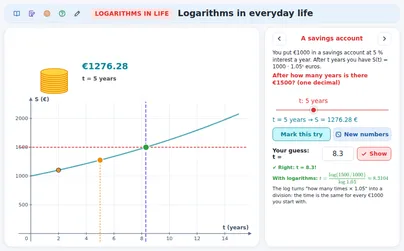 Logarithms in everyday lifeFour everyday situations where the question goes backwards: when is the money at the target, when is less than a target of medicine left, how many people make the noise, how many times must you dilute.Open
Polynomial functions2
Quadratic functions4
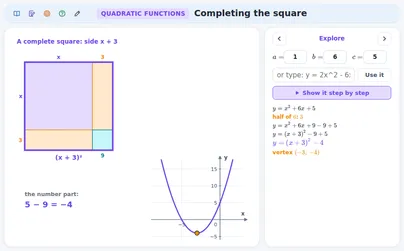 Completing the square with a picturex² + bx is a square and a strip; cut the strip in two halves and a corner (b ÷ 2)² is missing.Open
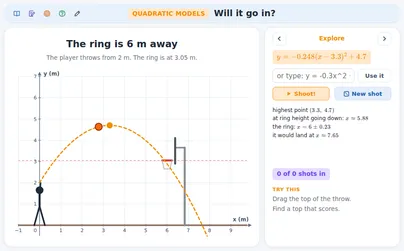 Will it go in? A basketball parabolaThe path of the ball is a parabola from the player's hands.Open
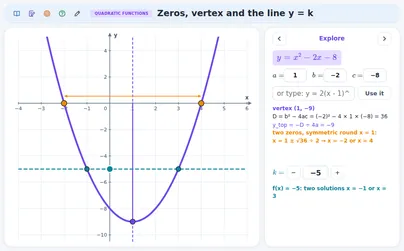 Zeros of a parabola: the graph viewThe zeros lie symmetric round the axis, the vertex is at height −D ÷ 4a, and the line y = k shows the solutions of f(x) = k.Open
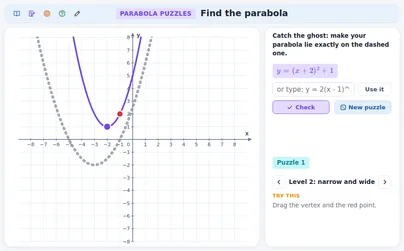 Parabola puzzles: ghosts and descriptionsA game: make your parabola lie on a dashed ghost, or build the parabola of a description (vertex and point, zeros and point, three points).Open
Square root and rational functions3
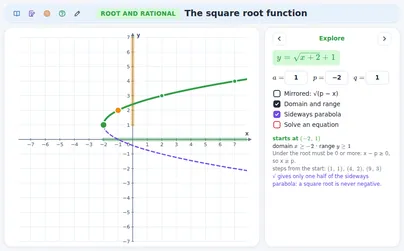 The square root function y = a√(x − p) + qThe square root function y = a√(x − p) + q: the graph starts at (p, q) and a square root is never negative.Open
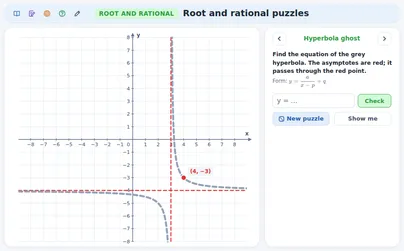 Root and rational puzzlesRoot and rational puzzles: a game with four puzzle types.Open
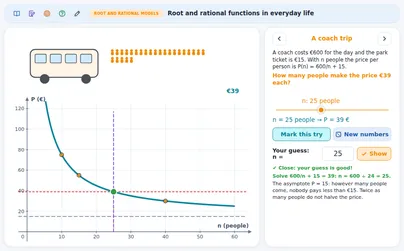 Root and rational functions in everyday lifeFour everyday scenes with a root or a fraction in the model (a shared coach trip, juice, a pendulum, the horizon) and what an asymptote means.Open
Transforming graphs3
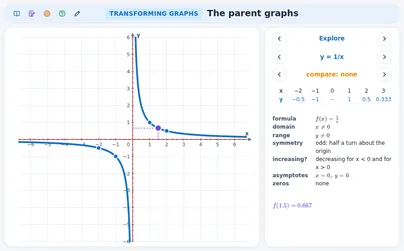 The parent graphsThe parent graphs y = x, x², x³, √x, 1/x, |x| and 2ˣ: the starting point of every transformation.Open
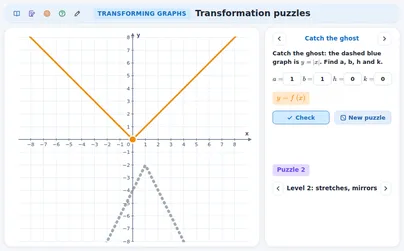 Transformation puzzlesTransformation puzzles: a game with three levels (moves; stretches and mirrors; everything).Open
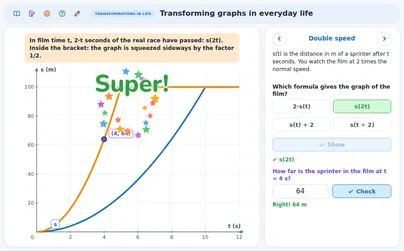 Transforming graphs in everyday lifeMove, stretch and mirror a graph in six everyday situations (a later bus, a booking fee, a film at double speed, a sale) and read values of the new graph.Open
Networks: parts, routes and weights3
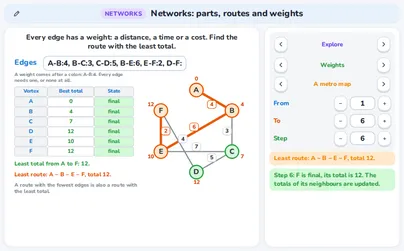 Networks: parts, routes and weightsLearn to read and use networks: vertices and edges, degrees and parts, routes and their weights, in your own network or in one of 4 situations.Open
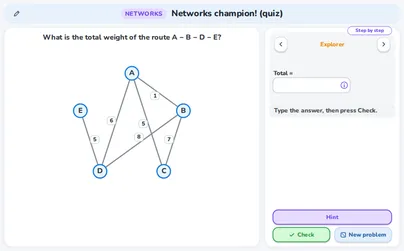 Networks champion! (quiz) QuizEndless practice with a score on the topic ‘Networks: parts, routes and weights’.Open
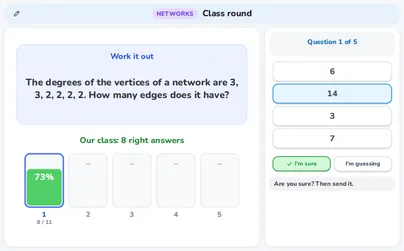 Class round: the whole class at once Class roundFive questions for the whole class at once: definitions, rules, true or myth, and sums.Open
Surds and standard form4
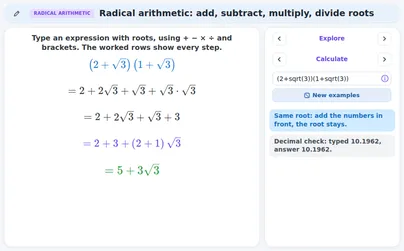 Radical arithmetic: add, subtract, multiply and divide rootsType any expression with roots and watch the working: roots simplified, brackets multiplied out, like roots collected.Open
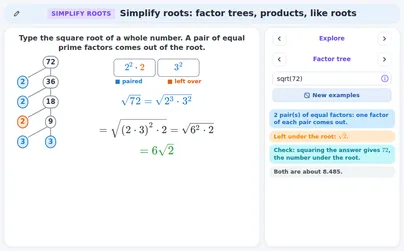 Simplify roots: factor trees, products and like rootsType a root and see its factor tree: the pairs of equal primes come out of the root, the primes left over stay inside.Open
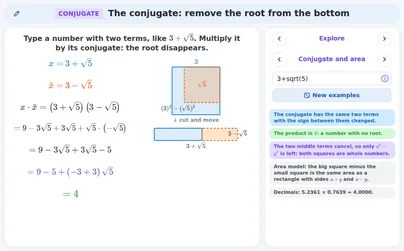 The conjugate: remove the root from the bottomType a number with a root and see its conjugate and the area picture: a big square minus a small square.Open
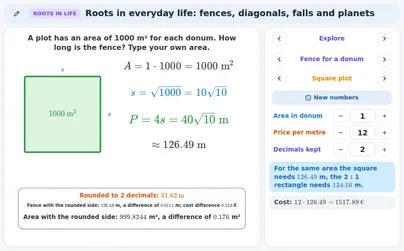 Roots in everyday life: fences, diagonals, falls and planetsFour real scenes with your own numbers.Open
Confidence intervals8
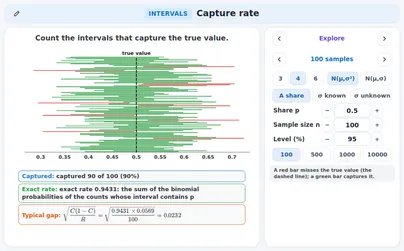 Capture rate: what 95% confident meansThree tabs about the capture rate: 100 or more seeded samples with the count and the exact rate, the picture of why the level works, and the intervals with z^* and s from small samples.Open
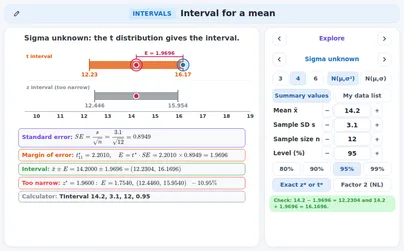 Interval for a mean: z, t and matched pairsFive tabs about the interval for a mean: with known, with unknown, the t distribution, matched pairs and the conditions.Open
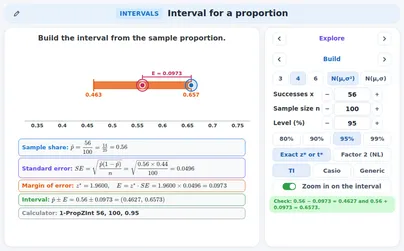 Interval for a proportion: margin of error and conditionsThree tabs about the interval for a proportion: build it from your own numbers, check its conditions and write the four-step answer.Open
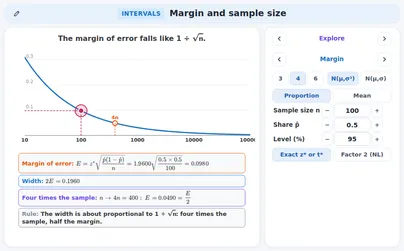 Margin and sample sizeFour tabs about margin and sample size: the margin against n, the sample size for a margin wanted, the trade-offs between level, margin and n, and a margin found by simulation.Open
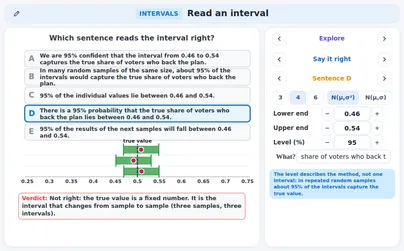 Read an interval: say it rightThree tabs about reading an interval: five sentences to choose from, claims against the interval, and two overlapping intervals.Open
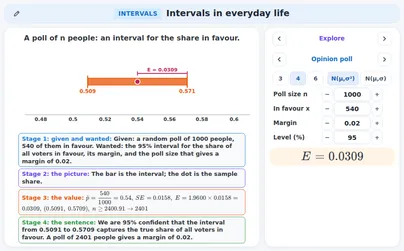 Intervals in everyday lifeFour workbenches with your own numbers: an opinion poll, a lab measurement, a factory check and delivery times.Open
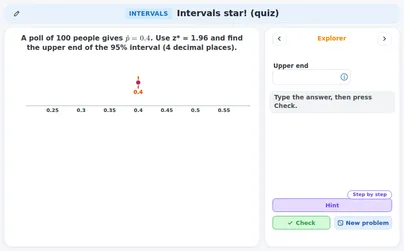 Intervals star! (quiz) QuizEndless practice with a score on the topic ‘Confidence intervals’.Open
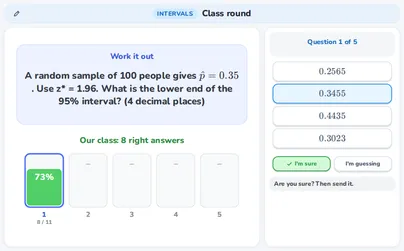 Class round: the whole class at once Class roundFive questions for the whole class at once: definitions, rules, true or myth, and sums.Open
Hypothesis tests8
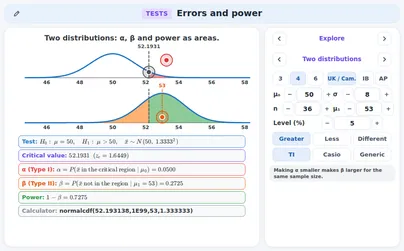 Errors and power: Type I and Type IIFour tabs about the two ways a test can be wrong: the decision table, two distributions with alpha, beta and power, the same idea with bars, and what changes the power.Open
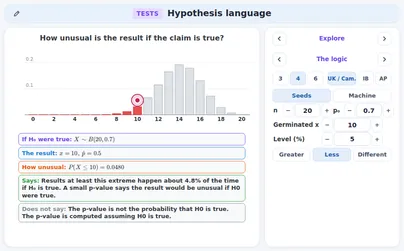 Hypothesis language: H0, H1, tails and levelsFour tabs about the language of testing: the logic of a test, hypotheses from a claim in words, tails and levels on one picture, and which test fits the question.Open
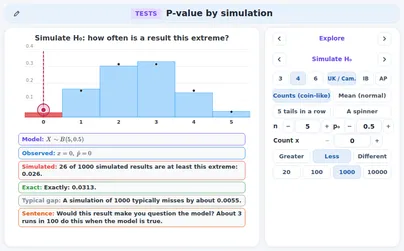 P-value by simulation and the correlation testThree tabs: simulate the null model and count the extreme results, judge eight sentences about the p-value, and test a correlation with a t test and by shuffling.Open
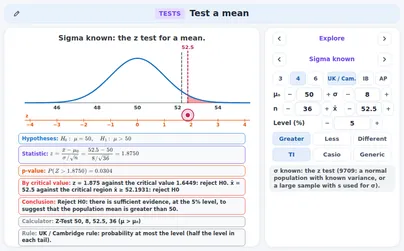 Test a mean: z, t and matched pairsFour tabs about the test for a mean: sigma known, sigma unknown, matched pairs and the conditions.Open
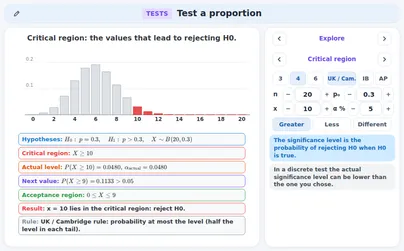 Test a proportion: exact, critical region and normalFour tabs about the test for a proportion: the exact binomial test, the critical region with its actual level, the normal approximation and the conditions.Open
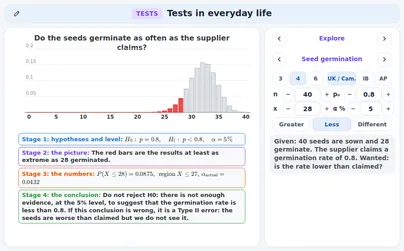 Tests in everyday lifeFour workbenches with your own numbers: seed germination, a bottling machine, delivery times and a fair spinner.Open
 Tests star! (quiz) QuizEndless practice with a score on the topic ‘Hypothesis tests’.Open
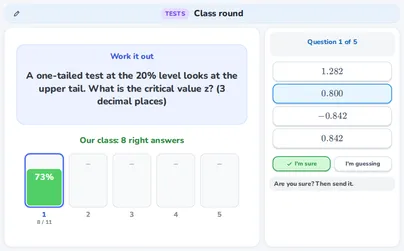 Class round: the whole class at once Class roundFive questions for the whole class at once: definitions, rules, true or myth, and sums.Open
Sampling distributions3
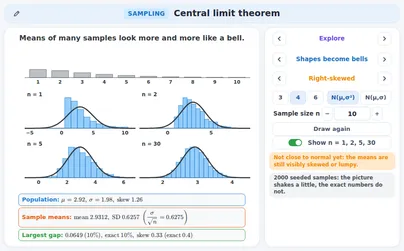 Central limit theoremThree tabs about the central limit theorem: shapes that turn into bells, a table that shows how large n must be, and sums next to means.Open
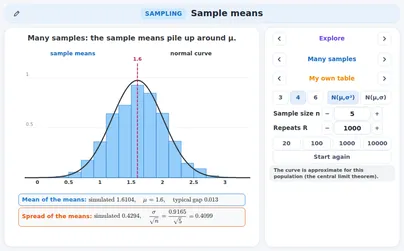 Sample means: the distribution of the sample meanFive tabs about the sample mean: one sample, many samples, the exact table with exact fractions, a probability for a normal population and the conditions.Open
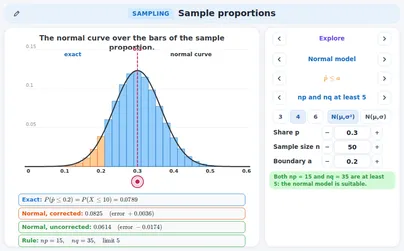 Sample proportions: the distribution of the sample shareFour tabs about the sample share: the exact bars of the sample proportion, the normal model next to them, the conditions and a sentence that states the probability correctly.Open
Spread and shape: quartiles, box plots, histograms, standard deviation2
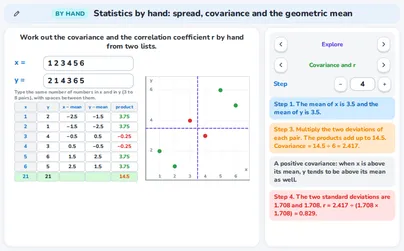
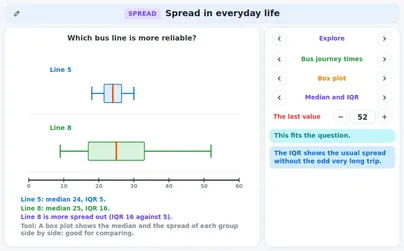
Statistics with a computer: big data sets5
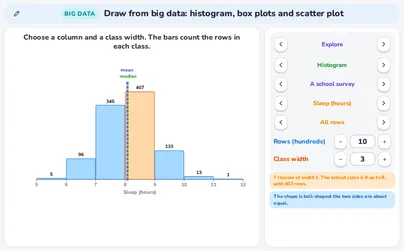 Draw from big data: histogram, box plots and scatter plotLearn to draw from big data: a histogram, box plots and a scatter plot of the columns you choose, with the numbers that go with them.Open
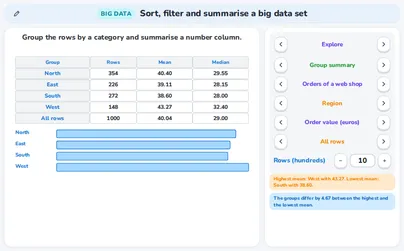 Sort, filter and summarise a big data setLearn to work with a big data set the way a computer does: sort it, filter it and summarise it by group, in 4 invented situations of 300 to 2 000 rows.Open
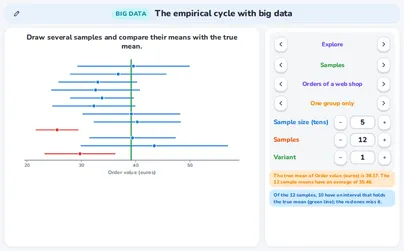 The empirical cycle with big dataLearn to investigate a question with a big data set and to judge whether a conclusion is justified.Open
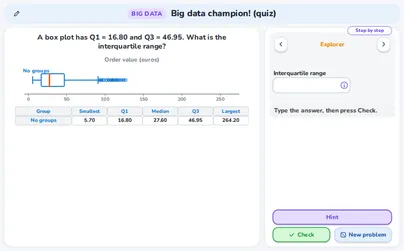 Big data champion! (quiz) QuizEndless practice with a score on the topic ‘Statistics with a computer: big data sets’.Open
 Class round: the whole class at once Class roundFive questions for the whole class at once: definitions, rules, true or myth, and sums.Open
Two variables: scatter plots, correlation and regression1
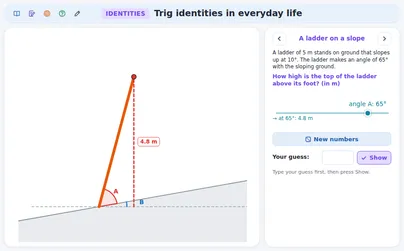
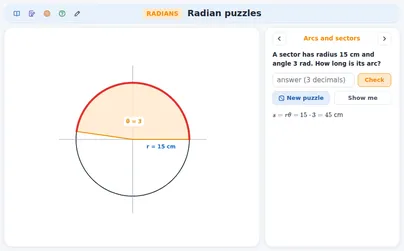
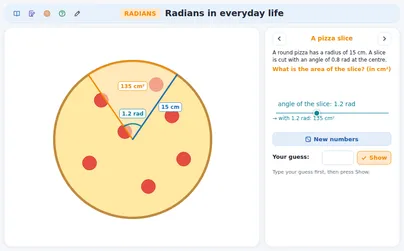
Reciprocal and inverse functions2
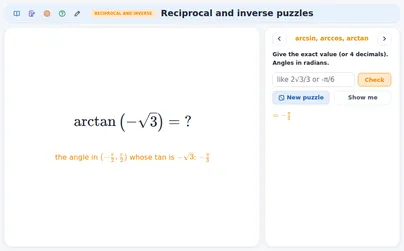
Right-angled triangles4
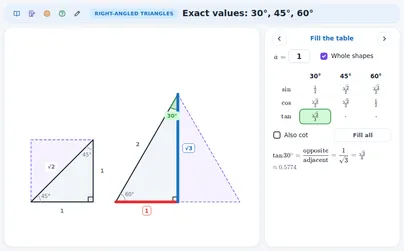 Exact values for 30°, 45° and 60°Half a square (a, a, a√2) and half an equilateral triangle (a, a√3, 2a) give exact values.Open
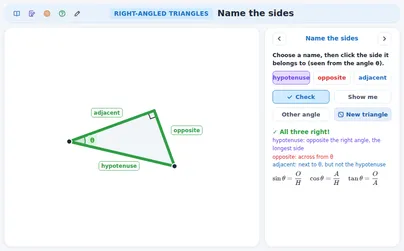 Name the sides: opposite, adjacent, hypotenuseA right triangle in any position with one acute angle θ marked.Open
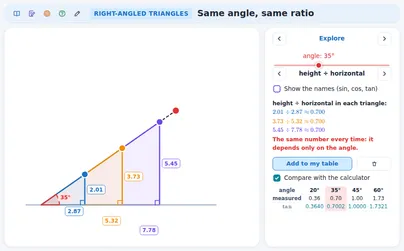 Same angle, same ratioThree ramps with the same angle but different sizes: height divided by horizontal distance always gives the same number, because the triangles are similar.Open
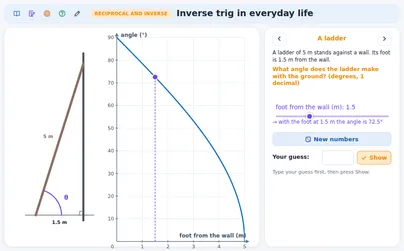
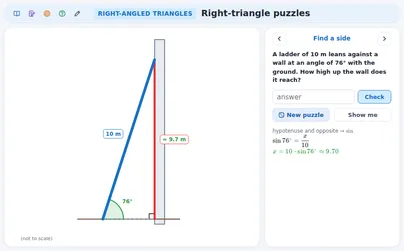 Right-triangle puzzlesPuzzles in context, new ones every time: a ladder against a wall, a ramp, a kite, the shadow of a pole, a plane, a steep road.Open
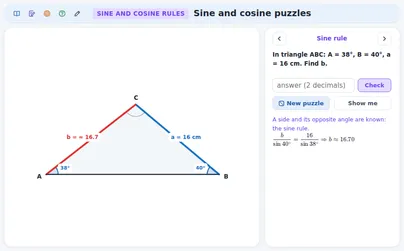
Trigonometric equations2
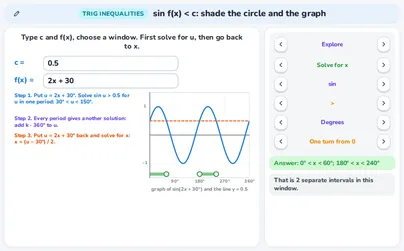 Trig inequalities: shade the circle and the graphType c and a sign: the arc and the part of the graph that satisfy it are coloured (tab Circle and graph).Open
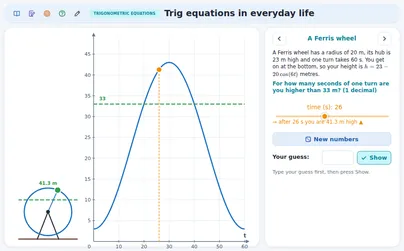 Trig equations in everyday lifeFour everyday scenes with a periodic model: a Ferris wheel, a ship in the harbour, long days and a warm day.Open
Position vectors and geometry2
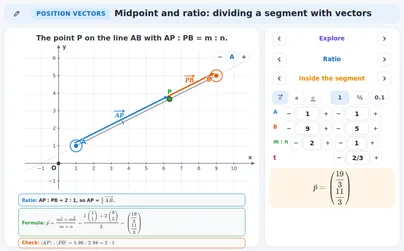 Midpoint and ratio: dividing a segment with vectorsFind the midpoint of two points, the point that divides a segment in the ratio m : n, and the centre of mass of weighted points.Open
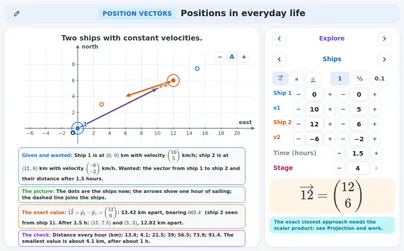 Positions in everyday lifeFour workbenches with your own numbers: a meeting point, the centre of a group, a relay tower on a drone loop and two ships with constant velocities.Open