Introduction to algebra
Applications 3 applications
Syllabus: p. 17


Introduction to algebra
Syllabus: p. 17
Introduction to algebra
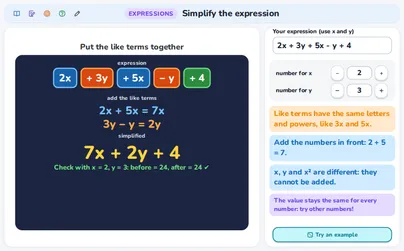
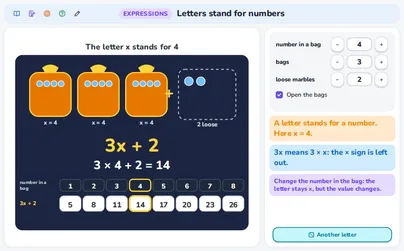
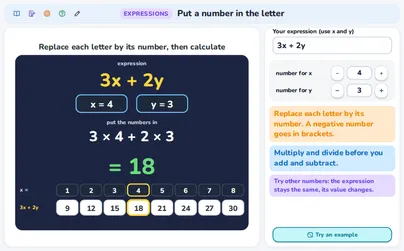 ExplorePut a number in the letterType your own expression with x and y and choose the numbers.Open
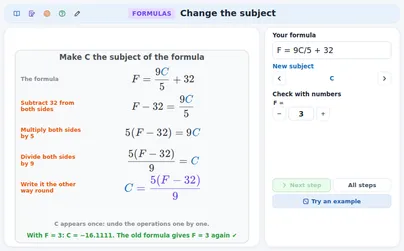
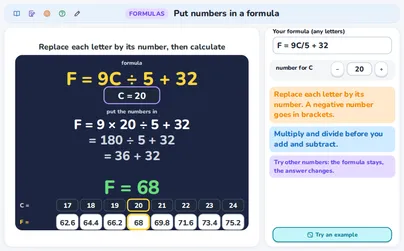 ExplorePut numbers in a formulaType your own formula with any letters (C = 3 + 2k, A = lw, F = 9C/5 + 32 …) and choose a number for every letter on the right.Open
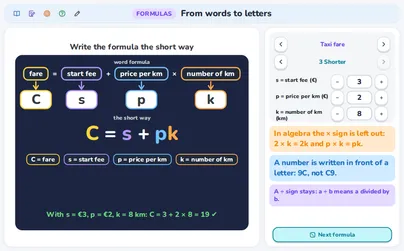 ExploreFrom words to lettersThe same ten word formulas in three steps: the words, a letter for every word and the short way of writing (2 × k = 2k).Open
Syllabus: p. 17
Algebraic manipulation
Syllabus: p. 17
Algebraic manipulation
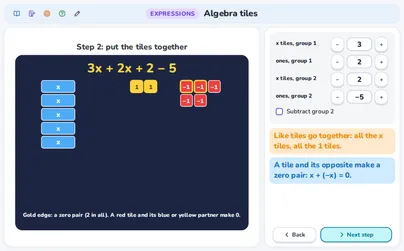
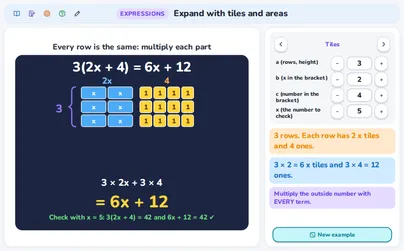 ExploreExpand with tiles and areasA bracket is a rectangle: the number outside is its height, the terms inside are its widths.Open
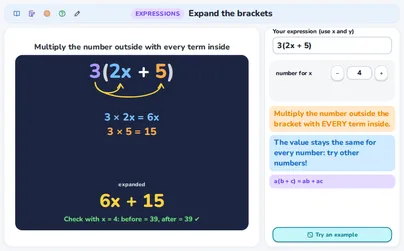 ExploreExpand the bracketsType your own expression with brackets.Open
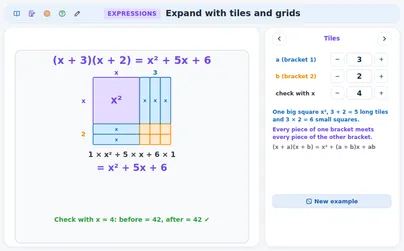 ExploreExpand with tiles and gridsTwo brackets are the sides of a rectangle.Open
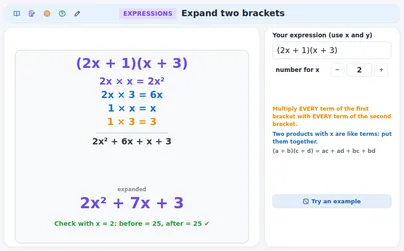 ExploreExpand two bracketsType your own product of two brackets.Open
Syllabus: p. 17
Algebraic manipulation
Syllabus: p. 17
Indices II
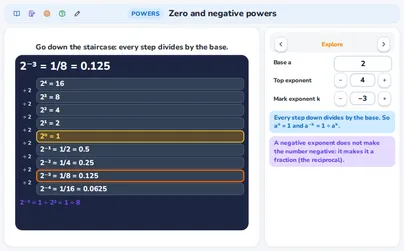 ExploreZero and negative powersGo down a staircase of powers: every step divides by the base, past 1 and into the fractions.Open
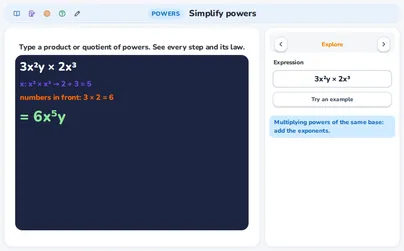 ExploreSimplify powers (numbers and letters)Type an expression and see it simplified one law at a time, with the name of each law.Open
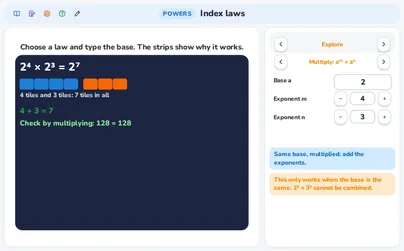 ExploreIndex laws: multiply, divide, power of a powerChoose a law, type the base and the exponents, and see the strips of factors show why the exponents add, subtract or multiply.Open
Syllabus: p. 17
Indices II
ExploreSimplify powers (numbers and letters)Type an expression and see it simplified one law at a time, with the name of each law.OpenExploreIndex laws: multiply, divide, power of a powerChoose a law, type the base and the exponents, and see the strips of factors show why the exponents add, subtract or multiply.Open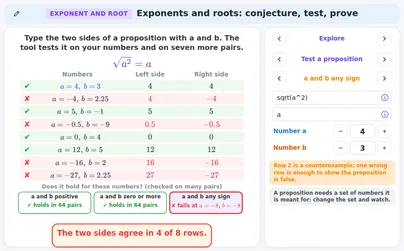 ExploreExponents and roots: conjecture, test, proveType your own proposition about powers and roots and test it on your numbers and on more pairs.Open
Syllabus: p. 17
Equations
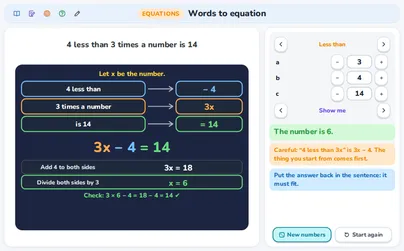 ExploreWords to equationTen number sentences become an equation, piece by piece.Open
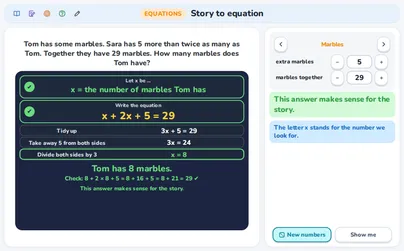 ExploreStory to equationEight stories with numbers you can change.Open
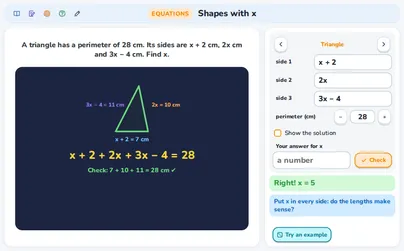 ExploreShapes with xOpen
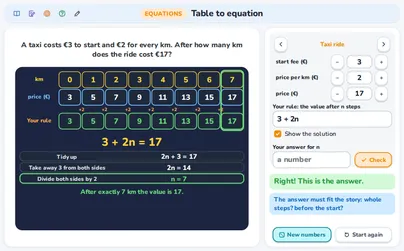 ExploreTable to equationA table of values (taxi, saving, a tank, a candle, phone credit) with a start value and a step that you choose.Open
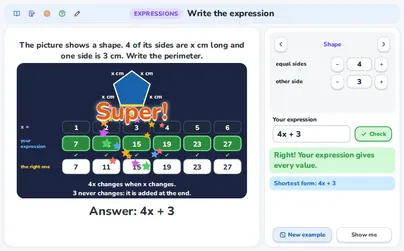 ExploreWrite the expressionA short story or a picture is given.Open
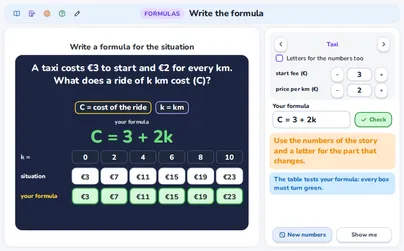 ExploreWrite the formulaA situation in words: type the formula yourself.Open
Syllabus: p. 17
Equations
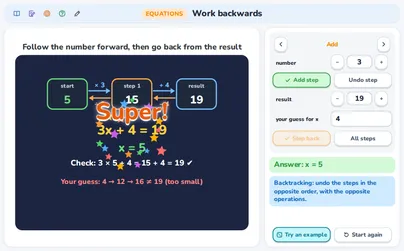 ExploreWork backwardsBuild your own chain of up to 5 steps (add, subtract, multiply by, divide by) and choose the result.Open
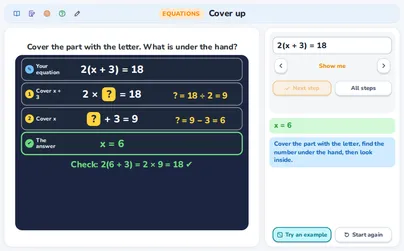 ExploreCover upType your own equation with the letter written once, like 3x + 4 = 19 or 2(x + 3) = 18.Open
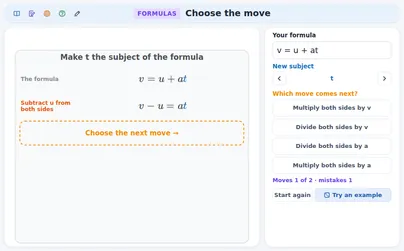
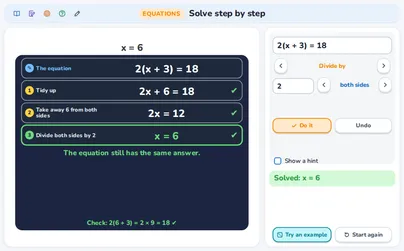 ExploreSolve step by stepType your own equation (with brackets or the letter on both sides) and solve it yourself with the balance method.Open
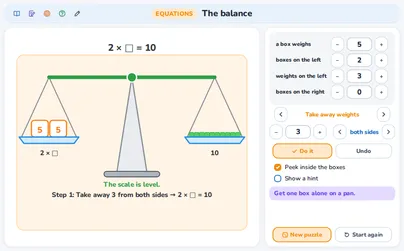 ExploreThe balanceA scale with boxes (every box hides the same weight) and loose weights.Open
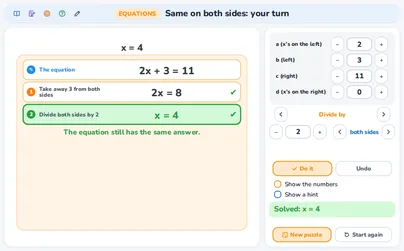 ExploreSame on both sides: your turnSet an equation with your own numbers and solve it yourself.Open
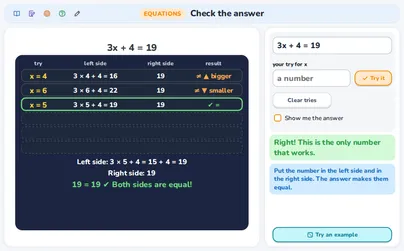 ExploreCheck the answerType your own equation and then try numbers for x.Open
Syllabus: p. 17
Equations
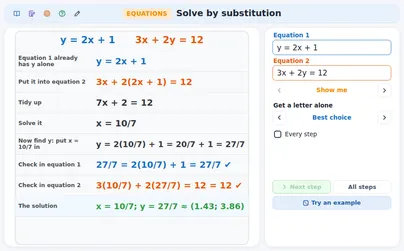 ExploreSolve by substitutionType two equations with x and y.Open
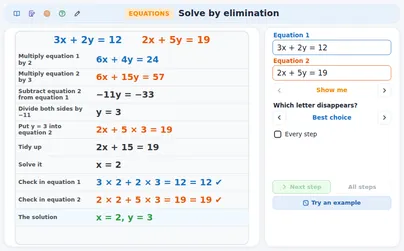 ExploreSolve by eliminationType two equations with x and y.Open
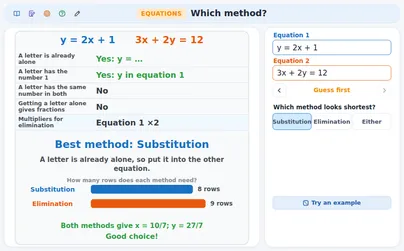 ExploreWhich method?Open
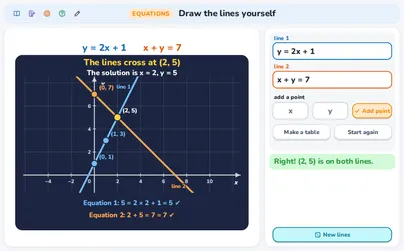 ExploreDraw the lines yourselfTwo equations are given (type your own, or press New lines).Open
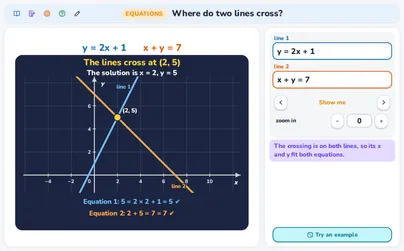 ExploreWhere do two lines cross?Type two equations with x and y (y = 2x + 1 and x + y = 7, 3x + 2y = 12 and x − y = 1 …).Open
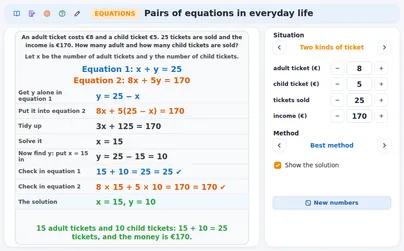 Everyday lifePairs of equations in everyday lifeFive stories with your own numbers: two kinds of ticket, a mixture of nuts, ages, a boat on a river and a rectangle.Open
Syllabus: p. 17
Equations
Syllabus: p. 17
Syllabus: p. 18
Sequences
Syllabus: p. 18
Sequences
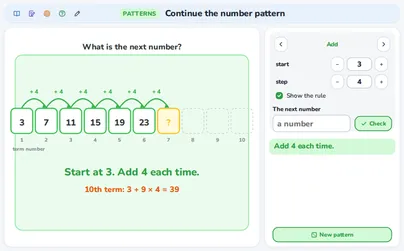
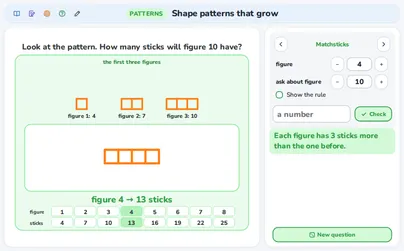
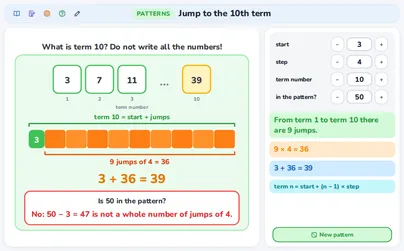
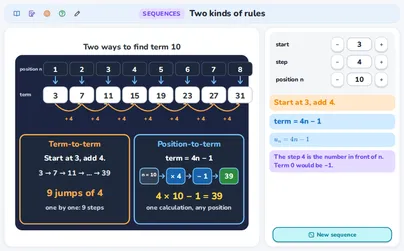 ExploreTwo kinds of rulesA sequence can be described in two ways.Open
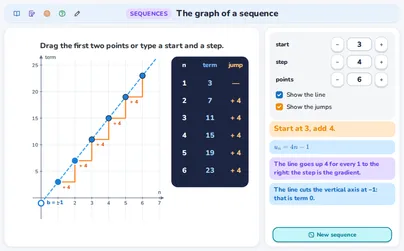 ExploreThe graph of a sequenceThe points (n, term) of a linear sequence lie on a straight line.Open
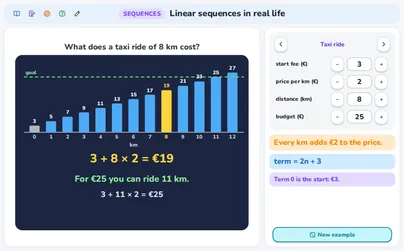 ExploreLinear sequences in real lifeA taxi ride, a growing plant and a burning candle all follow a linear sequence: a start amount and the same change every time.Open
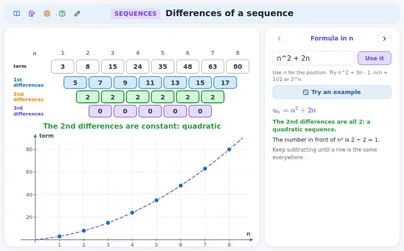 ExploreDifferences of a sequenceType a formula in n or your own numbers.Open
Syllabus: p. 18
Sequences
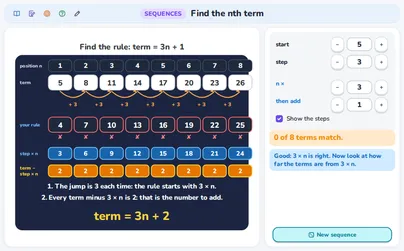 ExploreFind the nth termType a sequence (start and step), then build its nth term “term = a × n + b” with the two guess boxes.aOpenExploreThe graph of a sequenceThe points (n, term) of a linear sequence lie on a straight line.aOpen
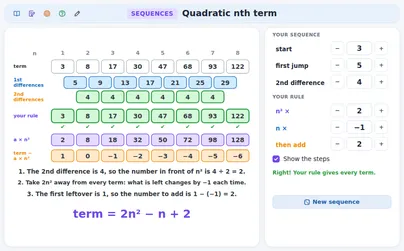 ExploreFind the nth term of a quadratic sequenceType your own quadratic sequence (a start, a first jump, a 2nd difference).bOpenExploreDifferences of a sequenceType a formula in n or your own numbers.b · cOpen
Syllabus: p. 18
Graphs in practical situations
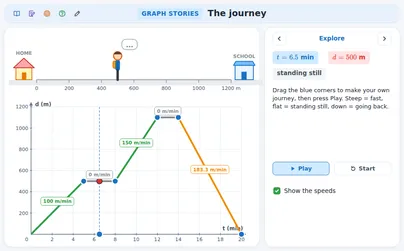 ExploreThe journey: distance-time graphsThe journey: a distance–time graph and a walker on a street.Open
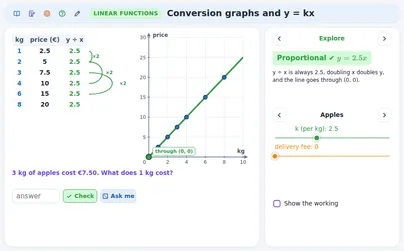 ExploreConversion graphs and y = kxConversion graphs and y = kx.Open
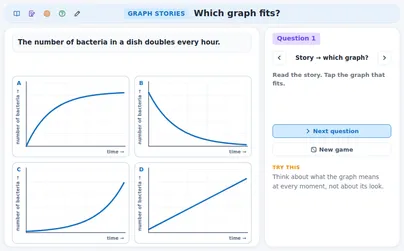 PracticeWhich graph fits? (puzzles)Which graph fits?Open
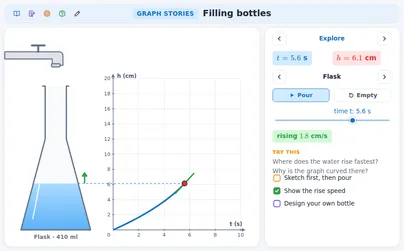 ExploreFilling bottlesFilling bottles: a tap pours water into a bottle at a steady rate; the water surface and the point of the graph stay on one line.Open
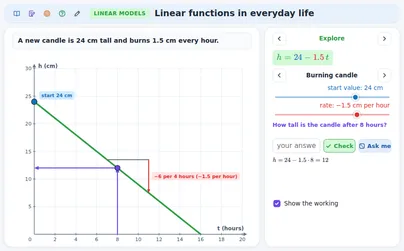 ExploreLinear functions in everyday lifeLinear models: a real situation as y = start value + rate × x.Open
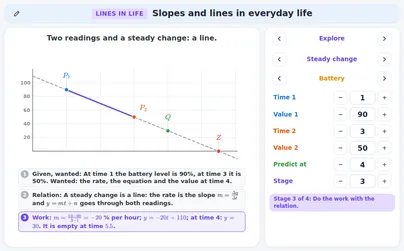 Everyday lifeSlopes and lines in everyday lifeOpen
Syllabus: p. 18
Graphs in practical situations
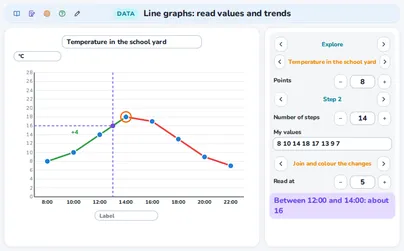 ExploreLine graphs: read values and trendsRead a line graph of a day or a plant, or make your own, and find the highest point and the biggest rise.Open
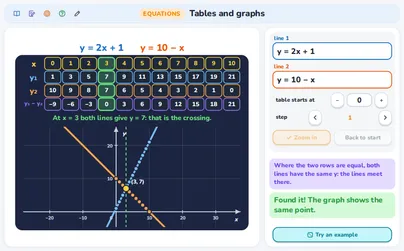 ExploreTables and graphsType two equations (y = 2x + 1 and y = 10 − x …).Open
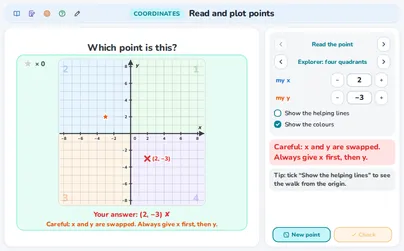 ExploreRead and plot pointsThree ways to play.Open
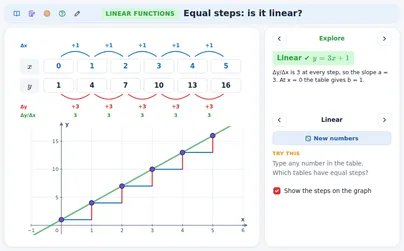 ExploreEqual steps: is the table linear?Equal steps: type a table and the application shows the steps Δx, Δy and Δy/Δx, and a staircase on the graph.Open
Syllabus: p. 18
Graphs of functions
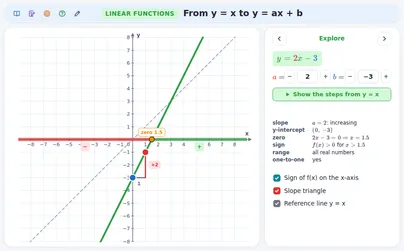 ExploreFrom y = x to y = ax + bFrom y = x to y = ax + b: the line y = x is multiplied by a (steeper, flatter or flipped) and then moved up or down by b.b1OpenExploreTables and graphsType two equations (y = 2x + 1 and y = 10 − x …).b1Open
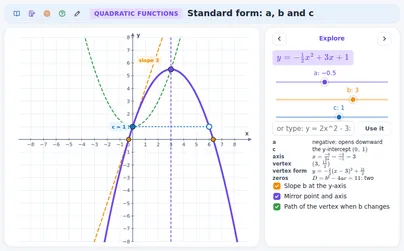 ExploreStandard form: what do a, b and c do?The parabola y = ax² + bx + c with sliders for a, b and c, the slope at the y-axis and the mirror point.b2Open
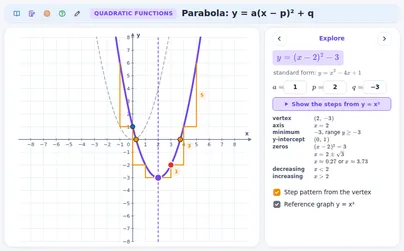 ExploreThe parabola y = a(x − p)² + qThe parabola y = a(x − p)² + q, built from y = x² in steps, with its properties.b2Open
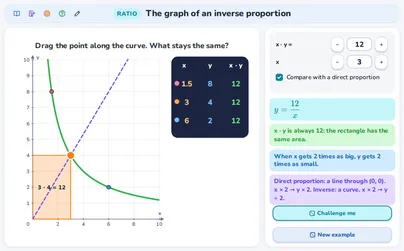 ExploreThe graph of an inverse proportion: a curveChoose the number x · y = k and drag the point along the curve y = k ÷ x.b3Open
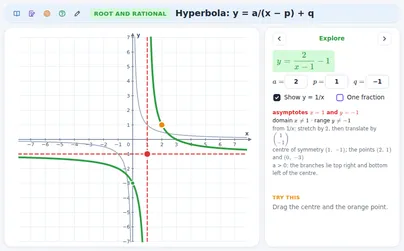 ExploreThe hyperbola y = a/(x − p) + qThe hyperbola y = a/(x − p) + q is 1/x stretched by a and moved p to the right and q up.b3Open
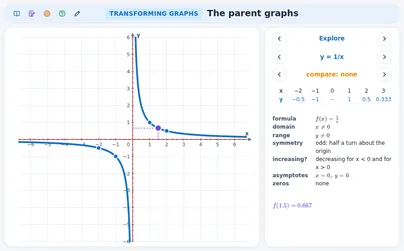 ExploreThe parent graphsThe parent graphs y = x, x², x³, √x, 1/x, |x| and 2ˣ: the starting point of every transformation.Open
Syllabus: p. 19
Graphs of functions
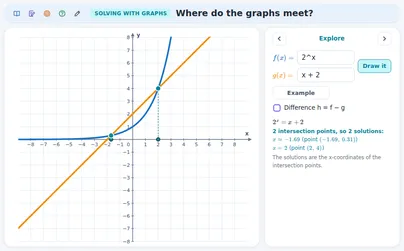 ExploreWhere do the graphs meet? f(x) = g(x)Type two functions and see where their graphs meet.Open
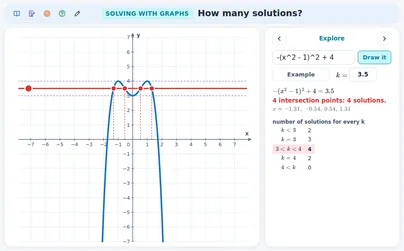 ExploreHow many solutions has f(x) = k?Move the horizontal line y = k up and down over a graph and watch how many times it meets the graph.Open
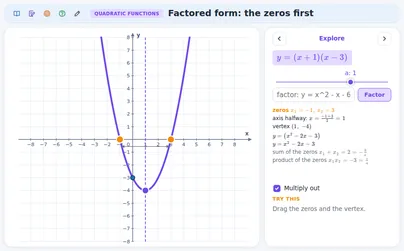 ExploreFactored form: the zeros firstDrag the two zeros and the vertex: the axis lies halfway, the formula multiplies out.Open
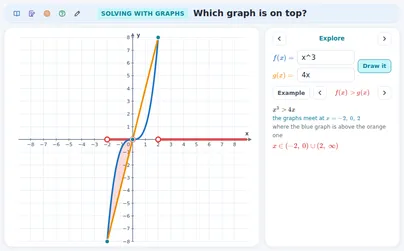 ExploreWhich graph is on top? f(x) > g(x)Solve an inequality with the graphs: where is the blue graph above or below the orange one?Open
Syllabus: p. 19
ExploreThe parent graphsThe parent graphs y = x, x², x³, √x, 1/x, |x| and 2ˣ: the starting point of every transformation.OpenExploreFactored form: the zeros firstDrag the two zeros and the vertex: the axis lies halfway, the formula multiplies out.bOpen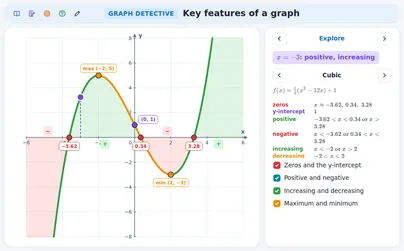 ExploreGraph detective: key featuresGraph detective: a point P rides along a graph and says what the graph does there.OpenExploreFrom y = x to y = ax + bFrom y = x to y = ax + b: the line y = x is multiplied by a (steeper, flatter or flipped) and then moved up or down by b.aOpen
Syllabus: p. 19