Introduction to algebra
Applications 3 applications
Syllabus: p. 37


Introduction to algebra
Syllabus: p. 37
Introduction to algebra
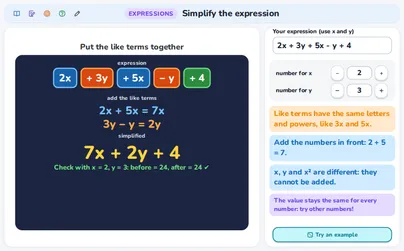
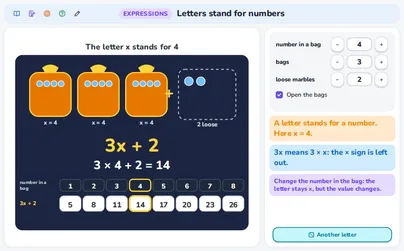
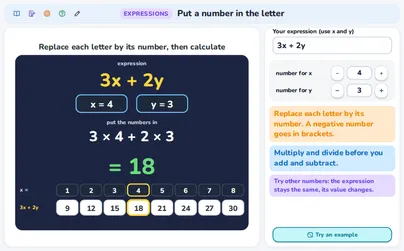 ExplorePut a number in the letterType your own expression with x and y and choose the numbers.Open
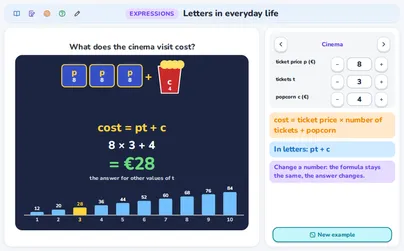
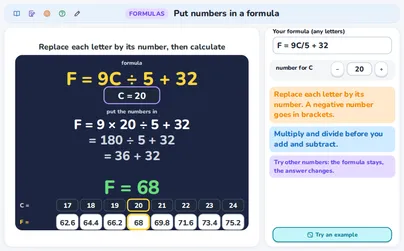 ExplorePut numbers in a formulaType your own formula with any letters (C = 3 + 2k, A = lw, F = 9C/5 + 32 …) and choose a number for every letter on the right.Open
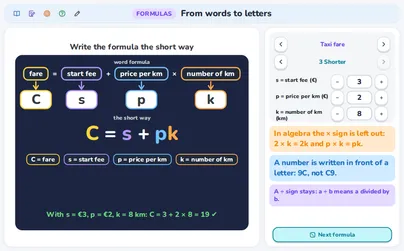 ExploreFrom words to lettersThe same ten word formulas in three steps: the words, a letter for every word and the short way of writing (2 × k = 2k).Open
Syllabus: p. 37
Algebraic manipulation
Syllabus: p. 37
Algebraic manipulation
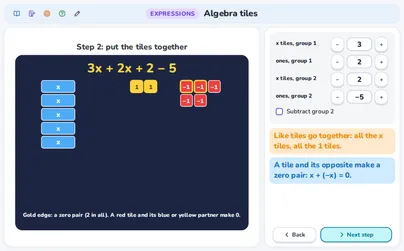
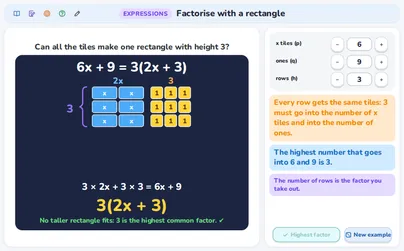
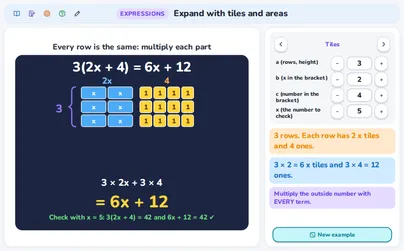 ExploreExpand with tiles and areasA bracket is a rectangle: the number outside is its height, the terms inside are its widths.Open
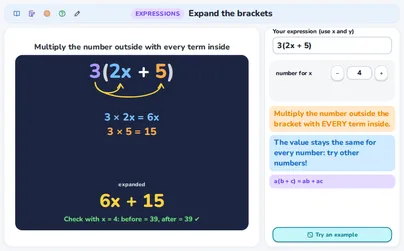 ExploreExpand the bracketsType your own expression with brackets.Open
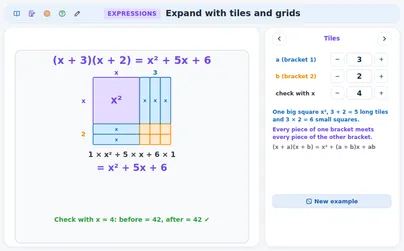 ExploreExpand with tiles and gridsTwo brackets are the sides of a rectangle.Open
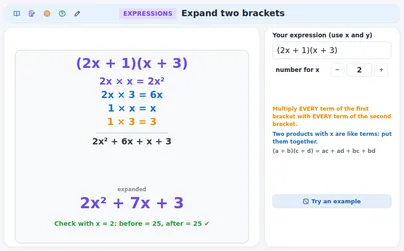 ExploreExpand two bracketsType your own product of two brackets.Open
Syllabus: p. 37
Algebraic manipulation
Syllabus: p. 37
Algebraic manipulation
The rest is completed as classroom work.
Syllabus: p. 37
Algebraic manipulation
Syllabus: p. 37
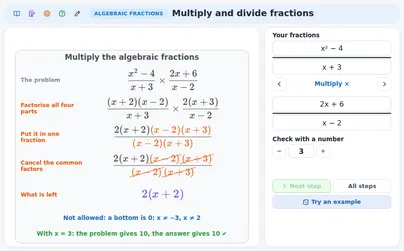
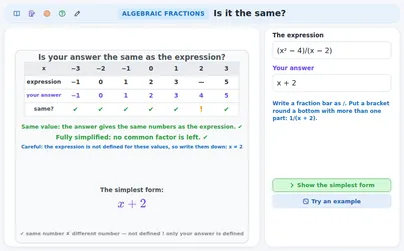
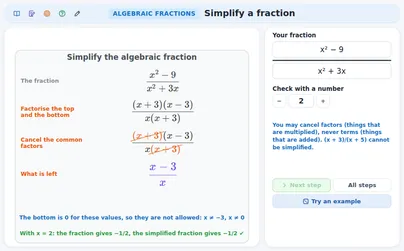
Algebraic fractions
Syllabus: p. 37
Algebraic fractions
Syllabus: p. 37
Indices II
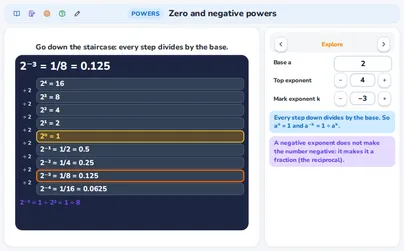 ExploreZero and negative powersGo down a staircase of powers: every step divides by the base, past 1 and into the fractions.Open
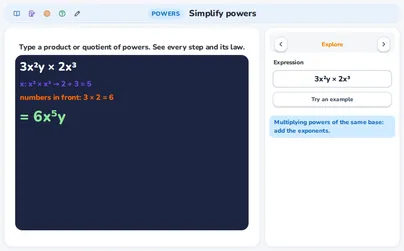 ExploreSimplify powers (numbers and letters)Type an expression and see it simplified one law at a time, with the name of each law.Open
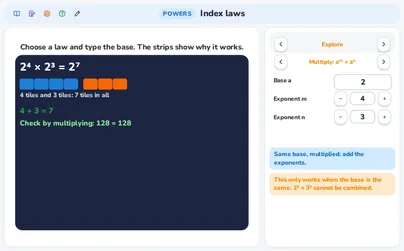 ExploreIndex laws: multiply, divide, power of a powerChoose a law, type the base and the exponents, and see the strips of factors show why the exponents add, subtract or multiply.Open
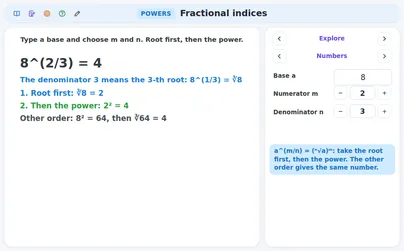 ExploreFractional indicesType a base and a fractional index, or an expression with letters, and see the root and the power worked out.Open
Syllabus: p. 38
Indices II
ExploreSimplify powers (numbers and letters)Type an expression and see it simplified one law at a time, with the name of each law.OpenExploreIndex laws: multiply, divide, power of a powerChoose a law, type the base and the exponents, and see the strips of factors show why the exponents add, subtract or multiply.Open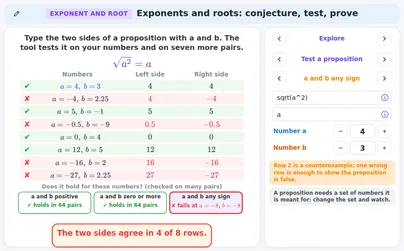 ExploreExponents and roots: conjecture, test, proveType your own proposition about powers and roots and test it on your numbers and on more pairs.Open
Syllabus: p. 38
Equations
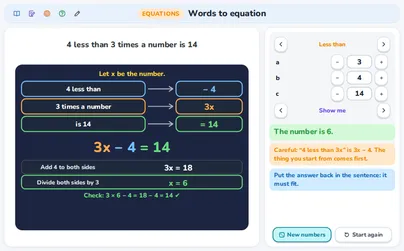 ExploreWords to equationTen number sentences become an equation, piece by piece.Open
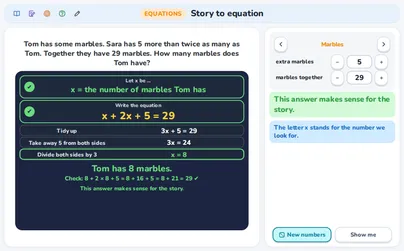 ExploreStory to equationEight stories with numbers you can change.Open
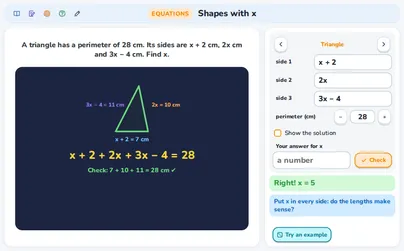 ExploreShapes with xOpen
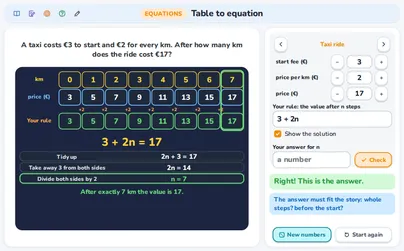 ExploreTable to equationA table of values (taxi, saving, a tank, a candle, phone credit) with a start value and a step that you choose.Open
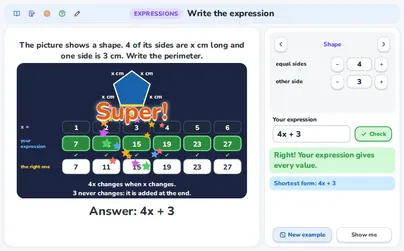 ExploreWrite the expressionA short story or a picture is given.Open
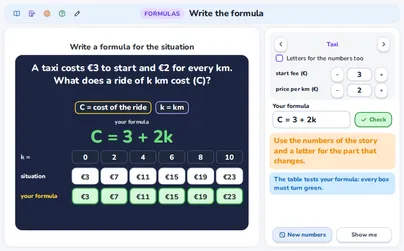 ExploreWrite the formulaA situation in words: type the formula yourself.Open
Syllabus: p. 38
Equations
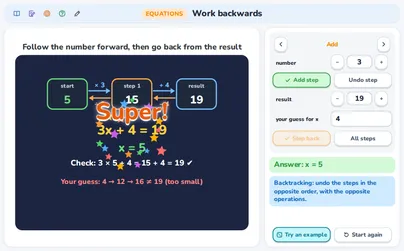 ExploreWork backwardsBuild your own chain of up to 5 steps (add, subtract, multiply by, divide by) and choose the result.Open
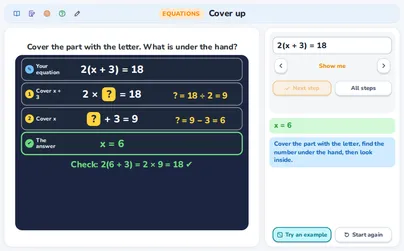 ExploreCover upType your own equation with the letter written once, like 3x + 4 = 19 or 2(x + 3) = 18.Open
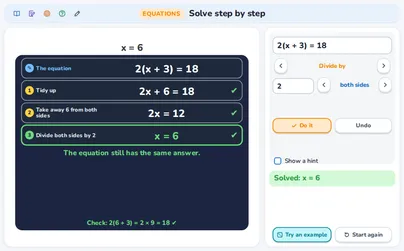 ExploreSolve step by stepType your own equation (with brackets or the letter on both sides) and solve it yourself with the balance method.Open
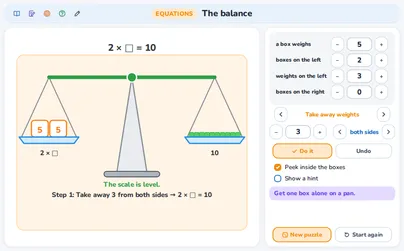 ExploreThe balanceA scale with boxes (every box hides the same weight) and loose weights.Open
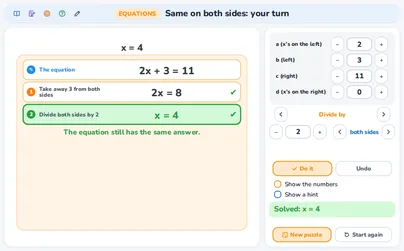 ExploreSame on both sides: your turnSet an equation with your own numbers and solve it yourself.Open
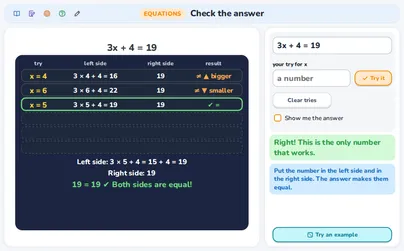 ExploreCheck the answerType your own equation and then try numbers for x.Open
Syllabus: p. 38
Equations
Applications cover part of the scope of this outcome; the rest is completed as classroom work.
Syllabus: p. 38
Equations
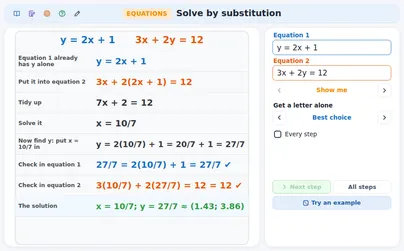 ExploreSolve by substitutionType two equations with x and y.Open
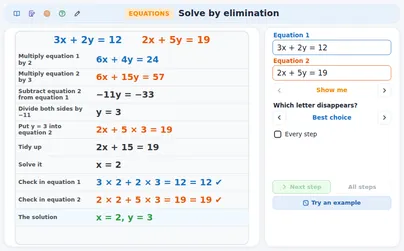 ExploreSolve by eliminationType two equations with x and y.Open
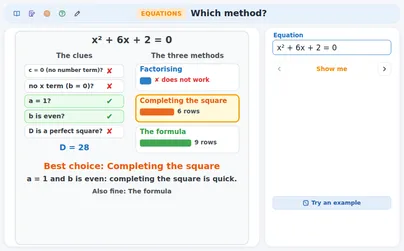
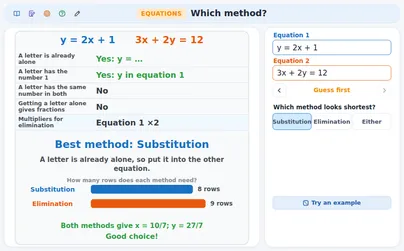 ExploreWhich method?Open
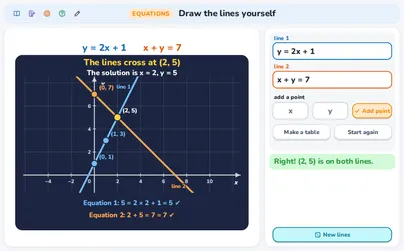 ExploreDraw the lines yourselfTwo equations are given (type your own, or press New lines).Open
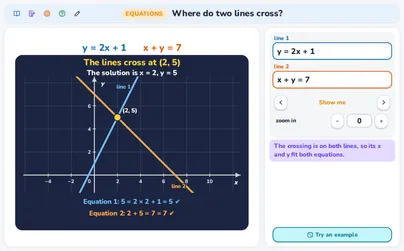 ExploreWhere do two lines cross?Type two equations with x and y (y = 2x + 1 and x + y = 7, 3x + 2y = 12 and x − y = 1 …).Open
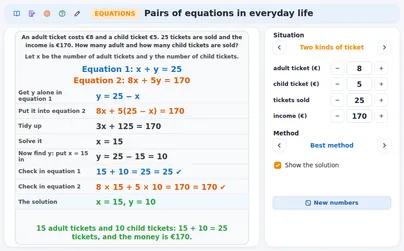 Everyday lifePairs of equations in everyday lifeFive stories with your own numbers: two kinds of ticket, a mixture of nuts, ages, a boat on a river and a rectangle.Open
Syllabus: p. 38
Equations
Applications cover part of the scope of this outcome; the rest is completed as classroom work.
Syllabus: p. 38
Equations
Syllabus: p. 38
Equations
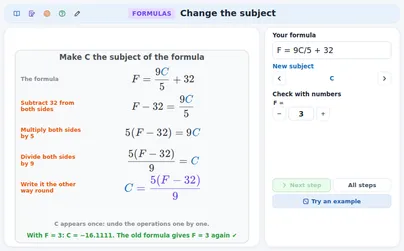 ExploreChange the subjectType your own formula and choose the letter that must become the subject.Open
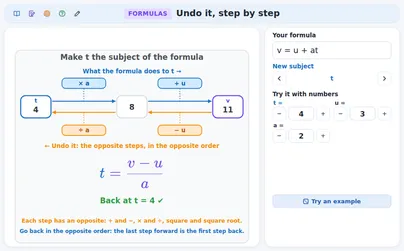 ExploreUndo it, step by stepA formula is a machine.Open
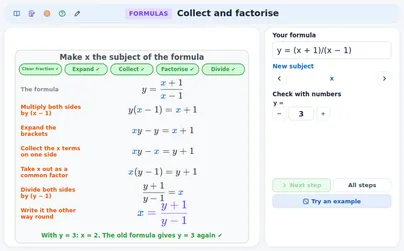 ExploreCollect and factoriseWhen the new subject is in the formula more than once you cannot just undo the steps.Open
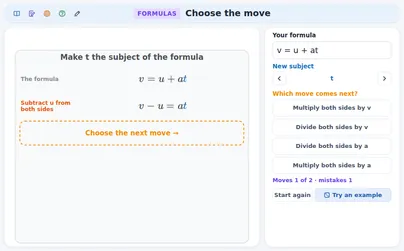 ExploreChoose the moveYou change the subject yourself.Open
Syllabus: p. 38
Inequalities
Syllabus: p. 39
Inequalities
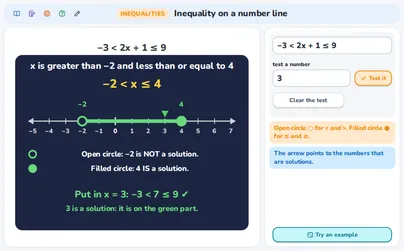
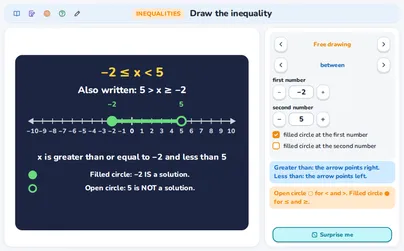
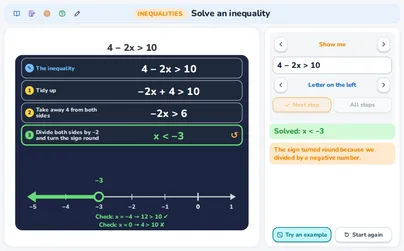 ExploreSolve an inequalityType any straight inequality (3x + 2 > 5x − 6, 4 − 2x > 10, −3 < 2x + 1 ≤ 9 …).Open
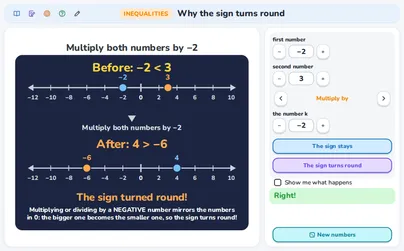 ExploreWhy the sign turns roundChoose two numbers, a step (add, take away, multiply by, divide by) and a number k.Open
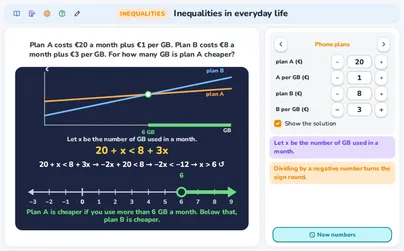 Everyday lifeInequalities in everyday lifeOpen
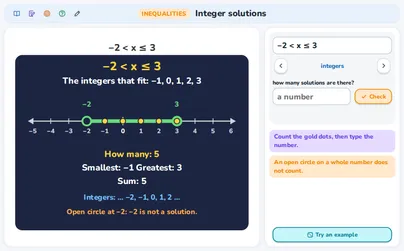 ExploreInteger solutionsType any inequality (−2 < x ≤ 3, 2x − 1 < 7, −3 ≤ 2x + 1 < 9 …).Open
Syllabus: p. 39
Inequalities
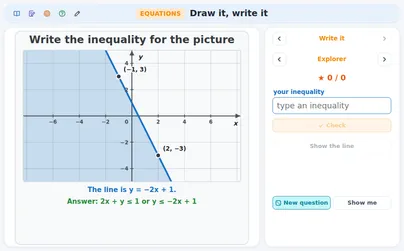
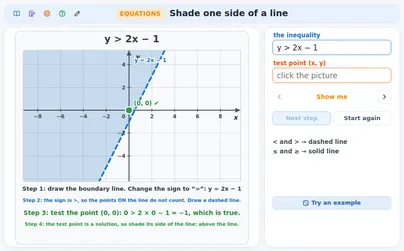 ExploreShade one side of a lineType ANY inequality in x and y (y > 2x − 1, x + y ≤ 6, 3x − 2y < 12, x < 4 …).Open
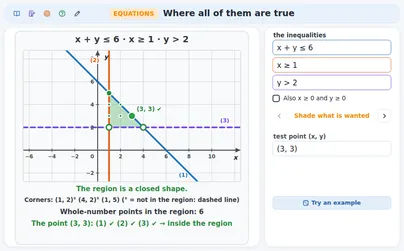 ExploreWhere all of them are trueType up to three inequalities (and tick x ≥ 0, y ≥ 0).Open
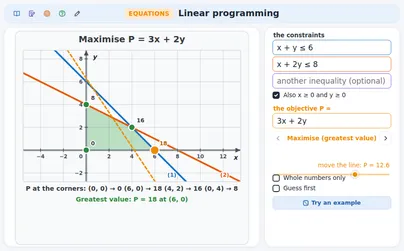 ExploreLinear programmingType the constraints (up to three inequalities and x ≥ 0, y ≥ 0) and the objective P = ax + by.Open
Syllabus: p. 39
Inequalities
Syllabus: p. 39
Sequences
Syllabus: p. 39