Back to the lecture notes: Conditional probability: given that 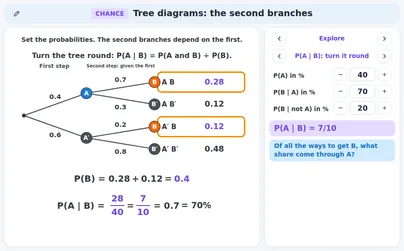
Tree diagrams: the second branches Plus
This application is part of Plus
Plus opens all applications: € 4,99 per month or € 19,90 per year. Log in to your account; no account yet? Make a free one first, then you can look at Plus.
Are you a teacher? Teacher login
Your own teacher subscription already includes every application, Plus included — there is nothing extra to buy.
What this application teaches
- I can say that the second branches of a tree are conditional probabilities, P(B given A) and P(B given not A), and that the branches of a node add up to 1.
- I can multiply along a branch: P(A and B) = P(A) × P(B given A).
- I can add the branches that end in B to get P(B).
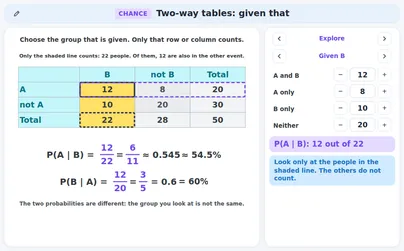
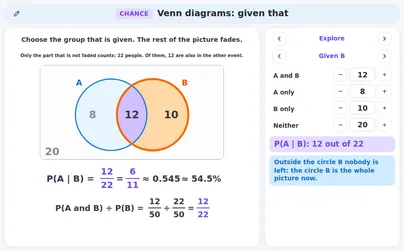
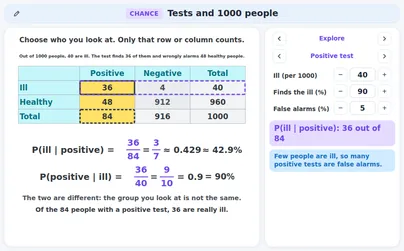
- I can turn the tree round: P(A given B) = P(A and B) ÷ P(B).
- I can see that drawing without replacement gives second branches that change, like P(red given red first).
Fits these school years
IB (MYP, Diploma): MYP 4, MYP 5
Cambridge International: IGCSE
Netherlands: Havo · Mathematics A, Vwo · Mathematics A, Vwo · Mathematics C, Vwo · Mathematics D
Türkiye (MEB): Year 10 (MEB), Year 11 (MEB)
England (GCSE, A Level): Year 10 (GCSE), Year 11 (GCSE)
USA (Common Core): Grade 8, Geometry