

Back to the lecture notes: Numbers in the news: chances, percentage points and kinds of data 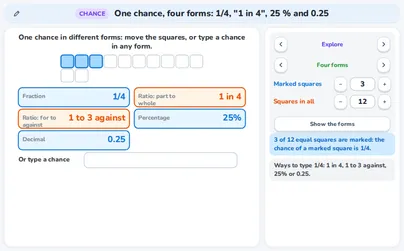
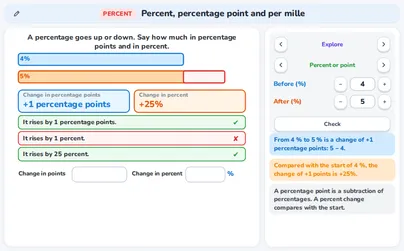 PlusPercent, percentage point and per mille
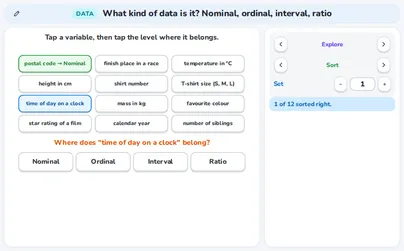 PlusWhat kind of data is it? Nominal, ordinal, interval, ratio
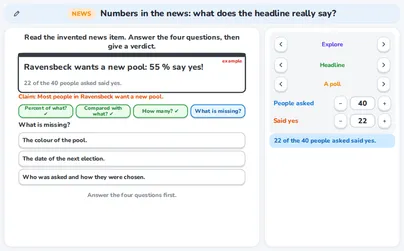 PlusNumbers in the news: what does the headline really say?
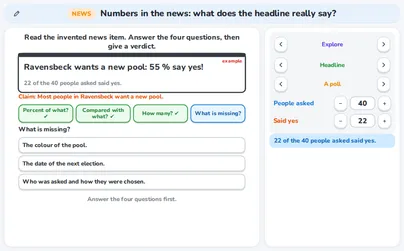 PlusNumbers in the news, primary school edition: what does the headline really say?
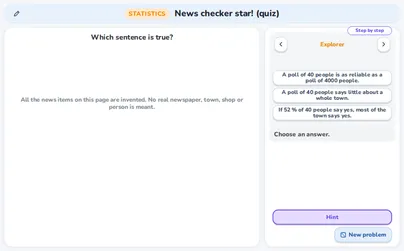 PlusNews checker star! (quiz), primary school edition
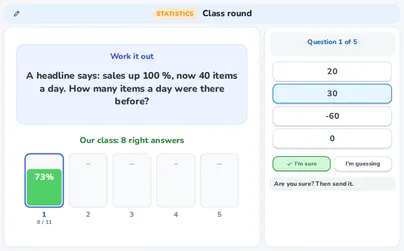 PlusClass round, primary school edition: the whole class at once
One chance, four forms: 1/4, "1 in 4", 25 % and 0.25 Free
This application is free with a free account
Make a free student account to open this application. It takes a minute, and it also opens 140+ other applications.
Already have an account? Log in and this application opens.
Are you a teacher? Teacher login
What this application teaches
- I can write one chance as a fraction, a ratio, a percentage and a decimal.
- I know the two ratio forms, “1 in 4” and “1 to 3 against”, and that “1 to 3 against” is not the fraction 1/3.
- I can read a weather forecast as days out of 100 and give the chance of no rain.
- I can put chances written in different forms in order, and fill a bag of counters for a given chance.
Fits these school years
IB (MYP, Diploma): MYP 1, MYP 2, MYP 3
Cambridge International: Lower Secondary, stage 7, Lower Secondary, stage 8, Lower Secondary, stage 9, IGCSE
Netherlands: Year 1, Year 2, Year 3 (havo, vwo), Havo · Mathematics A, Vwo · Mathematics A, Vwo · Mathematics C, Groep 8
Türkiye (MEB): Year 6 (MEB), Year 7 (MEB), Year 8 (MEB), Year 9 (MEB)
England (GCSE, A Level): Year 7, Year 8, Year 9, Year 10 (GCSE)
USA (Common Core): Grade 6, Grade 7, Grade 8, Algebra 1
Similar applications
PlusPercent, percentage point and per millePlusWhat kind of data is it? Nominal, ordinal, interval, ratioPlusNumbers in the news: what does the headline really say?PlusNumbers in the news, primary school edition: what does the headline really say?PlusNews checker star! (quiz), primary school editionPlusClass round, primary school edition: the whole class at onceRead the lecture notes: Numbers in the news: chances, percentage points and kinds of data