Part
- a[Understand and use the derivative of f( )xas the gradient of the tangent to the graph of y=f( )x at a general point (x, y);the gradient of the tangent as a limit; interpretation as a rate of change; sketching the gradient function for a given curve; second derivatives; differentiation from first principles for small positive integer powers of x] and for sinx and cosx
- b[Understand and use the second derivative as the rate of change of gradient]; connection to convex and concave sections of curves and points of inflection Classroom
Applications 8 applications
Explore
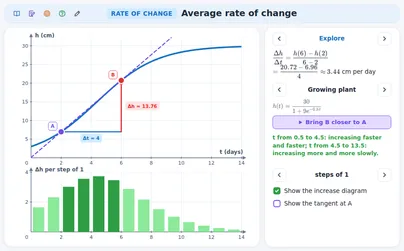 ExploreAverage rate of changeAverage rate of change: drag A and B along a graph; the secant and the step triangle show (f(b) − f(a)) ÷ (b − a) with its unit.aOpen
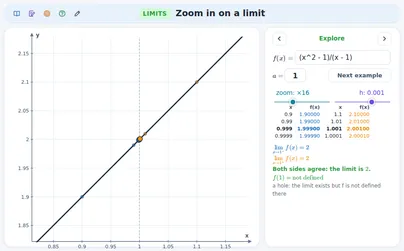 ExploreZoom in on a limit: left, right, hole, jumpZoom in on a graph near x = a and watch what f(x) does from the left and from the right.aOpen
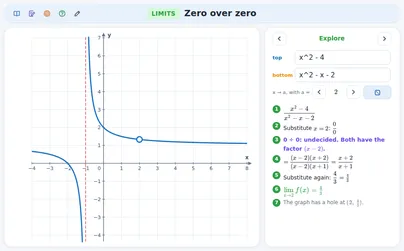 ExploreZero over zero: factor and cancelSubstituting x = a into a fraction can give a number, 0 ÷ 0 or a number ÷ 0.aOpen
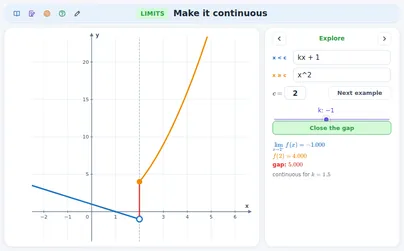 ExploreMake it continuous: close the gap with kA function made of two pieces is continuous at c when the left limit equals f(c).aOpen
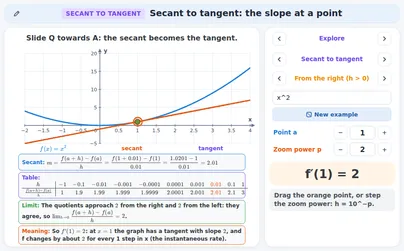 ExploreSecant to tangent: the slope at a pointOpen
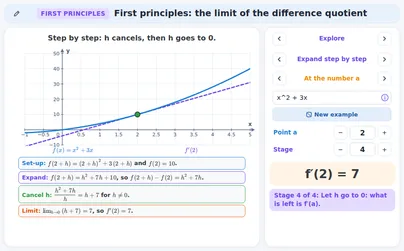 ExploreFirst principles: the limit of the difference quotientOpen
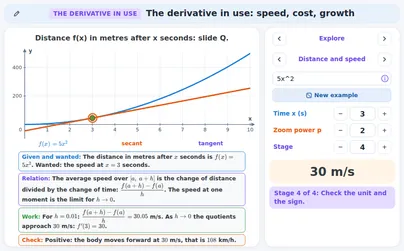 ExploreThe derivative in use: speed, cost, growthOpen
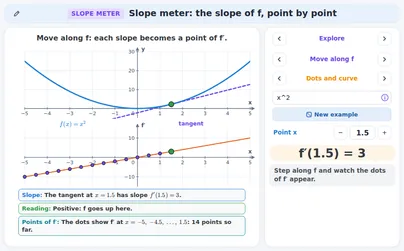 ExploreSlope meter: the slope of f, point by pointType a function and move along it: the tangent and its slope appear and each slope becomes a point of a second graph, the graph of f′.Open
Supporting applications 10 applications
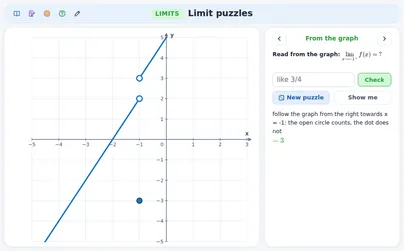
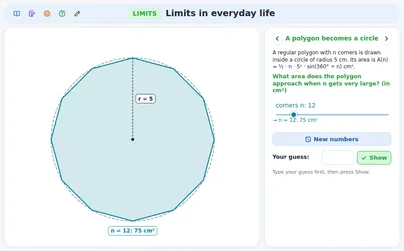
Quiz
The rest is completed as classroom work.
DfE content: p. 11